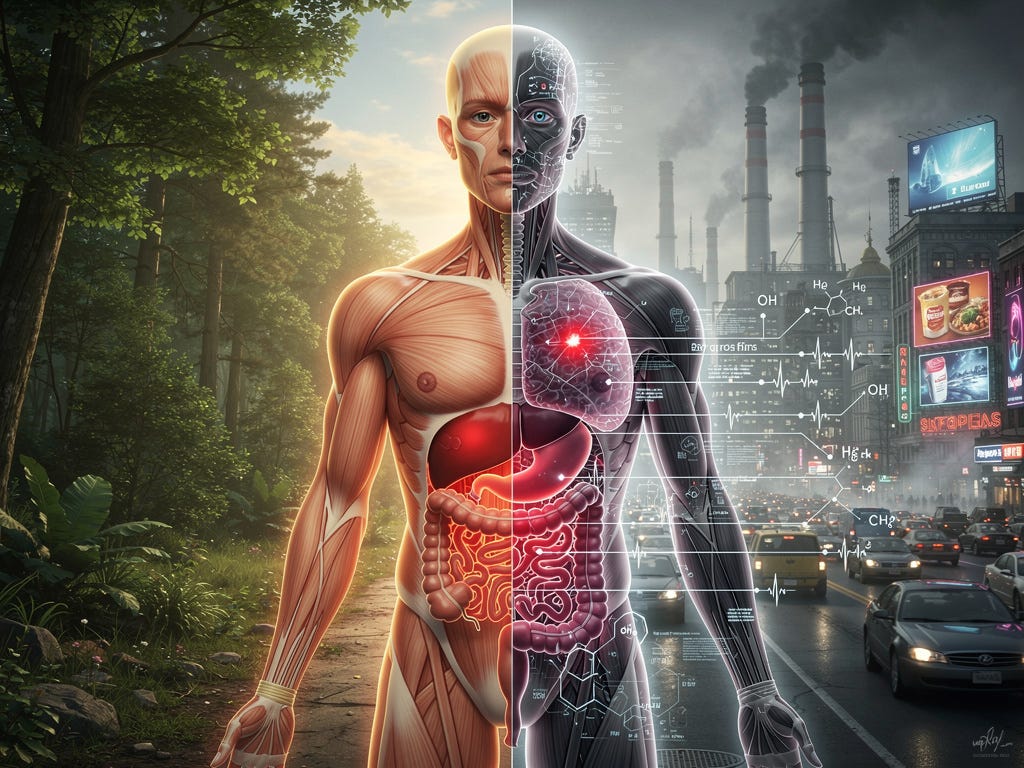
What would it mean to think with your body?
The question feels strange, doesn’t it? Possibly embarrassing? That strangeness is itself symptomatic. Somewhere in the architecture of how educated people in industrial civilisations have learned to hold themselves, the body became a vehicle rather than a voice. A platform for the mind’s operations. Useful, certainly. Occasionally inconvenient. A knower — never.
Consider what that dismissal actually costs. The heart contains approximately 40,000 neurones — an intrinsic nervous system sophisticated enough that researchers have taken to calling it a second brain. It communicates with the cerebral brain bidirectionally, shaping perception, emotional judgement, and the quality of attention itself. The enteric nervous system lining the gut runs to perhaps 500 million neurones — exceeding that of the spinal cord — and produces the overwhelming majority of the body’s serotonin. It operates with striking autonomy, influencing mood, cognition, and what we might cautiously call ‘intuition’ through pathways the cerebral brain never directly supervises.
And then there’s the skin. Embryologically, the skin and the nervous system are the same tissue, differentiated. The ectodermal layer that becomes the brain also becomes the body’s entire surface — its boundary with the world, its primary sensory interface, its most ancient organ of knowing. The nervous system didn’t develop and then grow a covering. It turned itself outward to meet the world.
Which raises a question. Descartes never had to answer, because he never thought to ask it: if the body’s intelligence extends all the way to the surface where self meets world, where does the knower end?
In 1637, René Descartes published his Discourse on the Method and, almost incidentally, performed the founding act of industrial civilisation. The famous formula — cogito ergo sum, ‘I think, therefore I am’ — was a civilisational declaration as much as a philosophical one. The self was located in thought. The body was demoted to a mechanism. The world beyond the body was rendered, by the same logic, as dormant matter awaiting description, measurement, and use.
Establishing this arrangement required enormous effort, and maintaining it required considerable violence. Every indigenous knowledge tradition encountered by an expanding European civilisation understood the body differently — as a site of relational intelligence, as a membrane between the human and the living world, as a participant in systems of meaning that exceeded individual cognition. These traditions were sophisticated epistemological architectures that had solved, over millennia, problems of sustainability, intergenerational obligation, and collective governance that the West has conspicuously failed to solve. So they had to be discredited.
Neuroscience now suggests they were substantially right — but they were incompatible with what industrial economism required. Enclosing a commons is impossible if the people living within it experience their bodies as continuous with it. Treating soil as a production input is incoherent if farmers understand their gut health as inseparable from soil health. Converting a forest into timber requires first converting the people who live alongside it into strangers to it — severing the somatic bond that would otherwise make destruction register as self-harm because, in the most precise biological sense, that is what it is.
The Cartesian settlement didn’t simply relocate the self. It numbed the somatic intelligence that would have made extraction feel like what it was. What followed was four centuries of civilised dissociation.
III.
The traditions that preserved somatic knowing did not disappear. They were marginalised, exoticised, or absorbed into a burgeoning wellness industry — commodified into the same system that produced their suppression.
Ponder what survived in fragments. The Polynesian navigators who crossed the Pacific without instruments were practising a form of integrated intelligence that modern navigation can’t replicate and barely understands — reading wave patterns through the hull of the vessel and through the body seated within it, registering star positions through a cultivated somatic attunement to orientation and drift that has no equivalent in cartography. The knowledge lived in the body because that’s where knowledge of this kind belongs. Commit it to paper charts, and something essential escapes in the transcription.
Traditional Chinese medicine mapped the body as a system of dynamic relationships — between organs, between body and season, and between individual constitution and living environment — that modern biomedicine is only now beginning to approach from the direction of systems biology and the microbiome. Ayurvedic practice understood the gut as the primary seat of intelligence and the foundational site of health two thousand years before enteric neuroscience arrived at the same conclusion. These were knowledge systems operating at a level of somatic attention that the Cartesian tradition had neither the concepts nor the patience to engage.
What the body knows, it knows directly. It registers whether food nourishes or depletes, whether a relationship sustains or corrodes, and whether a place carries vitality or its absence. These signals are neurologically real. The question is whether the civilisation in which a body is embedded has cultivated the capacity to receive them or has trained that body, systematically and from earliest childhood, to override, suppress, and ultimately forget that the signals were ever there.
Industrial civilisation made its choice early. The consequences are now written in the epidemiology.
IV.
The body doesn’t forget what the mind has been trained to ignore. It registers. It accumulates. And eventually, with the patience of a system that has been sending unacknowledged signals for decades, it breaks down in ways that reveal, to anyone willing to read them, exactly what has been suppressed.
The epidemiology of industrial civilisation is a civilisational confession.
Chronic inflammatory disease — the substrate of conditions from diabetes and cardiovascular illness to depression and autoimmune disorders — is now the dominant health burden of the developed world. Inflammation is the body’s signal that something in its environment is wrong. When that signal becomes permanent, embedded in the baseline functioning of entire populations, it has ceased to be a medical event. It is instead a systemic condition produced by general causes. The body is registering, at a cellular level, that the conditions of industrial life constitute a continuous threat.
Sleep — the body’s primary mechanism for restoration, memory consolidation, immune function, and emotional regulation — has been progressively colonised by the logic of productivity. Average sleep duration in industrialised nations has fallen by one to two hours over the past century. Artificial light overrides the circadian intelligence that evolved across hundreds of millions of years. The boundary between work and rest, between stimulation and recovery, between the demands of the economic system and the requirements of the biological one, has been systematically eroded. A civilisation that treats the body’s need for darkness and stillness as an inconvenience to be engineered around has made a declaration about which intelligence it considers sovereign.
Food — the most ancient and intimate relationship between the body and the living world — has been converted into a supply chain. The extraordinary microbial intelligence of the gut, which evolved in continuous conversation with the diversity of the living world, now operates in an environment of industrial monoculture, chemical processing, and nutritional impoverishment. The consequences run deeper than nutrition science has yet fully mapped: a disrupted microbiome, compromised immune functions, degraded enteric signalling, and the chronic low-grade inflammation that underlies conditions industrial medicine treats as separate, unrelated events.
Beneath all of this runs something harder to measure but no less consequential: the ambient disconnection from living systems that characterises urban industrial existence. The body evolved in continuous sensory relationship with soil, the seasons, non-human presence, weather, and the particular intelligence of specific places. Research on nature exposure, on the microbiome’s dependence on environmental diversity, and on the physiological effects of what the Japanese call ‘shinrin-yoku’ — forest bathing — suggests that the body requires contact with living complexity in ways that exceed recreation or aesthetic preference. Sever that contact methodically across generations, and the degradation is somatic as well as spiritual: the very intelligence that makes fully human knowing possible begins to attenuate.
The body is registering civilisational collapse at the most intimate scale available. Chronic illness is a symptom of this collapse. The sleep crisis is another such symptom. The nutritional catastrophe too. All of it is happening inside skin that was always, embryologically, the nervous system turned outward — still reaching, still trying to make contact with a living world the civilisation built around it has rendered increasingly unreachable.
V.
This is where the argument becomes genuinely demanding, because it points toward something that neither progressive politics nor technological optimism has the conceptual equipment to address.
A civilisational crisis rooted in epistemology — in what counts as intelligence, which signals get registered, and which ways of knowing are granted legitimacy — can’t be resolved by responses formulated entirely within the cognitive register that produced it. Policy, institutional redesign, and technological substitution: these are all moves made from within the dissociated mind that declared itself sufficient four centuries ago. They are, in the most precise sense, the problem continuing under new management.
There can only be one conclusion. The reinstatement of somatic knowing is a civilisational imperative.
In practice this is less mysterious than it sounds, though more demanding than any policy prescription. It means rebuilding, individually and collectively, the capacity to receive and act on the signals the body has never stopped transmitting. It means reading the chronic illness epidemic as diagnostic intelligence — a civilisation-scale readout of what sustained dissociation produces — rather than as a healthcare challenge awaiting a medical solution. It means taking seriously the epistemological traditions that preserved somatic knowing and were marginalised precisely because they were incompatible with extraction: repositories of tested intelligence that the successor civilisation cannot afford to continue ignoring.
At the furthest reach of the argument, it means reconsidering what the skin already knows. That the boundary between the individual body and the living world is a membrane, permeable and communicative. That the nervous system turns outward to participate in a larger field of intelligence, not to defend a sealed interior against it. That Teilhard’s noosphere — the planetary membrane of consciousness he intuited before the neuroscience existed to support it — may be less metaphor than description. The actual nervous tissue of embodied beings is in a somatic relationship with living systems, registering and responding to a world that has always been, at every scale, alive.
Descartes placed the self in thought and thereby made the world available for conquest. The civilisation that followed extracted, accumulated, and is now failing under the accumulated weight of what it trained itself not to feel.
The emerging civilisation — if it emerges at all — will know differently. With the full intelligence of a body that has never, despite everything, stopped trying to tell us what’s real.