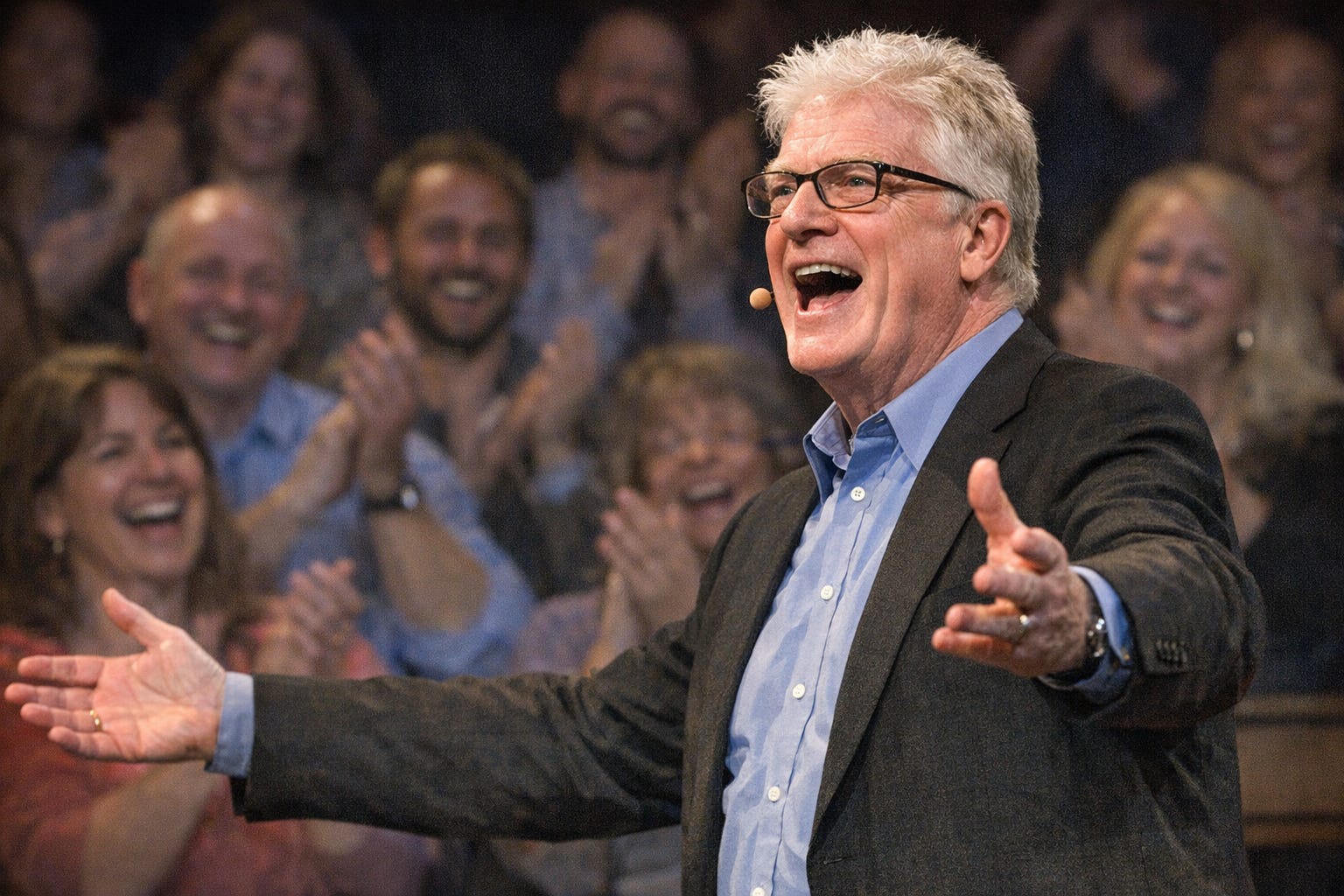
The system isn’t broken. It’s working exactly as designed. The problem is, it was designed for a world that no longer exists. — Sir Ken Robinson
I. The Building That Teaches Before You Enter It
Before a child learns a single verb or theorem, the school teaches something more durable and more damaging: that knowledge has edges, that curiosity has a timetable, and that the self must be subdued before learning can begin. This lesson is delivered not by any teacher but by the architecture itself — the rows of identical desks facing a single point of authority, the bell that ends thought mid-sentence, the corridor that enforces silence precisely where conversation would be most alive. We have mistaken the container for the content, and the container is very old indeed.
Sir Ken Robinson spent decades holding this mirror up to society, asking us to see what we had made and who we were making. His argument was structural and not in the least sentimental. He understood only too well that when you design a system to sort human beings by compliance, you shouldn’t be surprised when it produces compliant human beings — and then wonder where all the innovators have gone. The tragedy he described was one of momentum: institutions built for one world continuing to operate, with tremendous efficiency, in another.
We’re now deep in that other world. The question Sir Ken bequeathed to us is not simply how to reform the curriculum or retrain teachers, though both are urgent. The deeper question is whether we’re willing to examine the premises upon which the entire edifice rests — premises so old they have ceased to feel like choices. They feel, instead, like gravity.
The Industrial Inheritance
The modern school was born in the nineteenth century as a logistics solution. An industrialising economy required workers who could follow instructions, arrive on time, tolerate repetition, and accept hierarchy without the distraction of continuous negotiation. The school was designed, with remarkable fidelity, to produce exactly that. It sorted children into ability streams the way a factory sorted raw materials by grade. It measured outputs against standardised criteria because uniformity was what the production line required. It rewarded those who could suppress their individual curiosity in favour of the collective syllabus, because a machine doesn’t stop to ask questions.
None of this was a secret. The reformers of the era said so plainly. What they could not have known — what none of us can ever fully know — is how deeply that design would embed itself within the cultural imagination, so that a century and a half later, parents who have never set foot in a factory will fight fiercely to preserve a schooling model built entirely around factory logic. The familiar feels safe. The familiar feels inevitable. The familiar is neither!
We inherited an architecture of forgetting. It’s not that schools teach children nothing — they teach an enormous amount. But embedded within all that teaching is an implicit curriculum, unspoken and therefore unchallengeable: that there’s one right answer, that it belongs to the teacher, that your worth as a thinker is determined by how precisely you can retrieve it. This curriculum doesn’t produce ignorance but something more insidious: the learned incapacity to trust one’s own perception.
II. What We Called Intelligence
The standardised test is a confession. It reveals, with crystalline clarity, what a society has decided to value — and, by necessary exclusion, everything it’s decided doesn’t count. In the century since IQ testing was developed, we have built educational systems around a conception of intelligence so narrow it would have been unrecognisable to most of the cultures that preceded us, and will likely be unrecognisable to most of those that follow.
We called intelligence the capacity to manipulate abstract symbols in formal contexts under time pressure. We called it verbal and mathematical reasoning, and IQ stripped of context, separated from feeling, detached from the body, and disconnected from place. We didn’t call it the ability to read a landscape, to sense the emotional temperature of a room, to improvise in the dark, to hold contradiction without collapse, to make something from nothing with whatever happens to be at hand. Those capacities we filed under talent, or gift, or — if the holder lacked institutional credentials — pure luck.
The consequence was a systematic undervaluing of complete modes of human knowing. The child who couldn’t sit still but could dismantle and rebuild a machine from memory was told she was a problem. The boy who cried at music but could not parse a quadratic equation was told he was lagging behind. The young person who understood suffering with a precision no textbook could confer was told this was not a subject worthy of study. We measured the measurable and called it important, a category error so total that we built entire civilisations on top of it without noticing the foundation was lop-sided.
Multiplicity Denied
Howard Gardner’s theory of multiple intelligences, which arrived in 1983, was not so much a revolutionary discovery as a formal acknowledgement of what every attentive parent and every curious teacher had always known: that human beings are extraordinarily varied in the ways they are brilliant. Musical intelligence, spatial intelligence, bodily-kinaesthetic intelligence, interpersonal and intrapersonal intelligence, naturalist intelligence — each of these is a genuine mode of engaging reality, not a consolation prize for those who couldn’t manage the mathematics.
Yet the educational response, even where Gardner’s framework was nominally adopted, was largely cosmetic. Schools added an art class and permitted movement breaks and felt virtuous. They introduced group projects and called themselves collaborative. The underlying grammar of assessment — the ranked score, the comparative grade, the credential that serves as a lifelong passport — remained intact, and that grammar continued to say, quietly but unmistakably: there’s still one hierarchy here, you know where you stand on it, so just follow the rules.
Sir Ken understood this. His frustration was not with the individuals inside the system but with the system’s extraordinary resilience to genuine transformation. In his formulation schools had become rather like fast food restaurants that have added a salad option and believe they are now expert nutritionists. The ingredients change; the industrial model of production persists. In essence the child remains the raw material being processed toward a predetermined outcome.
III. The Standardised Child
There is no standardised child. There has never been one. The very concept is a fiction so useful to administrators and so harmful to human beings that its persistence constitutes one of the unspoken scandals of modernity. Every child arrives carrying an irreducible uniqueness — a particular constellation of temperament, curiosity, timing, sensitivity, and capacity that will never be exactly replicated in the history of the species. To process this singularity through a standardised apparatus and then measure the residue against a consistent criterion is not education. It’s preparation for a life of compliance.
Sir Ken Robinson’s central insight — that children differ from one another in ways that matter enormously for how they learn — is a hard empirical claim with hard structural implications. If children differ, then education cannot be delivered. It must be cultivated. The difference between delivery and cultivation is the difference between a conveyor belt and a garden: one imposes a predetermined path on whatever passes along it; the other creates the conditions in which living things can find their own form.
A garden doesn’t treat every plant identically. A gardener doesn’t insist that the vine grow upright or that the oak produce flowers. It pays attention. It adjusts. It understands that the health of the whole depends on the particularity of each part, and that the attempt to make everything uniform produces fragility rather than strength — a monoculture, which is to say a system exquisitely productive in one narrow band of conditions and catastrophically vulnerable to everything outside it.
Compliance as Curriculum
The school’s most durable product is not the graduate. It’s the habit of deference. Twelve or more years of institutional life teaches, with the reliability of water on stone, that authority resides outside the self — that the person at the front of the classroom knows, that the textbook contains, that the examination confirms, and that your own unmediated experience of the world is evidence of nothing until it has been validated by a credential. This is the deepest prospectus, and it runs beneath every subject that’s formally taught.
It is no accident that the skills most demanded in the twenty-first century — adaptive thinking, creative synthesis, tolerance for ambiguity, the capacity to ask questions that have no established answers — are precisely the skills that the compliance curriculum systematically suppresses. We trained a generation to regurgitate facts and figures and then wondered why they couldn’t invent. We rewarded certainty and then wondered why they couldn’t navigate uncertainty. We taught them to perform understanding and then wondered why genuine comprehension was so rare.
The problem is the architecture. Human beings are naturally creative, naturally curious, naturally inclined toward meaning-making and improvisation and the deep pleasure of learning something that genuinely matters to them. These inclinations survive despite the school, in the spaces between lessons, in the conversations that continue after the bell has rung, in the obsessions that thrive precisely because they are not assessed. The challenge facing education is not how to install curiosity into children. It is how to stop removing it.
IV. The World for Which the System was Designed
That world was stable. Or rather, it appeared to be stable, which amounts to the same thing for the purposes of institutional design. The economy offered recognised categories of employment, and the school’s task was to populate those categories with appropriately credentialled individuals. The future was, if not absolutely certain, then at least legible: the child who excelled at mathematics would become an engineer, the one who excelled at language would become a lawyer, and the great undifferentiated middle would find its level in the administrative and manufacturing sectors that required competent execution rather than original thought.
The bargain was explicit and, for a time, honoured. Work hard at school, acquire the credential, exchange it for a stable livelihood. The credential was a promise written by an economy that no longer exists to a young person who has not yet been born into the economy that has replaced it. In large measure we’re still honouring the paperwork of a transaction that one party to it has already vacated.
The acceleration of technological change has made this obsolescence visible in ways that are now impossible to ignore. Within the working lifetime of a young person entering school today, entire categories of employment will be created and destroyed several times over. The skills that command premium reward in 2025 may be automated by 2035, and the skills that will be valued in 2035 have yet to be named. To educate for a known destination in this environment is not preparation. It is misdirection.
What Acceleration Demands
Acceleration in terms of complexity or transformative change doesn’t necessarily demand more knowledge. It demands a different relationship to knowledge — one characterised by flexibility rather than rigidity, by revision rather than certainty, by the capacity to learn, unlearn, and relearn across an entire lifetime rather than to acquire a fixed body of content in the first two decades and then deploy it for the remaining five. The industrial school was designed to fill vessels to the brim. The post-industrial era requires people who can swim.
This isn’t an argument against knowledge. Knowledge remains the substance of thought, the material with which the mind works. But which knowledge, and how it’s held, matters enormously. Inert knowledge — accumulated but not integrated, memorised but not metabolised — offers no advantage in conditions of ambiguity and rapid change. Indeed it can easily become a liability, encoding assumptions drawn from a world that has since transformed and making its owner resistant to evidence that contradicts what was so expensively learned.
What the accelerating world demands, above all, is what Sir Ken Robinson called divergent thinking: the capacity to see multiple possible interpretations of a question, multiple possible routes toward a resolution, multiple possible frames within which a problem might be understood. This is the native condition of the young child, who approaches every encounter with the world as though it might yield surprise. The research Sir Ken cited is unsparing: divergent thinking, tested longitudinally, declines sharply with years of schooling. We are engineering the removal of creativity and originality.
V. The Anthropocentric Era and Its Demands
The term anthropocentric carries, in most contemporary discourse, a pejorative charge: it assumes human beings are the measure and purpose of all things, the error that placed us at the centre of creation and licensed the ecological devastation that followed. I use it here in a different and more precise sense. The anthropocentric age is the moment in which the question of what it means to be human has become urgent in a way it’s not been since the Axial Age — the moment in which technology, ecological crisis, and civilisational fracture converge to make the distinctively human capacities not simply interesting but existentially necessary.
What the machine can’t do — not yet, not fully, perhaps not ever in the ways that matter most — is what we were designed to do before we constructed the school to dismantle it. Machines can’t feel the particular weight of a moral dilemma. They can’t hold grief in one hand and possibility in the other and discern, in the silence between them, what ought to be done. They can’t be astonished. They can’t be moved. They can’t love a problem so completely that the problem transforms the person pondering it. These capacities are not supplementary to intelligence. They are its beating heart.
Education in the post-industrial era must, therefore, turn toward precisely what the industrial school turned away from: subjectivity, relationality, moral imagination, ecological literacy, the capacity for genuinely empathic encounters with others. These are not soft skills. They can’t be bolted onto a hard curriculum. They are the curriculum, understood for the first time without reticence or apology.
Towards a Pedagogy of Encounter
The school adequate to this moment cannot primarily be a place of transmission. It has to be a place of encounter — between the learner and the world, between the learner and other learners, between the learner and the deep strangeness of disciplines that haven’t yet made their peace with each other. Mathematics encounters music and discovers that both are languages of pattern. History encounters ecology and discovers that civilisations are not events but metabolisms. Biology encounters ethics and discovers that the boundary between description and obligation is thinner than either discipline likes to admit.
A pedagogy of encounter begins with the learner’s actual questions, not the curriculum’s anticipated ones. It treats the question that arrives as unexpected — the one that derails the lesson plan and makes the teacher’s heart either sink or soar, depending entirely on what kind of teacher she has become — as the most material energy in the room. It understands that the question a child genuinely needs answered can’t always be scheduled for a Tuesday morning in term three, and that any attempt to schedule it kills it.
This doesn’t mean the abandonment of structure. I have used the metaphor of the garden deliberately. Gardens require structure — walls, paths, the discipline of seasonal consideration. But the structure serves the living thing; it doesn’t override it. The school of the post-industrial era will be structured around principles of developmental ecology rather than industrial efficiency: what does this particular learner need, at this particular moment, in order to grow into the fullness of what she or he is becoming?
VI. What Must Be Dismantled
The age-cohort model is the first to be challenged. The assumption that children of the same birth year are at the same stage of development in any domain worth caring about is contradicted by everything developmental psychology has discovered in the century since the model was institutionalised. We group children by date of manufacture rather than by readiness, curiosity, or capacity — and then we pathologise those whose development doesn’t conform to the cohort schedule. The child who is not ready to read at six is labelled slow or lazy. The child who was ready at four has spent two years being held back by a system that can’t accommodate her arrival.
The subject-silo model must be questioned. The division of knowledge into sealed, separately-assessed disciplines corresponds to the administrative convenience of universities, not to the structure of reality. The world’s most pressing problems — ecological collapse, algorithmic governance, democratic erosion, the ethics of synthetic biology — don’t present themselves as maths problems or history problems or science problems. They present themselves as entanglements, requiring modes of thinking that can move fluidly across disciplinary boundaries, that can hold scientific rigour and humanistic compassion simultaneously, that can tolerate the irreducible complexity of problems that have no clean solution.
The credential-as-endpoint model must be examined. The moment the qualification is awarded, learning is declared complete — and the institution that conferred it loses interest in what happens next. This is not education. It is processing. Genuine education, understood as the ongoing cultivation of a human being’s capacity to engage reality with intelligence and feeling, has no graduation ceremony. It continues, deepens, and transforms across a lifetime, and the institution that doesn’t understand it’s role in this has confused administrative convenience with educational purpose.
What Must Be Imagined
We need schools in which failure is understood as information rather than a verdict — in which the child who attempts something beyond their current reach and falls short is recognised as having done something braver and more informative than the child who attempts only what he is certain to succeed at, and triumphs. The current system produces risk-aversion in learners with the reliability of a natural law, because the stakes attached to failure are too high and the rewards attached to effort too invisible. You cannot cultivate creativity in a culture of assessment that punishes the attempt.
We need schools in which teachers are understood and embraced as co-learners and knowledge designers— not as empty vessels pouring information into emptier ones, but as adults who are themselves in the process of becoming, who model curiosity, who admit ignorance without shame, who demonstrate, through the quality of their own engagement with questions, that learning is not something you finish. The teacher who has stopped being curious about her subject should not be in front of children. Not because she is a bad person, but because the most important thing she communicates is not the content of her lesson but the attitude she brings to not-knowing.
We need schools in which the relationship between the institution and the wider world is porous — in which the problems of the community enter the classroom not as case studies but as living challenges, and in which the work of young people enters the community not as display but as authentic contribution. The school that is sealed from its context teaches, inevitably, that knowledge is sealed from its context — that what you learn in the classroom has no purchase on what you encounter outside it, and that the appropriate response to a real problem is to wait until you have more qualifications.
VII. The Teacher in the Anthropocentric Era
No reform of curriculum, no revision of assessment, no architectural reimagining of school buildings will matter much if the person at the centre of learning — the teacher — is not herself a living embodiment of what education is supposed to produce. The system doesn’t merely fail students. It fails teachers, methodically wearing away the very qualities — wonder, adaptability, a tolerance for uncertainty, the delight in the unexpected — that drew them to teaching in the first place. It recruits people who love learning and then constructs conditions almost perfectly designed to kill that love.
The conditions under which most teachers work are antithetical to what we claim to want from them. Over-assessed, under-supported, buried in administrative trivia, accountable for outcomes no institution can honestly guarantee — the outcomes of individual human development, which resists standardisation precisely because it is alive — teachers inhabit a profession structured to consume the very energy it most needs. The exhaustion is not incidental. It is the system working as designed.
The teacher in the anthropocentric age is, above all, a practitioner of attention. Not attention to the category a child occupies in the assessment framework, or to the gap between a child’s performance and the standardised expectation, but to the actual living person: what moves her, what stops her, where her energy gathers and where it drains away, what questions she carries when nobody is asking her to answer theirs. This quality of attention has no curriculum equivalent. It cannot be mandated, inspected, or quantified. It is simply the difference between a teacher who sees the child and one who sees the score.
VIII. Sir Ken Robinson’s Unfinished Argument
Sir Ken Robinson died in August 2020, leaving behind him one of the most widely-seen TED Talks in history, a body of work that had reached into schools and conversations on every continent, and a reform agenda that remained stubbornly incomplete. Not because he hadn’t made the argument clearly enough — he had made it with exceptional clarity, and with a warmth and wit that disarmed even those most invested in the status quo. But unfinished because the argument, however clearly made, ran up against something that arguments alone can’t shift: the institutional inertia of systems that serve interests other than the ones they officially exist to serve.
The difficulty is structural and worth naming plainly. Schools do not primarily serve learners. They serve the economy that needs credentialled workers, the state that needs manageable citizens, the universities that need applicants pre-sorted to their specifications, and the parents who need reassurance that their children are being prepared for a recognisable future. Each of these interests has its own gravity, and none of them is asking what the child needs. Until they are restructured — or until they converge, against the odds, with the interests of the learner — reform will remain a vocabulary exercise: new language applied to an unchanged architecture.
The work points toward a transformation that is both necessary and possible. What it requires is more than better schools. It requires a civilisational conversation about what human beings are for — what kind of future we are trying to produce, what quality of intelligence it will demand, and what we owe to the children who will be asked to inhabit it. That conversation remains, in most of the institutions that should be hosting it, essentially unbegun.
What His Work Opens
The deepest implication of Sir Ken Robinson’s life work is not pedagogical but philosophical. It’s the claim that every human being arrives in the world with a unique configuration of gifts — that there is, in the language he borrowed and transformed, an element: a place where natural aptitude meets personal passion, where the work doesn’t feel like work, where a person is most fully and most freely able to be themselves. The tragedy he documented was not the waste of economic potential, though it’s that too. It was the waste of lives — of the particular and irreplaceable vitality that each person carries, which the school so often identifies as a problem to be managed rather than a gift to be cultivated.
To take this seriously is to recognise that the question of education can’t be separated from the question of meaning. What is a human life for? What does it mean to be human in the post-industrial era? What constitutes a life well-lived, a mind well-used, a self fully realised? These are not questions that belong to a separate philosophical seminar, cordoned off from the practical business of schooling. They are the questions that every teacher answers, by her practice, every single day — whether she knows it or not. They are answered in what she chooses to value, what she chooses to assess, who she chooses to praise and who she chooses to overlook. They are answered in the structure of the room and the grammar of the timetable and the language in which she speaks of failure and success.
Ken’s legacy is the insistence that we make these answers conscious. That we stop pretending the school is a neutral instrument and begin owning it as a moral choice — a choice about what kind of human beings we’re trying to become, and what kind of world we’re trying, together, to make.
IX. A Manifesto for What Comes Next
Education adequate to this moment must begin with a confession: we don’t know what the future holds, and neither do our students. We can take an educated guess. We can look for patterns and try to make sense of what they are telling us. This is not a deficiency. It’s the human condition. The appropriate response to it is not the pretence of certainty — the curriculum that knows in advance what a child will need in 2040 — but the cultivation of the capacities that flourish in uncertainty: curiosity, resilience, collaborative intelligence, moral seriousness, and the particular form of courage that’s required to say, out loud, I do not know! But let’s find out together.
Every child arrives carrying a form of intelligence the world has not yet learned to name. The school’s task is not to assess that intelligence against a predetermined standard but to help the child discover it, develop it, and understand its relationship to the world’s genuine needs. This requires something of institutions, and something of the people inside them. It requires teachers who remain genuinely unfinished — who have not mapped the limits of their own curiosity, who are still capable of being surprised by a question they did not see coming, who understand that the child in front of them may be carrying something the world urgently needs and has not yet found a language to request. The transmission model cannot produce this. Only encounter can.
For the most part, the institutions that will educate people for the post-industrial era do not yet exist. They will be built by people who have been badly educated by the institutions that preceded them — people who have, despite everything, retained some flicker of the curiosity and creative resilience that the system tried to disappear through regulation. This is, in its way, the most extraordinary testimony to Sir Ken Robinson’s argument: that human beings are so fundamentally oriented toward growth and meaning that even an institution designed to suppress those elements cannot entirely succeed. The flicker persists.
There’s a biological analogue worth sitting with. Inside the dissolving body of a caterpillar, before the butterfly exists in any form the eye could recognise, there are clusters of cells that carry the blueprint of what’s coming. The caterpillar’s own immune system attacks them, treating them as foreign matter, as threat. But they are not destroyed. They find each other. They multiply. And in time — not by overcoming the old form but by outlasting it — they become the new one. These are imaginal cells. They don’t announce themselves. They don’t require permission. They simply persist, in the dissolving dark, oriented toward a form they cannot yet inhabit. The people who will build education adequate to this century are already in the world. Many of them are sitting in classrooms that don’t know what to do with them. It is enough to begin.
The manifesto, if it can be distilled at all, runs like this.
Every child is, in potential, a philosopher, an artist, a scientist, and a citizen. Education worthy of the name develops all four. Intelligence is plural, embodied, relational, and contextual, and cannot be adequately measured by any instrument that requires silence, stillness, and isolation to administer. Failure followed by disappointment is not a problem to be managed but a necessary phase of genuine learning — a system that cannot tolerate failure in its students cannot produce growth in them either. The primary gift of those who teach is not knowledge but the quality of their presence: their aliveness to the subject, to the student, and to the irreducible mystery of what it means to help another person become more fully themselves. And the purpose of education is not to prepare children for the world as it is, but to help them — with all the ambition and humility that requires — lay the groundwork for the world as it ought to be.
What Ken Robinson gave us was not a curriculum. It was a conscience. Our role is to continue what he started.
✦