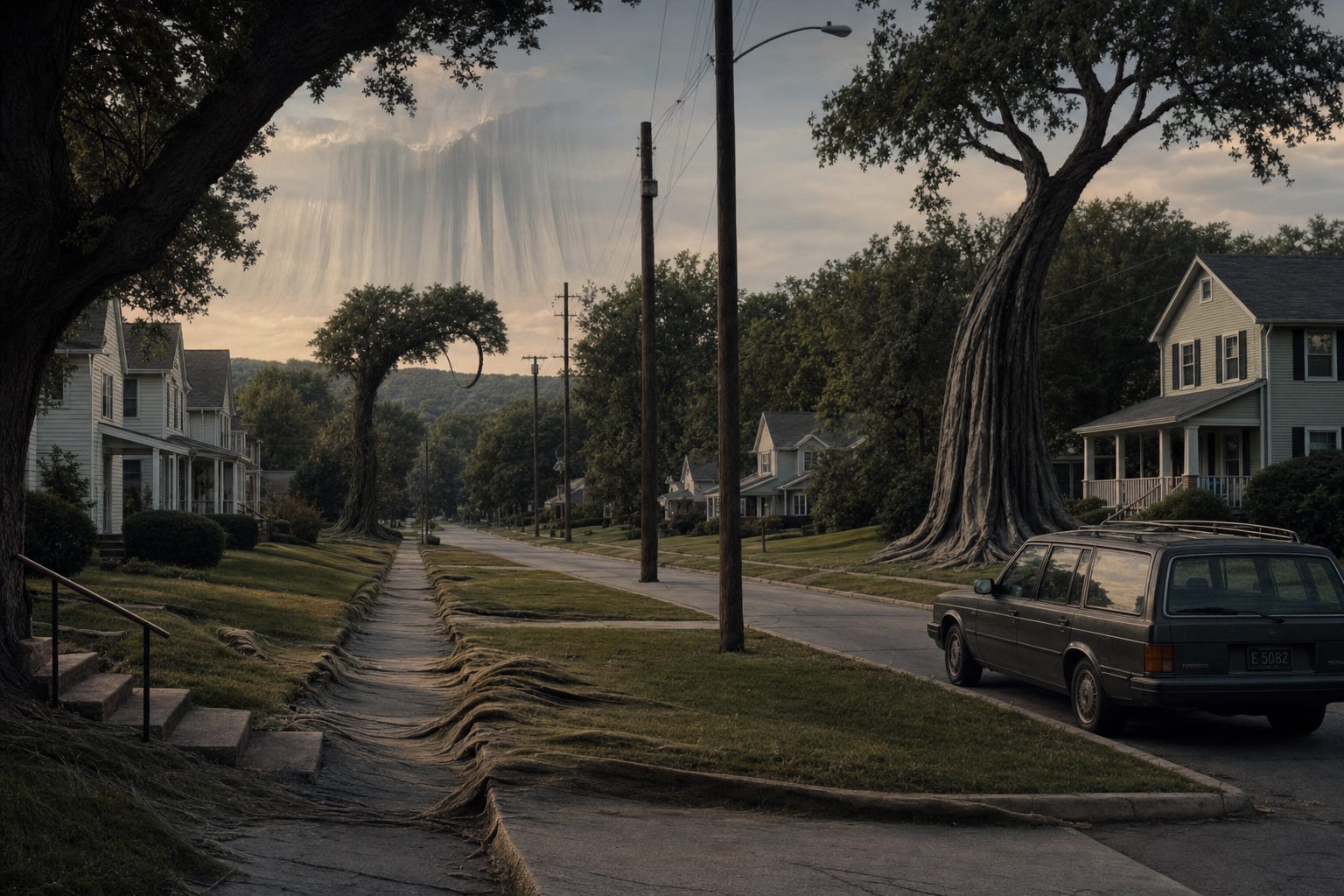
I woke this morning to the full significance of eighty years. Not with dismay or dread — something much quieter than that, more like the recognition one has when a long-familiar landscape suddenly becomes strange for no apparent reason, and you understand that the strangeness was always there, like a frayed thread you’d stopped noticing, waiting for you to be still long enough to see it.
My life, like most lives, was held up by three elements.
The first was something I can only describe as an invisible mantle — a felt sense of being supported, validated, encouraged, and secure within human existence itself. Not safe from difficulty or loss, but a deeper kind: knowledge that the universe is not, at its root, indifferent to you. Call it devotion in its most elemental form, before it attaches to any particular face. I had it early. I watched as it waned.
The second was what grew from that: a deep and enduring love for the human family, made palpable through the connections with actual people, including those I came to love in ways that surprised me. A love that survives arguments and separations; outlasts the particular grief of watching someone you cherish leave to start another life without you; and even death. This kind of anthropological acceptance has a tensile strength the first does not because it’s been tested. It knows what it’s made of.
The third was more granular — individual relationships as the sites where meaning and identity are forged. Not love as a general orientation but love as a specific, irreplaceable, finite encounter with this person, in this city, at this time. Bangkok at dusk with Suna. Modena in winter. Exploring Shanghai with Elizabeth in the midst of winter fog and an endless stream of bicycles. Melbourne with its four seasons in a day. The conversations that change the direction of a life. We all have this memory bank that comes to define the particular journey we have taken.
All three are under pressure now. Not from any single event or policy or failure of will, but from something more systemic and less visible — a civilisational logic that has been quietly dismantling the conditions under which these forms of connectedness can take root and hold true.
The severing didn’t happen suddenly. It was undertaken gradually, imperceptibly, through the routine operations of institutional life, bureaucratic rationalisation, and the vast and obdurate machinery of industrial economism – a system whose deepest assumption is that human beings are primarily productive and consumptive units and that everything else about them is either instrumental to that function or irrelevant to it.
Our spiritual nature was not destroyed. It was reclassified. Moved out of the shared commons and into the private domain, where it could no longer constitute a way of knowing the world and became instead a lifestyle preference, a personal consolation, and a weekend retreat. What had once been the connective tissue of entire civilisations, the felt understanding that human life is embedded in and answerable to something more-than-human, was renegotiated into sentiment. The machinery didn’t need to attack it directly. It needed only to render it economically irrelevant, and the rest followed.
Nowhere is this more visible — or more revealing — than in how the inheritors of industrial economism have treated the peoples who never abandoned older ways of knowing. Indigenous communities across every continent carry, in their epistemologies, their land relationships, their ceremonial lives, and their languages structured around participation rather than extraction, something that industrial modernity has systematically worked to eradicate. They are called First Nations — the phrase has the character of a concession, a nomenclatorial gesture — while being treated, in practice, as populations who have simply not yet grasped what life is actually for: production and consumption, acquisition and growth, the forward march of a progress that’s never bothered to ask where it is going, or what it is leaving behind.
The irony, if irony is still the right word for something this consequential, is that what has been treated as ignorance is knowledge. Specific, hard-won, ecologically precise, philosophically sophisticated knowledge about how to live within the web of relationships that constitutes a living world. The Andean concept of sumak kawsay is living well in relational abundance, not accumulative excess. The Aboriginal understanding of country as kin, not as property. The Tagalog principle of kapwa, which locates the self not inside the individual but in the shared space between persons. These are not charming cultural curiosities. They are alternative operating systems, ones that proved their viability across timescales that make the industrial experiment look like a flicker. And the contempt with which we have come to treat these alternative wisdom traditions only reveals our own ignorance.
We dismantled them. And in doing so, we severed the fourth connection – the one that underlies all the others – the thread between the human and the more-than-human world, the living fabric of species, cycles, soils, atmospheres, and the ten thousand forms of intelligence that are not ours but upon which ours has always depended.
What I awoke to this morning was not just personal. It was the recognition that the fraying I have watched across eighty years is not incidental to the way this civilisation has organised itself. It is the product of it. Competition as the primary social logic. Fear as the instrument of compliance. Paranoia as the ambient atmosphere of a world in which everyone is simultaneously surveilled and surveilling. Separation—of the human from nature, of communities from their land, of individuals from each other, of the present from any liveable future—is the structural condition that all the other pathologies require in order to persist.
What we are left with is a civilisation that has made itself sick in a very particular way: by severing the very relationships through which health – ecological, social, spiritual, psychological — is generated and sustained.
Some of us are remembering. Reaching back into wisdom traditions that the machinery did not entirely succeed in erasing, finding in them not nostalgia but orientation. This is real. It matters.
But I find myself, this morning, less interested in the answers being tentatively reconstructed than in the questions that have simply stopped being asked. The questions that an earlier humanity — in its multiplicity, across its many centres — held as the proper business of a conscious life.
What does it mean to live well within the conditions that actually sustain life? What do we owe to the generations who will inherit what we are currently spending? What would it look like to organise collective life around the obligations we carry — to each other, to those who come after us, to the living systems within which we are not masters but participants? What kind of knowing have we discarded in our haste to measure, monetise, and manage? Whose epistemologies have we silenced, and what have we lost in the silencing that we don’t yet have the conceptual vocabulary to even name?
These are not rhetorical questions. They are the questions a civilisation asks when it is serious about surviving. And the most telling thing about the present moment — the thing I notice most from eighty years of watching — is how thoroughly we have stopped asking them.