Synopsis. For as long as we’ve kept calendars we’ve circled the date of our own extinction in red, but the world keeps declining to attend the party. I am in an unusually light-hearted mood today. So those readers who assume that I invariably get out of bed wearing a grave countenance should be forewarned. I am here poking fun at the prophets, then at the psychologists who studied them. And then at the rest of us, before asking why a dated ending appeals so strongly to our adolescent species, and what a grown-up relationship with genuinely planetary danger might demand.
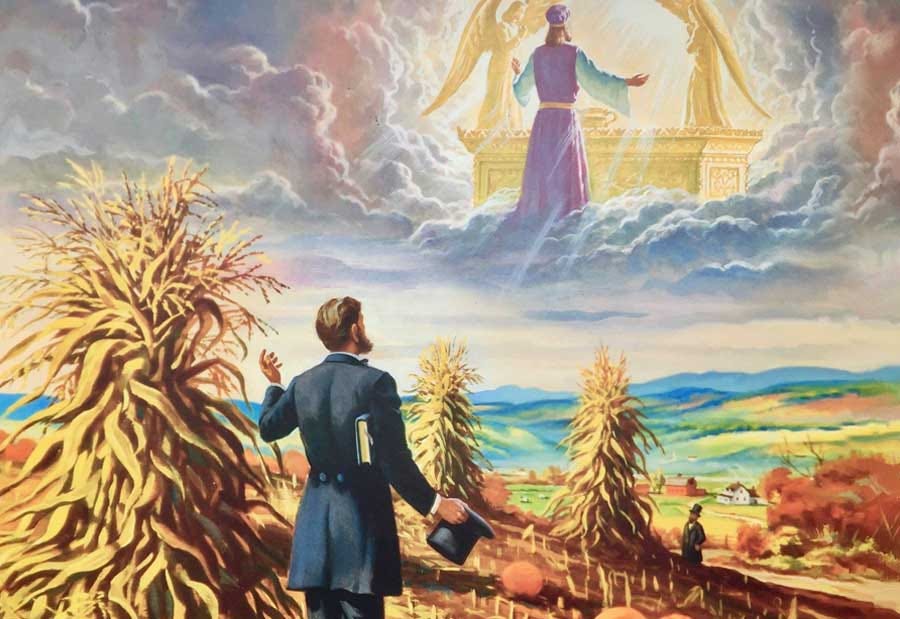
Early on the morning of Wednesday 23 October 1844, a prosperous farmer named Hiram Edson set off across his own cornfield in upstate New York, choosing to walk between the rows of stalks rather than along the open road. The road ran past his neighbours. The day before, he’d invited several of them to a final meeting, informing them, with the serene courtesy of a man settling his affairs, that he never expected to see them again, since the Lord was coming that day.
The Lord hadn’t come. The neighbours, regrettably, had stayed.
Anyone who has announced a grand departure from a party and then spent ten minutes rummaging for a coat among the pile on the host’s bed grasps a fraction of what Edson felt. Multiply it by eternity, and add the laughter of people who had declined salvation and still had to milk the cows on Wednesday. The Millerites, who had worked out Christ’s return from the prophetic mathematics of the Book of Daniel and settled at last on 22 October, would remember the day as the Great Disappointment. A few believers fell physically ill from the shock. Many walked away. Edson, moving between the stalks, received what he described as an insight: the date had been correct all along, but the event had taken place somewhere else, in a heavenly sanctuary beyond human sight. The appointment had been kept. It was simply held in a different location.
That insight deserves a small plaque, because nearly every disappointed prophet since has reached for it. In a few days’ time it’ll be 182 years since Edson’s walk, and humanity has spent the interval perfecting the art of the relocated appointment.
*
On 21 December 1954 a Chicago housewife called Dorothy Martin, who took dictation by automatic writing from beings on a planet called Clarion, expected a flood to drown much of North America before dawn, with a flying saucer collecting the faithful shortly beforehand. The saucer was delayed. So was the flood. Some hours before sunrise a fresh message arrived explaining that the little group’s devotion had shone so brightly that the catastrophe had been called off for the time being. As cancellation notices go, it’s unbeatable. The world was spared, and it was spared because of you.
Harold Camping, a retired civil engineer turned radio evangelist, brought an engineer’s thoroughness to the problem. His Family Radio network paid for more than five thousand billboards and a caravan of twenty RVs announcing the Rapture for 21 May 2011, timed for six in the evening, local time, rolling around the planet zone by zone, an apocalypse with the punctilious manners of an international airline. One reporter found his desk calendar counting down the days, a plea for mercy written against the twenty-first and every subsequent page left blank. When six o’clock had come and gone in every zone, Camping explained that the judgement had been spiritual and invisible, and that the physical finale would follow in October. It didn’t. Meanwhile atheists in several American cities threw rapture parties, which may be the only occasion in recorded history when a prophecy was more faithfully observed by its satirists than by its believers.
These stories are easy to laugh at. Laughing at them is healthy. The most instructive comedy in the archive of failed endings, though, belongs to the people who came to study the believers.
*
Martin’s circle, usually known as the Seekers, had been infiltrated by a team led by the social psychologist Leon Festinger. Their 1956 book, When Prophecy Fails, reported that once the flood failed to arrive the core believers doubled down, rushing to proselytise in order to quieten the agony of having been wrong. From that observation grew the theory of cognitive dissonance, among the most cited ideas in modern psychology and a fixture of introductory textbooks for seventy years.
In early 2025 Festinger’s papers at the University of Michigan were unsealed. A researcher, Thomas Kelly, went through them and argued that the canonical account had been, to put it gently, massaged. On his reading the Seekers had been courting publicity well before the deadline and drifted away from their beliefs fairly quickly afterwards. The researchers and their paid observers made up something like a third of the group, and the notes record them encouraging the faith at moments when it wobbled. Kelly’s critics accuse him, in turn, of cherry-picking, and the scholarly quarrel is far from settled.
I find the shape of it simply exquisite. The founding parable of how human beings cling to a disconfirmed prediction may itself be a disconfirmed prediction to which human beings, many of them with doctoral degrees, have clung for the better part of a century. Edson’s cornfield, it turns out, has a faculty lounge.
I raise this without any sense of disdain. I’ve spent much of my working life in the forecasting trade, and a sincere “nowist” ought to admit that the futures industry is Camping’s billboard dressed in a suit and tie. We charge more. We hedge our dates with ifs and buts. And we far prefer the term “plausible” to the word “guaranteed”. Yet the temptation is identical: to be the one who saw it coming. The seduction of catastrophe doesn’t stop at the edge of the cult. It sits quite comfortably in ministries, faculties, trading desks and editorial meetings.
*
Why are we so drawn to the end of days?
Part of the answer is narrative hunger. An ending resolves. It promises that accounts will finally be settled, the wicked surprised, the faithful vindicated, and that the dreary obligations of tomorrow will be cancelled, along with tomorrow itself. The apocalypse is the only story in which nobody has to do the washing-up. Real life offers no such mercy. It’s a serial without a finale, in which every crisis survived generates the chores of the next instalment.
Part of the answer lies closer to the bone. Decades of experimental work in social psychology suggest that when people are reminded of their own mortality they hold more tightly to their worldview and warm more readily to those who promise strength and certainty. Dread makes us loyal long before it makes us wise. So the prophet and the political saviour tend to arrive together, the first to supply the terror and the second to sell its cure, and they often share a platform. Occasionally they even share a body.
And part of the answer is vanity. To live at the end of history is to matter enormously. Every generation privately suspects it’ll be the last, to some extent because it can’t quite imagine the world managing or enduring without it. Most parents will recognise the adolescent version: the teenager certain that the household will fall apart the moment he leaves home, and quietly wounded when it doesn’t.
Adolescence is where the satire turns serious. The adolescent mind oscillates between two fantasies. One is total doom: my life is over, everything is ruined, nobody understands. The other is total rescue: someone, a parent, a lover, a champion, will arrive and put it right just in time. Both fantasies share a hidden convenience, which is that each relieves the dreamer of responsibility. If all is lost, there’s no point trying. If rescue is coming, there’s no need. A species that swings between the doom-merchant and the strongman is behaving exactly like a troublesome fifteen-year-old asked to put away the laundry.
*
The dated ending is, in any case, a rather provincial product. Many of the world’s great cosmologies imagined time as a wheel. Hindu reckoning gives the present Kali Yuga, the darkest age of the cycle, a span of 432,000 years, which makes even the most alarmed pundit look impatient. Buddhist teaching treats the dissolution of worlds as one more expression of impermanence, to be met with clear sight rather than electronic billboards. And the Maya Long Count, which this century’s spiritual entrepreneurs marketed as a countdown to oblivion on 21 December 2012, predicted nothing of the kind. It completed a great cycle, much as an odometer rolls over. Descendants of the Maya watched coachloads of foreigners arrive to witness the end of a world their own calendar had never forecast. The prophecy was imported; only the ruins were local.
The linear apocalypse, with its single culminating midnight, is an inheritance that spread around the globe with the same efficiency as its commercial cousins. Industrial economism runs on a strikingly similar story: perpetual acceleration towards a destination that’s always about to arrive and never does, a promised land of abundance permanently scheduled for the next quarter or the next government’s first term. Endless growth and sudden doom are two faces of the same calendar. Each insists that the present is a departure lounge, and that the real life of the species begins, or ends, somewhere else.
*
Then there’s the clock that isn’t a prophecy at all.
In January 2026 the Bulletin of the Atomic Scientists set its Doomsday Clock at 85 seconds to midnight, the closest in its history, citing nuclear arsenals, climate change, biological threats and the destabilising spread of artificial intelligence, and attributing the setting explicitly to a failure of leadership. When the clock first appeared in 1947 it stood at seven minutes. Those minutes have long since been spent. The scientists now count in seconds, and one can picture a future meeting at which somebody proposes milliseconds and somebody else, very gently, proposes a different clock.
The joke here is on us, but it’s a bleak one. Apart from Nostradamus, who was tiresomely vague, the prophets of the past kept handing us dates. Today’s dangers refuse to supply one. Carbon accumulates without reference to six o’clock local time. Antimicrobial resistance doesn’t advertise on Instagram. An arms race arrives through procurement cycles, an engineered pathogen through a laboratory lapse or a private grudge, and the collapse of a shared sense of what’s true through ten billion seemingly inconsequential decisions about what to click. These dangers are planetary, cumulative, and chronic. They behave less like a flood before dawn and more like subsidence, the kind of sinking that registers in millimetres a year until, quite abruptly, the water is at the door.
This is why the old superstition has become so hazardous. The apocalyptic imagination trained us to scan the heavens for a single blinding event: a trumpet, a comet, a flying saucer running late. So we keep our telescopes trained on deep space in the hope of meeting aliens, and our weather apps on the next storm, while the ground beneath the observatory quietly subsides.
Denial and despair, which present themselves as opposites, turn out to be the same dating error. Denial says: not just yet, and not here. Despair says: already, and everywhere. Each writes us a sick note for the week ahead. Despair is especially fashionable among the well-educated, who can recite the projections and therefore feel entitled to a sulk. It’s the adolescent’s slammed door, with footnotes.
*
What has actually postponed the end, so far, is far less theatrical than prophecy. In 1991, with the Cold War receding and arsenals being cut, the Bulletin moved its clock back to seventeen minutes, the furthest it has ever been from midnight. Human beings moved those hands. In September 1983 a Soviet duty officer, Stanislav Petrov, judged a satellite warning of incoming missiles to be a false alarm and declined to report it up the line as an attack; scepticism at the right desk on the right night may have done more for the survival of our species than every revival meeting in history. The Montreal Protocol, agreed in 1987, phased out the chemicals that were thinning the ozone layer, and the damage is slowly mending.
Nobody put up posters for the Montreal Protocol. Picture five thousand of them along the major highways of the world:
CHLOROFLUOROCARBONS PHASED OUT. THE TREATY GUARANTEES IT.
Imagine caravans of RVs touring provincial towns to announce verified stockpile reductions, and sceptics throwing parties to mark the inspection of a decommissioned warhead. It’s absurd, but the absurdity is instructive nevertheless. Our cultures have elaborate rituals for anticipating catastrophe and almost none for celebrating its prevention. The prophet who got the facts spectacularly wrong earns the headlines; the negotiator who talked the arsenals down might get a pension.
Postponement is an achievement, and like a garden or a marriage it decays without proper upkeep. The appointment with catastrophe remains in the diary, pencilled rather than inked; it’s been rescheduled again and again, and the next postponement depends, irritatingly, on somebody keeping up the patient, unglamorous labour that secured the last. There’s no app for this, and no consultant willing to take it off our hands at any price we’d care to pay.
Adulthood, in a person, tends to arrive on some unremarkable morning when it dawns that nobody is coming: no parent to settle the bill, and no catastrophe obliging enough to cancel it. The bills simply keep arriving, and somebody has to pay them. A species reaches that realisation more slowly, and with far greater reluctance, because both its favourite exits close at once. The story has no final page to race towards, and no saviour waiting in the wings to finish it on our behalf. What remains looks dismayingly like housework: mending what we’ve broken, keeping faith with the people beside us and with those not yet born, tending living systems without which neither has anywhere to stay.
This sort of responsibility seldom appears in speeches. It reads the small print, fixes the leak before the roof gives way, turns down the profitable shortcut, and thinks in generations in a world that rewards anyone able to see as far as next Friday.
It also requires a particular courage, the nerve to look at injuries we’ve inflicted on ourselves and others without converting the guilt into theatre. Prophets have always been admirably clear about where catastrophe comes from, and it’s never from us: it’s God’s judgement, the aliens’ flood, the enemy’s plot, the other party’s policy agenda. An adult civilisation has to accept the far more embarrassing truth that the gravest dangers it faces are almost entirely home-made, with the receipts in its own handwriting. That’s at once the worst news and the best. What we made we can, at least in principle, slow, contain, reverse, dismantle or outgrow.
Wisdom, I suspect, is largely a matter of changing our relationship with time, which is awkward, since time has never shown the slightest interest in a relationship with us. The apocalyptic mind lives on a perpetual eve, forever dressed for the decisive hour and so never quite arriving in the present, like a guest who has been standing in the hallway in his coat since 1844. Its wiser counterpart inhabits an “expanded now” in which the future shows up folded into every decision made today: the field we sow, the weapon we leave on the drawing board, the vote, the purchase, the silence or the protest, the child we teach to read the sky without fearing it.
Edson never did take the road. He spent the rest of his life elaborating his insight from the shelter of the cornfield. The doctrine he helped shape has outlived him by more than a century, which is more than can be said for most forecasts, mine included. A reinterpretation, offered at the right moment to people who badly need one, can prove far sturdier than any prophecy.
We’ve become rather accomplished at that kind of sturdiness. Each lapsed emissions target and each expired arms treaty has been met with its own small sanctuary doctrine, usually issued as a press release: the goal was always aspirational, the progress real but invisible from here. Some of the most ingenious theology of our age is drafted at climate summits.
Meanwhile the neighbours to whom we owe the most aren’t leaning on any fence. Most of them haven’t been born, and those who have are watching from places our maps still regard as marginal, waiting to learn whether we’ll come out of the corn before the season turns, or keep walking between the rows, explaining to one another, in ever more eloquent prose, why the appointment was kept somewhere else.