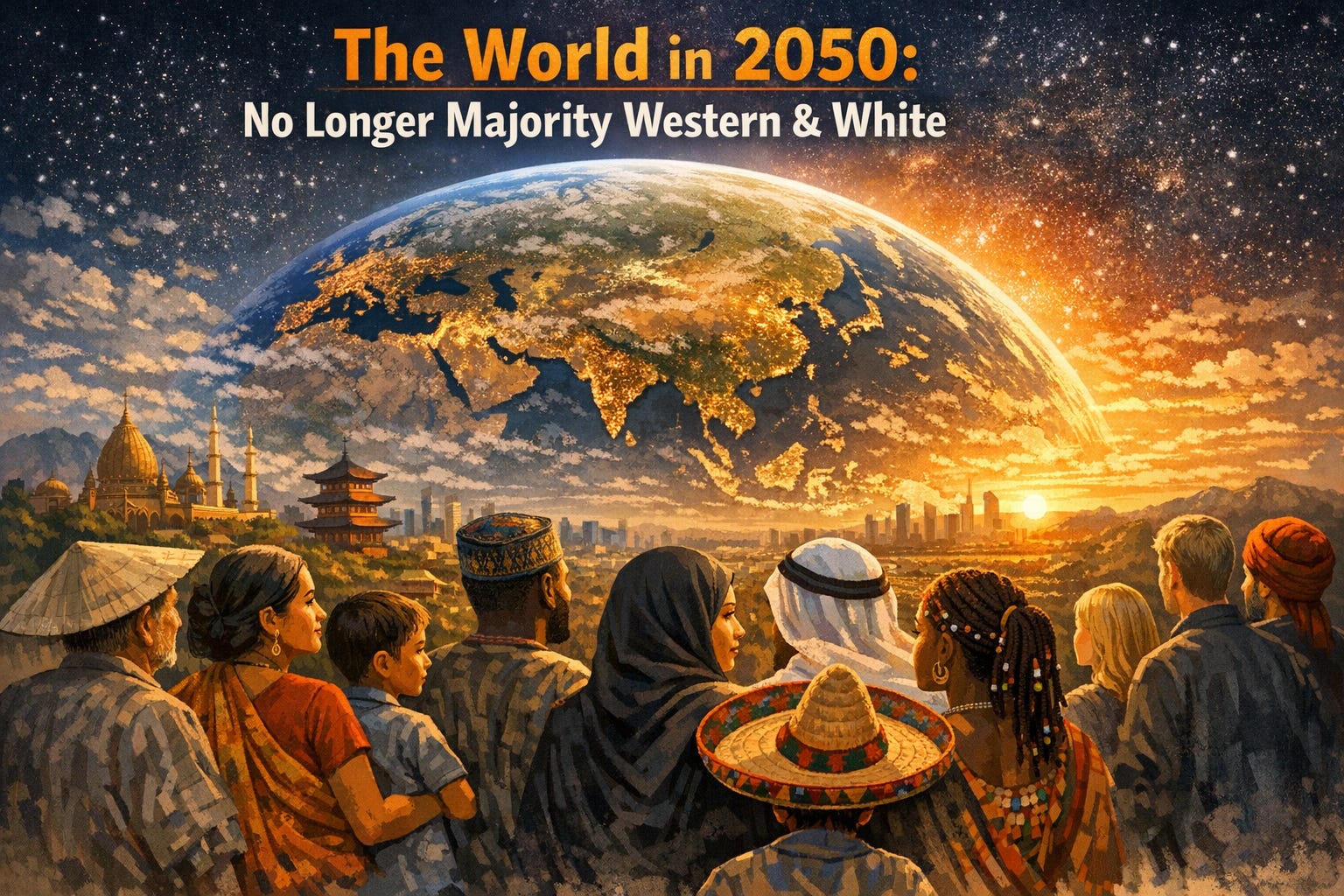
There’s a seminal question that the demographic evidence eventually forces, if you follow it far enough and honestly enough. It’s not a comfortable question, and the discomfort is not incidental — it is investigative. The question is this: if the systems we have built to organise human life were designed by a particular society, for a particular vision of what human life is about, what happens to those systems when the civilisational community that designed them is no longer the majority experience of what it means to be human?
This is not a question about diversity. It’s not a question about inclusion. It’s not answered by adding more voices to existing structures or by ensuring that the rooms where decisions are made contain a wider range of faces. This is a question about ontology — about the foundational assumptions regarding what’s real, what has value, what a person is, what time means, and what the relationship between the human and the living world should be. Those assumptions are not neutral. In today’s world they are broadly Western, patriarchal, and colonial in their origins as well as in their continuing operation. And they’re in the process of becoming the minority experience of the species — not the majority one.
The civilisational wager now in play is a matter of statistical data. Not whether the world will change. It will. It is. The demographic arithmetic is unambiguous. By mid-century the majority of the world’s population will be African and Asian. The majority of the world’s young people — the ones who will build and manage the institutions, set the terms of exchange, define the boundaries of the possible — will have been formed in traditions of knowing, relating, coordinating and administering that are not centred around the ontological assumptions that generated the world as it currently exists. The wager is whether the transition that implies will be a genuine civilisational opening, or whether the colonial project will complete itself by ensuring that the demographic majority inherits only the epistemological framework of the minority that preceded it.
To understand what’s actually at stake, you have to be willing to see the current world order for what it is — not as modernity, not as development, not as the inevitable peak of human progress, but as a precise product of a precise tradition, operating according to precise assumptions that are neither universal nor inevitable.
The Western, patriarchal, colonial model is a complete ontology. It rests on a set of foundational tenets and commitments that are so deeply embedded in the institutions it generated that most people operating within those institutions cannot perceive them as commitments at all. They present as simply the way things are. The individual as the primary unit of social and moral life. The separation of mind from body, human from nature, reason from relationship. Linear time moving toward a destination we dub progress. Value generated by human labour transforming raw resources, with nature itself counting for nothing until it’s in that transformed state. Knowledge as something generated by a particular methodology, in particular institutions, credentialled by particular authorities — and alternative ways of knowing relegated to the category of culture, belief, or tradition, which is to say, the category of things that don’t count.
These commitments generated extraordinary inventions. The scientific method. Democratic governance in its various forms. Technologies of communication and medicine and mobility that have genuinely extended and enriched human life. To say that the Western ontology is partial is not to say that it has produced nothing of value. It’s to say that it has produced what it has produced at enormous cost — to the natural world, to the communities whose knowledge and labour and land it consumed in the process of its expansion, and to the dimensions of human experience it systematically devalued in order to maintain its internal coherence.
The colonial project was not purely economic or political. It was epistemological. Its deepest function was the replacement of indigenous ways of knowing with European ones — the systematic destruction of the educational, spiritual, governance, and ecological knowledge traditions of the societies it encountered, and their replacement with institutions designed to produce subjects capable of operating within the colonial order. That project was so thorough, and has been so continuously reinforced by the post-colonial institutional settlement, that its effects are still the primary reality for the communities now at the centre of demographic changes now underway.
The patriarchal organisation of knowledge has done its own quieter damage, less visible than colonialism’s because it presents not as conquest but as nature. The elevation of abstract, universal, and disembodied reasoning as the only form of knowing that counts institutionally — and the corresponding relegation of relational, contextual, and embodied knowledge to the category of the merely personal, the merely cultural, the merely feminine — is not a neutral epistemological preference. It’s a political act with a five-century institutional history. It has systematically excluded from the design of life-critical systems precisely the knowledge most intimate with care, continuity, and the conditions under which communities actually sustain themselves. The matrilineal traditions of West and Central Africa, the relational cosmologies of many Southeast Asian communities, the feminine governance traditions suppressed not only by colonial administration but by the patriarchal epistemology it carried with it — these are not marginal inheritances. They are foundational design intelligence, excluded not because they failed to answer the questions but because the questions they answered were not recognised as being serious. The demographic formation now underway includes, at its centre, communities that have never fully relinquished these traditions. Whether those traditions are allowed to operate as genuine sources of civilisational design — rather than as cultural heritage to be celebrated and ignored — is one of the defining questions of what comes next.
Children being born in Lagos and Nairobi and Dhaka and Kinshasa are being born into societies whose schools still teach in the epistemological framework of the coloniser, whose hospitals still operate within a biomedical model that excludes most of what those societies have always known about health and healing, whose courts still adjudicate by legal frameworks imported from European traditions, whose universities still credential knowledge according to standards set in London and Paris and Boston. In other words, the demographic majority is forming inside an epistemological minority’s institutional architecture. This is the real colonial residue — not the flags and the governors, but the more profound occupation of the mind.
Which brings us to the most important design question of the 21st century. Not how do we build better systems for the emerging demographic majority. But whose civilisational imagination gets to define what a world-system is, what it’s for, and what it would mean for human life to flourish within it.
Because there are other answers to those questions. There have always been other answers. And the traditions carrying those answers are not peripheral, not primitive, not pre-modern versions of the story that the West tells about itself. They are fully developed, philosophically sophisticated, practically tested ways of organising human life that were not superseded by the Western model — they were suppressed by it. That difference is not trivial.
Ubuntu — the Southern African philosophical tradition whose central claim is that a person is only a person through others — is not a warm mushy sentiment about community. It’s a complete social ontology with profound implications for how governance, economic life, and the relationship between the individual and the collective should be structured. It begins from a fundamentally different premise than liberal individualism, and the systems it generates are correspondingly different — more relational, more oriented toward collective flourishing, more attentive to the obligations that bind rather than the rights that separate.
The Confucian tradition — still deeply alive in East and Southeast Asian cultural life despite a century of modernisation pressure — offers a different but equally complete account of the relationship between individual, family, community, state, and cosmos, organised around the cultivation of virtue through relationship and the primacy of obligation over entitlement. Its answers to the design questions of governance, education, and economic life are not the same as the Western solutions. They are not better in every respect. But they are different in ways that matter enormously when the question is what kind of world-system is adequate to the lives of the majority of human beings.
Indigenous ecological knowledge traditions — present across Africa, Asia, and the Americas in enormous variety — share a structural feature that the Western ontology has almost entirely lost: the non-separation of the human from the living world. The assumption that the health of human communities and the health of ecological systems are not separate problems to be managed in separate compartments, but a single reality to be understood and tended as such. This is a sophisticated body of knowledge about how to live well within the limits and gifts offered by particular places, accumulated over millennia of intimate practice. Its systematic exclusion from the design of health, agricultural, economic, and governance systems is not only a cultural loss. It’s an epistemological catastrophe at precisely the moment when the organic living systems on which all human life depends are under the most severe stress.
Given all of this, what does the global demographic shift we’re facing actually imply? Not a larger market. Not a more compliant workforce for existing economic structures. Not a more complex administrative challenge for institutions already struggling to govern themselves. But a genuine civilisational opening — the first in the modern era — in which the knowledge traditions of the demographic majority have the possibility of operating on their own terms rather than as subordinates within someone else’s framework.
That possibility is not automatic. It is contested, vulnerable, and easily foreclosed. The most likely outcome, if the current trajectory continues, is that the demographic majority inherits the epistemological architecture of the minority — that the schools built across Africa and Asia continue to churn out graduates capable of working within the global economy as currently structured, while the knowledge traditions that might produce genuinely different answers to the design questions continue to erode. This would be the colonial project’s final victory: a world in which the demographic majority thinks, designs, and governs in the image of the minority that preceded it.
The alternative requires something far more radical than reform. It requires the genuine legitimisation of other ways of knowing as sources of design intelligence — not as cultural heritage to be preserved in museums and festivals, but as living epistemological traditions with genuine answers to the questions that the Western model is demonstrably failing to answer.
How do you organise economic life in a way that generates collective flourishing rather than concentrating wealth and externalising cost? How do you govern communities in a way that maintains coherence and self-determination at scale? How do you design health systems adequate to the full reality of human wellbeing? How do you relate to the living world in a way that sustains rather than consumes it?
The Western tradition has had five centuries of institutional dominance to answer these questions. Its answers have produced real goods and catastrophic harms. It’s not obvious that continuing to apply those answers to a world that is predominantly not Western is the most intelligent response to where we find ourselves.
—
This is where ecority enters — not as a Western solution dressed in ecological language, but as an attempt to articulate, in terms that institutional actors can engage with, something that the non-Western traditions have always known and the Western tradition has almost entirely forgotten.
The triple obligation at ecority’s centre — what we owe to each other, what we owe to those who come after us, what we owe to the living systems that make human life possible — is not a Western idea. It is, in various formulations, the foundational ethical commitment of Ubuntu, of indigenous ecological philosophy, of Confucian relational ethics, of Buddhist interdependence. The West has had versions of it — in its religious traditions, in its suppressed ecological and communal inheritances — but they were systematically marginalised by the ontological commitments that drove industrialisation and colonialism.
The trimunary test applied to system design asks a question that the dominant paradigm cannot ask within its own framework: is this system adequate to all three obligations simultaneously? Does it generate genuine mutual flourishing among those it serves? Does it preserve and enhance the conditions that those who come after will need? Does it operate within the integrity of the living systems on which it depends? A system that satisfies one of these obligations by externalising costs onto the others is not a successful system with unfortunate side effects. It’s a failed system that has successfully hidden its failure.
Most of the life-critical systems currently operating in the world fail this test comprehensively. Education systems that produce individuals capable of economic participation while systematically destroying the cultural coherence and ecological knowledge of the communities they serve. Health systems that extend individual lifespan while generating pharmaceutical dependencies and ignoring the social and ecological determinants of wellbeing. Economic systems that produce measurable growth while consuming the natural capital on which all future growth depends and concentrating its benefits in the hands of a diminishing minority. Governance systems that maintain formal democratic structures while the actual locus of decision-making migrates to institutions — financial, technological, corporate — that are accountable to no community and responsible to no place.
These are not systems in need of improvement. They are systems in need of replacement — and the replacement can’t come from within the ontological framework that generated them, because that framework cannot perceive its own failures as failures. It perceives them as costs, as externalities, as unfortunate but necessary features of the only model of progress available.
The demographic shift is creating, slowly and unevenly but genuinely, the conditions in which that perception can be challenged at a civilisational scale. Not because the communities forming the demographic majority are automatically wiser or more ecologically attuned or more relationally sophisticated than the communities whose model has dominated the modern era. But because they are forming in traditions that carry different answers to the foundational questions — answers that have been suppressed but not totally destroyed, marginalised but not extinguished — and because their sheer demographic weight means that, for the first time, the assertion of those answers cannot simply be managed as a peripheral concern.
—
What this means for system design is both simple and radical.
It means that the design of life-critical systems adequate to the world forming around us can’t be done from outside the communities those systems will serve. Not because outside knowledge is worthless — it is not — but because the foundational questions that design must answer are not technical questions. They are questions about what a good life is, what a healthy community is, what a just relationship between human activity and the living world is. Those questions have answers already — partial, contested, alive — in the knowledge traditions of the communities concerned. Design that ignores those answers is not neutral. It is colonial.
It means that the agency question is not a question about participation or consultation or co-design in the familiar sense of those terms. It’s a question about epistemic authority — about whose ways of knowing have genuine standing in the design process, not as local colour or community input to be considered alongside the actual expertise, but as primary sources of design intelligence. The elder in the Sahel who has watched the relationship between rainfall, soil, and human community for sixty years knows something that no remote sensing technology can capture and no development economist has been trained to ask about. That knowledge is not supplementary. It is basic.
It means that the timeframe of design must change. Systems adequate to a demographic reality that will play out over fifty to a hundred years cannot be designed on the incentive timescales of electoral cycles and quarterly returns. Many of the non-Western traditions that are demographically ascendant carry a different relationship with time — more cyclical, more ancestral, more orientated toward the obligations that extend backward and forward beyond any individual life. The Haudenosaunee principle of seven-generation thinking is not a romantic anachronism. It’s a design specification. It asks of any significant decision: what will this mean for the people living seven generations from now? That is approximately the timeframe the current demographic formation demands.
And it means, finally, that the question of what a system is for must be reopened — genuinely, uncomfortably, without the protection of assuming that the answer is already known. Is education for the production of economically functional individuals, or for the cultivation of human beings capable of living well in relationship with each other and with the world? Is health for the management of disease in individual bodies, or for the maintenance of the conditions in which communities can flourish? Is governance for the administration of territory and the management of competing interests, or for the ongoing negotiation of what it means to live together well, in a particular place, at a particular moment in the long story of human habitation of the earth?
These are old questions. They have been answered differently by different traditions, and the answers that prevailed were not the ones that proved most adequate to human flourishing. They were the ones backed by the most effective combination of military force, economic power, and epistemological confidence.
That combination is losing its grip. Not quickly, not cleanly, not without enormous resistance from the institutions and interests it has generated. But the demographic arithmetic is not on its side.
The civilisational wager, then, is not whether the world will change. It will. The question is whether the change will be merely demographic — a larger population organised by the same ontological assumptions, wearing the same institutional clothes, asking the same questions and finding the same inadequate answers — or whether it will be genuinely civilisational, a moment in which the suppressed majority of human knowledge and experience finds, at last, the conditions to operate on its own terms and contribute its own answers to the questions that the dominant tradition has proved unable to resolve.
That wager cannot be won by the communities forming the demographic majority alone. It requires something from the institutions and traditions currently holding power — something genuinely difficult, genuinely rare, and genuinely necessary. Not charity. Not development assistance. Not the enlightened management of transition.
The willingness to be taught. To recognise that the knowledge required to design systems adequate to the world forming around us is not concentrated in the places that have held institutional power for the past five centuries. That it is distributed, alive, and waiting — in the epistemological traditions of the communities whose children are, right now, being born into the majority of the human future.
The first act of adequate design is always the same. It’s the act of genuine listening — not to confirm what you already know, but to encounter what you don’t know and hadn’t even considered. Everything else follows from there. It always has. It always will.