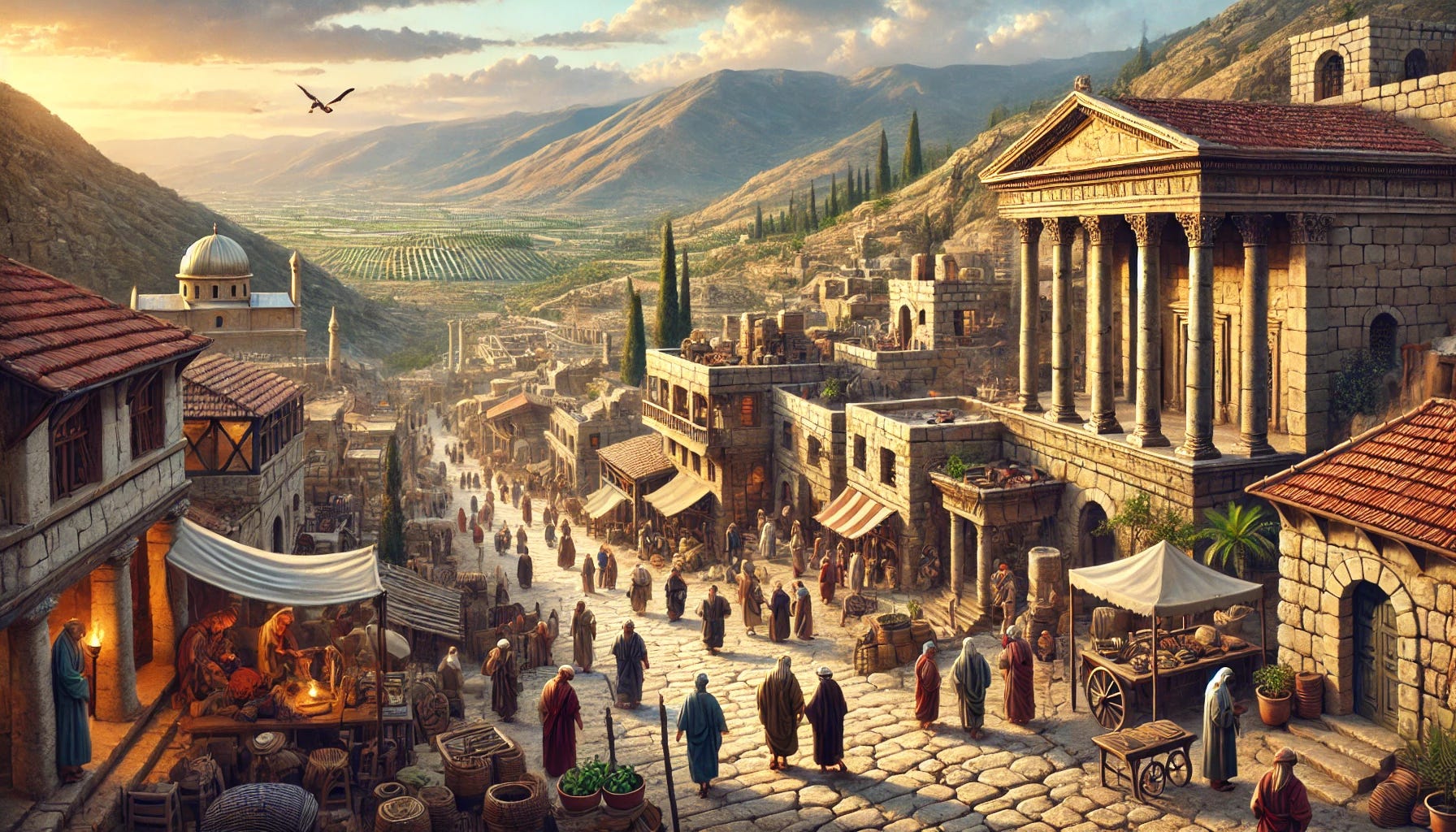
The Scribes Keep Writing
Somewhere in the ruins of Ugarit, a city on the Syrian coast that ceased to exist around 1185 BC, archaeologists found a clay tablet that had never been fired. It was still in the kiln when the city burned. The letter it carried was a plea for military assistance — ships had been spotted offshore, something was wrong, help was needed urgently. No reply came. No help arrived. Ugarit was destroyed and never rebuilt. The tablet survived only because the catastrophe that made it irrelevant also preserved it.
What strikes any careful reader of this period is not the violence of the ending but the administrative continuity that preceded it. The palace scribes of the Late Bronze Age kept recording. Grain allocations, tribute assessments, diplomatic correspondence, livestock inventories — the bureaucratic metabolism of civilisation continued functioning with remarkable fidelity right up to the destruction layers that archaeologists find beneath their trowels. There is no stratum of reassessment. No archive of emergency rethinking. The system administered itself to the very end.
This is not a failure unique to the Bronze Age. It is what world-systems do. The more elaborately a civilisation has organised itself around a particular set of assumptions, the more total its commitment to those assumptions becomes — not just as ideology but, far more critically, as infrastructure. The assumptions are no longer believed; they are instantiated. They live in the supply chains, the accounting systems, the bureaucratic procedures, the trained habits of every functionary who keeps the palace running. To question them is not to think an heretical thought. It is to dismantle the apparatus of one’s own existence.
We know this condition intimately. We call it by different names depending on our discipline — institutional lock-in, path dependency, the gravity of prior investment — but what we’re describing is inevitably the same phenomenon: a civilisation that has confused its administrative categories with reality and so continues managing an order that is already, structurally, crumbling. The quarterly earnings reports keep coming. The GDP figures are revised and re-revised. The carbon markets are calibrated and recalibrated. The summits convene and issue communiqués. The tablets keep being written. And somewhere offshore, just beyond the edge of what the palace scribes are trained to record, something has been sighted that the existing categories have no name for.
Eric Cline, in his meticulous reconstruction of the Bronze Age collapse, calls what happened a ‘systems collapse’ — borrowing the term from complexity theory to describe what occurs when a highly integrated, efficiency-maximised network loses the redundancy that would allow it to absorb multiple cascading failures. No single cause brought the Bronze Age world down. It was drought and internal rebellion and the disruption of trade routes and the movement of peoples and the failure of harvests and the breakdown of diplomatic networks – all of it arriving more or less concurrently into a system that had, over centuries of prosperity, traded away every buffer it once had. The very sophistication that made the Bronze Age world remarkable was the source of its fragility. It had become, in a very precise sense, its Achilles heel.
The warning is not comfortable. But it’s not, in itself, new. What is new — what changes the nature of the warning entirely — is something Cline documents but fails to fully reckon with. We will come to that. First, we need to understand what the Bronze Age actually built and why its loss still echoes.
The Globalisation That Was
It is difficult, looking at the ancient world from our present vantage point, to resist the condescension of scale. Bronze Age kingdoms seem small, their horizons limited, their technologies so rudimentary against our own. This is an error of imagination. What the Late Bronze Age constructed, across roughly five centuries of sustained development, was the first genuinely interconnected international system — a web of trade, diplomacy, specialisation, and mutual dependency that spanned from Egypt to Mesopotamia, from the Aegean to the Levant, from Cyprus to Anatolia. This was not our world in miniature. It was our world in prototype.
The evidence is specific and startling. A shipwreck discovered off the Turkish coast at Uluburun, dating to around 1300 BC, carried in its hold ten tonnes of Cypriot copper, one tonne of tin from sources in central Asia, ebony logs from tropical Africa, glass ingots from Egypt or Mesopotamia, Canaanite amphorae, Baltic amber, a golden scarab bearing the cartouche of Nefertiti, and goods from at least seven distinct cultural regions. This was not an exceptional cargo. It was routine commerce. In the language of our own moment, this ship was a container vessel — a node in a supply chain whose endpoints were separated by thousands of miles and whose smooth functioning depended on political stability, reliable navigation, shared weights and measures, and the maintenance of diplomatic relationships between a dozen sovereign powers simultaneously.
Those relationships were maintained with striking sophistication. The Amarna letters — a diplomatic archive recovered from Egypt, consisting of cuneiform tablets exchanged between the great kings and their vassals across the fourteenth century BC — reveal a world of cautious protocol, reciprocal gift exchange, dynastic marriage, and sustained negotiation. The great powers addressed each other as brothers. They complained, with a familiarity that crosses three thousand years without difficulty, about delayed shipments, inadequate gifts, and the unreliability of messengers. They managed alliance and rivalry through the same channels simultaneously. What they had built was not simply a trading system but a socio-economic order — a shared framework of expectations, obligations, and mutual recognition that made the movement of copper and grain and scribes and brides across vast distances not just possible but normal.
Underneath this diplomatic canopy ran an economic architecture of remarkable complexity. The palace economies of the Bronze Age were redistributive systems — wealth flowed inward to the centre through tribute and taxation; was processed and allocated by palace bureaucracies; and flowed outward again as rations, wages, and investment in craft production. The palace was not simply a residence or a ceremonial centre. It was the operating system of the economy — the institution through which resources were converted into social organisation, military capacity, and the reproduction of the civilisation itself. Everything of economic significance passed through it or was registered by it. The scribes who kept the tablets were not administrators in any modern, merely clerical sense. They were the interface through which reality was made legible to power.
This is the configuration that Cline identifies as the source of both the Bronze Age’s extraordinary achievement and its catastrophic vulnerability. A system this integrated, this mutually dependent, this thoroughly organised around the smooth functioning of its central nodes, has eliminated — gradually, invisibly, through the accumulation of rational individual decisions — the distributed redundancy that once allowed local communities to absorb disruption without transmitting it outward. When the palace at Ugarit cannot receive grain from Egypt because Egyptian harvests have failed, and cannot substitute local production because local agriculture has been reorganised around palace redistribution rather than subsistence resilience, and cannot appeal to alternative suppliers because the same drought has struck across the entire region simultaneously, the system has no move left. Every efficiency gain of the preceding centuries becomes, in this moment, a compounded liability.
We have a word for this now. We call it globalisation, and we have spent three decades celebrating its productive power while largely declining to examine its structural logic. The Bronze Age didn’t have the word. But it built the system — and then discovered, at enormous cost, what the system does when its assumptions fail.
The assumptions that destroy a system are never the ones being monitored closely. They are the ones it has lost the capacity to see — because the apparatus that makes vision possible is itself built from those assumptions. To see them would require standing outside the very structure that organises sight. The Bronze Age palace scribes could not record what they had no category for. With rare and precious exceptions, neither can we.
What the Drought Did Slowly
Civilisations don’t usually know they’re dying. They know they are stressed, that harvests are thin, that the tribute is late, that the roads are less safe than they were. They know, in the way that institutions know things — partially, defensively, through the distorting filter of their own administrative categories — that something is not right. What they don’t know, cannot know from inside the system’s own logic, is that the reserves which once absorbed such stresses have already been spent. That the margin is gone. That what previously would have been a difficult year has become, imperceptibly, an existential one.
Paleoclimatic research has transformed our understanding of what happened in the eastern Mediterranean around 1200 BC. Pollen cores, isotope analysis of speleothems, ancient tree rings — the slow sciences of deep time — have reconstructed a picture of sustained, multi-generational drought beginning around 1250 BC and intensifying across the following century. This was not a single bad harvest or a temporary disruption. It was a decades-long desiccation of the agricultural base on which the entire Bronze Age system rested. Egypt, the Levant, Anatolia, the Aegean — the drought did not respect political boundaries. It moved across the interconnected world as slowly and as thoroughly as the trade routes had once moved copper and grain.
The crucial dynamic is not the drought itself but what the drought found when it arrived. It found a system that had been optimising for generations — rationalising agriculture around palace redistribution, concentrating specialist production, extending supply chains, deepening interdependencies — and had in the process quietly eliminated the local resilience that subsistence communities once maintained as a matter of survival. The village that once kept seed reserves and managed its own water supply had been incorporated into the palace economy. Its surplus flowed upward. Its needs were met by redistribution. This was, by every measure the palace scribes used, an improvement. Productivity rose. Specialisation deepened. The civilisation grew more elaborate, more capable, more impressive.
What it grew less capable of was surviving the failure of its own assumptions.
When the drought arrived in force, the redistribution system that had replaced local resilience could not substitute for what it had displaced. The palace could not conjure rain. It couldn’t restore the seed stocks that had been redirected into tribute. It couldn’t rebuild, in the span of a crisis, the distributed agricultural knowledge that generations of centralisation had made redundant. The efficiency gains were real. The resilience losses were equally real. They simply weren’t visible until the system needed resilience rather than efficiency — at which point the need and the capacity were separated by an unbridgeable distance.
Brandon Drake’s analysis of pollen records from the Sea of Galilee, Bernd Kaniewski’s reconstruction of agricultural collapse in the Levant, the isotopic evidence assembled by researchers across multiple disciplines — this body of work does not diminish the agency of the Sea Peoples or the reality of internal rebellions. What it does is relocate them within a larger story. The invaders and the rebels didn’t destroy a functioning civilisation. They administered a fatal blow to one that the drought had already weakened. Sudden violence was the acute event. Gradual depletion was the actual cause.
This distinction — between the acute event that triggers collapse and the slow depletion that makes collapse possible — is among the most important that Cline’s synthesis offers. It is also among the most systematically ignored in contemporary analysis of our own situation. We spend enormous energy debating which acute crisis will prove decisive: which pandemic, which financial contagion, which geopolitical rupture, which technological disruption. The question directs our attention, structures our policy responses, fills our news cycles. It is, in the deepest sense, the wrong question—or rather, it’s the right question asked too late, of a system whose reserves have already been depleted by a slow emergency that was never quite urgent enough to displace the administration of daily life.
This slow emergency has a name. It has many names, in fact, depending on which dimension of it one is measuring: biodiversity collapse, soil exhaustion, aquifer depletion, ocean acidification, atmospheric destabilisation, the fraying of the mycorrhizal networks that underpin terrestrial food systems, and the erosion of the microbial communities on which agricultural productivity ultimately depends. These are not separate crises requiring separate responses. They are readings from different instruments of the same underlying condition: the depletion of the ecological systems that constitute, in the most literal sense, the ground on which any civilisation stands.
The Bronze Age scribes did not cause their drought. We have caused ours. This is not only a moral point. It’s a structural one. The slow emergency bearing down on our own interconnected system is not arriving from outside, as the Eastern Mediterranean drought arrived from the complex dynamics of a climate system indifferent to human arrangements. It is arriving from inside — from the operating logic of the system itself, from the accumulated consequence of the same efficiency-maximising, resilience-stripping, growth-compounding processes that produced the integration whose fragility now confronts us.
The palace kept writing while the drought did its work. It is still writing now. The question is not whether we understand what the instruments are telling us. It is whether understanding, at this point, is still sufficient.
The Fundamental Difference
Every civilisation that has ever collapsed has also, in some form, continued. This is no consolation, of course. It’s simply a structural observation about how collapse has historically worked — and why the pattern Cline documents, however sobering, has until now carried within it an implicit horizon of recovery.
The Bronze Age world ended. What followed – the period historians call, with unconscious disdain, the Greek Dark Ages – was by every measurable index a decline. The population fell dramatically across the eastern Mediterranean. Long-distance trade contracted to a fraction of its former volume. The palace economies vanished and didn’t return in their previous form. Literacy, which had been the administrative tool of palace bureaucracies, largely disappeared for several centuries. Ugarit was never rebuilt. Mycenae never recovered its former power. The interconnected world of the Amarna letters, of the Uluburun cargo, of the great royal correspondence — all of it was gone, and gone with a thoroughness that still surprises contemporary scholars who study the transition.
And yet. Within a few centuries, what emerged from this deterioration was in several respects more broadly capable than that which had been lost. Alphabetic literacy, freed from its palace context, spread beyond the scribal class and became a technology of ordinary life. Iron, initially a scarce prestige material, became democratised through techniques whose wider diffusion the palace economy had not required and therefore had not pursued. Trade networks reconstituted themselves on different, more distributed foundations. New political forms emerged — the Greek polis and the Phoenician city-state — that organised collective life without the palace at the centre. The Dark Ages were genuinely dark. They were also, in ways that took centuries to become visible, an uncluttering.
This recovery was possible for one reason above all others: the ecological ground held. The drought eventually ended. The soils, though stressed, retained their essential capacity. The forests, though depleted in places, still existed. The watersheds functioned. The atmosphere remained stable. The mycorrhizal networks that no Bronze Age scribe ever recorded but every Bronze Age harvest depended upon — they persisted through the collapse and the dark centuries and the slow reconstruction, waiting, as living systems wait, for the conditions that would allow them to resume their work. The planet didn’t collapse with the palace. The palace collapsed within a planet that remained, at the level that ultimately matters, intact.
This is the one most critical condition that no longer obtains. We are not facing the exhaustion of a civilisational operating system within a stable planetary ecology. We’re facing the exhaustion of a civilisational operating system that has, in the course of its operation, destabilised the planetary ecology itself.
The slow emergency documented previously is not analogous to the Bronze Age drought – an external climatic perturbation arriving into a human system. It’s the product of a manmade system. We have not simply built a fragile civilisation on top of a resilient planet. We have manufactured a fragile civilisation that has been systematically reducing the planet’s resilience while increasing its own fragility.
These two curves — civilisational brittleness intensifying and ecological carrying capacity decreasing — are not independent variables. They are the same process, viewed from different angles.
What this means for the Cline comparison is precise and important. The Bronze Age collapse was terrible for the people who lived through it — the violence, the displacement, the hunger, the loss of everything that had made their world intelligible and navigable. But it was not, in the deepest sense, irreversible. The substrate on which new forms of life could be built remained available. Time, the patient work of ecological recovery, and the distributed human ingenuity that palace economies had organised but not extinguished, were sufficient, eventually, to conjure something new from the ruins.
We do not know whether those conditions will prevail for us. We have reason to doubt it — not as pessimism, not as the performance of urgency that has become its own form of administrative continuity, but as a sober reading of what the instruments are telling us about the state of the systems that underpin all human possibility. The IPCC reports, the biodiversity assessments, the soil science, the oceanography — these are, collectively, the paleoclimatic record of our own moment, written in real time by the equivalent of Cline’s slow sciences. They are telling us that the depletion is not superficial. That some of what is being lost will not recover on any timescale relevant to human civilisation. That the ground itself is changing in ways that will constrain what can be built on it, regardless of what forms of social organisation we eventually manage to construct.
This is the argument that Cline, as a careful empirical historian, cannot make — because it requires moving from the archive to the present, from documentation to judgement, from what happened to what is happening and what it means. He offers the mirror. He doesn’t say what he sees in it. But a mirror held up to a civilisation that has forgotten how to think is only useful if someone is willing to look directly at the reflection and name what they find there.
What I find is this: for the first time in the history of complex human civilisation, the collapse of a dominant system and the degradation of the ecological substrate are occurring simultaneously and are causally connected. There is no outside to which we can retreat. The notion that another planet might serve as the outside, because this one no longer can, is not a plan. It’s palace logic extended to the solar system — the same assumption of inexhaustibility elsewhere that has governed three centuries of extraction, scaled up and pointed at the sky. There is no dark age after which a recovering planet will offer its soils and forests and stable climate as the raw material of renewal. The next civilisational form — if there is one — will have to be built not on ground that is still being damaged, by a system that has not yet finished doing its damage, or by people who are still, for the most part, inside the palace whose scribes keep writing.
This changes what is required. Not incrementally. Categorically.
The Imaginal Margin
There’s a biological phenomenon that sits at the edge of what seems possible. I find it enthralling each time I think about it. When a caterpillar enters its chrysalis, it does not simply rearrange its existing structures into a new configuration. It digests itself. The larval body breaks down into something close to undifferentiated cellular material — a kind of organised dissolution that looks like pure destruction. What makes this dissolution something other than death is the prior existence of imaginal cells: clusters of tissue that carry, encoded within them, the blueprint of a radically different form of life. They were present throughout the larval stage, dormant and functionally irrelevant to the caterpillar’s existence. In the chrysalis, as the old structure dissolves, they activate. They find each other. They begin, against the resistance of the dissolving system’s own immune response, to build something that has never existed before in that particular body.
The metamorphosis metaphor has become familiar enough to risk becoming just another consoling biological analogy pressed into the service of change management. I want to resist that domestication, because what makes the imaginal cell story instructive is not its hopeful arc but its precise description of a structural condition. The new form doesn’t emerge from the reformation of the old. It emerges from clusters of capacity that were present but peripheral throughout the period of the old form’s dominance, that could not have scaled or flourished within that dominance, and that become generative only in the context of dissolution. The chrysalis is not a planning process. It’s not a transition managed by the institutions whose dissolution it requires. It’s what happens when the old system has lost coherence and the imaginal capacity that was always present but always marginal is finally free to find itself.
The Bronze Age survivors — the ones whose descendants eventually built the Iron Age world, carried alphabetic literacy into ordinary life, and established the distributed political forms that the palace economies had made unnecessary and therefore never developed — were not, for the most part, the palace dwellers. They were not the scribes whose training was inseparable from the administrative apparatus that burned. They were the people operating at the margins of the integrated system: the communities that had retained subsistence capacity because they were too peripheral to be fully incorporated into palace redistribution, the traders who knew multiple ports and multiple languages and could reconstitute networks on different foundations, the craftspeople whose knowledge lived in their hands rather than in palace inventories, the farmers in upland valleys whose distance from the centres of sophistication had preserved, inadvertently, a distributed relationship with their immediate ecological context.
These were not heroic figures or visionaries who had seen the collapse coming and prepared for it. They were, mostly, people whom the palace economy had found insufficiently useful to fully absorb. Their resilience was the residue of incomplete integration — and it was precisely this residue that allowed them to survive the system’s failure and, eventually, to build from its ruins forms of life the palace could not have imagined and probably would not have permitted anyway.
What they built, they built without knowing they were building it. There was no moment of conscious decision, no founding charter, no theory of transition. There was only the unhurried work of people who still knew how to feed themselves from proximate ground, who still held knowledge in their bodies and their communities rather than in palace inventories, who still maintained the kinds of reciprocal relationship with their immediate world that the integrated system had made to seem primitive and had never quite finished eliminating. They didn’t save civilisation. They became, without intending to, the material from which a different civilisation eventually grew.
This is where the mirror becomes most uncomfortable — not because the parallel is inexact, but because it’s too precise in the wrong direction. We can identify, with reasonable confidence, what survived the Bronze Age collapse and why. We can trace the lineage from the marginal communities of 1200 BC to the distributed, alphabetically literate, Iron Age world that eventually emerged from the dissolution. What we cannot do is run the same analysis forward from our own present, because the variable that made Bronze Age recovery possible — the ecological ground holding through the dark centuries, patient and indifferent and ultimately regenerative — is the one critical variable we have placed in doubt.
The people who persisted at the margins of the Bronze Age system didn’t need to understand mycorrhizal networks or atmospheric chemistry or the hydrological consequences of deforestation. The ground worked whether they understood it or not. It absorbed their presence, processed their waste, and renewed its capacity across seasons they didn’t need to manage. The systems that sustained them required nothing of them except that they not overwhelm them entirely – and the scale of Late Bronze Age human activity, vast as it seemed to those within it, remained within the bounds of what the planetary system could absorb and recover from.
We have forsaken those bounds. This is the reality that the Bronze Age comparison cannot soften, however carefully I frame it. The slow sciences that reconstructed the eastern Mediterranean drought from pollen cores and isotope ratios and ancient tree rings are the same sciences now documenting what’s happening to the systems that underpin our own civilisation’s possibility. And what they’re documenting is not a perturbation from which recovery is guaranteed, but a structural alteration of the conditions that made recovery possible in the first place. The Bronze Age had a morning after. Whether we do is genuinely uncertain.
Cline ends his book with a warning: complex, interconnected systems are vulnerable in ways their inhabitants cannot see from inside them. We would do well to remember this. It is a responsible conclusion for a careful historian. It is also, measured against what the evidence actually implies, insufficient — not because Cline is wrong but because the historian’s discipline properly stops at the archive’s edge, and the archive’s edge is not where we happen to be standing today.
In the entire recorded history of complex human civilisation, there is no precedent for what is now underway — not because collapse is unprecedented, but because the coincidence of civilisational exhaustion with planetary-scale ecological destabilisation is without historical parallel. Every previous collapse, including the one Cline documents with such care, occurred within a margin of planetary tolerance that absorbed the damage and eventually renewed the ground. We have been drawing down that resilience for two centuries. What remains of it is no longer sufficient to guarantee the conditions that Bronze Age survivors could take for granted without knowing they were taking them for granted.
This is not the conclusion that a reading of 1177 BC requires. It’s the conclusion that a reading of 1177 BC makes unavoidable for anyone willing to follow the logic of Cline’s own evidence past the point where the historian’s responsibility ends and the civilisational one begins.
The palace scribes kept writing at Ugarit until the fire made writing irrelevant. The fire, when it came, was not the cause of anything. It was the final administrative act of a process that had been underway for generations, in the soils and the supply chains and the diplomatic archives and the accumulated decisions of people who were, by any reasonable measure, doing their best within the system they had inherited and could not imagine living without.
We, too, are doing our best. The question the ruins of Ugarit pose — quietly, without urgency, from beneath three thousand years of accumulated earth — is whether our best, this time, will be enough to matter.