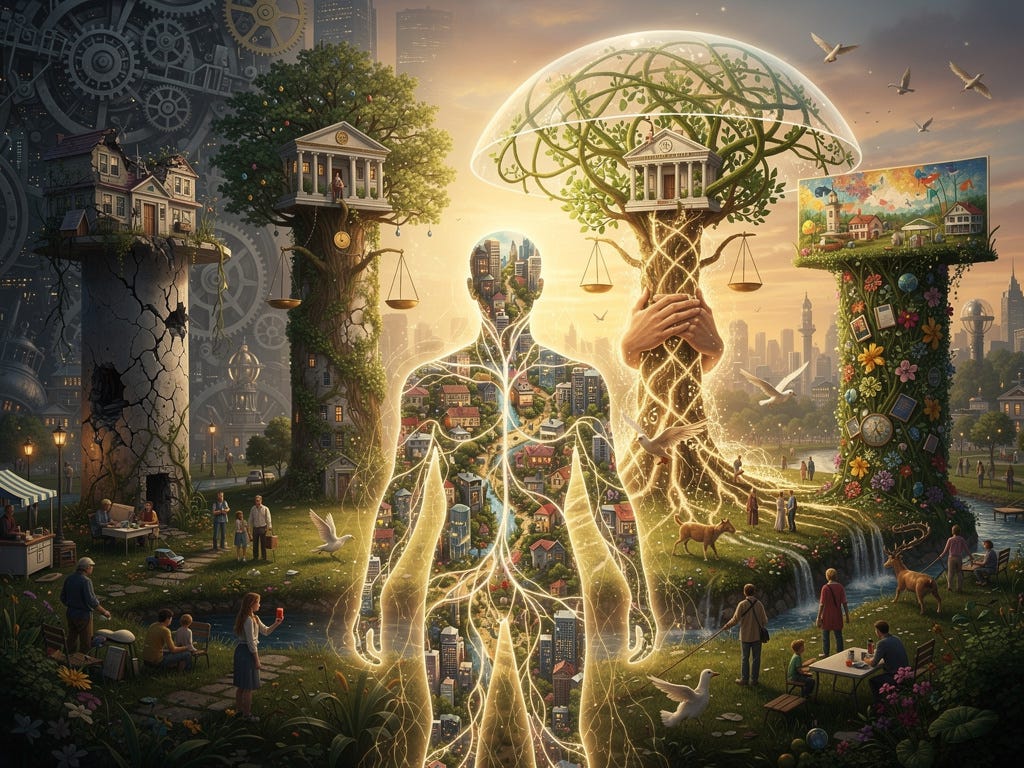
A civilisation is not a machine with replaceable parts. It’s closer to a living body — or better still, an ecosystem — in which certain conditions must all be present simultaneously for the whole to thrive. Remove any one and the system begins to compensate, to degrade, to fail.
There’s a question that sits beneath almost all others — beneath the arguments about governance and economics, beneath the debates about technology and education, beneath the urgent scramble to make sense of a world coming apart at its seams. The question is this: what are the conditions without which a healthy, peaceful, and generative human civilisation cannot exist, least of all evolve into higher levels of consciousness?
Not policies you will note. Not systems. Not ideologies. Conditions. The deep substrate. The non-negotiables.
I want to try and name them — not as a checklist, but as a constellation. Each one is distinct. Each one is necessary. None is sufficient alone. And they relate to one another the way organs relate in a living body: remove any one and the whole begins to fail, though not always immediately, and not always visibly.
Trust
Every serious attempt to understand civilisational health arrives, eventually, at trust. As it must. It’s the binding medium — the substance in which everything else either coheres or dissolves. Without trust, transactions become extractions. Without trust, institutions become fortresses. Without trust, strangers become threats.
But trust is not a feeling. It’s a structural condition — something that either exists in the architecture of relationships and institutions, or does not. It can be built, deliberately, over generations. It can be destroyed in a moment of betrayal, of exposure, of incoherence between what was promised and what was delivered.
Trust, in this civilisational sense, has at least five registers:
Ontological trust — the pre-conscious confidence that the world is sufficiently stable and coherent to act within; that the regularities we have built our lives upon will persist; that existence itself is not arbitrary.
Interpersonal trust — the basic confidence that the person beside me will not deceive or harm me.
Institutional trust — confidence that the systems designed to serve the common good actually do so.
Epistemic trust — shared confidence that there is a reality we can orient ourselves toward together, and that some sources of knowledge are more reliable than others.
Temporal trust — the confidence that commitments made today will be honoured tomorrow, and that the future has not been mortgaged to serve the present.
Each of these registers is under extraordinary strain right now. Which is why trust, though foundational, cannot stand alone.
Truthfulness
Beneath trust lies something more elemental still: a shared commitment to truthfulness — to orienting oneself and one’s community toward reality as it actually is, rather than as one wishes it to be, or as it’s ssometimes useful to claim.
Truthfulness is not the same as truth. We can’t always know the truth. But truthfulness is a practice — an orientation, a discipline — it distinguishes between the genuine effort to understand and the strategic deployment of narrative in the service of power.
The civilisational crisis of our moment is, at its root, an epistemic one: the systematic erosion of shared ground, the weaponisation of uncertainty, the industrialisation of deception. When truthfulness collapses, everything that depends on it — trust, accountability, the possibility of collective action — collapses with it. You cannot navigate together if you can’t even agree that there’s a territory to navigate.
Humility
The companion to truthfulness is humility — the recognition that one’s knowledge is always partial, one’s culture not the measure of all things, one’s certainties always provisional. This is not a counsel of relativism. It is an epistemological fact about the human condition.
Civilisations fail, with remarkable consistency, not from ignorance but from the refusal to acknowledge ignorance — from the conviction that the current model is complete, that the current arrangement is natural, that there’s nothing important left to learn. Humility is the cognitive condition for adaptation, for learning from encounter with what is genuinely other, for the kind of course correction that complex systems require.
It’s also a precondition for genuine dialogue — which is, in turn, one of the very few mechanisms we have for transcending the limitations of any single perspective.
Accountability
Trust requires something to make it rational rather than just sentimental: the knowledge that broken commitments carry consequences. This is accountability — the principle that those who make decisions must bear responsibility for their outcomes, and that the gap between promise and performance cannot indefinitely be papered over with rhetoric.
Accountability is what makes trust durable at scale. Personal trust between individuals can rest on character, on intimacy, or on long mutual observation. But institutional trust — the kind that holds a civilisation together — requires structural accountability. Systems in which power cannot be questioned, mistakes cannot be acknowledged, and failure carries no cost are systems that will corrode, slowly and then catastrophically.
The crisis of accountability in contemporary institutions — the extraordinary impunity with which governments, corporations, and their agents operate — is no accident. It’s a design feature of a world organised around the protection of existing advantage. Restoring it is not a technical problem. It’s a political one, which means it is ultimately a civilisational one.
Reciprocity
There’s a distinction that matters enormously and is almost never made clearly: the distinction between exchange and reciprocity. Exchange is transactional — I give you this, you give me that, the ledger balances, we part. Reciprocity is something deeper — the recognition that we are constituted by our relationships, that what one takes from a web of connection must be returned in some form, that the logic of living systems is not extraction but cycling.
Reciprocity in this sense is the civilisational expression of ecology. It is how healthy communities, ecosystems, and cultures actually function — not through the zero-sum logic of competition but through the syntrophic logic of mutual nourishment. It is what disappears when industrial economism reduces every relationship to a transaction.
The failure of reciprocity — between nations, between classes, between generations, between the human species and the living systems that sustain it — is one of the deepest sources of the disorder we are now living through.
Guardianship
Guardianship (or care) is not sentimentality. In the civilisational sense I mean here, it’s the genuine orientation toward the wellbeing of others — including those not yet born, including those not of one’s own kind, including those with no power to compel consideration. It is the opposite of indifference, and it’s the quality without which all the other tenets become performances rather than practices.
Accountability without guardianship is punitive. Reciprocity without guardianship becomes calculation. Even truthfulness, stripped of guardianship, can be wielded as a weapon.
Guardianship as caring is what keeps a civilisation from becoming simply a system for the optimisation of advantage. It is, if you like, the ethical dimension of love — not the romantic variety but the ancient sense of agape: the basic recognition of the other as mattering, as having a claim on one’s attention and one’s action.
Coherence
Of all these tenets, coherence is the one whose violation is most insidious — because it erodes trust slowly, without announcing itself, until the accumulated incoherence becomes impossible to ignore.
Coherence means alignment: between what is said and what is meant, between what is meant and what is done, between the values an institution professes and the decisions it makes. It is integrity made structural — not just a personal virtue but an organisational and civilisational discipline.
The slow fragmentation of this alignment — in governments that speak of democracy while engineering its erosion, in corporations that speak of sustainability while deepening extraction, in institutions that speak of justice while reproducing injustice — is perhaps the defining feature of the current moment. When people say they no longer believe in anything, what they’re usually describing is the exhaustion of having watched coherence fail too many times.
Justice
Justice is the condition under which people can trust that systems will treat them fairly — that their claims will be heard, their grievances addressed, their dignity respected regardless of their power or position. Without it, the social contract is not simply strained; it is fraudulent.
This is both procedural and distributive. Procedural justice asks: are the rules applied consistently? Is there meaningful recourse? Do those in power face the same standards as the powerless? Distributive justice asks: are the fruits of collective life shared in ways that don’t permanently concentrate advantage and foreclose possibility for those who begin with less?
Neither question has a simple answer. But the refusal to ask them — the insistence that existing arrangements are simply natural, or that any attempt to interrogate them is destabilising — is itself a form of injustice. And ultimately a form of civilisational risk.
Regeneration
My final tenet is perhaps the one that distinguishes a genuinely evolved civilisation from merely a sophisticated one. Regeneration is the commitment to make to the future; leaving conditions better rather than worse — not as an aspiration but as a structural discipline.
It applies across time: to future generations who will inherit what we build or destroy. It applies across species: to the living systems without which human civilisation is not possible. And it applies across scale: from the soil to the atmosphere, from the local watershed to the global commons.
This is where the concept of ecority — the synthesis of ecology and security, delivered with integrity — does its most important work. The question it poses is not merely “does this system function?” but “does this system renew the conditions for its own functioning?” Extraction is always efficient in the short term. Regeneration is the only strategy that works across time.
A civilisation organised around regeneration looks fundamentally different from the one we have built. It accounts for what it consumes. It invests in the renewal of what it depends upon. It understands that the economy is a wholly owned subsidiary of the ecology — not the other way around.
The Constellation, Not the Hierarchy
These eight tenets — trust, truthfulness, humility, accountability, reciprocity, guardianship, coherence, and regenerativion — do not form a hierarchy. None can be reduced to another. None can substitute for another. Remove any one and the whole is compromised, though the failure may take time to manifest.
They also cannot be realised individually. A person can practise all of them and still inhabit institutions that systematically undermine them. The work of civilisational renewal is therefore not primarily a work of individual virtue — though that matters — but of institutional design, cultural shift, and the patient reconstruction of the conditions under which these tenets can actually take root.
What’s most striking, looking across this constellation, is how thoroughly the dominant organising logic of the past two centuries — the paradigm of industrial economism, with its reduction of all value to market value and all relationship to transaction — has worked against almost every one of them. Not incidentally. Structurally.
Which means the question of civilisational renewal is ultimately the question of what we put in its place. Not a better version of the same logic. Something genuinely different.
That’s the conversation we need to be having. And we are, finally, beginning to have it.