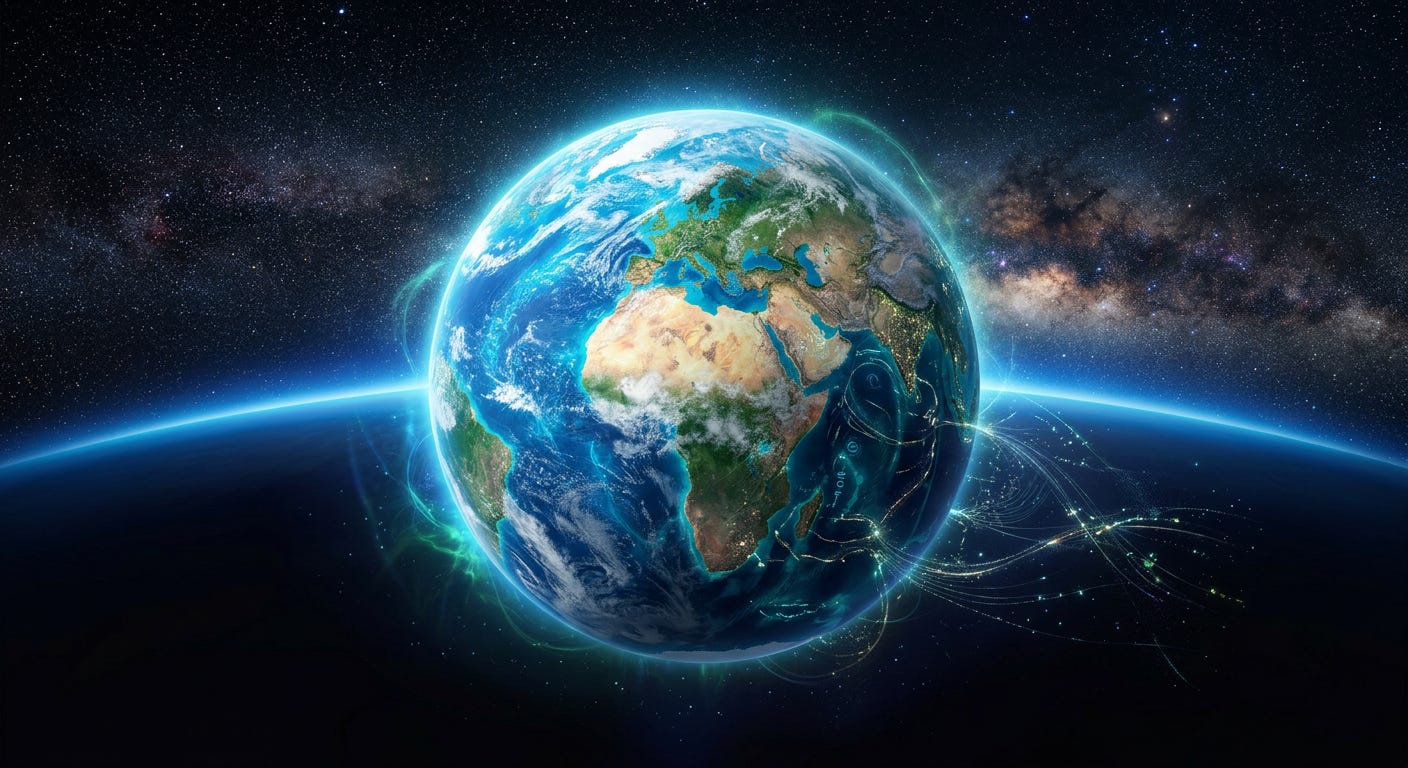
There are moments when a handful of simple observations can dismantle an entire civilisation’s illusion of superiority.
Just think about what we know. We inhabit a planet where trees communicate through vast underground fungal networks, warning one another of drought, disease, and predators. Octopuses appear to dream—their sleeping bodies shimmering through impossible colours as if rehearsing alternate realities. Elephants have been observed returning, even years later, to the bones of their dead, pausing in a silence that feels indistinguishable from grief. Bees dance directions into existence. Crows remember human faces and somehow pass those memories to their offspring. Ants construct cities whose engineering would shame many human settlements. The low-frequency purr of a cat seems capable of stimulating the healing of damaged bone. And when wildfires have reduced forests to ash, the earth’s first instinct is to flower.
This is the ordinary miracle of life. Yet the truly astonishing fact is not that these phenomena exist, but that despite living among them, we continue to imagine ourselves as somehow separate from them. For three centuries, Western civilisation has pursued a story that elevates humanity above nature. We have celebrated intelligence while equating it almost exclusively with calculation. We have worshipped competition while overlooking cooperation. We have measured success by accumulation, growth, and extraction – as though the purpose of existence were to consume rather than to participate.
Nature tells a very different story. A forest is not simply a collection of trees competing for sunlight; increasingly, ecology reveals it as a community exchanging nutrients, information, and resilience. Mycorrhizal fungi bind individual organisms into living systems of astonishing complexity. Older trees appear to nurture younger saplings. Species once thought to be competitors frequently sustain one another. Life flourishes through relationship.
This interdependence should not surprise us. The human body itself is less an individual than an ecosystem: we carry more microbial cells than human cells. Every breath we take depends on forests we have never seen; every heartbeat is synchronised with oceans, the atmosphere, bacteria, and sunlight. The illusion of separateness is precisely that—an illusion.
And yet, our civilisation has systematically institutionalised separation. Economics became divorced from ecology. Politics distanced itself from ethics. Education fragmented knowledge into isolated disciplines. Medicine split the body from the mind. Religion placed humanity above the rest of creation. Even our tools increasingly separate us from direct experience. Each of these separations promised efficiency. Each also exacted a cost. We now inhabit a world of unprecedented connectivity and profound disconnection. Perhaps that’s why so many people experience a strange homesickness without knowing where home actually is.
The indigenous peoples of virtually every continent understood something that modernity forgot: to them, land was never simply “land” – it was kin. Mountains could be ancestors, rivers had their own agency, animals were teachers, and forests were libraries. The boundary between human and more-than-human was permeable, negotiated each day through ritual, careful observation, and gratitude. Tragically, such traditions were dismissed as primitive because industrial civilisation mistook technological sophistication for wisdom. History may yet conclude the opposite.
Artificial intelligence now threatens to become the latest expression of humanity’s oldest mistake. We rush to build machines that might exceed human cognition, all while remaining uncertain of what intelligence actually is. If intelligence is defined merely as computational speed and data processing, then machines will inevitably surpass us. But if intelligence also includes empathy, reciprocity, restraint, beauty, playfulness, intuition, ecological awareness, and the capacity to sustain life, then forests, whales, and fungi may already possess forms of mind that our algorithms can barely begin to comprehend. The real danger isn’t that machines become more like humans; it’s that humans become more like machines: predictable, optimised, efficient, disconnected—unable to listen, unable to wonder, unable to belong.
All our current crises—climate disruption, biodiversity collapse, political polarisation, economic inequality, and technological alienation—appear unrelated only because we insist on analysing them separately. In truth, they are symptoms of a single, underlying pathology: the belief that we exist outside the living systems that created us.
A civilisation organised around extraction inevitably ends up extracting from everything without question – from forests, from oceans, from labour, from children, from attention, from culture. Eventually, it even begins extracting meaning itself. The result is prosperity without fulfilment, information without wisdom, and progress without direction.
Nature offers another template. No forest produces waste; no coral reef convenes quarterly earnings meetings; no wolf pack pursues infinite growth. Every mature ecosystem eventually discovers balance rather than endless expansion. Perhaps that is evolution’s deepest lesson: maturity means learning when enough is enough.
Even catastrophe follows different rules in nature. A wildfire may appear to destroy everything, yet many Australian plants require fire before their seeds will germinate. The ash becomes nourishment, dormant possibilities awaken, and flowers emerge precisely because destruction has occurred. Nature rarely lets suffering go to waste. Human societies, by contrast, often do. We transform crisis into blame instead of learning from it. We cling to obsolete systems simply because familiarity feels safer than transformation. We even confuse resilience with resistance. True resilience belongs not to what refuses change, but to what adapts without losing its essential identity. And that’s as true for individuals as it is for civilisations.
The seminal questions confronting humanity are, therefore, neither technological nor economic – they are deeply philosophical. Can we remember that we belong to life rather than imagining life belongs to us? Can we recover reverence without abandoning reason? Can we cultivate an intelligence that measures success by the flourishing of the whole rather than the enrichment of a few? Can we redesign our institutions around reciprocity instead of perpetual extraction? These are existential questions that need answers.
The remarkable creatures with whom we share this planet are not just curiosities decorating a nature documentary narrated by David Attenborough. They are participants in an ancient conversation that has unfolded over nearly four billion years. Just think about that. Every species embodies solutions refined through countless generations of experimentation. Every ecosystem is a repository of living wisdom. The tragedy is not merely that we’re destroying them; it’s that we are silencing teachers before we have learned their lessons.
Perhaps future historians—if there are any—will not define our age by artificial intelligence, quantum computing, or space exploration. Perhaps instead they will say that this was the era when one species briefly imagined itself to be the author of life, rather than just one sentence in life’s ever-unfolding story. Yet fortunately, stories can be rewritten.
Every time a child kneelearntatch an ant carry fifty times its own weight, or someone plants a tree whose shade they will never sit beneath, the story is being rewritten. Every time we choose cooperation over conquest, regeneration over extraction, and curiosity over certainty, we step back into alignment with life’s deeper narrative. In these small moments, the Earth’s original invitation—one it has extended since the first cell divided in an ancient sea—can still be heard. That invitation is simple: to belong. Not above, not beyond, not apart from the rest of creation—simply to belong.
And perhaps that, more than anything else, is what it means to become fully human.