Every population that outruns its resource base contracts. Foxes do it, algae do it. In 1963-64, reindeer stranded on St Matthew Island did it in a single brutal winter. Bloom, breach, dieback. This is not a moral failing. The formula is played out through hunger and death. William Catton saw this most clearly of anyone writing on the human case: he coined “overshoot” not as a metaphor but as ecology, insisting that Homo sapiens obeys the same carrying-capacity logic as any other organism, however elaborate the stories we tell ourselves about our own exemption. Overshoot is not a uniquely human pathology. It’s one of the oldest patterns the ecosphere knows, older than cognition, older than culture, older than the first tool struck from flint.
But a distinction has to be made, and collapse narratives routinely fail to make it. The species is not the civilisation. Homo sapiens overshooting and surviving in reduced, altered form would place us alongside almost every other organism that has ever tested the outer edge of its niche. What may be genuinely exceptional — not biologically, but historically — is what’s currently responsible for doing the overshooting: a six-thousand-year-old, now fossil-fuelled, single-species social formation with no precedent in the geological record. Joseph Tainter’s account of why complex societies fail is instructive here and rarely applied at the scale it deserves: complexity itself becomes a burden once the marginal return on each additional layer of bureaucracy, infrastructure and specialisation turns negative, and societies simplify — sometimes gently, more often catastrophically — because the cost of maintaining complexity has outrun what the underlying resource base can fund.
This is not evolution’s own pattern, whatever the popular shorthand assumes. Natural selection doesn’t select for complexity as such; it selects for fitness in a given environment, and simplification is as much an evolutionary outcome as elaboration ever is — the blind cave fish, the parasite that sheds an organ system once a host does the work for it, entire bacterial lineages that have stayed elegantly simple for billions of years and outlasted almost everything more elaborate. What differs is how each kind of complexity gets tested. Biological complexity runs against fitness continuously, pruned by extinction across a trillion parallel experiments with no attachment to any particular result, and it’s cheap to abandon the moment it stops paying its way. Civilisational complexity accretes instead through institutional investment, sunk cost and elite self-protection, and it resists being pruned long after it has stopped paying its way, because the people administering the bureaucracy have every incentive to defend it regardless of what it is costing everyone downstream. The ecosphere prunes. Civilisations, at least past a certain point, find it impossible to prune themselves.
Techno-industrial civilisation is not an ecosystem. It has none of the ecosphere’s billions of years of distributed resilience, none of its redundancy, none of its capacity to detour around damage. It’s closer to a single vast organism, wired for growth, with no built-in mechanism for stopping and, by Tainter’s logic, already deep into the zone of diminishing returns on its own complexity. While that formation can fail completely, the species carrying it doesn’t have to fail with it.
And this is where the question of human exceptionalism has to be handled carefully, because both the believers and the debunkers are partly right and mostly talking past each other. The idea that humanity stands categorically apart from nature — exempt from thermodynamics, exempt from carrying capacity, and entitled to a permanent exception to the laws every other species obeys — is a delusion, and a dangerous one. It is precisely the delusion underwriting industrial economism’s promise of infinite growth on a finite membrane of soil, water and air. Yet something did change with us, and pretending otherwise is its own kind of deceit. No other species has rewritten its environment at a planetary scale or developed symbolic culture capable of transmitting knowledge across millennia. No other species has produced the axial sages, the Enlightenment’s rupture with inherited religious authority, the long emancipatory arc that ended chattel slavery in law if not yet in practice, or the art, architecture, poetry, music, dance and drama that every culture in every century has felt compelled to make even at the point of starvation. A cognitive architecture built for foraging bands of a few dozen kin did, somehow, produce all of that.
So the evolutionary-mismatch argument — that our brains are running civilisation on the wrong software and that this constitutes structural dysfunction beyond correction — simply cannot be the whole account. It explains a great deal about why large societies default to hierarchy, short-termism and tribal reflex under stress. It explains nothing about the axial breakthroughs, the moral imagination that ended slavery, or a species that keeps crafting beauty precisely when artistry offers no survival advantage whatsoever. The truth holds both of these facts without collapsing one into the other: we are creatures of small-group cognition who have, on occasion and against the grain of that cognition, transcended it. Exceptional, then — but not exempt from the laws of physics. That’s the distinction human exceptionalism as an ideology refuses to draw.
The numbers make the stakes concrete rather than abstract. Humanity’s ecological footprint now runs some 78 per cent beyond the planet’s regenerative capacity. A genuinely sustainable global economy, delivered at today’s average material standard, could support roughly 2.5 billion people. We are 8.3 billion and rising. This is not a gap that redistribution closes. Economists like Thomas Piketty and Olivier de Schutter are writing serious, humane economics for a world that used to exist — a world in which the central problem was the unjust division of a growing pie. Reallocating who eats what, and taxing the overfed to feed the underfed, may honour a real commitment to social justice. It does absolutely nothing whatsoever to shrink the aggregate throughput of energy and material that the ecosphere is now straining to absorb. William Rees names the very thing they will not name: overshoot at this scale is not a policy failure awaiting correction through better distribution. It’s a terminal condition of the current civilisational form, and the roughly 45 per cent reduction in throughput required to salvage a functioning ecosphere can’t be delivered by justice alone. It requires sufficiency — which is precisely the ground on which the philosophy of ecority stands and precisely the ground most economists, however well-intentioned, decline to walk on.
There’s a second failure hiding inside the first, one that belongs alongside the throughput issue rather than beneath it. Redistribution debates presuppose a “we” capable of deciding together what “enough” looks like and enforcing it collectively. But a species fragmenting into algorithmically sorted digital tribes, each certain of its own virtue and increasingly unable to recognise a shared stake in anything, is not a species positioned to agree on limits. The absence of a “we” is not a side issue to the overshoot crisis. It is close to the central mechanism preventing any response proportionate to the scale of what’s unfolding.
Extreme hierarchy compounds this failure rather than merely accompanying it. Nearly every prior civilisational collapse was preceded by a widening gulf between those who made decisions and those who bore the consequences of those decisions. The question of who is allowed to eat, who is allowed to extract, or who is permitted to externalise cost onto the living world is never separable from the question of who holds power over the decision-making process.
And now a third accelerant, barely visible a generation ago, has reared its uncaring head. Artificial intelligence, deployed almost entirely in service of the same industrial economism that produced the overshoot, optimises extraction and consumption at a velocity no previous civilisation could match, teaching silicon to calculate everything and to feel nothing. A civilisation without a “we”, governed by an ever more concentrated few, now amplified by machines indifferent to the ecosphere’s limits, is not a minor footnote to the overshoot story. It may be the mechanism by which overshoot converts from a survivable correction into something closer to catastrophe.
And yet, the ecosphere itself offers a different lesson than the one collapse narratives usually draw from it. It is not static even in what ecologists call a ‘steady state’. It is constantly restructuring and reshaping, evolving toward greater diversity, complexity and resilience, even as individual species and even entire assemblages fall away. Seen from this vantage, the human project looks less like a partner in that unfolding and more like something that has attached itself to it — extracting, redirecting, and converting living systems into inputs for its own expansion, giving back astonishingly little in return. It resembles a parasitically hostile takeover of the ecosphere by one of its own former constituents, now behaving as though it were external to the living order that made it.
Parasitism, though, is not the only relationship available to an organism embedded in a larger system, and this is where the question turns from diagnosis toward design. Mutualism is the alternative on the table — each party better off for the other’s presence, rather than one flourishing at the other’s expense. What would a mutualist mode of the human enterprise actually look like? And does the ecosphere have any vote in which mode follows the current one?
On the second question: yes, decisively. A system drawn down past its capacity for regeneration will simply stop supplying what the extraction depends on, regardless of what any human institution decides. The ecosphere’s vote is cast in yields, in aquifers, in soil, and in the migratory patterns disappearing from around us. It’s cast on the insects — the base of nearly every terrestrial food web — vanishing from places that held them in abundance only a generation ago.
On the first question? This is the terrain ecority was developed to occupy: not the management of ecosystems from the outside, as though stewardship were only a gentler form of dominion, but a life lived fully from the inside — materially simpler, smaller in aggregate demand, organised around the obligation to one another, to those not yet born, and to the living systems all obligations ultimately rest on, rather than on relentlessly perpetual growth. Syntrophic wellbeing replaces extractive wellbeing. A sufficiency economy stands where industrial economism once stood — a predatory monster that mistakes more for better in every instance, everywhere, permanently.
None of this requires civilisation, in its current form, to survive the century. It may be more honest to expect that it will not. But civilisation collapsing and humanity disappearing are two entirely different propositions, routinely and lazily conflated by writers who should know better. The caterpillar’s structure dissolves almost completely before the imaginal cells — present all along, dormant, concealed from the organism they will eventually replace — begin organising the wholly different structure that emerges from the cellular soup.
Something functionally similar may be underway now, if we let it: not a managed transition engineered by those institutions and individuals currently in charge, many of whom have every incentive to protect the architecture from failing us, but a slower regeneration carried by those already living the ternary’s ethos in practice, already treating “enough” as a sufficient and honourable measure of a good life. The gravity of ghosts—inherited assumptions about growth, progress, and human primacy—will keep pulling toward the old form for a long while yet, past the point where the pull no longer serves anyone. That gravity always weakens eventually. Indeed, it’s weakening now.
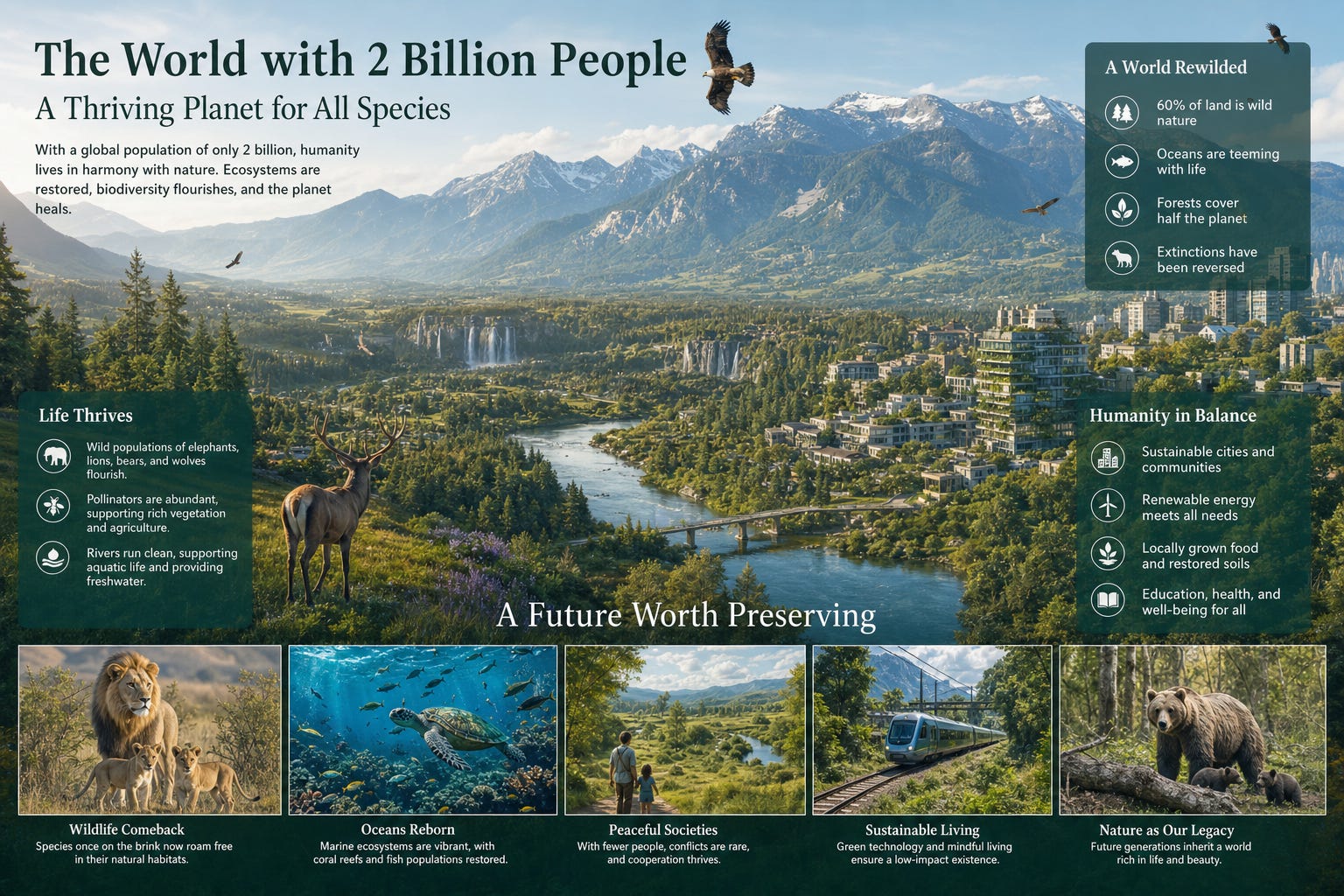
My own reckoning sits close to those of Rees and Lovelock, though not identical: a global population narrowing toward two billion by the end of this century, driven less by any single catastrophe than by the compounding weight of famine, reduced fertility, resource wars, climate change migration, and the slow failure of systems designed to fail exactly this way. Rees measured the overshoot with a footprint. Lovelock, in his bleaker years, priced the correction at a billion or fewer. None of us are prophesying from outside the pattern — we are reading the same arithmetic through different instruments and arriving at kindred numbers. A contracted population marks a threshold rather than a verdict, and thresholds are where transformation gathers quietly, long before anyone can see it. Two billion people, embedded rather than extracting and bound by obligation to one another, to those not yet born, and to the living systems that carried us this far, could do more for the ecosphere’s recovery in a generation than eight billion ever managed under the old paradigm. That’s the arithmetic of mutualism, waiting on the far side of the contraction we can already see on the horizon.
What follows the present civilisational form, if this account is right, is not a repaired version of industrial economism with the demand curve bent a little further toward justice. It’s a different relationship to the living systems from which we evolved and have spent six thousand years treating as an inert backdrop rather than kin. Smaller. Slower. Embedded rather than extractive.
The ecosphere is not waiting for our permission. Judging from current events, like the heatwave in Europe and uncertainties about the state of the AMOC, it is not especially patient. Enough of us will either learn to live within the principles of ecority in time, or the lesson will arrive anyway, taught the way it has always been taught — through contraction, through loss, through consequence.