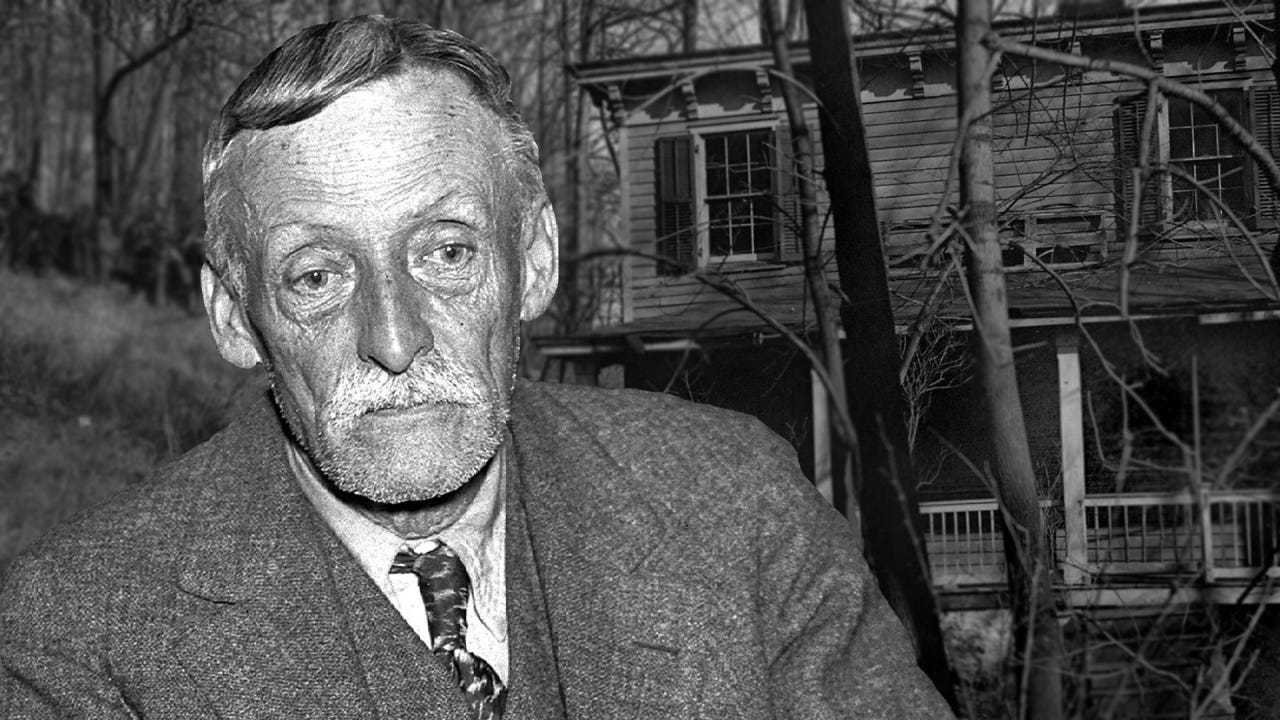
Albert Fish was born in Washington, D.C. in 1870 and executed at Sing Sing prison in New York in 1936. During the intervening years he worked in menial jobs, lived on the margins, raped and killed children, mutilated himself, and wrote letters to the families of his victims that are almost unbearable to read. His father died when he was very young. His mother and close relatives had psychiatric disturbances that, by today’s standards, would almost certainly demand clinical attention. Fish spent part of his childhood in institutions where beatings, sexual assault, and humiliation appear to have been routine. Later, he would prey on children who were poor, Black, or disabled because they were “easier” to abduct in a social order that treated them as less visible, less valued. At his trial, the jury accepted he was insane and still decided he should die. His final recorded words were: “I don’t know why I’m here.”
Most accounts freeze at this point. They present Fish, the Vampire of Brooklyn, as an aberration, a spectacularly depraved anomaly. That’s comforting. It isolates him in a category entirely apart from the rest of us, as though he dropped from some extra-human dimension of horror. But to do that is to miss what matters. I am less interested in Fish as a specimen of pathology than as a mirror held up to the brutality of our civilisation. What kind of world produces a man like this, fails to see him for most of his life, then kills him and moves on as though the matter is closed? What conception of progress, justice, sanity and morality is exposed when we look at Fish not simply as “monster” but as a product of a particular configuration of beliefs, institutions and blind spots?
A man almost nobody wanted to see
Fish’s childhood was not just unfortunate; it was emblematic of a pattern that recurs again and again in the biographies of extreme offenders: early abandonment, violent or erratic parenting, institutionalisation in places designed more for containment than for care, and social invisibility. It would be wrong, and factually misleading, to say that abuse “turns” people into killers in any linear way; most abused children don’t become abusers or murderers. But it’s difficult to find the reverse: individuals like Fish without a history of severe, prolonged violation.
Why are such histories almost background noise in our public conversation? We have known for decades, across health systems, criminal justice systems, and social work agencies, that adverse childhood events have traumatic impacts on adult behaviour, including the likelihood of violence. This has been documented in settings as varied as North America, East Asia and sub-Saharan Africa. And yet, as a species, we still treat the early years of life as a kind of private experiment conducted by families and improvised institutions, only occasionally supervised by the state or community, and barely resourced compared with our investments in policing, incarceration and war.
As a child, Fish cycled through workhouses whose operating logic was to discipline the poor and unwanted through labour and pain. We have updated the furniture and the language, but the underlying mindset lingers: those who don’t fit the economic machine, or who are inconvenient to families and authorities, are often warehoused out of sight. Whether we call the establishments orphanages, detention centres, refugee camps, psychiatric hospitals, hostels, shelters or “special schools” is secondary. Once people are sealed away, the rest of us are able to avert our gaze and tell ourselves that “someone” is looking after them.
What kind of system breeds a “Gray Man”?
Witnesses called him “The Gray Man” because everything about him seemed drained of colour, as though life had passed through him without leaving any warmth. That image is important. Fish was not a charismatic villain. He was shabby, forgettable, the sort of figure one passes in any city and immediately forgets. That is precisely the problem.
Predators flourish against the backdrop of personal pathology but also inside systems that render certain categories of people unimportant. Fish admitted that he targeted Black and disabled kids because, in his judgement, they were less likely to be missed, and far less likely to provoke a thorough investigation. Was he wrong? Across different cultures and eras, from plantation economies to modern slums, the poorest and least powerful vanish with minimal concern. Their absence rarely shakes governments or markets.
To focus purely on Fish’s psychology is to pretend that he somehow created his hunting ground by sheer force of will. In reality he occupied a niche within a larger ecology. That ecology is structured by worldviews: tacit agreements about who matters, how suffering is allocated, what counts as “normal” and what is conveniently ignored. In an imperial-industrial worldview, humans are routinely ranked by race, class, productivity, conformity, and proximity to power. Those at the bottom of such hierarchies are not just exploited economically; they are treated as expendable.
From caste orders in South Asia to the Taliban’s religio‑militarised patriarchy, and authoritarian regimes that classify dissenters as less than human, many systems sanctify male control and treat women and children as expendable infrastructure. The labels change—untouchable, illegal, insane, deviant, enemy, surplus population—but the function is unwavering: to create a category of person to whom almost anything can be done with impunity. Fish sensed this, consciously or not, and moved within it.
How worldviews manufacture disposable humans
A worldview is not just a set of ideas inside individual skulls. It manifests in concrete arrangements—laws, bureaucracies, schools, workplaces, media, prisons, churches, mosques, temples. It shapes where we place our institutions, who controls them, how we fund them, and whom we train to work in them. Over time, these arrangements develop their own inertia. People born into them rarely question their basic legitimacy.
The workhouses of Fish’s childhood were built on a belief that poverty and deviance are moral failings to be corrected through hardship and shame. The asylums where his relatives were confined sprang from an alliance between medical authority and a social order that framed any kind of mental psychosis as something to be kept apart from the rest of us. The segregated neighbourhoods where he found his victims were the material expression of racial hierarchies rationalised as “natural” or “necessary”.
Many societies have deployed comparable complexes of belief and structure. What changes is the terminology and the self-justification. What doesn’t change is the production of disposability. If a child is born into a caste deemed impure, into an undocumented family on the margins of a metropolis, into a war zone where bodies are daily shredded by explosives, or into a village where sexual abuse is silenced in the name of honour, their vulnerability is not random. It’s shaped by inherited thought-forms that make some lives collateral.
Albert Fish lived inside such a structure. But more to the point, he became one of its products. If we imagine that he was simply “born evil”, we absolve the network of expectations, rituals, omissions and institutions that formed the contours of his world from any accountability. If we move to the other extreme and imagine that he was only a victim of these forces and lacked any agency, we dissolve the reality of his choices and the suffering he inflicted. Both positions are far too convenient.
Mental illness, evil, and the collapse of our binaries
At his trial, the jury decided Fish was insane and yet still chose to execute him. That verdict seems to be contradictory: if he lacked sanity, on what basis could he be held fully responsible for his actions? But I suspect it captured, in a crude way, a deeper discomfort. People who inhabit such extremes of cruelty and self-destruction don’t fit comfortably in our neat categories. Was he mad? Was he evil? Was he a damaged child who never found a way to be anything else? Was he a conscious sadist? The record implies he was all of these at once.
We prefer our moral universe to be partitioned. On one side: the mentally ill, who are presumed not fully in control of their actions and therefore deserving of treatment. On the other: the wicked, who are presumed free to choose between right and wrong and therefore fit for punishment. Fish fractures this simple arrangement. He mutilated himself, wept in interviews over his own behaviour, heard voices, experienced religious delusions, and yet planned abductions, manipulated children, and taunted grieving parents.
Why does this matter beyond one historical case? Because our entire vocabulary around crime, justice and mental health rests on assumptions about agency and responsibility that are increasingly threadbare. Neuroscience, trauma studies and cross-cultural psychology all point to complex interactions between biology, experience and environment. Yet our courts and media still swing between two poles: either the “evil monster” or the “sick man”. Fish’s case made that oscillation explicit. We had to declare him irrational in order to maintain a sense of horror; we had to execute him in order to maintain a sense of control.
If we accepted that profound damage and profound responsibility can coexist in the same human being, would our institutions look different? Would we build systems that prevent such damage early, and systems that protect society without simply dumping people into cages—or onto execution gurneys—as though that settles the matter? Or would that level of complexity simply be too much for our present civilisation to admit?
The ecology of predation: who we allow to be hunted
Fish openly admitted that he chose Black children and disabled children because he believed society cared less about them. That statement should sear itself into our collective consciousness. He was not only exploiting individual vulnerabilities; he was exploiting a systemic gradient of value.
In every society I have studied, predators—whether sexual offenders, human traffickers, corrupt officials, or paramilitary groups—focus on those whom the dominant culture already discounts: children in institutions, migrant labourers, the poor, ethnic minorities, displaced people, women with no legal standing, the mentally sick, the chronically ill. These are not random victims; they are products of a hierarchy of merit.
This is where “worldview” and “world-system” meet the intimate body. It’s not an abstract relationship. When a girl in a village cannot read and has no legal recourse to escape a violent marriage, that is a worldview congealed into bone and bruises. When a homeless boy vanishes from a city alley and nobody files a report, that is a worldview operating through the apathy of bystanders and the protocols of local police. When a child in a disability institution is abused repeatedly and staff “do not notice”, that is a worldview written into staffing levels, training manuals, resource allocation and shared myths about who deserves protection and who does not.
Fish was, in this sense, less an outlier and more a grotesque amplifier of patterns that exist everywhere, including today. The fact that he existed a century ago does not invalidate the lesson. In some countries, the institutions have changed labels. In others, they have multiplied.
Justice as theatre, punishment as distraction
The execution of Albert Fish was presented as justice done. A dangerous man was removed from society. A verse of retribution was spoken. The community breathed more easily. But what was actually resolved?
Killing Fish did almost nothing to address the institutional violence that shaped him, the conditions that allowed him to operate undetected, the social indifference that made certain children “easy” to abduct, or the absence of meaningful mental health frameworks. His victims remained dead. Their families remained broken. The workhouses remained open. The racial order remained intact. The punitive model of justice didn’t just remain, it expanded.
We should ask: to what extent is punishment in cases like this a profound reckoning, and to what extent is it theatre to reassure the majority that the system works, that evil is rare and contained, that we need not examine our complicity? Many legal systems worldwide—from liberal democracies to religious theocracies—rely on public or symbolic punishment to maintain legitimacy. That’s not new. What is new is our growing access to evidence about what actually reduces violence, what actually heals trauma, what actually prevents repetition.
Where states invest in early childhood, mental health support, community networks that detect and respond to abuse, and social norms that refuse to treat any group as disposable, rates of violent crime tend to decline over time. Where states treat prisons, solitary confinement, and executions as primary default mechanisms, the underlying drivers of harm remain intact.
Yet case after case—Fish’s included—shows that even when we know the precursors to catastrophic behaviour, we are drawn back to a simpler story: evil deeds, righteous punishment, closure. That story may be psychologically soothing. It is also, in human terms, disabling.
The futures we refuse to prevent
Albert Fish’s final reported words—“I don’t know why I’m here”—have been interpreted as banal, evasive, or ironic. But suppose we take them at face value. He was not questioning the presence of the electric chair beneath him. He was asking why a life like his had ever been allowed to exist in that form at all: a pipeline of pain from birth to death, devoid of love, almost devoid of redemption, threaded through with acts that revolted even him.
This issue is not about one degenerate man. It’s about us. Why do we allow conditions that predictably generate broken lives—some of which will erupt into spectacular horror—to persist decade after decade? Why do we spend so much intellectual and political energy debating how to punish or contain the “monsters” after the fact, and so little transforming the wombs and nurseries and schools and streets and institutions where such monsters are most likely to be formed?
As a futurist and strategist, I am interested less in moral outrage than in trajectory. What is the pattern? Can we change it? At what level must we intervene? If childhood trauma, institutional violence, systemic discrimination, economic precarity and untreated mental illness repeatedly show up in the biographies of those who commit severe violence, is it responsible for us to treat each case as a singular mystery? Or is that simply a refusal to evolve?
We live in a civilisation that spends trillions on sophisticated weapons, predictive financial algorithms, and surveillance technologies, yet claims it is “too complicated” or “too expensive” to guarantee basic safety, nurturing and dignity for children and marginalised adults. That is not an accident. It’s the logical extension of a worldview that prioritises competitive advantage, property, and abstract growth over the inner life of sentient beings. World-systems evolve from that worldview: global supply chains that devour communities, urban designs that isolate, care systems that collapse under cost-cutting, political narratives that scapegoat the weak. Mindsets are then shaped in turn: “it has always been this way”, “nothing can be done”, “monsters are just born”.
What would it take to declare such resignation obsolete?
Nobody can possibly guarantee that there will never be another Albert Fish. Human biology and culture interact in ways we don’t fully grasp and probably never will. But we do know enough to reduce the likelihood and the scale of such damage. We know that stable, loving, affection early in life reduces the risk of extreme antisocial behaviour. We know that communities where difference is not automatically translated into inferiority make predation harder. We know that institutions subject to genuine transparency and accountability abuse their wards less. We know that racialised and caste-based hierarchies create pools of people whom predators identify as expendable.
The point is not to sentimentalise offenders or to demand forgiveness from their victims. It is to shift our civilisation’s investment away from ceremonial violence—executions, mass incarceration, demonisation—and towards the unglamorous labour of redesigning the conditions under which minds and bodies develop. That’s not soft. It is hard, disciplined work. It will never make for sensational headlines. It will, however, change the statistical landscape in which the next potential “Gray Man” grows up.
Fish’s life, viewed from this angle, is not principally a horror story. It’s a systems diagram written in blood and trauma. It shows what happens when a worldview that treats large swathes of humanity as expendable is combined with institutions that punish rather than heal, and with mindsets that prefer mythologising monsters to confronting structures. If we absorb that lesson, his final cry—“I don’t know why I’m here”—can be turned back on ourselves: why are we here, as a civilisation, if not to stop manufacturing such lives?