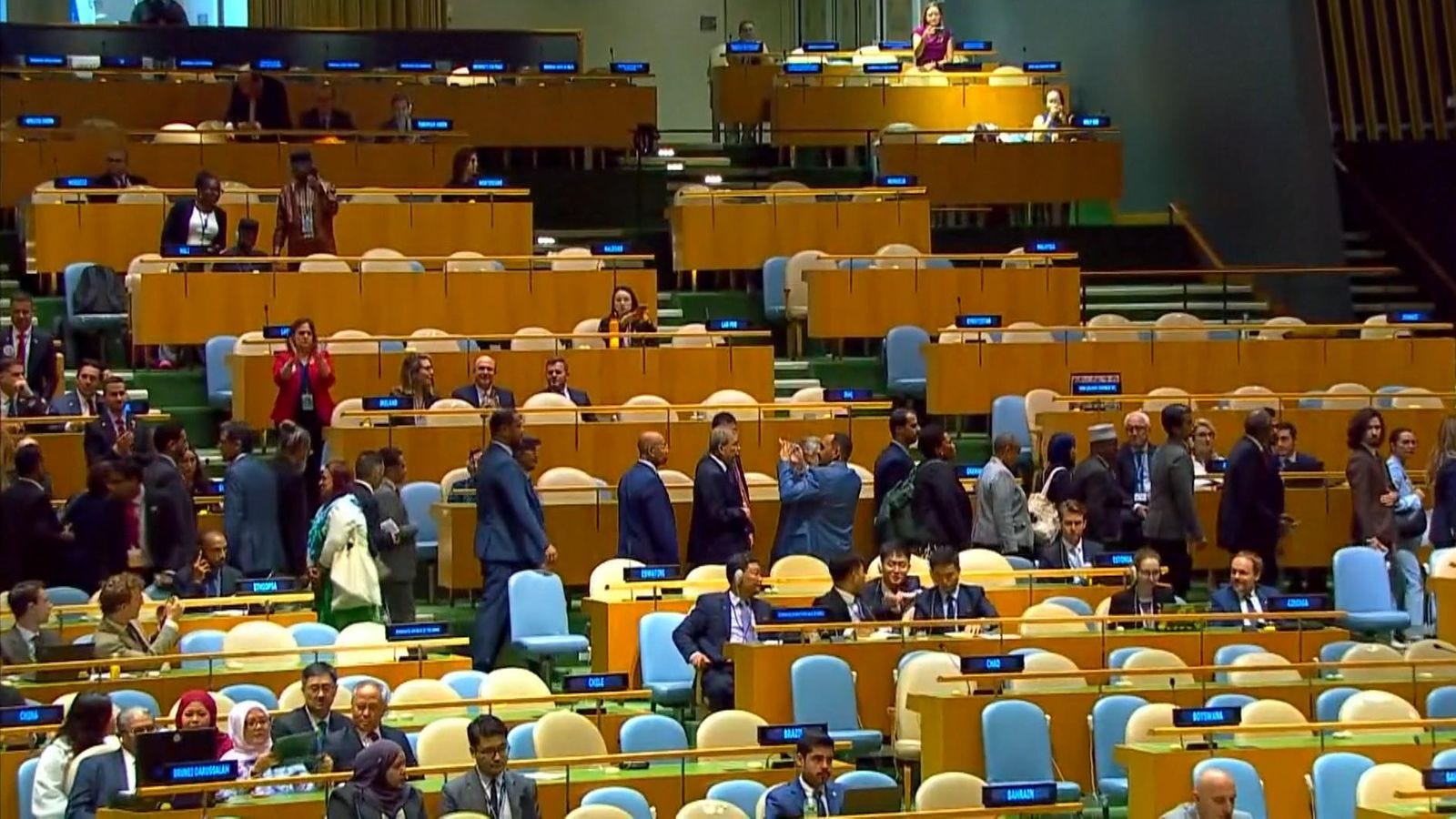
Synopsis: When dozens of delegations walked out on Netanyahu at the UN, he saw vindication, not rejection. This essay follows that reflex, turning criticism into confirmation, through strongmen and their enemies alike, through the media that rewards the performance, and finally to the audience enjoying the empty seats. Reality has no constituency. It waits, and the price of keeping it waiting falls on people who never stood at any podium.
The seats began to empty before he reached the podium. Dozens of delegations rose, gathered their papers and filed out of the General Assembly hall on 24 September, leaving nameplates and vacated chairs facing a speaker who had not yet said a word. A walkout need not signify defeat. Some leave because they disagree. Some because their point has already been made. Others because they no longer believe the person speaking is worth hearing.
But watch what happens when the strongman looks out at the vacated seats. He does not see rejection. He sees confirmation.
That is the peculiar psychology of contemporary power: opposition converted into proof of strength; isolation renamed independence; criticism taken as evidence that a nerve has been touched. Benjamin Netanyahu’s appearance offered an almost theatrical demonstration. He greeted the departures by inviting any moral cowards still in their seats to follow the others out — to applause from those who stayed — then defended Israel’s conduct and its war against Iran, hailed Donald Trump as the finest partner Israel has ever had, and insisted that Israel had been protecting the very nations whose envoys had just left.
It would be easy to file the scene under the interminable theatre of the Middle East. After all, his real audience was never in New York. It was at home, where a man fighting for his political future needs to be seen standing alone against the world. Standing alone is the point. And something older, and far more widespread, is at work in that posture.
Somewhere along the way the leader and the nation fuse. Criticism of one reads as an attack on the other. Opposition shades into disloyalty, compromise into weakness, and institutions harden into obstacles — sorted into those who recognise the leader’s truth and those supposedly too cowardly, corrupt or deluded to see it.
The leader gazes into the political world and finds himself reflected everywhere. He mistakes the mirror for the world — a world sealed by conviction and by hubris. Every piece of disconfirming evidence — a walkout, a court ruling, a lost vote — is metabolised into confirmation. A politics in which nothing can count against the leader has sealed itself off from the terrain it claims to govern.
The mirror obscures a plain distinction. Controlling the narrative is achievable. Controlling reality is, for any single person, close to impossible. A politician can dominate a press conference, a parliament, an election campaign, even the political imagination of millions. None of that confers sovereignty over consequence.
Reality has no constituency. It doesn’t require votes. It doesn’t hold rallies. It doesn’t post online. It doesn’t need to win an argument. It simply accumulates consequences until political language can no longer conceal them. Nor does it take sides. The illusion that tempts leaders at podiums tempts those who oppose them just as readily.
Hamas built a political theology on the proposition that sufficient will, ruthlessly enough applied, could undo Israel itself. The October 7 attacks were the purest expression of that fantasy — the belief that a single act of force could rewrite a structural condition. What followed was the devastation of Gaza, and a setback for the Palestinian cause whose full depth may take a generation to measure.
Tehran spent decades and fortunes constructing an “axis of resistance” on the premise that confrontation would yield regional dominance. It yielded sanctions, isolation and a network left badly weakened.
The mirror belongs to no single nation, faith or party. Any politics that promises its followers that willpower alone can abolish an adversary is selling the same product — and reality collects the same invoice.
The kinship between Trump and Netanyahu matters less because the two men are aligned than because they appear to read power in the same grammar: confrontation preferred to mediation, conflict made personal, criticism burned as fuel, the indispensable leader ringed by hostile institutions and ungrateful elites. Trump’s own address to the Assembly, two days earlier, displayed the same instincts — forceful assertion, swipes at the very institution he stood inside, American action cast as the decisive ingredient in every crisis.
The attraction is obvious. Complexity is draining. Ambiguity is expensive. Uncertainty is hard to sell. Strength is simple, and certainty is intoxicating.
Yet something corrodes beneath the surface. When politics turns into an extension of personal survival, national interest and personal interest grow dangerously hard to tell apart. The leader must be seen to be winning, always. And once winning is an existential requirement, compromise all but disappears — because any compromise invites an awkward question: if you are the indispensable defender of the nation, why are you bargaining with the people you said were threatening it?
So the rhetoric escalates. The enemy grows ever more dangerous. The stakes grow more absolute. And the political system begins to feed on its own escalation.
The mirror was never the leader’s private possession, though. It is built into the machinery that now surrounds every podium — the broadcast feed, the clipped highlight, the platforms tuned to reward the moment of defiance and forget the decade of consequence. A walkout is footage. A denunciation is footage. The slow arithmetic of a collapsing ceasefire is not, and so it barely exists. An attention economy that pays in outrage produces strongmen the way a river lays down silt — through no one’s design, through the steady pressure of whatever the current rewards.
Israel has held overwhelming military superiority over the Palestinians for more than half a century. The Palestinian national movement is older than a great many of the states now seated in the General Assembly. Superiority has settled nothing. Persistence has settled nothing. The observation concerns what force can accomplish, and passes no verdict on which side is the more virtuous.
Power can accelerate, threaten, punish, mobilise, polarise, frighten and inspire. It can dominate the news cycle and even alter the geopolitical landscape. But it can’t repeal history. It can’t command memory. It can’t eliminate identity, or order another people to stop wanting dignity, or legislate away grief. It cannot indefinitely substitute personal will for structural reality.
What would prove all this wrong? A confrontation that delivered lasting security. A leader who fused himself with his nation and went on to resolve, rather than manage, its central conflict. The record of the past century is open to anyone who wants to search it for either.
There are Israeli fears that are real. There is Palestinian suffering that is real. There are legitimate Israeli security concerns, and legitimate Palestinian claims to dignity, agency and self-determination. There is antisemitism; there is anti-Arab racism; there is Islamist violence; there is state violence. None of these realities cancels the others out. That is the unbearable complexity the theatre exists to escape — because binary worlds are easier to govern through fear, and reality is inconveniently plural.
And here the mirror swings round. The delegations who left the hall were performing too, for audiences at home who wanted to watch their governments refuse to listen. A walkout costs a government an hour; it rarely costs a contract. And those of us watching from elsewhere — sharing the clip of the emptying seats, enjoying the small warm certainty of standing on the right side of the aisle — were gazing into a mirror of our own. The satisfaction of watching a strongman address vacant chairs is its own kind of confirmation. It converts the world into evidence for what we already believed, and it asks nothing of us.
Holding contradictory truths at once starts with refusing a childish proposition — that recognising one people’s suffering requires denying another’s. It proceeds from the understanding that security cannot be made permanent by reproducing insecurity; that military superiority and political resolution are different animals; that law matters most precisely when it constrains those powerful enough to ignore it. And it recovers an idea that has become almost unfashionable: no leader is larger than the system he or she inhabits.
The great irony of strongman politics is that the man most determined to bend history to his will may end as its prisoner. Power breeds the illusion that everything is controllable — until, abruptly, nothing is. The podium falls silent. The cameras swing elsewhere. The slogans fade.
Reality, which has been waiting patiently beneath the performance, is still there. Its patience is no mercy. It can wait out a career, a generation, a war, and the price of keeping it waiting is paid in lives, in grief, in narrowing futures, by people who never stood at any podium.
The seats in the General Assembly stood empty for the length of one speech. The delegates came back for the next. Other chairs — at tables in Gaza, in the border kibbutzim, in apartments in Tehran and Beirut — have stood empty far longer, and no one who left them chose to go.