Synopsis: Israeli military shorthand for anticipated civilian deaths gives Yuval Abraham and Rachel Szor’s documentary its title. This essay follows the word outward, from the former soldiers who used it, to an army that answered their testimony by examining the filmmakers, to a festival audience that applauded for twenty-four minutes, and on into this autumn’s burning of olive groves and the carbon our generation is leaving to the unborn. Recognition is worth only what it changes.
Nezek agavi. In Hebrew military usage the phrase means collateral damage. Like most phrases that do a great deal of work it was worn down into an acronym, NAZA, and then worn down yet again into a noun that could be counted. A strike that killed fifteen uninvolved people killed fifteen Naza. One of the former soldiers interviewed for the documentary that now bears the word explains that twenty became a benchmark, the number of civilian dead regarded as acceptable when the target was a suspected Hamas operative. In the working vocabulary these men and women describe, women and children didn’t appear as words at all. They had no need to. The acronym had already absorbed them.
Any apparatus that kills at scale eventually requires a term like this, a term for the people standing close to the enemy. Other armies speak of collateral damage. Engineers tracing a reservoir across a valley have their own euphemisms for the villages that will lie beneath the waterline, and economists have theirs for the rivers and lungs that absorb whatever a factory releases. The grammar is universal. A person becomes a quantity before anyone is obliged to see the real person.
Yuval Abraham and Rachel Szor, two of the Israeli filmmakers behind the Oscar-winning No Other Land, spent around three years gathering testimony from twenty-four former Israeli military and intelligence personnel. They filmed at night on rooftops in Tel Aviv, faces in shadow, voices altered. Behind the speakers the city goes about its evening: the usual traffic, lit towers, a luxury hotel. The film, produced by The Guardian, builds on years of reporting by +972 Magazine and Local Call, including the 2024 investigation into Lavender, an AI-assisted system that, according to six intelligence officers, generated targets later approved with only cursory human review. The Israeli military has disputed central elements of that reporting, insisting that targets are individually assessed. It rejects the film’s allegations as baseless.
There’s something close to unbearable in the arrangement on those rooftops. Confession is made high above a city whose ordinary night continues undisturbed, as most cities’ nights continue while their wars are prosecuted somewhere else, by people they’ll later sit beside at dinner. Several of the speakers, one reviewer observed, present themselves as liberal and metropolitan, members of an educated elite: the sort of people who, in another country, might read the newspaper that financed the film.
I’ve listened from a distance to soldiers like these, though younger and further along the road away from the uniform. Late last year I spoke with five young Israelis who had deserted the army, none of them, I’d guess, older than twenty-three. Their distress was unmistakable. They had walked away from their units, but they hadn’t walked away from what they had seen and done there. Some of it they could tell me. Much of it they couldn’t, or wouldn’t. I can’t even begin to imagine what they withheld. I’ll say only that nothing I heard made the public record seem in the least exaggerated. It taught me instead how much of a war never reaches the record at all.
Their horror was an Israeli horror, formed in Israeli homes and Israeli schools. The conscience the institution required them to suspend was still active within them, functioning too insistently for them to stay. That refusal is, I think, the clearest evidence I possess that what happened in Gaza is the failure of a state, a doctrine and a chain of command. Anyone who reads it as the character of a people is reading against the witnesses themselves.
Software can rank people. It can’t consent on anyone’s behalf to their deaths. Someone fixed the threshold at twenty; others, strike after strike, found that reasonable. Automation inserts additional steps between a decision and a body, and each step feels, to whoever occupies it, like someone else’s responsibility. Yet distance has never been a form of innocence, however many intermediaries crowd into it. Precision in locating a man can’t justify flattening the house where his family sleeps.
NAZA premiered at the Venice Film Festival in September and took the jury’s special prize. The ovation that followed reportedly lasted twenty-four and a half minutes, said to be the longest in the festival’s history. Within days Israel’s chief of the general staff, Eyal Zamir, had instructed the military prosecutor to examine possible legal measures against the film and those involved in it, citing false claims about soldiers and risks to their safety and to the state. Prime Minister Netanyahu, senior officers and some former hostages condemned it. The military says it hasn’t been shown the complete film and has asked for a copy so it can respond.
Set those two responses side by side. An audience on its feet for over twenty minutes, and an institution whose first formal act, on learning what its own personnel had said, was to inspect the people who had listened to them. Neither response, so far as the public record shows, has reopened a single targeting decision.
I spent years on concert platforms, and I know what an ovation does. It completes the experience. Feeling is returned to the stage, the circuit closes, and the audience walks out into the night lighter than it came in. That’s a fine outcome after a symphony. After testimony about twenty Naza it becomes something closer to a release: hands perform the response so that the rest of the body can leave the auditorium unaltered. I don’t write this to sneer at anyone who stood. I suspect I’d have stood too. Grief has an uncanny way of feeling like payment.
But it isn’t. Shortage of evidence has never been the obstacle. In December 2024 Amnesty International concluded that Israel was committing genocide against Palestinians in Gaza. In July 2025 B’Tselem, an Israeli organisation staffed by Jewish Israelis and Palestinians, published a report it called Our Genocide, reaching the same conclusion on the same day as Physicians for Human Rights Israel.
Israel’s government rejects the charge, and it’s incumbent upon us to remember that these are findings by human rights organisations, not the judgment of a court. That distinction deserves to be kept intact. So does its counterpart: a dispute over legal classification is no licence to avert one’s gaze from documented conduct. It’s difficult to recall another catastrophe recorded so thoroughly, by so many citizens of the society responsible, while the destruction it described was still continuing.
Which is why the phrase that tempts every commentator at moments like this, that humanity itself stands accused, needs handling with care. Spoken loosely, it lets the people who fixed the threshold vanish into the species. The officer who authorised a strike and the student who marched against it don’t stand in the same place. Nor do the official who drafted a policy and the surgeon in Khan Younis working through the night on what that policy left behind. I originally trained as a physician, and I have no patience with any formula, however lofty, that flattens that distinction. Responsibility that means anything is specific: political, military, institutional and, where due process establishes it, criminal.
Why, then, accuse humanity at all? Because the acronym’s operation isn’t confined to Hebrew, or to soldiers. A universal principle honoured only for allies is a preference in borrowed robes. If deliberately attacking civilians is forbidden, the prohibition can’t lapse at a border. If children can’t inherit the guilt of armed groups, that conviction can’t depend on whose children they are. The Israelis killed and abducted on 7 October 2023, and the families who waited out the long captivity, possess exactly the humanity the people of Gaza possess. To use either people’s suffering as licence to discount the other’s is to perform the acronym’s own arithmetic.
And the same logic disciplines the critic. Scrutiny belongs on a state and on the decisions of those who govern and command it. The instant it slides toward Jews as a people, it repeats the operation it set out to condemn, a category swallowing persons, membership treated as guilt. NAZA, in that sense, is a word anyone can learn to speak. The defence of Palestinian lives requires no denial of Jewish ones, and Jewish safety will never be secured by the proposition that Palestinian lives count for less.
Despair offers another exit, quieter and more respectable. If Gaza proves only that people are cruel, then nothing could have gone otherwise and every refusal shrinks to a gesture. That conclusion would hand the threshold-setters their most complete victory. The evidence runs against it. The two people who made this film are Israeli. So are the organisations that applied the word genocide to their own government, and so are the twenty-four who climbed onto those rooftops knowing what their army might do to them, as are the five I listened to last year. Acquiescence was always one available response among several.
What follows from having seen? Something less flattering than admiration. Independent investigation, for a start, and the preservation of evidence before it’s bulldozed or deleted. Humanitarian access treated as an obligation, never a bargaining chip. Protection for witnesses, a demand that sounds abstract until one remembers that the army’s first formal step after Venice was legal scrutiny of the people who did the recording. And from governments that supply, finance or shelter the campaign, an honest reckoning with what their support has underwritten.
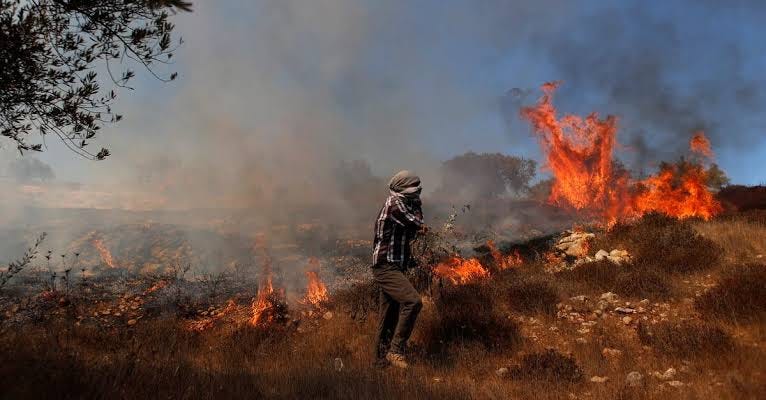
While I’ve been writing this, the olive harvest has begun in the West Bank. It runs from October into November, and for Palestinian families it’s meant to be the happiest stretch of the year, ladders against the trunks and tarpaulins spread beneath them. This year it opened under assault. In the first days of October, village after village reported harvesters beaten, crops and tools stolen, groves set alight. Near Abu Dis, settlers torched some fifty-five trees along with a family’s freshly picked fruit. Where settlers didn’t block the picking, soldiers often did. A Palestinian was killed during an attack on harvesters near Burqa. By the Palestinian Authority’s count, more than 26,000 olive trees were cut down or damaged in the first half of the year, and settlers carried out 647 attacks in September alone. Even Israel’s president has conceded that the country’s politicians haven’t done all they could to restrain the assaults.
I can’t prove that impunity in Gaza emboldened the men setting fire to groves outside Nablus and Ramallah. It would be strange, though, if it hadn’t. A threshold left unenforced in one place is read as permission in the next, and the most violent elements in any society are always the quickest readers.
Some of these trees are astonishingly old. One in al-Walaja, south of Jerusalem, has been estimated by visiting specialists at somewhere between three and five and a half thousand years, and many across the territory have passed a thousand. A grove of that age is a living archive, the patient work of ancestors no one alive ever met, tended in the faith that people not yet born would pick from it. To burn one is violence against a family’s future as much as against this season’s income. It reaches backward and forward in time at once.
Here two thefts touch. Carbon dioxide released this year won’t dissipate on any human timescale. A substantial share of it will still be warming the planet a thousand years from now, and a portion will linger far longer, which means the exhaust of my lifetime will be pressing on harvests as far into the future as the oldest of those olive trees reaches into the past. Settlers, and the state that shields them, are stealing the well-being of Palestinians in the present tense. My generation has been stealing the well-being of everyone who comes after us in every tense at once. I’m eighty-one. The account is in my name as much as anyone’s.
The two denials share a temperament. Each has had the evidence placed in front of it many times over. Each persists because acknowledgement would cost the denier something precious: a way of life, a political alliance, a flattering idea of one’s own decency. And each kills, the one through bombs and closed crossings, the other through heat, drought and flood that fall hardest on those who burned least. The arithmetic of the dying differs. The self-interest doesn’t.
Gaza mustn’t be converted into a parable about the rest of us. The people who live there aren’t supporting characters in an argument about whether distant audiences are decent; their lives, their streets, their unfinished futures matter in themselves. Yet the film’s title points somewhere distinctly uncomfortable. Each of us already owns a unit like the one those soldiers used: the casualty figure scrolled past between other headlines, the “humanitarian situation”, the gigatonne, the total grown large enough to stop meaning anything at all. The men and women on those rooftops learned to say twenty without seeing twenty faces. Most of us have acquired an adjacent skill, hearing the number, applauding the courage of those who confessed it, ...and stepping back into an evening that a different vocabulary would have interrupted, while somewhere the next figure is entered, by someone, as one more Naza.