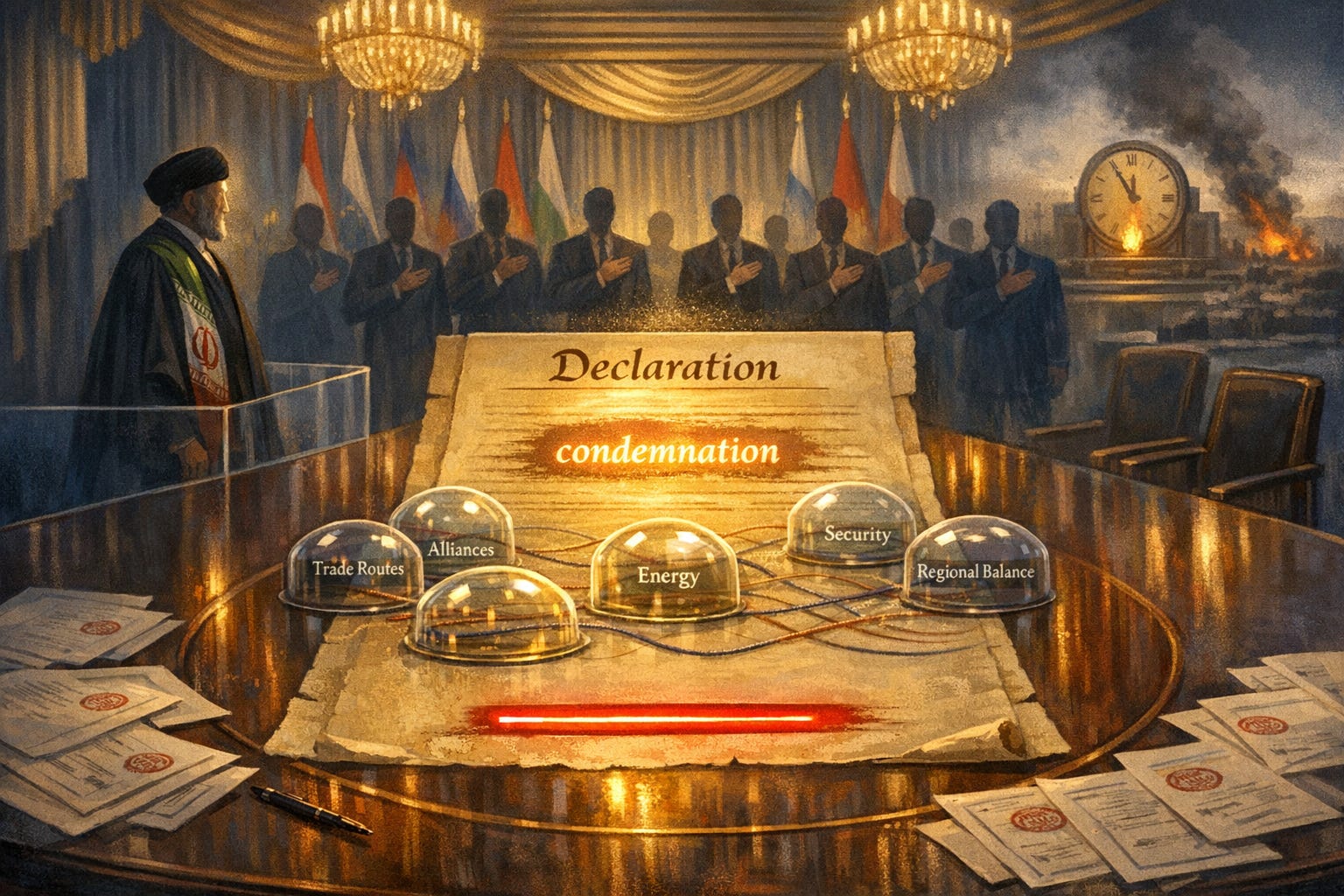
The accusation arrives early in the Bishkek Declaration, and it arrives with full force: strikes on Iranian territory violated the UN Charter, damaged international law, and put regional peace and stability at risk. Strong language, yet still no defendant named. A year earlier, at Tianjin, the same organisation had spelled out its subject without hesitation, holding Israel and the United States accountable in writing for the June 2025 strikes. This September, in Kyrgyzstan’s capital, the same ten governments condemned substantially the same conduct and allowed the names to fall away.
Although the circumstances had shifted between the two summits, the underlying facts had not.
By February 2026, joint Israeli and American strikes on Iran had killed the country’s Supreme Leader, several members of his family, including a young granddaughter, and, in a single strike on a girls’ primary school in Minab, somewhere between a hundred and fifty and a hundred and seventy children and staff, the toll rising with each week’s count. Human Rights Watch called for the school strike to be investigated as a possible war crime. None of this is seriously disputed. Casualty figures moved the way they always do in an active war, upward, in fits, as rescue crews reach further into the rubble. But the fact of the strike and its target were never in question.
Given the scale of what had happened, the retreat from naming by the Shanghai Cooperation Organisation (SCO) looks like calculation dressed as caution. Iran’s sovereignty is reaffirmed. The strikes are branded violations of the Charter. Condolences are extended for a head of state whose death the declaration doesn’t attribute to anyone in particular. The document performs every diplomatic gesture of accusation except the one that would require its most powerful signatories to say, on paper, who they believe pulled the trigger.
There’s a straightforward explanation. China trades with the United States at a scale that dwarfs its trade with Iran. India has spent a decade cultivating a security relationship with Israel that neither Narendra Modi nor Benjamin Netanyahu wants disturbed by a joint communiqué. Even Russia, whose interest in seeing American power humbled is genuine, still needs a working relationship with Washington on Ukraine, on sanctions, and on the terms of whatever peace eventually gets negotiated there. Naming a superpower in a multilateral document incurs a cost. Grieving with Iran while declining to explain why costs nothing at all.
In order to understand this fully we need to appreciate the uncommon scope of the SCO, which rarely gets its due in mainstream Western commentary. The ten full members of the SCO, China, Russia, India, Pakistan, Iran, Belarus and four Central Asian states, between them comprise close to forty-three per cent of humanity. NATO’s thirty-two members, by contrast, account for roughly one in eight people alive. The United States alone is closer to one in twenty-five. Vladimir Putin likes to round the SCO figure up to half of humanity, which overstates the figure, though not by much. When close to half the species has a government in a summit condemning a set of strikes, however carefully hedged the condemnation, that’s a fact about the distribution of formal political voices on the planet, independent of whether the sentiment behind it is sincere.
Scale and leverage are different measurements, and the temptation to treat them as one should be resisted. Forty-three per cent of the world’s population signed a document. It changed no sanctions regime, moved no interceptor stock, altered no flight path. Ports in Sri Lanka still service the ships they were built to service. Iranian oil still moves through the same narrowed channels it moved through before Bishkek. A declaration is a speech act. What a government puts on paper, and what it refuses to put on paper, establishes what a government is willing to say, or not, and to whom. But the gap between the size of the signatories and the size of the consequence is the gap this grouping has lived with since its founding. Enormous demographic and territorial heft, translated into remarkably little that a farmer in Punjab or a shipping clerk in Bandar Abbas would notice.
The hedging reveals more than the signatures do. India signed a declaration reaffirming Iranian sovereignty while its foreign ministry continues, in parallel, deepening defence procurement from Israel and trade access to American markets. Recep Tayyip Erdoğan travelled to Bishkek in the expanded dialogue-partner format, met Putin, spoke warmly of closer cooperation, and in the same visit insisted Ankara had no intention of turning its back on NATO or the West.
These aren’t contradictions requiring explanation so much as they are the actual shape of middle-power strategy in 2026: keep every door ajar, commit fully to nothing, let ambiguity do the work that alliances used to do. Indonesia and Egypt, present as partners rather than members, occupy an even looser version of the same posture. The unaligned bloc that never quite forms, decade after decade, functions less as a failure of coordination than as the strategy itself.
The contortion outlives the moment that produced it. Every SCO member watching from the back of the room in Bishkek, Kazakhstan, Tajikistan, Belarus, has just watched the template for what happens when one of their own gets struck: solidarity, condolence, sovereignty reaffirmed, and no name attached to whoever did it. That template is now the default, ready to be reused with a fresh set of blanks the next time. Iran gains no closer route to reparation from it, no strengthened case before any tribunal that would need an attributed perpetrator to proceed. What it gains instead is grief given diplomatic shape, formally distinct from the compensation or deterrence a named accusation might eventually have supported.
There’s also a cost to international law itself in all of this, separate from the cost to Iran. A Charter violation invoked without an accused becomes a phrase available to anyone: solemn, correctly worded, yet empty of consequence. Repeat that often enough, across enough summits and enough conflicts, and the invocation stops functioning as a legal claim and starts functioning as a genre. In that case it becomes the diplomatic equivalent of a condolence card sent to an address the sender already knows will never be opened.
None of which makes the disparity in how this story got told irrelevant. The February strikes, the death of a Supreme Leader, the destruction of a school full of children, received extensive Western newsroom analysis: front-page treatment in the New York Times and the Guardian, wire reportage, sustained investigation by human rights monitors.
The September declaration condemning those same strikes, signed by leaders representing a plurality of the human race, received a fraction of that exposure in the same outlets, while Al Jazeera, and the Indian, Pakistani, Iranian and Chinese press, covered it in granular detail. Call it a blackout and the case is overstated. European and American papers did report it. Call it proportionate and there’s a harder question to answer. Namely, why an act causing measurable harm earns saturation coverage while the collective diplomatic response of half the planet earns only a paragraph or two. The gap in emphasis says less about suppression than about where a newsroom in London or Washington still locates the centre of the world, reflexively, without anyone having to affirm it.
Once the diplomatic theatre is stripped away, what the Bishkek Declaration actually offers is neither triumph nor scandal. It confirms that a large fraction of humanity considers the war on Iran illegal, and says so on the record. This matters to Iranian diplomats trying to build a case for accountability at a later date, however distant that later remains. It reaffirms, in its clause on Palestine, that a comprehensive settlement is the only durable path to regional stability, a position that costs its signatories nothing to hold and asks nothing of Israel to accept. It alters no material fact on the ground and asks no signatory to change a single existing relationship with Washington. And it declines, pointedly, to say who did the killing, even while it grieves the man who was killed.
A document can condemn an act while shielding every relationship that made the accusation costly to spell out. Iran gets sympathy without leverage. The signatories get solidarity without cost. Everyone gets to have spoken, on the anniversary of a war not yet finished, without anyone risking the one line that would have made speaking very expensive indeed.