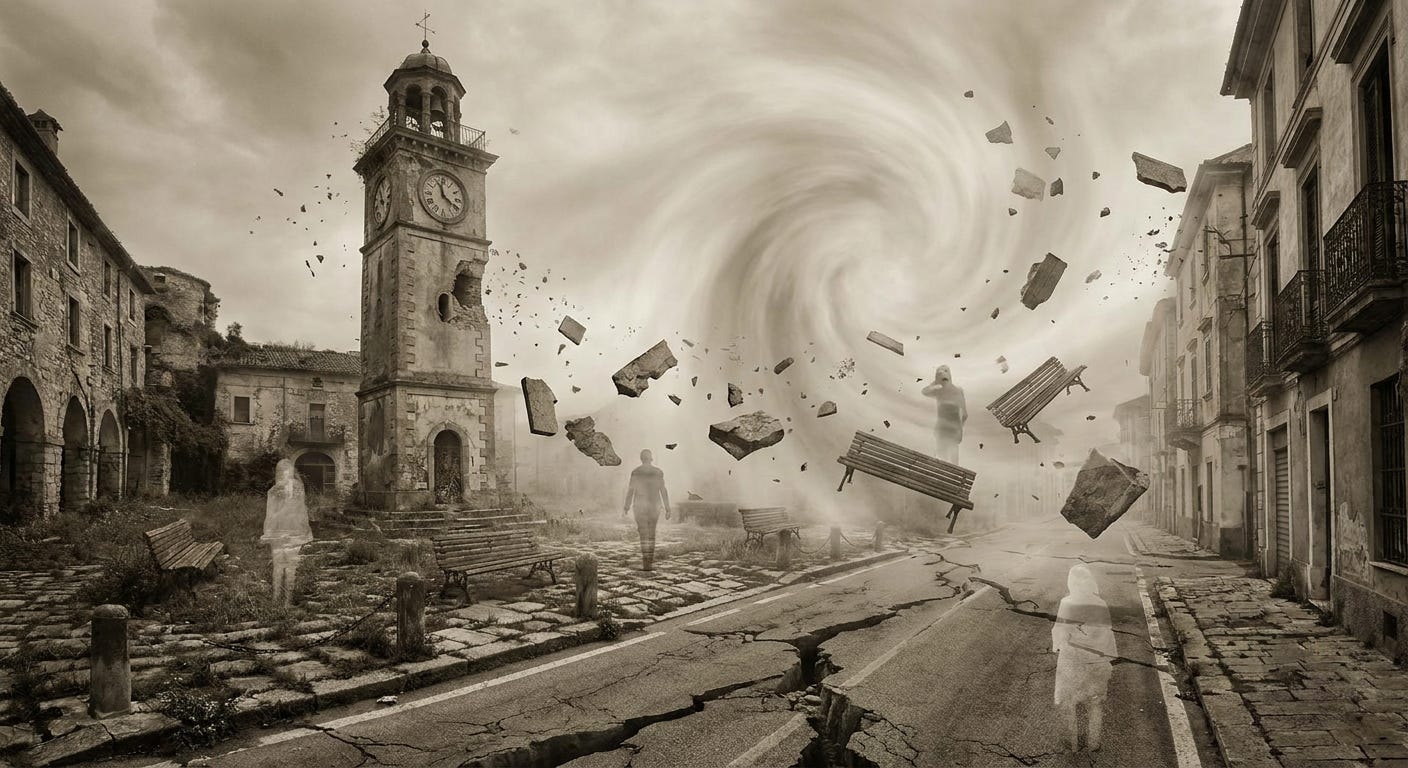
Take any city on a day when nothing happens. Bangkok in the wet heat of a Tuesday; Lagos as the traffic thickens; and Melbourne hit with four seasons in one day. The screens are crowded all the same. A drone has struck something across the Russian border that the report doesn’t quite name. A court in New York has handed down a decision that will reshape who owns a sentence. A regulator has adjusted the terms under which a machine is permitted to decipher the world. A finance minister has lost an argument about the price of fuel. None of it arrives labelled as war, or revolution, or collapse. Each of them, looked at squarely, involves force, or constraint, or the quiet surrender of something a people once held in common.
We have stopped recognising the crisis. Not because the crisis has gone, but because it has changed its shape, and our instruments are still tuned to the old silhouette. We are watching for the bold declaration, the front line, the moment the sirens sound. Meanwhile the thing itself has slipped sideways into the ordinary and learnt to wear the clothes of a regular working day.
From declared war to permanent hostility
Choose a headline. A strike attributed to no one in particular. A proxy attack reported through the carefully passive voice of the wire services. A drone that crossed into airspace it had no business entering. Read how it’s framed. It comes to us as an episode, sealed off from what preceded it and what will follow, wrapped in the vocabulary of self-defence, targeted response, and deterrence. Each word is a small door closed against a larger pattern.
Set this against the older grammar of conflict. Wars used to begin with a declaration and a date. They had front lines you could mark on a map, an enemy with a flag, and an end that arrived as a treaty signed at a particular table. There was a beginning, a middle, and a negotiated close, and the whole of it took place inside a frame that everyone agreed to call war. The frame did terrible things, but it was at least a frame. It carried the idea that violence was an exception to peace and would one day have to answer for itself.
That frame has dissolved. Violence has migrated into what we used to dismiss as the margins. It lives now in the deniable operation, the automated system that decides without a hand on the trigger, the sanctions regime that strangles a population while insisting it is merely policy, and the cyber-intrusion that never admits to being an act of war because admitting it would oblige someone to respond as though it were one. We gave this condition a name, the grey zone, and the name was meant to suggest a periphery, a smudged edge where the real business of states doesn’t happen. The truth is the reverse. The grey zone is no longer the edge of the theatre. It’s the stage.
A battlefield disguised as a marketplace
Turn from the drone to the machine that reads and sorts. The fight over artificial intelligence and the news arrives dressed as commerce. Data scraped at scale. Summaries spun out of other people’s reporting. Lawsuits over training sets. The slow asphyxiation of the revenue that once paid for a correspondent to stand in a square and describe what she saw. On the surface it’s a dispute about copyright and fair use, about publisher opt-outs and platform policy, the sort of thing that fills a trade journal and empties a room.
Tilt the frame and something harder comes into view. This is a contest over who gets to decide what reality is made of. News organisations live on attention, and attention is the thing being syphoned away. Platforms live on the extraction of content and behaviour, taking what others make and what others do and converting both into a position from which to sell. The new intelligence systems live on ingestion, and what they ingest is everything and anything that moves. The public sphere, the place where a society was supposed to find out about itself, has become a battlefield that refuses to admit it is one. The weapons are ranking algorithms and recommendation engines and synthetic prose that arrive sounding like neutral descriptions but are nothing of the kind. No one declares this war either; it’s fought in terms of service and quarterly earnings, and the newsrooms it empties are gone before anyone agrees a war was fought.
The thinning of the state
Now consider the institutions that were meant to bolster a society. A building burns that an inspection might have saved. A clinic with the lights on and no medicine on the shelves. A corruption scandal so baroque it reads as satire. A tunnel for smuggling found running under a border with the casual engineering of a metro line. A court system so overwhelmed that justice becomes a question of how long you can afford to wait. We file these as aberrations, one-off failures, and the bad luck of bad actors. They are nothing of the kind. They’re the symptoms of states that have been hollowed of capacity while retaining every gramme of their coercive power.
The thinning runs along three seams. The first is capacity. The basic functions that a state exists to perform – the inspection, the service, the maintenance of the everyday unglamorous machinery of a shared life – fail more often and more visibly. The second is legitimacy. As the machinery fails, people believe less in the formal processes and invest their trust elsewhere: in rumour, in patronage, in whoever can actually deliver, in force. The third, and the most corrosive, is imagination. Politics narrows until it is mostly performance, while the decisions that matter migrate quietly to technocrats and creditors who never stand for anything and answer to no one in the street.
Watch what a hollowed state does to prove it still exists. It reaches for spectacle, the mega-event, the strongman cadence, and the announcement designed to fill a screen. And it reaches for the punitive ritual, the exemplary sentence, the new security law, the show of severity that costs little and signifies much. A state that can no longer reliably collect the rubbish or staff the courts can still, at very short notice, find the resources to punish. Severity is cheap. Competence is expensive. A failing order will always choose the cheaper proof of life.
One pattern: wearing three masks
Braid these three strands; the shape declares itself. Militaries operating in the grey zone between war and peace. Platforms and intelligence systems operating in the grey zone between consent and theft, between authorship and ingestion. States operating in the grey zone between legitimacy and the exercise of naked force. We treat these as three separate crises, parcelled out to three sets of experts who rarely speak to one another. They are not three crises. They are one pattern, learning to express themselves in three registers at once.
This pattern has a signature, and the clearest mark of it is extraction without reciprocity. The drone takes security from one side of a border and returns none to the other. The machine that reads the correspondent’s sentence and returns her no readers. The hollowed state takes obedience and taxes and returns neither the service nor the protection they were meant to buy. Value flows out of a place or a people or a body of work, and nothing flows back. The other marks follow from it. Opacity dressed as efficiency, the refusal to explain reframed as the streamlining of a process too sophisticated for the layperson to follow. And permanent emergency without responsibility, a condition of unending alarm in which someone always has the power to act and no one can ever be made to answer for the actions. Think of a civilisation whose immune system has turned on its own flesh, attacking the very organs that keep it alive. Think of an ecosystem in which the apex predators have learned to hunt in fog and have come to prefer it because the fog is where accountability can’t follow.
The public as a vanishing habitat
It’s worth asking, plainly, what we still mean by the public realm. We meant, once, a shared store of information, a common ground of fact from which arguments could begin. We meant shared risks and shared protections, the understanding that a flood or a fever or a market crash was something a society faced together. We meant institutions and the rituals of accountability that came with them, the enquiry, the election, the public record, and the sense that power could be called to a table and made to explain itself.
Each of these is disintegrating before our eyes. The shared store of information has atomised into a myriad of personalised feeds and the smooth, sourceless output of models so that no two people any longer stand on the same ground of fact. Risk has been quietly privatised, sorted into the gated community, the premium insurance policy, and the offshore option held in reserve by those who can pay to exit the common fate. The institutions survive, but increasingly as brands, hollow at the centre, their letterhead intact and their function gone. The real casualty of the grey-zone era is not the nation-state, which persists in its uniforms and its flags and its anthems. It’s the older and more fragile factor the nation-state was supposed to accommodate: the idea of a shared habitat, in which decisions are made together and the consequences are borne together. That’s what is leaving us, and it’s leaving without so much as a funeral or a memorial service.
Adaptation, withdrawal, improvisation
Drop back to the level at which life is actually lived. In cities where the formal arrangements no longer hold, people build informal ones: the neighbourhood watch that’s really a private militia and the building that organises its own security because the state’s has stopped arriving. Parallel networks of information thread through the encrypted group, the diaspora channel, and the neighbour whose word is trusted more than any broadcast. Young people move with great fluency across global platforms while holding not a shred of faith in any formal path to a stable life and see no contradiction in this because, for them, there is none.
We’re not the passive victims of any of this. We adapt and improvise and stitch together micro-worlds that work, often with remarkable ingenuity, often more humanely than the systems they are replacing. But the cost should be evident. Horizons shrink to the span of a week. Anxiety becomes the resting state, the background hum of a life lived without any reliable floor beneath it.
And there settles over everything a kind of double consciousness, the practised gap between what a person knows to be real and what they must perform as conviction in order to move through the day. A society in which everyone is quietly performing conviction in institutions no one trusts is not at peace. It’s holding its breath.
Leadership, stewardship, and the vacuum between them
It helps to separate two things we usually run together. Leadership is what happens when people organise around a living intention, when a shared sense of where to go pulls a group into forward motion. Stewardship is the careful exercise of formal power, the holding of something in trust for those who will come after. Much of what we now call leadership is neither. It’s nothing more than the banal management of grey-zone systems, the politician performing ‘calamity’ to be seen performing it, the executive refining the machinery of extraction, and the technologist extending reach across the world while accountability is left somewhere far behind, unable to keep up.
There are counter-examples, and they are worth keeping in mind. The local network that defends an ecosystem because the people in it have decided the ecosystem is theirs to defend. The city is experimenting, against the grain, with new forms of trust and coordination. The small alliance that refuses the logics of hostility and extraction and stakes itself on reciprocity instead. None of this should be idealised. These are small, often fragile, and frequently defeated. But they register as proof. They demonstrate that the dominant pattern is a choice and not a law of nature, that other patterns remain available to a civilisation willing to reach for them.
The question underneath the headlines
Only now is it safe to surface the deeper question, the one the headlines are too loud and lurid to let us hear. What kind of civilisation arranges itself so that everything of consequence happens in the grey zone? What story about value, what account of progress, produces a world in which war goes undeclared, information goes untrusted, and institutions are at once everywhere yet utterly empty? It’s not a conspiracy, and it’s not an accident. It’s an operating system, an extractive worldview so deep in the foundations that we mistake it for the ground itself, a logic that knows how to take and has forgotten how to return.
The headlines, then, are not the crisis. They are the noise a civilisation makes while it changes its operating system underneath itself, the grinding and the sparks thrown off by a transition that no one announced and no one is steering. We keep mistaking the sparks for the fire. The fire is lower down. It’s been burning for a long time.
A different kind of dark
Return to the city where we began, on the same ordinary day, with the same low sense that nothing happened. What has changed is not the quantity of crisis. It is its texture. Crisis has become the light we read by, not the eclipse. You don’t declare an emergency over murkiness. Your eyes adjust, which is the problem — they adjust.
So leave the question open rather than closing it with an answer. If the grey zone is now the main theatre, where might a new public world be quietly rehearsing itself, out of the lights, in the parts of the day the screens don’t reach? In what small and unreported practice is a different relationship to power and information and responsibility already being lived, not as a manifesto but as a habit?
Picture it as a scene rather than an argument. A side street where two people are having the kind of conversation that assumes a shared world. A cooperative that runs on trust because trust is cheaper than the alternative and also truer. A stretch of riverbank being restored by people who will not live to see it finished. Somewhere the dominant logic is briefly suspended, not as utopia, never that, but as an experiment.
Our eyes will go on adjusting. But adjustment is not the only option — a civilisation, unlike an eye, can decide to turn the lights on rather than learn to see without them.