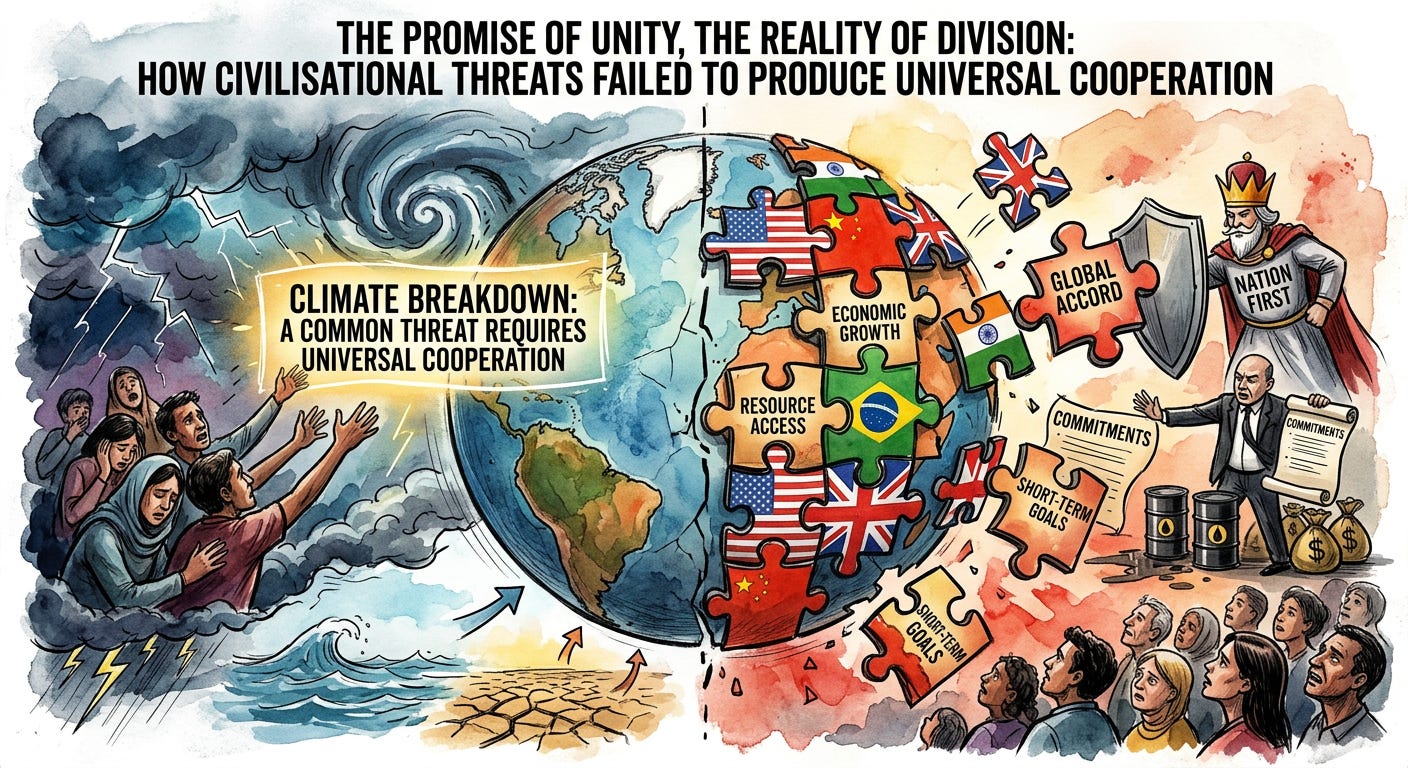
In Bonn this June, the closing plenary of the UN’s mid-year climate talks did what closing plenaries have increasingly learned to do: it deferred action. Negotiators failed to reach agreement on scaling up emissions cuts or funding for adaptation, and diplomats used the closing session to lament a weakening of trust in the process itself. Nobody walked out. No headline captured a single dramatic rupture. The delegates filed their unfinished business forward to Antalya in November, the way an overdue account gets carried to the next quarter. Everyone returned home to countries that are, on the whole, still perfectly capable of building bridges, running hospitals, and coordinating the arrival of ten thousand flights a day without a single midair collision. Our species has not lost the ability or willingness to cooperate. It has lost the capacity to cooperate at planetary scale, on planetary problems. This distinction matters.
This is the profile of the problem we keep failing to solve on climate breakdown. The benefits of decarbonising are planetary. They will be shared by everyone whether or not they lifted a finger toward the fix. The cost of moving first is national, immediate, and borne disproportionately by whoever moves first. The result is a waiting game — every individual government calculating that the wiser strategy is to let its rivals pay the price of virtue and step in only once the bill has already been settled by someone else. The irony sitting underneath that arithmetic is poignant: a threat this size has no rivals in it anywhere. Only neighbours, mistaking a shared exposure for a contest, each waiting for the other to blink first in a game where losing and winning turn out to be the same outcome wearing different names.
The Global Carbon Project has warned that at current emission levels the remaining budget for holding warming to 1.5 degrees will be exhausted within four years, a number specific enough to plan around but abstract enough to change nobody’s working week. Every government in Bonn understood the maths. Comprehension was not the missing ingredient. What was absent was any mechanism by which the country that pays the near-term costs of transition can trust that its rivals will not simply pocket the advantage of having waited. It isn’t a failure of intelligence, or of goodwill, or even of diplomacy. It’s the machinery of the sovereign state running exactly as it was designed to function. No urgency read aloud in a closing statement changes anything in that regard.
Fragmentation appears to be the opposite problem — an outbreak of parochialism exactly when planetary-scale thinking is most needed. But look closely at what fragmentation does and the picture bends. When Turkey, Saudi Arabia and Pakistan signed a mutual-defence pact this August, they were not abandoning cooperation. They were relocating it — narrowing the radius within which a promise can still be trusted to hold, because the wider promise, the one made by the postwar security architecture, had already stopped feeling reliable to any of these three. The same logic runs through a Spanish border checkpoint reappearing on a road that Schengen was supposed to have made invisible, through a bloc’s readiness to reach for its own defence formula the moment the old guarantor looked distracted or unwilling.
Fragmentation, looked at this way, is not the absence of a cooperative instinct. It’s that same instinct retreating to the smallest circle in which reciprocity can still be verified — family, sect, nation, coalition of the recently frightened — because the larger circle stopped paying out on its promises and nobody has yet rebuilt a reason to trust it again.
Which brings the argument to militarism. Here’s where the frame itself needs to be turned round and examined, because up to this point I have been speaking in the vocabulary of failure — cooperation that isn’t happening, trust that has broken down, a capacity that’s gone missing.
That vocabulary is itself part of what needs considering. It borrows, without quite admitting it, an accountant’s view of the world: cooperation as a deliverable, trust as a balance that should be rising but isn’t. Industrial economism doesn’t just fail to solve the climate problem. It supplies the exact language in which the failure gets described, so that even the diagnosis ends up measuring civilisational relationships the way a firm measures quarterly output.
The Bulletin of the Atomic Scientists set the Doomsday Clock at eighty-five seconds to midnight this January. This is the closest it has ever been. The group cited collapsing understandings among the major powers and a widening deficit of the cooperation needed to manage nuclear risk, climate change and the misuse of new technologies together, as a single interconnected exposure rather than separate line items. Even the instrument built to warn the world has started measuring several different collapses as one number, because at some level its own designers realised that splitting the threats apart was part of the original and most costly error.
Three crises, then, filed under three separate headings in every briefing document, every ministry guarding its own portfolio — and beneath them, one massive failure. The horizon within which any state can still imagine keeping a promise has shrunk, and shrunk faster than the horizon the problems themselves occupy. Climate needs a horizon of centuries and a radius of the whole planet. Fragmentation is the visible symptom of that radius collapsing toward the nation, the alliance, the tribe. Militarism is what fills the space vacated when a wider radius of trust no longer holds — the oldest technology available, reached for precisely because it requires trusting nobody beyond your own capacity to threaten.
None of this resolves into a single lever a conference could pull. There is no reform of the UNFCCC process, no new pact modelled on Makkah’s language of mutual defence but built for mutual restraint instead, that manufactures trust by declaration. Trust of the kind these three crises actually require — the kind that lets a government absorb a near-term cost on faith that others will eventually absorb theirs — has never been built by architecture alone. It has been built, historically, in the unglamorous years between crises, by institutions boring enough that nobody noticed them succeeding until the moment they were needed and were still there.
The tragedy of the present moment may be exactly that: the institutions built in the last such quiet period are being dismantled faster than any new ones can be laid down, by governments that can feel the danger accelerating and have concluded, not unreasonably given the incentives in front of them, that they no longer have the decades such institutions take to prove themselves.
Bonn will reconvene in Antalya. The clock in Washington will be reset again in January, closer or, this once, perhaps not. Somewhere between now and then a country will sign a pact that promises to defend a border, but no country anywhere will sign one that promises to widen a horizon.
That asymmetry, more than any single failed summit, is the actual measure of where our species currently stands. Not a lack of the capacity to keep faith with one another, but a faith that has contracted to fit only the radius small enough to still feel safe and secure, while the size of the danger keeps refusing to shrink along with it.