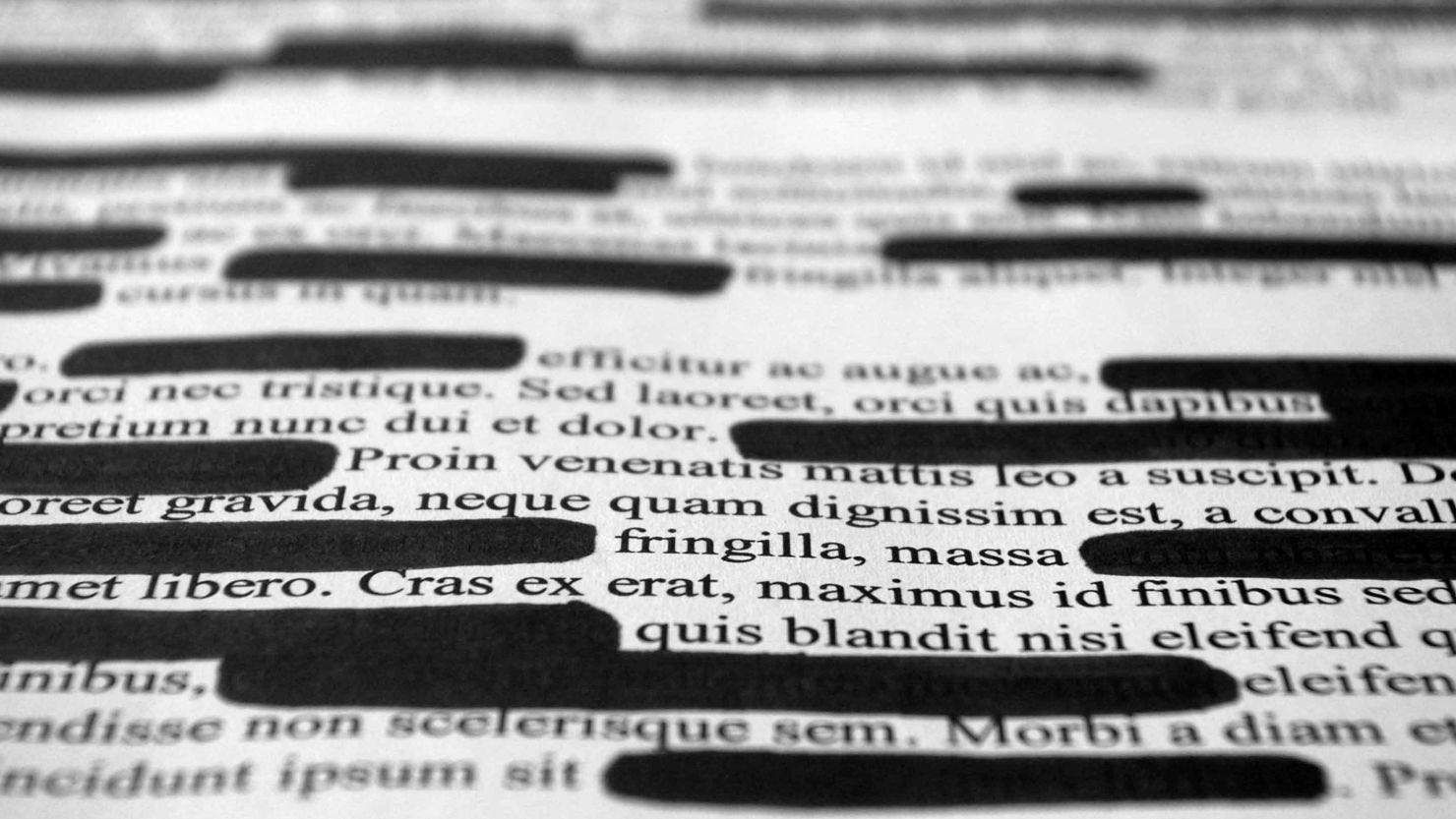
When a government releases a document so heavily redacted it resembles a barcode more than a narrative, we are told this is “Freedom of Information”. In a strictly legal sense, that is accurate: a request was made; a process was followed; something was released. But if the aim of such laws was to align public governance with truth, then the spectacle of black ink obliterating entire pages invites a more disruptive question: freedom of which information, in service of whose truth?
States don’t lie only by commission. They can lie by omission, by theatrical half-disclosure, by releasing fragments that are technically accurate yet systematically misleading. A redacted document is a curated absence. It’s an admission that something happened, shorn of the connective tissue that would allow a citizen to make meaning from it. We get nouns without verbs, dates without motives, decisions without context. The appearance of openness is preserved, while the core of truth – intelligibility – is amputated.
“Freedom of Information” regimes were introduced, in many jurisdictions, as a response to scandal or the ingrained abuse of power. They promised to tip the relationship between the governed and those who govern towards greater accountability. Yet over time these regimes have been colonised by the self-same bureaucratic cultures they were meant to challenge and dismantle. Instead of enabling disclosure, they are often used to manage it.
This inversion cannot be considered accidental. Every large-scale institution – whether a ministry, corporation, religious hierarchy or security apparatus – learns to treat information in this age of information as both asset and risk. Facts that threaten legitimacy become classified, rephrased, delayed, drowned in procedure, or released so incompletely that only specialists can piece together what is going on. This professionalisation of concealment is not simply “bad behaviour”. It arises from an unspoken doctrine embedded in the modern worldview: that stability is maintained by managing perceptions.
In that sense, redacted FOI releases are performances in the much larger theatre of reassurance. They enable prominent public figures to say, with a straight face, “we’re committed to transparency” while ensuring the citizen never has enough raw material to construct a fully informed critique. Truth, in this setting, is not a correspondence between statements and reality; it becomes part of a controlled narrative, a field of allowable interpretations.
We might ask whether the dissonance between “freedom of information” and “heavily redacted” rests on a deeper confusion about what we actually mean by truth in complex social systems. Many people still cling to an implicit belief that truth, in political life, is a stable object waiting to be uncovered: a set of documents, a single chain of events, a definitive explanation. If only we could gain access to the files, everything would become much clearer.
But truth in public affairs is relational. It emerges from multiple vantage points, an untidy mess of conflicting interests, contested memories, incomplete records, and shifting narratives. A memo written by a senior official might accurately record what they knew at the time, yet omit certain perspectives that never entered their field of view. A whistle-blower may reveal what was hidden inside one department, while remaining blind to the forces shaping that department from outside. Even a complete, unredacted archive is still only a partial window on a much more intricate web of causation and meaning.
The problem with extensive redaction, therefore, is not that it prevents us from accessing some pristine “master truth” that would otherwise be available. It is more insidious. By stripping away contextual clues, it blocks the possibility of multiple, competing truths being surfaced, debated and integrated into our shared understanding. It artificially narrows the spectrum of stories we can tell about ourselves.
Every civilisation operates from a more or less coherent worldview – a deep, mostly unexamined story about what’s real, what matters, and how power should be organised and exercised. Modern industrial civilisation, for example, is underpinned by a belief in linear progress, human dominion over nature, the sovereignty of the state, the neutrality of markets, and the separation of facts from values. These beliefs don’t simply sit in philosophy textbooks. They are encoded into institutions: parliaments, ministries, banks, schools, media platforms, militaries.
Those institutions, in turn, form world-systems: tangible patterns of extraction, production, control and communication. They shape which lives are deemed valuable, which regions are expendable, which harms are acknowledged, and which are denied. Within those systems, the management of information becomes central. Whose suffering is visible? Whose deaths are counted? Whose voices are archived?
Heavily redacted FOI documents are one of the places where worldview, system and mindset touch. The worldview says: “The state must appear accountable while retaining the sovereign right to define threats and manage risk.” The world-system operationalises that belief through secrecy laws, national security doctrines, classificatory rituals and legal manoeuvres. The cultural mindset – the habits of thought carried by officials – then expresses it daily in risk-averse decisions: withhold this; black out that; refer to legal; delay until it is no longer politically dangerous.
From the citizen’s perspective, this looks like an infuriatingly opaque bureaucracy which it is. From within the system, it’s felt as “responsible management” which it is. Both perceptions are real, but they operate from different vantage points. Truth, in this sense, is fractured by design.
The claim that knowledge is power is repeated so often it has become wallpaper. Less often asked is: power for whom, and over whom? If information is a form of energy in a social system, then Freedom of Information laws might be seen as an attempt to redistribute that energy from the centre to the periphery – from elites to ordinary people. Yet, in practice, FOI regimes have often been shaped to protect the system’s own autopoiesis. Exemptions for “national security”, “commercial confidentiality” or “internal deliberations” can be stretched so far that the core of decision-making is effectively sealed off. Black ink on a page is simply the most visible, literal representation of a much broader pattern in which whole domains of political and economic life are placed beyond scrutiny.
This doesn’t mean every instance of redaction is illegitimate. There are genuine dilemmas. How do we safeguard the identities of people who might be harmed by disclosure? How do we handle information that, if released, could genuinely enable violence, extortion, or large-scale fraud? These questions are not trivial, and democracies that ignore them can so easily drift into a kind of moral exhibitionism, where everything is exposed without regard for real-world consequences. But if the reflex is always to protect the system rather than the people it supposedly serves, redaction becomes a tool of domination rather than prudence. Truth, at that point, is treated as a controlled substance, released in doses judged safe for public consumption.
So how is any of this compatible with the truth? Legally, one can argue that a redacted document is better than none at all. Ethically, though, the notion of compatibility becomes strained when the form of disclosure reinforces ignorance. A truth that cannot be situated, tested, contested, cross-referenced or reinterpreted is barely a truth at all; it’s an inert piece of data, stripped of its relational meaning.
Perhaps the more productive question is not whether such practices align with truth, but what conception of truth they implicitly promote. A regime dependent on heavy redaction seems to operate as if truth were a dangerous substance, to be rationed, framed, and sometimes deferred indefinitely. It implies that only those judged “responsible” – usually insiders – can be trusted with the full picture. Citizens become permanent adolescents in an epistemic sense, presumed too fragile, too volatile, or too easily misled to handle complex, ambiguous, or disturbing realities.
If that assumption goes unchallenged, Freedom of Information risks evolving into little more than a meaningless ritual: an official channel through which the system releases carefully curated fragments, while maintaining a monopoly over the deeper patterns.
There is another way of approaching this problem. Instead of treating truth as a commodity owned by institutions, what if we treat it as an emergent property of a living culture – a quality of relationship between people, systems, and the world they share? Based upon that view, two shifts become vital.
The first is a logical flip from secrecy-as-default to openness-as-default, with specific, time-bound exceptions that are independently supervised. In some places, mechanisms such as independent information commissioners, judicial oversight of classification, or statutory “sunset” clauses on secrecy have been introduced. Whether these are genuinely effective in practice is an empirical question that demands ongoing scrutiny rather than pious assumption.
The second is from passive transparency to active sense-making. Even where data is released, it often arrives in forms that ordinary people cannot reasonably interpret. Dumping thousands of redacted pages into the public domain, or releasing databases without explanation, can generate the illusion of openness while actually entrenching dependence on intermediaries – major media outlets, specialist analysts, think tanks – whose own biases and dependencies are rarely transparent and challenged.
Truth, in this more generative sense, requires spaces where new interpretations can be forged collectively, across differences in expertise, class, culture and geography. It requires citizens who are not treated merely as recipients of whatever the state deigns to reveal, but as co-authors of the narratives by which we govern ourselves.
All of this points to a deeper developmental question: can our global civilisation grow beyond a fairly juvenile relationship with truth? Adolescents, as many parents will confirm, often oscillate between deceit, strategic silence, and theatrical confession. They disclose selectively, admit only what cannot be denied, and frame half-truths as full ones. States and corporations, at times, behave in much the same way.
An epistemically mature society would acknowledge that truth in public life is necessarily incomplete, yet refuse to weaponise that incompleteness. It would accept that some information genuinely needs temporary protection, while insisting that such protection is narrowly defined, always independently monitored, and always open to challenge. It would understand that freedom of information is not exhausted by the release of documents, redacted or otherwise, but is embedded in the ongoing renegotiation of who gets to know what, when, and why.
Heavily redacted FOI releases, viewed through that lens, are diagnostic. They tell us something about the stage of development in which our institutions are currently trapped. They reveal how fear, habit, and inherited worldviews constrain the imagination of those who hold office. They invite us to ask whether we’re content with a model of governance in which truth is metered out from the centre, or whether we are ready to cultivate forms of power that draw their legitimacy from a more distributed and participatory relationship with reality.
That question cuts across borders, ideologies and cultures. It confronts autocracies and formal democracies alike. It asks whether we’re willing to move beyond a civilisation that treats knowledge as a weapon to be hoarded, towards one that treats shared understanding as a commons to be tended.
If we take that question seriously, then the sight of a document drowned in black ink is no longer just an irritant. It becomes a mirror held up to our collective immaturity. The answer reflected there is not flattering. The more important issue is whether we choose to do anything about it.