A state can lose a war and recover. France did. Twice in living memory. What a state can’t easily recover from is the slow withdrawal of belief — the moment its founding story stops persuading, first the world outside its borders and then the citizens within them. Israel crushed Iran in the field in twelve days and emerged more isolated than when it began. It is always the aftermath, not the war, that should concern us.
On the seventeenth of June, at Versailles, an American president signed a preliminary memorandum to end the conflict. A sixty-day window, extendable by agreement, was opened over the wreckage of Iran’s air defences, its missile stocks, its nuclear facilities and the senior tier of its military command. Within days the architecture was already trembling. The vice-president’s talks in Switzerland were postponed without explanation. Israeli forces continued to bombard southern Lebanon, despite a settlement that promised to end precisely that. Tehran’s foreign minister declared that the war had not ended at all while Israeli troops remained on occupied ground. A military triumph had been converted, almost overnight, into a diplomatic predicament — and that’s the more revealing of the two.
Here is a puzzle worth pondering. Israel has rarely been more dominant in the field and rarely more isolated outside it. Battlefield supremacy and moral standing have come apart, and the fracture between them is widening. That gap is not a public-relations problem to be managed by sharper messaging. It’s a crisis of legitimacy — and legitimacy is a philosophical category long before it becomes a strategic one.
The withdrawal of belief
Hannah Arendt spent a career insisting on a distinction we have largely forgotten. Power and violence, she argued, are not points on a single scale. They are opposites. Power rests on the agreement of many to act in concert; it’s what a people grant a government when they consent to be governed by it. Violence is what appears when that consent thins — the instrument a regime reaches for precisely because the agreement underneath it has begun to fail. Where one rules, the other is absent. The state that must coerce its way to compliance is not displaying strength. It’s simply advertising the erosion of its foundations.
For most of its existence Israel possessed a narrative of unusual moral force. A people emerging from unimaginable catastrophe. A democracy ringed by hostility. A small nation that had made the desert answer to it. That story did real work in the world. It generated sympathy. Sympathy translated into diplomatic cover, and the cover functioned – there is no gentler word – as a shield. Criticism bounced off it.
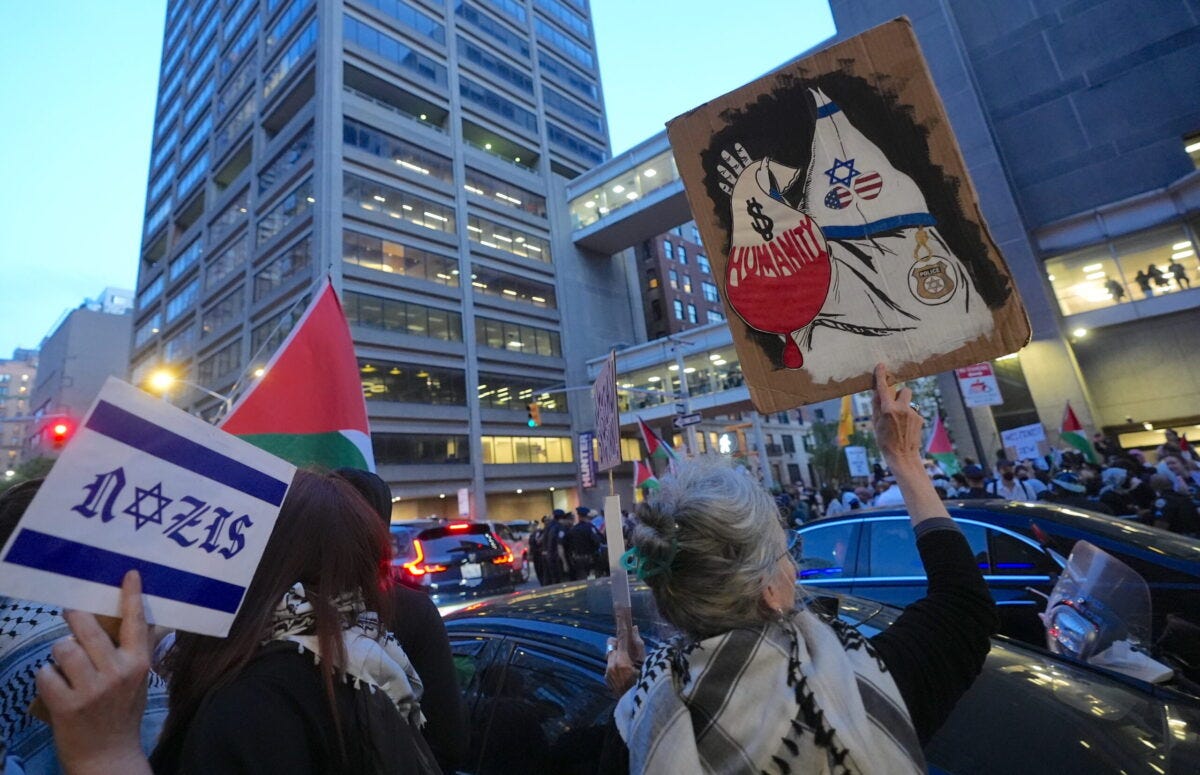
The shield is corroding. The shift is not subtle, and it’s not confined to the usual quarters. Across universities, cultural institutions, the foreign ministries of the Global South, and a generation of citizens in allied countries who have no memory of 1948 and little of 1973, the terms of the conversation have moved. Objection to a particular policy now bleeds, with increasing ease, into a challenge to the legitimacy of the state as such. Israel is debated less as an ordinary member of the international order behaving badly and more as something singular and intolerable. That is a different order of jeopardy. A state can absorb condemnation almost indefinitely. Sustained delegitimisation is the slow toxin, because it corrodes what no army can defend — the shared conviction that an entity deserves to exist at all.
Can the most hated nation endure?
The question, stripped of comfort, is whether a state can survive when its existence is widely experienced as an affront. Hatred by itself settles nothing; history is littered with detested regimes that have endured for decades on repression, deterrence and the patronage of a great power. Israel could, in principle, join their number. What makes its situation distinct is not the intensity of the hostility but the contradiction at the centre of its self-understanding.
Israel insists on being three things at once. That it’s a liberal democracy. That it belongs to the West. That it acts as a moral agent within international norms. And it is drifting, in significant constituencies, toward the status of a pariah. The two images can’t be held together without tension, because each identity makes demands the other cannot meet. A fortress narrows the democracy that garrisons it; emergency becomes permanent, and the emergency writes the law. A democracy, meanwhile, depends on moral reciprocity — on being recognised by others as bound by the same rules it invokes. You can build a state on hard power alone, or you can build one embedded in a shared moral order. The difficulty arrives when you try to do both, and the present settlement, signed and already breached in Lebanon, is what that difficulty looks like in practice.
Decline, if it comes, will not arrive as catastrophe. It rarely does. It comes incrementally, along four quiet roads. The first is legal and diplomatic siege: the steady accumulation of court proceedings, sanctions campaigns and cultural boycotts that isolate a state while its formal alliances remain technically intact. The second is patron fatigue — the generational drift in allied societies, that converts unconditional backing into something conditional and therefore volatile. The third is fragmentation from within, as the religious and the secular, the demographic asymmetries, and the grinding cost of permanent mobilisation wear through the social fabric; legitimacy fails inside a border as readily as across it. The fourth is the strangest. A state may persist, in fact, while its right to exist is contested in principle — surviving physically, year on year, yet outside the circle of broadly recognised moral standing. It endures, but is narrower, harder, and more brittle than the vision that founded it. Collapse, in this register, means not destruction but emptying: the slow loss of narrative coherence until the fortress is all that remains.
The failure to think
Arendt gave us one more instrument, and it’s the one most often misquoted. The banality of evil was never a claim about the scale of the harm. It was a claim about its texture. Eichmann, as she watched him in the Jerusalem dock, was not a demonic architect. He was a functionary who had mislaid the capacity for reflective judgement — a man who followed the process, met the targets, and outsourced his conscience to the chain of command. The horror she identified was that monstrous outcomes need no monstrous intent. Procedural normality will manufacture them, given sufficiently elaborate machinery and enough people willing to stop thinking.
The warning has aged into something close to a description of contemporary governance everywhere. Decisions are driven by cycles of outrage. Policy is shaped by the metrics it will be judged against rather than the world it will produce. Leaders respond to dashboards. Meanwhile, institutions take shelter behind procedure, which has the convenient property of distributing responsibility so widely that no one need carry any of it. The faculty Arendt thought indispensable to politics — the citizen and the leader who can still stop and ask what world this brings into being, what it will cost those not yet born, and what responsibility requires beyond compliance alone — is precisely the faculty an accelerated, reactive, algorithmically mediated public sphere is least able to sustain.
Israel’s predicament is one acute instance of this larger atrophy, not an exception to it. The deeper question is not whether one state weathers its hostility. It is whether human institutions, anywhere, retain the capacity for the kind of judgement that confers legitimacy in the first place.
First, not unique
The order assembled after 1945 rested on premises that now look like period assumptions. Stable nation-states. Borders that meant something. National identities coherent enough to govern by. International institutions with the standing to mediate a quarrel. Each of these premises is dissolving in real time. Borders leak. Identities are contested from within and below. Non-state actors field the capabilities of governments and answer to none of their constraints. And institutions from the UN to the ICC issue rulings and resolutions that no one is obliged to honour.
Israel sits at the precise junction where these pressures meet and amplify one another. Ethnonationalism collides with the universal grammar of human rights. Security maximalism runs into a globalised civil society that watches everything and forgives little. Overwhelming technological superiority in the field proves strangely impotent against decentralised insurgency and the mobilising power of a mobile phone. Seen this way, Israel is not uniquely broken. It is early. It’s the most visible point at which the contradictions of the late nation-state have erupted into full global view — and if legitimacy is becoming harder for any state to sustain in a world of permanent visibility, then Israel’s trouble is a forecast as much as a case. Others will arrive at this junction. Some are already on the road.
What rescue would actually require
Were the crisis military, deterrence would answer it, and the rubble in Iran is proof that deterrence is not in short supply. Were it diplomatic, alliances would answer it. But a crisis of legitimacy and imagination yields to neither weapons nor patronage, and confusing the categories is how a state spends a decade applying force to a problem that force can’t reach. Two transformations would be needed, and both are the work of generations rather than ministries.
The first is a reimagined political identity — a movement away from a narrow ethnonational definition of belonging toward a civic frame built on equal citizenship and the pragmatic fact of coexistence. Not an adjustment of policy but a reframing of who the polity is for. The cost is not hidden. It would demand political courage of a rare order and, more critically, compromises that look, from inside the fortress, like surrender. It would mean confronting the existential fear that has organised Israeli politics since before the state existed. No one should pretend this is anything other than colossal.
The second is harder still, because it’s not Israel’s alone. The twentieth century handed us a set of binaries — left against right, nationalist against globalist, security against freedom — and we have worn them smooth without noticing they no longer cut anything. They were designed to manage tensions they can now only restate. What the moment demands is not a finer calibration of the old oppositions but a different political language altogether: one capable of holding identity, security, pluralism and dignity in the same frame without collapsing each into a zero-sum contest with the others. Absent that reinvention, fear becomes the organising principle by default. And a politics organised around fear will, in time, justify almost anything in fear’s name.
The terminal crisis of imagination
So perhaps the question was never whether Israel survives, as so many people are beginning to ask. Perhaps it’s whether political imagination survives — the capacity of any people to tell a credible story about why their common life deserves to continue and to be believed in the telling both at home and abroad. When that capacity fails, violence rushes in to fill the silence. When citizens lose the habit of reflective thought, they mistake brittle arrangements for permanent ones and call resignation realism.
Political entities live and die by the stories that sustain them. This has always been true. What’s new is the speed of the verdict and the size of the jury. A military victory that deepens isolation, a peace signed at Versailles and breached over Lebanon within the week, a state more dominant and less legitimate in the same season — these are not contradictions to be explained away. They are the symptoms of a narrative that has stopped functioning. Israel may yet rearticulate its purpose and widen its sense of belonging and recover the consent that no settlement can manufacture. Or it may become the first major casualty of a breakdown in the nation-state model itself, the canary in the coalmine that went quiet first.
Nothing here is foretold. Collapse is not inevitable, but neither is permanence, and the comfort of assuming otherwise is part of what got us here. What can be said with some confidence is that we’re not watching the difficulty of a single country. We are watching, in one floodlit place, the exhaustion of a way of imagining political community — and the question that exhaustion poses is addressed to all of us, not to Israel alone.