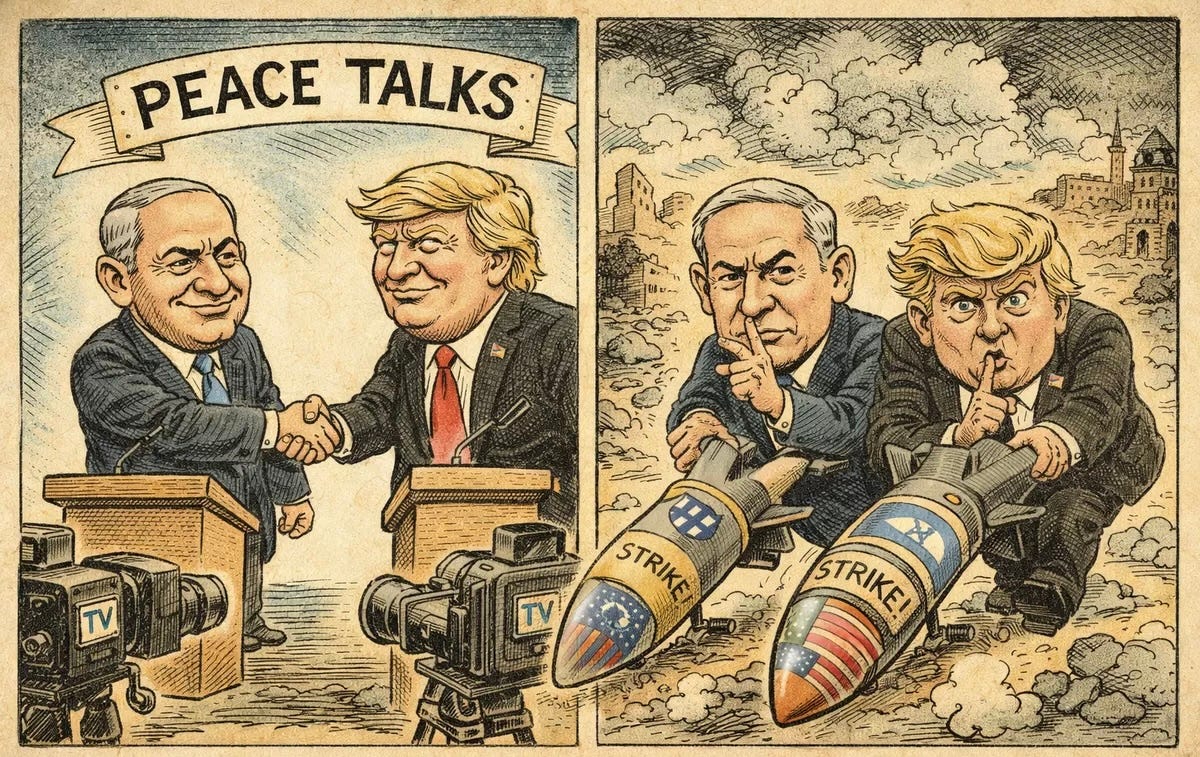
There’s a persistent illusion in modern politics: that leadership is a rare quality possessed by an individual, a personal magnetism that can be asserted through confidence, rhetoric, charisma, or sheer force of will. The events of the past several weeks in Israel, the United States, and among America’s own allies offer a useful corrective – but only if we’re willing to be precise about what the word “leadership” actually means, rather than dishing it out automatically to anyone who happens to hold high office.
As I argued in The Five Literacies of Global Leadership, leadership has absolutely nothing to do with role or status and even less with character. It is better understood as a functional impulse — the raw drive of people to organise around and act towards a shared end — cocooned in action whose real effect is to improve the circumstances of those it touches. Both halves of that definition matter, and neither is sufficient alone. The impulse by itself is morally neutral. It is the same current that moves a rescue crew towards a collapsed building and a mob towardss a scapegoat, the same energy that animates a nation defending itself and a demagogue building a following on grievance. What makes it leadership, rather than mere mobilisation, appetite, or manipulation, is the cocoon: the containing, shaping presence of action that actually functions to make things better for the people caught up in it. Strip that cocoon away and what remains isn’t just a corrupted form of leadership. It’s the impulse in its raw state — the appetite for power, for survival, for control — never having been real leadership at all, however convincingly it was dressed up as such.
This is worth dwelling on, because it explains something otherwise very hard to account for: how a tyrant, a demagogue, or an official waging a war to save his own political skin can generate such enormous energy, mass participation, and outward confidence and yet be exercising no leadership whatsoever. The impulse in these cases is fully present — sometimes overwhelmingly so. What is absent is the cocoon. The action is not shaped by, or oriented towards, the improvement of anyone’s circumstances but the actor’s own. It is naked power wearing leadership’s garb. And the giveaway is always the same: sooner or later, the people who were supposed to benefit from it notice that the very opposite has occurred.
When the relationship is asymmetric — when a prime minister, a president, or any officeholder purports to act on behalf of a society — this cocooned impulse acquires a visible, measurable proxy: collective consent. Consent is not a vote taken on the raw impulse itself; apart from those who might benefit from its corruption, nobody consents to naked ambition or appetite for power once they’re pointed out. What a public actually consents to, and what it can subsequently withdraw consent from, is the cocoon – the credible claim that a given exercise of power is being contained and shaped by something that genuinely serves them. Consent, in other words, is what the cocoon looks like from the outside, while it still holds.
But consent by itself is not a comprehensive definition of leadership, and it would be a mistake to treat it as one, because the cocoon can be counterfeited. A skilled manipulator can construct a casing that looks virtuous — draped in the language of security, sacrifice, and victory — while the impulse inside remains entirely one of self-interest. A population can be propagandised, frightened, or misinformed into behaving as though the cocoon were intact, when in fact it has already split open and only its outward shell remains. This is precisely why the purpose test — did this action actually improve anyone’s situation? — is so important. — has to sit above the consent test, not besides it as an equal. Consent tells us whether the cocoon still appears intact from the outside. Only the purpose test tells us whether it ever held anything real to begin with.
That is precisely why the polling out of Israel, the United States, and – as we’ll see – two of America’s closest allies matters so much. It is evidence, gathered on four separate fronts, of cocoons visibly rupturing — of publics looking at what was supposed to be virtuous containment and finding, instead, the raw impulse exposed underneath.
This is also where a second and related distinction becomes useful: the difference between two entirely separate uses of language. Most people use words to connect and convey – to make an inner state clear to another person so that understanding and, eventually, informed action can follow. But there’s another use of language entirely, favoured by propagandists, spin doctors, and officeholders under pressure: language deployed not to convey an idea but to extract an outcome — compliance, esteem, forgiveness, or another term in office. For this second kind of speaker, a declaration of “total victory” is not a description to be checked against reality. It’s a lever, pulled in the hope that the public will move, and, more specifically, in the hope that a well-worded cocoon can substitute for a real one.
Recent polling suggests that, in this instance, the levers are not working. When the vast majority of a population — including the officeholder’s own supporters and even the populations of allied nations with every institutional incentive to be charitable — reject the official narrative, they are effectively doing what any sensible person eventually learns to do with a manipulator: ignoring the words and watching the outcomes instead and recognising, correctly, that the cocoon they were shown has ruptured.
The Israeli Case
A survey conducted by the Hebrew University of Jerusalem in collaboration with the Agam Institute, fielded among 3,644 respondents between June 17 and 20 this year, produced numbers that should unsettle any government. An overwhelming 92.1 per cent of respondents said Iran had either won the conflict or gained more from it than Israel, while 82.9 per cent felt that Israel’s long-term security had been weakened by the war and its aftermath. Crucially, this was not simply an opposition talking point. The perception that Iran came out ahead was not limited to opposition supporters; among voters aligned with the right-wing bloc that forms Netanyahu’s own political base, 93.1 per cent also believed Iran had emerged stronger.
This is the signature of a genuine credibility collapse rather than a partisan dispute — and it is direct evidence bearing on the purpose test, not merely the consent test. If 82.9 per cent of the public believes its own security has been weakened rather than strengthened, then whatever else the war accomplished, it has not, in the judgement of those who lived through it, improved the human condition it was supposedly fought to protect. The same poll found that nearly three-quarters of those surveyed, 72.5%, said they did not believe Netanyahu’s claims about the military campaign’s achievements, while 56.4% rated his management of the campaign as “failed” or “poor”. Israelis were also broadly sceptical of the diplomatic settlement itself: nearly two-thirds, 63.2 per cent, opposed the U.S.-Iran deal, while only 12.1 per cent backed it.
Perhaps most tellingly, the erosion extends beyond the immediate conflict to the entire war effort of the past two years. Asked whether the wars against Hamas and Hezbollah had fulfilled the government’s stated goal of “total victory”, a staggering 61.3 per cent of respondents said those goals were not achieved “at all”, while only 12.2 per cent believed Israel had achieved most of its objectives. Meanwhile, Netanyahu’s own political standing has been eroding in parallel: support for his premiership fell from 40.5% in early March to 29.4% in June.
None of this occurs in a vacuum. Netanyahu now approaches an election under the strain of his relationship with Washington. As CBS News has reported, the coalition between Trump and Netanyahu that once appeared unbreakable frayed visibly once the fighting shifted from a shared military campaign to a contested diplomatic settlement. One correspondent captured the bind precisely: “Netanyahu, for political reasons, can’t end this war because he hasn’t delivered these incredible promises and because he doesn’t want to face a reckoning with the Israeli public.”
Read against that bind, the cocoon metaphor sharpens rather than softens the judgement. A war reportedly prolonged in part to delay a personal legal judgement is, almost by definition, an impulse no longer contained by anything oriented outward towards the public good. Netanyahu did not lose his standing because a rival politician outmanoeuvred him in a debate. He is losing it because the casing that once made his wartime decisions understandable as leadership — rather than as the raw pursuit of political survival — has visibly split open, and his own coalition is the first to say so.
The American Parallel
The pattern repeats, with local variation, in the United States. Following the American strikes on Iran and the subsequent diplomatic settlement, Reuters/Ipsos polling found deep public scepticism about whether the conflict had been worthwhile. Just one in four Americans believes President Donald Trump’s war with Iran was worth its costs, and a majority worry that a truce with Tehran is unlikely to last. More specifically, only 23% of Americans—including just half of Republicans—think the U.S. is now in a stronger position with Iran compared with its position before the war, while some 35% think it is in a weaker position. Scepticism about the durability of the peace itself was even more pronounced: some 63% of Americans think it unlikely that the deal Trump signed will lead to lasting peace between the two countries, while just 18% see lasting peace as likely.
This scepticism has come at a direct political cost. The five-day poll, which closed on Monday, also showed the war weighing heavily on Trump’s popularity, with his approval rating dropping to 34%, a return to the lowest level of his second term. Approval of his handling of the conflict specifically was even weaker, with subsequent Ipsos tracking finding his rating on Iran policy at just 29 per cent, alongside a stark verdict on the war’s value: only 25% of Americans said it had been worth it when weighing both costs and benefits.
The View From America’s Allies
If domestic polling in Israel and the United States were the only evidence available, a sceptic could still argue that this is simply what wartime politics looks like — that citizens directly affected by casualties and costs are naturally harder to satisfy than citizens further removed. The judgement of two of America’s own treaty allies, Australia and the United Kingdom, closes off that argument because it measures the view of populations with no domestic political stake in either man’s survival — populations, in other words, positioned to see the cocoon clearly, without the distorting heat of their own skin in the game.
The Australian data is unambiguous. Only 21% of Australians say they trust Donald Trump to do the right thing regarding world affairs, the lowest level of confidence in any US president in the history of Lowy Institute polling, with six in ten saying they have “no confidence at all” in him. That collapse extends to the country itself: Australians’ trust in the United States to act responsibly in the world has fallen to its lowest level ever recorded, with the gap in trust between America and China narrowing sharply. Eight in ten Australians disapprove of the way Trump has handled the military campaign in Iran — a verdict rendered by a country that bore none of the war’s costs and had every institutional reason to defer to its principal ally’s framing of events.
The British data tells the same story through a different mechanism. As of June 2026, only 13% of Britons had a favourable opinion of Donald Trump, against 83% unfavourable, giving him a net favourability of -70 in Great Britain. Two-thirds of the British public, 67%, explicitly describe themselves as “anti-Trump”, including 56% who say they are very anti-Trump — a judgement that cuts across party lines, with clear majorities of Conservative, Labour, Liberal Democrat and Green voters all identifying as anti-Trump. Confidence in the wider relationship has curdled alongside confidence in the man: just three in ten Britons believe the so-called “special relationship” is positive for Britain, while a further 16% do not believe the special relationship exists at all. As one pollster summarised the findings, “the era of the United States as an unquestioned ally for the UK appears to be over.”
Here a complication is worth being honest about, because it sharpens rather than weakens the argument. Unlike Netanyahu and Trump, Keir Starmer never made an affirmative claim about Iran that his public then rejected — his government kept Britain out of direct involvement in the strikes, a position that broadly matched public opinion at the time. Yet Starmer’s own domestic standing has collapsed regardless, with his net approval falling to -46 in early 2026, a score described as his joint lowest on record and equal to Theresa May’s worst rating. That collapse is a separate story, driven mainly by the economy and cost of living rather than Iran, and it should not be folded into the same argument as Netanyahu’s or Trump’s. But it illustrates the underlying mechanics from a different angle: the cocoon is granular and specific to the action it contains, not a single undifferentiated aura around a man. British voters are perfectly capable of judging that the casing around Starmer’s economic decisions has failed while, entirely separately, judging that whatever casing Trump ever had around his handling of Iran has failed too — applying the purpose test independently to each man, on each action, exactly as this definition would predict.
What makes both the Australian and British cases particularly instructive is that they separate, with unusual clarity, the impulse from its container. Neither public has concluded that the underlying alliance with the United States as an institution is rotten to its core — a majority of Australians still call the alliance important to their security, and British criticism is aimed squarely at the current occupant of the Oval Office rather than the relationship itself. What both publics have concluded is something narrower and more precise: that this particular man’s actions are no longer credibly cocooned in anything serving them. The institution can retain its casing even as the individual’s personal claim to one collapses — because those are different questions, answered by different evidence, and two allied publics have now quietly and precisely answered them the same way.
The Common Thread
Neither Netanyahu nor Trump can simply declare victory and expect the public — whether their own public or the wider public of allied nations watching from outside — to accept it. In democracies, legitimacy depends on whether citizens believe that those who govern them have strengthened their country’s security, prosperity, and international standing — not on whether those officeholders assert that they have. That is the purpose test, the question of whether the cocoon ever held anything real. And legitimacy also depends on whether that cocoon still appears intact to the people living inside its consequences – that is the narrower, political test, measured as consent. What the polling across all four fronts shows is a case where both tests are failing simultaneously and for the same underlying reason: publics that no longer believe a given course of action improved anyone’s conditions are, as a direct result, watching the casing around that action come apart—even when, as in Australia’s and Britain’s case, they have no electoral mechanism through which to register the rupture at all.
This is the point that gets lost in the personality-driven coverage of modern politics: leadership is not a private attribute exercised downward onto a passive public, and it is not established merely by holding an office and issuing decrees of success, nor even by sustaining high approval numbers indefinitely. It’s a functional impulse, judged continuously by the governed on whether it remains cocooned in action that actually serves them – a judgement rendered, as the Australian and British data show, sometimes by people who are not even the officeholder’s own citizens. A prime minister or a president can command armies, control messaging apparatuses, and dominate a news cycle for a week or a month. What they cannot do is spin a new cocoon out of language alone once the old one has visibly torn, and they cannot indefinitely pass off the appearance of virtuous containment for the real thing.
As I point out in my book, The End of the Opposition, modern politics increasingly rewards theatrical certainty over measured judgement and foresight. Declarations of triumph, delivered with sufficient conviction, are treated by much of the political class as functionally equivalent to triumph itself — and, more troublingly, as sufficient grounds on their own for the word “leadership” to be applied to whoever made them. But history is less interested in an officeholder’s rhetoric than in measurable outcomes, and publics — however imperfect their information, however susceptible to spin in the short term, and however distant from the theatre of events — eventually measure conditions against the promises made about them. Polls do not determine historical truth. They do, however, reveal something equally consequential: whether citizens, wherever they sit, still see a credible cocoon around the actions taken in their name, or whether they have watched it split open to reveal the raw impulse underneath.
When overwhelming majorities – an officeholder’s own supporters, his own electorate, and now the publics of his closest allies – begin to converge on the same sceptical verdict, that officeholder is not just suffering a communications problem. He is being told, by the only body capable of telling him, that what occurred was an exercise of naked power rather than an exercise of leadership – that whatever virtuous casing once made his actions clear as service has failed, whatever his office still says about his authority.
That is often the first sign that political authority is beginning to erode — and it’s a sign that no single office, and no single occupant of that office, can re-spin by insisting on people respecting the title. The cocoon was never his to construct out of language alone. It was always the public’s to recognise or deny on the only terms that ever really mattered – and theirs to declare broken the moment those terms stop being met, whether that public sits at home or half a world away.