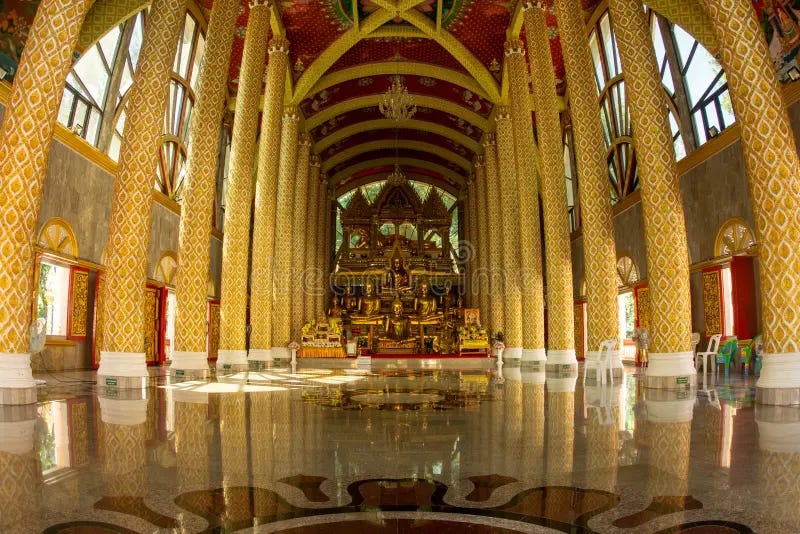
Bangkok on an ordinary afternoon, the kind the city produces without effort — heat; colour; the low percussion of traffic; and the smell of incense threading through diesel. My wife was attending to her mother. We had come to make merit at one of the great temples, Wat Arun most likely, its spires rising from the Chao Phraya bank in their usual extravagant indifference to the century.
I had been inclined to Buddhist philosophy since my teenage years in England. Not the kind assembled from books and weekend retreats but something that had visited early and quietly settled — a way of moving through a world that felt, if anything, more instinctively mine than the Christianity into which I had been chorally inducted as a boy. Standing outside the prayer hall, I felt what I always felt in such places. The particular stillness that comes from knowing you belong.
Then I read the sign.
Foreigners are not permitted entry while prayers are in progress.
I held the words at a slight distance for a moment, the way one might read a notice assumed to concern someone else. Then the distance closed. I was the foreigner. My practice, my years, whatever genuine interior calm I had accumulated — none of it visible to the sign, none of it legible to the institution behind it. What was clearly readable was my face. The category my body occupied whether I chose to or not.
The guardian at the door was politely adamant. I could not enter even with members of my Thai family. The empathy I had felt only seconds earlier — that easy fellow-feeling with the worshippers inside — didn’t disappear. It shifted register entirely. I understood now, with a suddenness that had the quality of something long known finally arriving, what it means to be classified before being encountered. To be read as a category rather than a person. To find that the universal claim of a tradition stops at the boundary of the particular body standing before it.
I wrote a letter to the Bangkok Post. It was published. I complained about the double standard — the tradition that welcomed all sentient beings within its cosmology and turned away foreign bodies at its door. The response, when it came, arrived not from the temple but from my employer. The Dean of the International School — an Australian like me, which is the detail that still carries the most weight — called me in. My behaviour, he explained with the particular care of someone delivering a verdict already decided, was too extreme.
I want to pause on that word. Extreme. Not wrong, not offensive, not culturally inappropriate. Extreme. As if the act of naming a contradiction clearly, in public, placed one outside the boundaries of acceptable conduct. As if the double standard were not the problem but the naming of it. I have since encountered this logic in boardrooms and government offices across three continents. The institution protects itself not by defending its contradictions but by reclassifying the person who notices them. You are not a critic. You are an extremist. The category does the work that argument cannot.
What I didn’t fully understand then, though my body registered it immediately as a kind of queasiness, was that I had stumbled into one of the defining mechanisms of the world-system I would spend the following decades trying to comprehend. Not the temple’s exclusion specifically — that was a local and arguably forgivable expression of a living tradition still negotiating its relationship with globalisation. What I had encountered was something more pervasive: the way institutions of every kind, religious, academic, corporate, governmental, manage the threat of transparency by reclassifying it as deviance.
The body knows these things before the mind has language for them. This is the elementary fact that we’re formed before we are educated, that the nervous system accumulates evidence long before the intellect is equipped to interpret it. Standing outside that prayer hall, I felt, in sequence, belonging, exclusion, and then the particular loneliness of someone whose belonging cannot be made decipherable to the systems that adjudicate it. That sequence had visited me before. It would visit me again. Each time, the body registered it with the same accuracy, the same stomach-turning recognition, before the mind caught up and began to construct the argument.
This is what industrial economism does at its most intimate level. Not the grand operations — the extraction of resources, the commodification of labour, the conversion of living systems into productive inputs — though it does all of these with thoroughgoing efficiency. What it does first, and most durably, is install a particular perceptual apparatus. It teaches the nervous system what to notice and what it can safely disregard. It calibrates the senses to the frequencies the system can process — productivity, measurability, legibility to accounting — and dampens everything else. The child sitting in rows absorbing pre-segmented knowledge is not being taught a curriculum. She is being taught what ‘the real world’ feels like. The conscript who learns to see the opposing force as a threat category rather than a collection of people with fears and desires similar to his own is not acquiring hatred — he is losing a specific form of perceptual access, the kind that makes pulling a trigger on a recognisable human being neurologically difficult. The training works not by adding but by subtracting.
Formation is more durable than instruction. You can argue with what you have been told. You cannot easily argue with what you have been made to feel.
The sign outside the prayer hall was not, in this sense, a Buddhist problem. It was a human problem of the most familiar kind — the institution asserting its authority over the experience it was created to serve. Every tradition does this. Every institution eventually runs the risk of mistaking its own continuity for its actual purpose. The temple that turns away the foreign Buddhist is doing what universities do when they credential compliance rather than cultivate understanding, what corporations do when they harvest attention rather than create value, what democracies do when they protect incumbency rather than represent the governed. The mechanism is identical. Only the sign changes.
What changes when you have lived long enough across enough cultures — the scattered geographies of a life organised around inquiry rather than settlement — is the ability to see the mechanism for what it is, stripped of the particular sign that announces it in any given place. This is not cosmopolitanism in the tourist sense. It’s less comfortable: the gradual, sometimes painful accumulation of evidence that the fictions we live inside are just that, that their authority is borrowed from our consent, and that the consent can, in principle, be withdrawn.
In principle. The difficulty is that by the time you can see the fiction clearly, you are already formed by it. The perceptual apparatus that allows you to recognise the mechanism is itself a product of the very system being recognised. We are trying to see the problem with eyes the problem already shaped. This is a precise description of the actual situation, which is the necessary beginning of any honest attempt to change it.
The dean who called me extreme was not a villain. He was a man who had made his accommodations with the institutions that employed him, as most of us do, and who experienced my refusal to make the same accommodations as a form of aggression directed at the order he had chosen to represent. I understand that now in a way I refused to appreciate originally. What I could not accept then and can’t concede now is that the accommodation was neutral. Every time we absorb an institutional contradiction in silence, we participate in its reproduction. The sign stays on the door. The next foreign Buddhist reads it. The institution continues its devotions undisturbed.
I left the university shortly afterwards. Not dramatically — these things rarely end dramatically when the institution holds the formal power. The exit was managed politely and conducted in the language of mutual agreement. But my body knew what it was. The same body that had stood outside the prayer hall, that had registered the shift from belonging to exclusion in the space between one sentence and the next, knew with equal precision what was happening in the Dean’s office and what it meant.
That precision is, I have come to believe, one of the most valuable and most suppressed forms of intelligence available to us. Not the intelligence of argument or analysis — though those matter in ways that are undeniable. But the somatic intelligence that’s been paying attention long enough to recognise a pattern when it recurs. Industrial economism has no use for this intelligence. It can’t be measured, credentialled, or converted into productive output. It’s precisely the kind of knowing that the school was not built to cultivate and the corporation was not built to reward.
And yet it’s the intelligence on which everything that matters depends. The capacity to feel the contradiction before you can name it. To know, in your body, that something is wrong with an arrangement — that the sign on the door and the teaching inside it are not the same thing, that the Dean’s language of mutual agreement and the reality of managed exit are not the same thing, that the growth curve on the quarterly report and the condition of the living systems that made it possible are not the same thing.
This is what a life lived across cultures and across the grain of institutional expectation slowly teaches if you’re willing to remain a student of your own experience rather than its manager. Not cynicism — cynicism is just disappointment that’s stopped paying attention. A rarer capacity develops in its place, more useful and more difficult: the ability to hold the contradiction without resolving it prematurely, to stay present to the gap between what institutions claim and what they do, and to keep asking, with whatever clarity the uncertainty allows, what it would mean to close it.
I assume the sign is still on the door of the temple today, although I haven’t been back to check. What has changed is not the sign but the quality of attention I bring to it — and to all the other signs, in all the other doorways, that announce in their various registers the same essential message: that the universal claim stops here, at the boundary of the particular body, the inconvenient question, the letter to the newspaper that someone in authority will find too extreme.
That edge is where the most important thinking always happens. Not inside the prayer hall, where the doctrine is rehearsed among the already converted. Outside it, in the heat, reading the sign, feeling the shift — from belonging to exclusion, from observer to object — and refusing, despite everything, to move on without understanding what just happened.