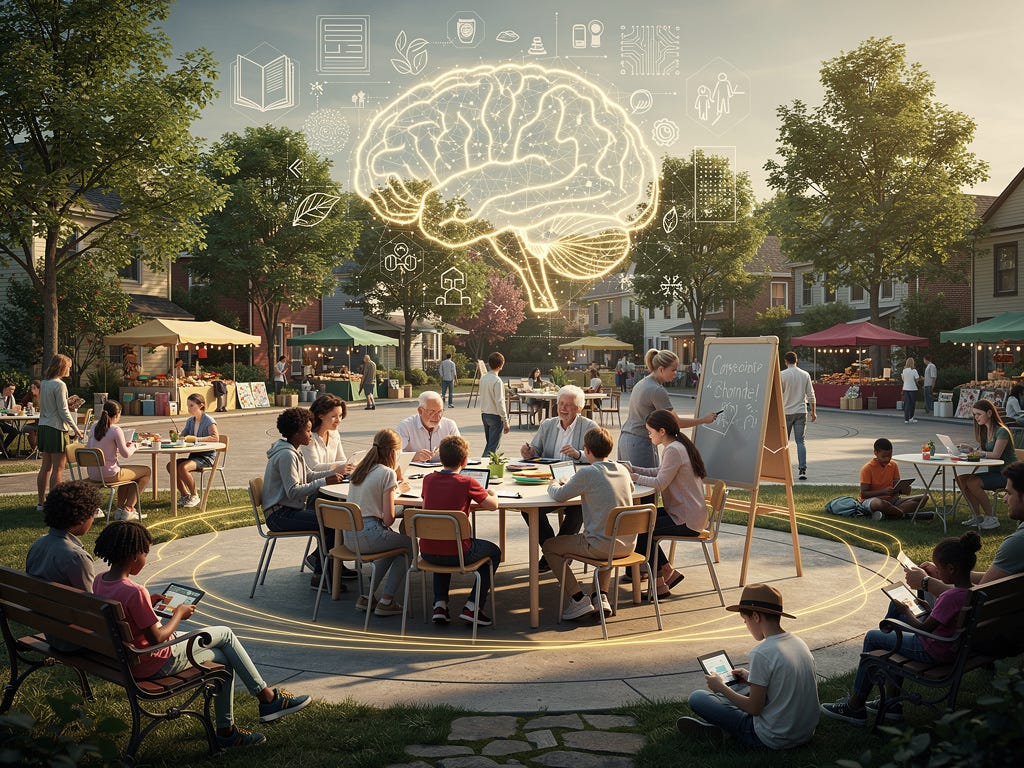
This essay is addressed to those who work within or alongside systems of formal education — teachers, curriculum designers, policymakers, educational researchers, and the administrators of institutions that have staked their legitimacy on preparing the young for a future that is no longer clear. It doesn’t rehearse the familiar critique of industrial schooling, which has been made with sufficient eloquence and sufficient futility for a century and a half. It asks, instead, a prior question: what is the educational relationship for, at a moment when the premises of the civilisation itself are in crisis? And it argues that the answer requires not reform of schooling but a rethinking so fundamental that the school, as currently conceived, may not survive it — and that this is not a catastrophe but an opportunity, if we are willing to think clearly about what must remain when the institution has been stripped away.
I. The Wrong Question Has an Impressive Building
Every institution is the fossilised answer to a question. The question that generated the modern school was: how do we produce, at scale and with consistent quality, the human capital required by an industrialising economy and a centralising state? It was a reasonable question for the nineteenth century. The institution it generated — age-stratified, subject-siloed, examination-driven, compliance-oriented, credentialling at its terminus — was a reasonable answer. The tragedy is not that the answer was wrong. It’s that the question has changed beyond recognition, and the institution, with the magnificent inertia of all successful institutions, continues to answer the original one.
Those who work inside education are not, in the main, unaware of this. The professional literature is saturated with diagnoses of misalignment between schooling and the contemporary world. The gap between what schools teach and what societies need, between what examinations measure and what intelligence actually is, between the institution’s official purposes and its actual effects — these gaps are documented, debated, and lamented at every level of the profession. What the literature conspicuously lacks is a willingness to follow the diagnosis to its logical conclusion: that if the question has changed this fundamentally, the institution built to answer the old question cannot be reformed into one that answers the new one. It must be reconceived.
Reconception is not destruction. It’s the recognition that a form which served one set of purposes admirably will serve a different set of purposes poorly, however much money and goodwill is spent on its renovation. The question before the profession is not how to improve the school. It is what the school is an institution – any institution – for, in a world where the assumptions that justified its existence are dissolving. This is not a comfortable question for those whose careers and identities are vested in the existing form. But it’s the only question whose answer will be adequate to the moment.
The Premises We Inherited
The school rests on four premises, rarely stated because they are so deeply assumed that they feel less like premises than like fixtures:
That there’s a body of knowledge whose transmission constitutes education, and that this body is sufficiently stable and sufficiently agreed-upon to form a curriculum.
That the appropriate unit of educational organisation is the age-cohort, and that children of similar age are at similar stages of intellectual and moral development.
That learning is a preparation for living, a process completed in the first two decades of life to equip the person for the five or six that follow.
That the primary purpose of education is economic — the production of individuals whose skills, dispositions, and credentials will make them useful to the economy into which they are released.
Each of these premises is now under severe pressure from the evidence. The body of knowledge is not stable: it’s expanding faster than any curriculum can track, and large portions of what is currently taught will be algorithmically automated within the working lifetime of the students currently learning it. The age-cohort model ignores everything developmental psychology has established about the variance in human maturation and neurodiversity. The preparation-for-living model is negated by the reality of lifelong learning in conditions of permanent change. And the economic purpose, never the whole truth and always more ideological than functional, is simply no longer adequate to the scale of the challenges that the next generation will inhabit.
What’s particularly striking is not that these premises are false. It’s that the profession knows they are false — that educational researchers, curriculum theorists, developmental psychologists, and many classroom teachers have known for decades that the institutional structure rests on foundations that don’t match the evidence — and that the institution has nevertheless continued, largely unchanged, because the premises are not held at the level of argument. They are held at the level of structure. And structure, unlike argument, doesn’t respond to counter-evidence. It responds only to a force capable of displacing it.
II. Industrial Economism and Its School
To understand why reform has so consistently failed to reach the institution’s foundations, it’s necessary to understand the civilisational paradigm within which the school, or the university for that matter, operates. That paradigm is industrial economism: not merely an economic policy or a set of market arrangements, but a total worldview — a comprehensive yet tacit account of what exists, what has value, how human beings relate to each other and to the living world, and what constitutes progress.
Industrial economism holds, as its foundational axiom, that value is produced by the application of human labour and capital to natural resources, and that this value is best measured and allocated through monetised markets. Everything else — ecological relationship, cultural meaning, moral obligation, the irreducible singularity of persons, the claims of future generations, the vitality of living systems not yet entered into any balance sheet — is either a private matter or an ‘externality’: a cost that the market has not yet found a mechanism to price, and that’s therefore zero - for the purposes of institutional decision-making at least.
This is not a caricature. It’s the operating logic of every ministry of education in the industrialised world, expressed with varying degrees of ideological candour. When governments speak of education, they speak of human capital, skills pipelines, graduate premiums, and international competitiveness. When they evaluate schools, they use instruments that measure the outputs most intelligible to an economic framework: standardised test scores, university entrance rates, employment statistics. When they fund research into pedagogy, they fund research whose outcomes are expressible in terms of measurable student attainment. The framework is so total that departures from it are not rebutted but simply unrecognised — they don’t register as wrong answers but as category errors, the wrong kind of question for a policy conversation.
What the Paradigm Costs
Industrial economism’s educational apparatus has produced, alongside its genuine achievements, three civilisational debts now coming due simultaneously.
The first is ecological. A species that has been educated, for six or more generations, to understand the natural world as raw material for economic transformation has developed, predictably, the relationship to the living world that such an education produces. The accelerating collapse of biodiversity, the destabilisation of the climate system, the contamination of hydrological cycles and soil ecologies that took millions of years to develop — these are not failures of individual moral will. They are the aggregate output of an educational system that has systematically trained attention away from ecological relationship and toward economic transaction. We didn’t produce ecological illiteracy by accident. We produced it by design, and we maintain it by curriculum.
The second debt is democratic. The compliance-oriented school produces, as its central character type, the person who waits to be told what’s true, what to value, and what constitutes an acceptable response to a situation. This character type was functional in a twentieth-century democracy of mass media and stable institutional authority. It is catastrophically dysfunctional in the information environment of the twenty-first century, where the capacity to evaluate competing truth claims, to resist sophisticated manipulation, to maintain epistemic integrity in the face of algorithmically curated persuasion, is not a specialist skill but a survival requirement. The school that trained compliance has produced a citizenry exquisitely vulnerable to the authoritarian and post-truth movements now destabilising democracies across the industrialised world.
The third debt is existential. Industrial economism, as an account of human purpose, is impoverished. It offers the individual a role — producer, consumer, credential-holder — but not a meaning or an identity within tht meaning. The extraordinary rates of mental health crisis among the young in industrialised societies, the epidemic of purposelessness that clinical literature documents with increasing alarm, the widespread sense that the future is something to be feared rather than occupied are not pathologies that have descended from outside the educational system. They are, in significant part, its products: the predictable outcomes of an institution that has spent twelve years measuring young people against an economic metric and found most of them wanting, while offering no alternative account of what a human life might be for.
III. The Teacher in the Age of the Knowing Machine
The emergence of generative artificial intelligence has introduced into the professional conversation about education a question that cuts to the bone of institutional identity: what is a teacher for, when the student has access to a system that has processed more text and imagery than any human being could assimilate in a thousand lifetimes, that can explain, tutor, evaluate, code, compose and generate across every domain of the curriculum, at any hour, in any language, with inexhaustible patience?
The profession’s initial responses to this question have largely been defensive: concerns about academic integrity, debates about detection, policies about permitted and prohibited uses. These responses are understandable, but they mistake the challenge. The problem is not that students might use synthetic intelligence to circumvent assessment. The problem is that the existence of synthetic intelligence has exposed, with sudden and uncomfortable clarity, what the school has actually been doing for the last century and a half — and that much of it turns out to be information transfer, a task for which the machine is simply better equipped than the human being.
If the teacher’s primary function is to transmit a curriculum — to convey information from the authorised source to the learner, and to verify that the conveyance has been successful — then the teacher is, as a professional category, in genuine existential difficulty. Not because she will be replaced immediately, but because the institutional rationale for her function has been undermined at its foundation. You cannot rebuild a professional identity on the premise that information transfer is the core of teaching, when a freely available tool performs information transfer better than any human being can.
The Irreplaceable Thing
What the machine cannot do — what it cannot do in any sense that touches the educational relationship at its core — is be present. Not present in the trivial sense of occupying the same physical space, but present in the phenomenological sense: genuinely engaging with another person, being moved by their confusion, altered by their question, surprised by the direction their thinking takes. The machine processes. The teacher, when she is fully what a teacher can be, encounters. And in the space of genuine encounter, something happens that no information transfer can produce or replicate: the learner discovers that her thinking matters to another human being, and this discovery — unremarkable in description, transformative in experience — becomes the precondition of genuine intellectual development.
But the encounter doesn’t transform only the learner. This is the insight that the transmission model of teaching has always suppressed, and that the existence of the knowing machine now makes impossible to ignore. Paulo Freire understood it as praxis: the dialectical movement in which reflection and action are inseparable, in which the teacher who genuinely engages with a student’s thinking is herself changed by that engagement — her understanding deepened, her assumptions disturbed, her sense of the subject renewed by the angle of vision that only this student, at this moment, could have provided. The teacher who is not changed by her teaching is not teaching. She is performing a delivery function, and the machine performs delivery functions better than she does.
Praxis refuses the hierarchy that the transmission model requires. It does not position the teacher as the one who knows and the student as the one who does not, with knowledge flowing in a single direction across the gap between them. It positions both as participants in a shared encounter with difficulty — an encounter in which the teacher’s greater experience and more developed framework are genuine assets, but in which the student’s freshness of perception, her unencumbered approach to the question, her refusal to accept the established answer as settled, are equally genuine assets of a different kind. Vygotsky’s zone of proximal development is usually understood as the space in which the student reaches beyond her current capacity with the teacher’s assistance. It is equally, and less often acknowledged, the space in which the teacher reaches beyond her habitual understanding with the student’s provocation.
The knowing machine doesn’t threaten the teacher who understands her work this way. It liberates her from the delivery functions that were never genuinely hers and that diminished her by their imposition. What remains when delivery is automated is precisely what cannot be automated: the rejection of a formulaic role for the quality of presence, the capacity for genuine encounter, and the willingness to be changed by what she meets. These are not supplementary virtues that a good teacher adds to her technical competence. They are the substance of teaching itself — the factor that every student who has ever been genuinely educated by another human being remembers, long after the content of the lesson has faded, as the thing that made the difference.
Epistemic Authority After the Credential
The knowing machine also dismantles, irreversibly, the epistemic authority that credentials have historically conferred. The credential said, in effect: this person has been certified by a recognised institution as having mastered a defined body of knowledge, and you may therefore trust her judgement within that domain. In a world where the body of knowledge is stable and its mastery is difficult, this was a useful signal. In a world where the body of knowledge changes faster than any credential cycle, and where access to current knowledge is available to anyone with a device and a connection, the credential as epistemic warrant is approaching obsolescence.
This is not an argument against expertise. Deep expertise — the kind that comes from years of sustained attention to a domain, the accumulated pattern recognition that cannot be compressed into any retrievable database, the capacity for judgement in conditions of genuine ambiguity — remains irreplaceable and will become more valuable, not less, as shallow information becomes more abundant. But deep expertise of this kind is not what credentials predominantly certify. They certify performance on standardised assessments at a particular moment in time. The gap between those two things is the space in which a new understanding of professional educational authority must be constructed.
The teacher in the anthropocentric era derives authority not from her possession of a curriculum but from the quality of her thinking — her capacity to reason in public, to change her mind on evidence, to hold complexity without false resolution, to demonstrate, by the texture of her own intellectual life, that engagement with difficult questions is worthwhile. This is an older model of educational authority than the industrial one, and in many respects a more demanding one. It cannot be conferred by a ministry. It must be earned, continuously, in front of the people it claims to serve.
IV. Scholastic Time and the Falsification of Learning
There’s a dimension of institutional schooling whose damage is so pervasive that it has become invisible: its relationship to time. The school bell is among the most powerful pedagogical instruments ever deployed, and among the least examined. It says, with the authority of the clock: this thought is complete. Move on. The fact that genuine understanding does not arrive on schedule, that insight is nonlinear, that the most important moments of intellectual development tend to occur in the spaces between directed activity — these are inconveniences that the timetable cannot accommodate and therefore doesn’t acknowledge.
Scholastic time — the artificial compression and segmentation of learning into fifty-minute parcels, distributed across a six-hour day, repeated across a forty-week year, for twelve or thirteen years — is not a neutral organisational convenience. It’s a theory of learning, and a false one. It encodes the assumption that understanding accumulates additively and predictably, that an hour of mathematics followed by an hour of history followed by an hour of science produces, at the end of the day, a person who knows more mathematics, more history, and more science. This is not how understanding works. Understanding works through digestion, incubation, unexpected connection, the sudden recognition that two apparently separate domains share a deep structure. It works through the question that arrives at two in the morning and cannot be answered until the following Tuesday. It works at its own pace, which is not the pace of the curriculum.
The consequence of scholastic time is a systematic falsification of the relationship between effort and understanding. The student who has not understood is moved forward anyway, because the timetable requires it. The student who has understood is kept in place anyway, because the cohort requires it. Both are taught, by this experience, that their actual cognitive state is irrelevant to the institutional process — that what matters is not whether they have genuinely grasped something but whether they have produced the required performance at the required moment. This lesson, absorbed across twelve years of schooling, produces the particular kind of strategic intelligence that the examination system rewards: the capacity to simulate understanding convincingly enough to satisfy an assessor, without necessarily achieving it.
Duration, Depth, and the Courage of Not Knowing
Genuine learning requires the permission to not know for extended periods. This permission is structurally denied by the assessment-dense curriculum, which requires the student to demonstrate knowledge at regular intervals and penalises demonstrated ignorance. The result is an educational culture in which not-knowing is experienced as failure rather than as the necessary condition of eventual understanding, and in which the simulation of knowledge — the confident deployment of half-understood concepts in the register of mastery — is consistently rewarded over the more honest and more educationally valuable acknowledgement that the question is still open.
Departments of education would do well to examine what they are actually rewarding when they reward high-performing students. In many cases, they are rewarding the capacity to produce fluent performances of certainty. This capacity is useful in some professional contexts and dangerous in others. It is dangerous in precisely those contexts where the most important professional skill is the recognition of what one does not yet know — in medical diagnosis, in public policy, in scientific research, in any domain where overconfidence in partial understanding produces outcomes that are difficult to reverse.
A pedagogy adequate to the current moment would treat not-knowing as a curriculum subject in its own right: something to be practised, developed, and assessed. It would ask not only what the student knows but how she holds what she knows — with what degree of tentativeness, with what sensitivity to counter-evidence, with what capacity to revise. It would understand that the most educationally significant question a student can ask is not the one whose answer he already suspects but the one that genuinely disturbs him, the one that he cannot close without loss. These questions cannot be scheduled. They can only be cultivated, in classrooms where the teacher’s own not-knowing is visible and respected rather than concealed behind the authority of the syllabus.
V. Whose Future Is Being Prepared?
Every curriculum is an act of imagination about the future, and every act of imagination about the future encodes the perspective of those doing the imagining. The curriculum of the modern school encodes, with remarkable fidelity, the perspective of the industrialised North Atlantic: its epistemological traditions, its historical narratives, its conception of rationality, its account of progress, its implicit assumptions about what constitutes a well-formed question and a satisfactory answer. This encoding is the natural consequence of the fact that the modern school was invented in a particular civilisational context and has been reproduced, largely unexamined, across a world that is not that context.
The implications for those who work in education are uncomfortable yet necessary. The science curriculum that treats indigenous ecological knowledge as folklore rather than as a different and sometimes more accurate framework for understanding local ecosystems is not neutral. The history curriculum that frames the colonial period as a story of development and modernisation, in which the agency and suffering of colonised peoples is incidental, is not neutral. The mathematics curriculum that treats Western formal notation as the universal language of quantity — rather than as one among many sophisticated systems of mathematical thinking developed across cultures — is not neutral. Each of these choices encodes a civilisational perspective as though it were a view from nowhere, and each of them shapes the mind that encounters them toward particular assumptions about whose knowledge matters, whose past is worth studying, and whose future is worth preparing for.
This is not, primarily, a question about representation in the curriculum, though representation matters. It’s a question about epistemological pluralism — about whether the school can tolerate, and actively cultivate, the recognition that there are multiple valid ways of knowing the world, and that the industrialised West’s ways of knowing, however powerful in particular domains, are neither complete nor universally applicable. An education adequate to the civilisational moment must produce people capable of thinking across epistemological traditions, not merely people who are aware that other traditions exist. The difference is the difference between cultural tourism and genuine intellectual encounter.
The Colonial Architecture of Assessment
Assessment is where the epistemological politics of the curriculum become most visible and most consequential. The standardised examination does not merely test knowledge. It tests a particular relationship to knowledge: the capacity to retrieve and deploy information in a decontextualised, individually competitive, time-pressured, written format. This relationship to knowledge is not universal. It is specific to a particular cultural tradition — one that values individual over collective cognition, written over oral expression, speed over depth, and convergent over divergent thinking.
The student who thinks best in conversation, collaboratively, slowly, through narrative, through embodied practice, through the accumulation of example rather than the application of principle, is not less intelligent than the one the examination rewards. She is differently intelligent, in ways that the examination framework cannot see and therefore cannot value. The school’s response to her difference has historically been remediation: she is identified as having a deficit relative to the norm, and resources are directed toward closing that deficit. The possibility that the norm itself might be the problem has existed largely outside the institutional frame.
A genuinely pluralist approach to educational assessment would not simply offer multiple formats within the existing framework. It would question the framework’s foundational assumption: that learning can be adequately evidenced by individual performance on a decontextualised task. It would ask what forms of evidence are genuinely illuminating of the capacities that matter, in a world where those capacities include collaborative intelligence, adaptive thinking, ecological literacy, moral reasoning under uncertainty, and the ability to construct and communicate meaning across cultural and disciplinary boundaries. None of these capacities is well evidenced by a three-hour written examination. All of them are essential.
VI. Ecority and the Educational Relationship
The civilisational framework within which a genuinely different education becomes not just desirable but logically necessary is what I have elsewhere called ecority. The word arrived through the Hall-Tonna Values Inventory, but the concept it names is more ancient than any taxonomy of values: it’s the recognition, available to any attentive observer of living systems, that ecology, security, and integrity are not separate domains requiring separate policies but different expressions of a single condition — the condition of flourishing in mutual life-affirming dependence.
Ecority holds that three obligations are not simply compatible but mutually constitutive: the obligation to be genuinely beneficial to each person within reach; the obligation to be syntrophic — generative rather than extractive — for the living world on which all other value depends; and the obligation to honour the claims of those not yet born alongside those already living. These three obligations form what I have called the trimunary: a simultaneous, non-negotiable, non-tradeable set of commitments that apply to individuals, institutions, and civilisations alike. You cannot satisfy one at the expense of the others. The attempt to do so is precisely what industrial economism has tried for two centuries, and the results are the civilisational debts described earlier.
Where industrial economism asks of any educational practice: does this increase measurable output at acceptable cost? — ecority asks something simultaneously simpler and more demanding: does this increase the vitality, resilience, and creative capacity of the living system it touches? Does it leave the learner more fully herself, more deeply connected, more capable of genuine contribution to the communities — human and more-than-human — in which she is embedded? Does it take seriously the world the learner will inhabit when the institution has released her, including the parts of that world not yet visible?
Syntrophy as Pedagogy
The concept of syntrophy — the tendency of living systems to create conditions that support further life, to build complexity rather than exhaust it — offers the most productive alternative to the extractive logic of industrial education that I know. Where extraction takes from the learner — takes compliance, performance, credential-eligible behaviour, standardisable output — syntrophic education deposits into the learner: capacity, confidence, connection, the specific and unteachable sense that one’s own thinking has genuine traction in and on the real world.
A syntrophic school does not extract performance from students in order to produce rankings. It creates conditions in which students’ capacities grow, surprise the institution, exceed what the curriculum predicted, and connect in ways the timetable did not schedule. This is a different relationship between the institution and the learner, and it requires a different institutional character: one that is genuinely curious about who each student is, rather than merely attentive to how each student performs; one that understands its own flourishing as a function of its students’ flourishing, rather than as something to be maintained at their expense.
Syntrophic pedagogy makes greater demands of the teacher than the transmission model, because it requires genuine attention rather than competent delivery. It makes greater demands of the institution, because it requires structural flexibility rather than bureaucratic consistency. And it makes greater demands of the student, because it asks for genuine engagement rather than strategic performance — it asks the student to be genuinely present to the difficulty of thinking, rather than adept at the simulation of having thought.
The Trimunary Test Applied
The trimunary test — is this good for future generations? Is this syntrophic for the living world? Is this genuinely beneficial to each person it touches? — applied systematically to the apparatus of formal education, produces verdicts that departments of education should find uncomfortable.
The standardised examination fails all three counts. It’s not good for future generations, because it selects for convergent performance under pressure, which is not the cognitive profile most needed in conditions of radical uncertainty and ecological emergency. It’s not syntrophic for the living world, because it organises attention around abstract symbolic manipulation in sealed rooms, training the mind away from the embodied, relational, and ecological modes of knowing that ecological literacy requires. And it’s not genuinely beneficial to each person it touches, because it ranks human beings against a single metric derived from a single tradition and declares the majority deficient, a verdict that is simultaneously false and damaging.
The age-cohort model fails all three counts. The subject-silo curriculum fails all three counts. The credential-as-endpoint model, which declares education complete at the moment of qualification and then loses interest in the continuing development of the person it has just released into a world it cannot predict, fails all three counts with a particular clarity. The compliance-over-curiosity pedagogy fails all three counts so comprehensively that its failure constitutes a kind of negative proof: if you wanted to design an educational apparatus maximally ill-suited to the civilisational demands of the twenty-first century, you would design something very close to what we currently have.
This is not said in condemnation of the people within the system. It is said in recognition of what the system is — and in the conviction that the people within it, many of whom became educators precisely because they believed in something larger than the system’s current form, are capable of building something different if given, or if they seize, the permission to do so.
VII. If Not the School, Then What?
The question that educational professionals most urgently need to pose is the one they are most professionally disinclined to ask: if the current form of schooling is as misaligned with the civilisational moment as the preceding argument suggests, what would replace it? This isn’t meant to be a rhetorical question. It’s a design question, and it deserves a serious answer.
The answer does not begin with an alternative institutional structure, because the error of the existing institution was precisely to begin with structure — to design the container before thinking about what it was for. The answer begins with the educational relationship itself: the irreducible encounter between a person who knows something from experience and a person who is trying to know something, in the context of a world that both of them must inhabit together.
That relationship is ancient, durable, and entirely independent of the institutional forms it has taken. It predates the school by as long as human beings have been human beings. It has existed in forests and workshops and courts and apprenticeships and conversations over fires. It has flourished in the most unlikely institutional containers and been stifled in the most elaborately appointed ones. It doesn’t require a curriculum or a timetable or an examination board. It requires attention, care, honesty, and the shared conviction that understanding is worth the effort of pursuing it.
These are not institutional properties. They are human ones. And no institutional reform, however comprehensive, will produce them if they are absent from the people inside the institution.
The Non-Negotiable Core
What remains when the school has gone — what must remain, what survives every institutional form and every civilisational transition — is this: the human impulse to make sense of experience, to share that making-of-sense with others, to pass on what has been hard-won to those who will need it next, and to do all of this in full awareness that the world is larger than any account of it, and stranger, and more generative than any syllabus has yet managed to reflect. This impulse is not produced by institutions. Institutions can honour it or suppress it. The first step toward educational renewal is understanding which of these the current institution is doing, and why.
The institutional forms that might better honour this impulse are beginning to emerge, experimentally and at the margins: learning communities organised around real problems rather than disciplines; assessment practices that ask for portfolios of genuine work rather than performances under artificial conditions; educational relationships that extend across generations rather than being confined to age-cohorts; schools whose walls are permeable to the communities they occupy, so that the problems of those communities enter the learning space as live material rather than as case studies; curricula that are co-constructed with learners rather than delivered to them, on the understanding that the question a young person genuinely needs answered cannot always be anticipated by a national framework.
None of these experiments is yet operating at scale, and none of them is without difficulty. Scale is not, in any case, the right measure for this kind of development. The mycorrhizal network does not scale in the manner of a production line. It spreads, connects, and deepens through the cultivation of conditions rather than the replication of units. The spread of genuinely different educational practice will look more like that than like the rollout of a policy initiative, and those who wait for the policy initiative before beginning will wait longer than the planet has to offer.
Departments of Education as Civilisational Actors
Departments of education, in particular, face a choice that their institutional culture has so far allowed them to defer. They can continue to optimise the existing system — tightening assessment frameworks, expanding curriculum content, developing teacher competency standards, improving the quality of instruction within the existing model — and produce, with increasing efficiency, an output that is increasingly misaligned with the world it is meant to serve. Or they can accept the role that the civilisational moment is offering them: the role of genuine metamorphosis, which means beginning the long, difficult, professionally risky work of dismantling the premises of the existing model and building from different foundations.
This choice can’t be deferred indefinitely. The ecological emergency, the democratic breakdown, the social fracturing, and the technological acceleration are not waiting for institutional readiness. They are already inside the school, in the form of the young people who experience, daily, the dissonance between what the institution tells them matters and what their actual encounter with the world suggests. That dissonance is educational, in the deepest sense: it’s an invitation to think. Whether the institution responds to it as a problem to be managed or as an inquiry worth taking seriously will determine whether the school survives its own irrelevance or transforms into something the next civilisation can actually use.
VIII. Educating for Ecority
What would it mean, in practical terms, to organise education around ecority rather than industrial economism? The question is not primarily curricular, though the curriculum would change substantially. It is primarily relational and institutional: a question about the quality of the encounters that the educational institution makes possible, and the civilisational premises that those encounters encode.
An education organised around ecority begins with a different account of the learner. Not a vessel to be filled with curriculum content, not a unit of future human capital, not a score on a standardised assessment — but a node in a web of living relationships, carrying an irreducible particularity, arriving with questions already forming, belonging simultaneously to a species, a culture, an ecosystem, a generation, and a moment in civilisational time that will not recur. To educate this person is not to process her toward a predetermined outcome. It’s to create conditions in which she can discover the fullest possible version of her own intelligence — which is to say, her own capacity to feel, make sense, design, create, act, and care in the world she has been given.
This is not a romantic or impractical notion. It’s the description of what the best teachers have always done, in every culture and in every institutional context. What ecority adds to this description is the insistence that it can’t be left to the best teachers. It must be the structural condition of the institution: the thing the institution is designed to produce, rather than the thing that occasionally happens despite what the institution is designed to produce.
What the Curriculum Becomes
In an education organised around ecority, the curriculum is not a body of content to be transmitted but a set of encounters to be cultivated. The encounter with the living world — not as the object of scientific study but as the condition of human existence, as the community of relationships within which the human community is embedded and on which it depends — is not an optional enrichment. It is foundational: the ground from which all other learning takes its bearings. Ecological literacy is not a subject. It is a prerequisite for understanding any subject with the depth that the current moment demands.
The encounter with moral complexity — with situations that are genuinely difficult, where competing obligations cannot be resolved by the application of a rule, where the right thing to do is not obvious and the consequences of error are real — is not a topic for the ethics class. It is the substance of every subject, encountered in the decisions scientists make about what to research and how to publish, in the choices historians make about what narratives to privilege and whose voices to include, in the judgements that mathematicians and engineers make about what problems are worth solving and for whom. An education that treats moral complexity as a specialist concern rather than a pervasive one is producing people ill-equipped for the most important decisions they will face.
The encounter with uncertainty — genuine, productive, generative uncertainty, rather than the simulated uncertainty of the examination question whose answer the examiner already knows — is the crucible in which intellectual character is formed. Departments of education that are serious about producing the cognitive profile that the twenty-first century requires must ask, with unflinching honesty, how much genuine uncertainty their assessment systems can tolerate. A system that can only assess what it already knows how to measure is a system that is, by design, educating for the past.
The Long Obligation
Ecority’s insistence on the claims of future generations is, among its implications for education, perhaps the most radical. It means that the educational institution is not accountable only to the students currently within it, or to the economy currently employing its graduates, or to the government currently funding it. It’s accountable to the world those graduates will inhabit and make — a world that extends decades and centuries beyond the current accounting period, and that includes beings, human and otherwise, who have no voice in the current conversation but whose interests are nevertheless at stake in every curriculum decision, every pedagogical choice, every institutional structure that encodes one set of values rather than another.
This long obligation does not make educational decision-making impossible. It makes it serious. It asks of those who design and deliver education: are you willing to be held accountable not only for what your graduates can do next year, but for what kind of world they will help to make in the decades that follow? Are you willing to ask, of every institutional choice, not simply whether it serves the current system but whether it serves the long continuity of human and more-than-human flourishing on a planet that cannot afford another century of the educational programme it has been receiving?
These are not comfortable questions for institutions whose accountability frameworks run to three-year policy cycles and annual inspection reports. Consider Australia’s NAPLAN — the National Assessment Program in Literacy and Numeracy, introduced in 2008 and administered annually to every student in Years 3, 5, 7, and 9. Its results are published on a public website, school against school, postcode against postcode, in a ranking exercise whose designers understood perfectly well that it would reshape pedagogy from the outside in. It has done exactly that. Reviewed repeatedly, defended strenuously, and reformed cosmetically, NAPLAN has been evaluated by its own critics against its stated aims and found to deserve a C grade; against the educational demands of the twenty-first century, an F. After a decade and a half of national testing, Australia is flatlining in the very measures the test purports to track, while the curriculum has narrowed, teacher autonomy has contracted, and a generation of children has been handed what researchers call “the black dot”: a public record of which percentile band their nine-year-old performance placed them in.
The trimunary test disposes of NAPLAN in three counts: it does not serve future generations, whose need is for adaptive and ecological intelligence the test cannot see; it is not syntrophic, generating institutional anxiety rather than the conditions of learning; and it is not genuinely beneficial to the individual child, who is measured against a metric of literacy and numeracy stripped of every context that makes either meaningful. NAPLAN is not an aberration. It’s industrial economism’s educational apparatus at its most comprehensible — the complete subordination of the educational relationship to the accountability relationship, of learning to measurement, of the child to the data point. The institution that cannot see this is not failing to understand NAPLAN. It is failing to understand itself. The questions that the civilisational moment is asking will not wait for the next review cycle, and the institution that does not ask them of itself will find them asked of it by forces it has far less capacity to shape.
IX. What Remains: A Manifesto
The school, as currently constituted, will not survive the civilisational transition underway. This is not a prediction of institutional collapse, although collapse remains possible. It’s simply the recognition that an institution built to serve one paradigm cannot, without fundamental reconstruction, serve the paradigm that is replacing it. What will remain, what must be carried through the transition and built into whatever institutional forms emerge on the other side, is not any particular structure or curriculum or assessment practice. It’s the educational relationship itself: the irreducible encounter between human beings who take thinking seriously, in the presence of a world that demands to be understood differently.
For those who work within formal education, this manifesto offers not a programme but a reorientation — a set of premises from which a genuinely different practice might grow, in whatever institutional context makes it possible.
Learning is not preparation for living. It is a form of living — perhaps the most characteristically human form, the activity in which the species is most distinctively itself. An educational institution that treats learning as a means to subsequent ends, rather than as a form of life worth supporting in its own right, has misunderstood its purpose at the root.
The teacher’s authority is moral before it is epistemic. It derives from the quality of his engagement with difficulty, his honesty about the limits of his understanding, his genuine care for the development of the person in front of him — not from his possession of a curriculum or his proximity to an examining board. Authority of this kind cannot be conferred by a qualification. It must be earned, daily, in the space between teacher and learner.
Assessment is a form of attention. What we assess is what we say we value, and what we say we value shapes what becomes possible to value. An assessment system that can only measure individual performance on decontextualised tasks is telling students, with the authority of institutional structure, that only individual performance on decontextualised tasks matters. This is a lie, and young people know it’s a lie, and the gap between the institutional message and their lived experience is itself educationally significant — as evidence of the institution’s limits, if not as the lesson the institution intends.
The school exists within the living world and is accountable to it. This is not a metaphor. The institution that exhausts its students, its teachers, and its community in the production of credentials is behaving extractively toward the living system it inhabits, and a system that extracts faster than it regenerates will encounter the same fate as every other extractive system in the ecological record. The sustainable school — sustainable in the fullest, most biological sense of the word — is one that leaves its participants more capable, more connected, and more alive than it found them.
The future is not the destination of education. It is its constant condition. Every educational encounter takes place in an “expanded now”, which is the future of every past decision and the past of every future one. The student in the room is already in the future — already shaped by choices made before she arrived, already shaping choices that will persist after she has left. To educate with full awareness of this is to accept a weight of responsibility that can’t be discharged by compliance with a curriculum framework, however well designed. It can only be discharged by the quality of presence — the genuine attentiveness, intellectual honesty, and moral seriousness — that each encounter either achieves or fails to achieve.
Industrial economism had a simple answer to the question of what education is for: it is for the production of economic value, through the development of human capital, measurable in terms of credential attainment and labour market outcomes. The answer was clear, administratively convenient, and wrong — wrong not as a matter of values but as a matter of ecology. A species that educates its young primarily for economic productivity, in a living world whose continued functioning is the precondition of all economic activity, is a species that has confused the instrument for the end result, and is consuming the conditions of its own continuation in the service of its confusion.
Ecority offers a different response. Education is for the cultivation of the capacity to flourish in mutual dependence — to be genuinely beneficial to oneself and to others, to be syntrophic rather than extractive in one’s relationship to the living world, and to honour the claims of those who are not yet present to make them. This response is older than the school, older than any institution, older perhaps than language itself. It’s the response that every human community that has sustained itself across generations has encoded in its practices of initiation, apprenticeship, and the transmission of hard-won understanding from those who have lived into the difficulties to those who are about to.
The school cannot deliver this response. It can only create the conditions in which it might be discovered — discovered, again and again, in every encounter between a teacher who has not stopped thinking and a student who has not yet been persuaded to stop. The work is not institutional. It is human. It has always been human. And it is, at this particular moment in the long story of the species, more urgently necessary than it has ever been.
Coda: A Word for the Teacher in the Chrysalis
This essay has been addressed, in the main, to institutions and to those who shape them. But institutions don’t change themselves. They are changed, when they are changed at all, by the people inside them who carry a different understanding of what the institution is for — people who maintain that understanding under sustained pressure to abandon it, who go on practising it even when it’s not rewarded, even when it’s actively penalised, even when the parent in the corridor and the inspector in the classroom and the examination board in the post are all, simultaneously, demanding something else.
This coda is for those people. And it begins with a biological fact.
When a caterpillar enters its chrysalis, it does not simply rearrange its existing structures into a new configuration. It dissolves. The larval body liquefies almost entirely, digested by its own enzymes into what biologists describe as an undifferentiated cellular soup. What survives this dissolution are clusters of cells called imaginal discs — or, more evocatively, imaginal cells. These cells have been present in the caterpillar since before it hatched, dormant and unremarkable, carrying within them a completely different blueprint: the architecture of the butterfly. For most of the caterpillar’s larval life, the immune system identifies the imaginal cells as foreign bodies and attacks them. They survive only because they cluster, because they recognise each other and form connections faster than the immune system can destroy them. When enough imaginal cells connect, when the network becomes sufficiently dense, the immune response is overwhelmed. The dissolution completes. And the transformation, which appeared from outside to be death, reveals itself as the condition of an entirely different form of life.
You are an imaginal cell.
The teacher who refuses to reduce his students to scores, who asks the question the curriculum did not schedule, who stays after the lesson to think with a student who is genuinely confused rather than moving the class forward to cover the material — this teacher is not failing to do his job. He is doing a different job: carrying a blueprint for a different kind of school inside an institution that has not yet been able to see it. The parent who wants only the grade, the administrator who wants only the data, the examination board that wants only the performance — these are not villains. They are the caterpillar’s immune system, doing exactly what an immune system does: identifying the unfamiliar as a threat and mobilising against it. The response is structural, not personal. And it is not, ultimately, decisive.
The pressures on a teacher in the contemporary school are not incidental. They are the specific pressures of civilisational transition: the collision between a paradigm that is losing its coherence and the emerging understanding that something irreplaceable depends on what teachers do in the space between the curriculum and the child.
The parent who wants university entrance above all else is not wrong that credentials matter in the world as it is. The employer who wants graduates who can function in complex organisations is not wrong that certain competencies are required right now. The student who wants to know what questions will be in the examination is not wrong that the examination will happen. These demands are real. They are also, taken together, a description of a world that’s ending — slowly, unevenly, with great resistance, but ending.
The teacher who knows this, who holds both the reality of the present system and the necessity of what must replace it, is holding the hardest position in education. She is living inside the chrysalis.
Living inside the chrysalis is not the same as being crushed by it. The dissolution that the chrysalis enacts is not the negation of the caterpillar’s life. It is the precondition of the butterfly’s. Every hour a teacher spends in genuine encounter with a student — every moment she is changed by a question she did not expect, every time she models the honesty of not-knowing, every time she treats a young person’s confusion as information rather than failure — she is doing what imaginal cells do: maintaining the blueprint, connecting with others who carry it, building the network that the transformation will require. This work is invisible to most accountability frameworks. It doesn’t show in the data. It will not be recognised in the next inspection cycle. It is, nonetheless, the most important work being done in education today.
Find the other imaginal cells. They are in every school, in every department of education, in every faculty of every university that trains teachers. They recognise each other by the questions they ask and the ones they refuse to stop asking. The immune response is real and it is tiring and it doesn’t stop. But the network, once formed, is more durable than the resistance. The caterpillar has never yet prevented the butterfly. The metamorphosis takes the time it takes. And believe me, it’s already underway.