Synopsis: The fire that gutted Limoges town hall on 17 October 2026 destroyed the office where the city recorded its births and marriages. The young people in the streets of France and Italy are reacting to a broken promise that each generation would be better off than the last. Seen from outside Europe, that promise was always an exception, resting on an exemption from limits most of the world has never escaped. The politics forming around its loss will decide who is made to bear the cost of its ending.
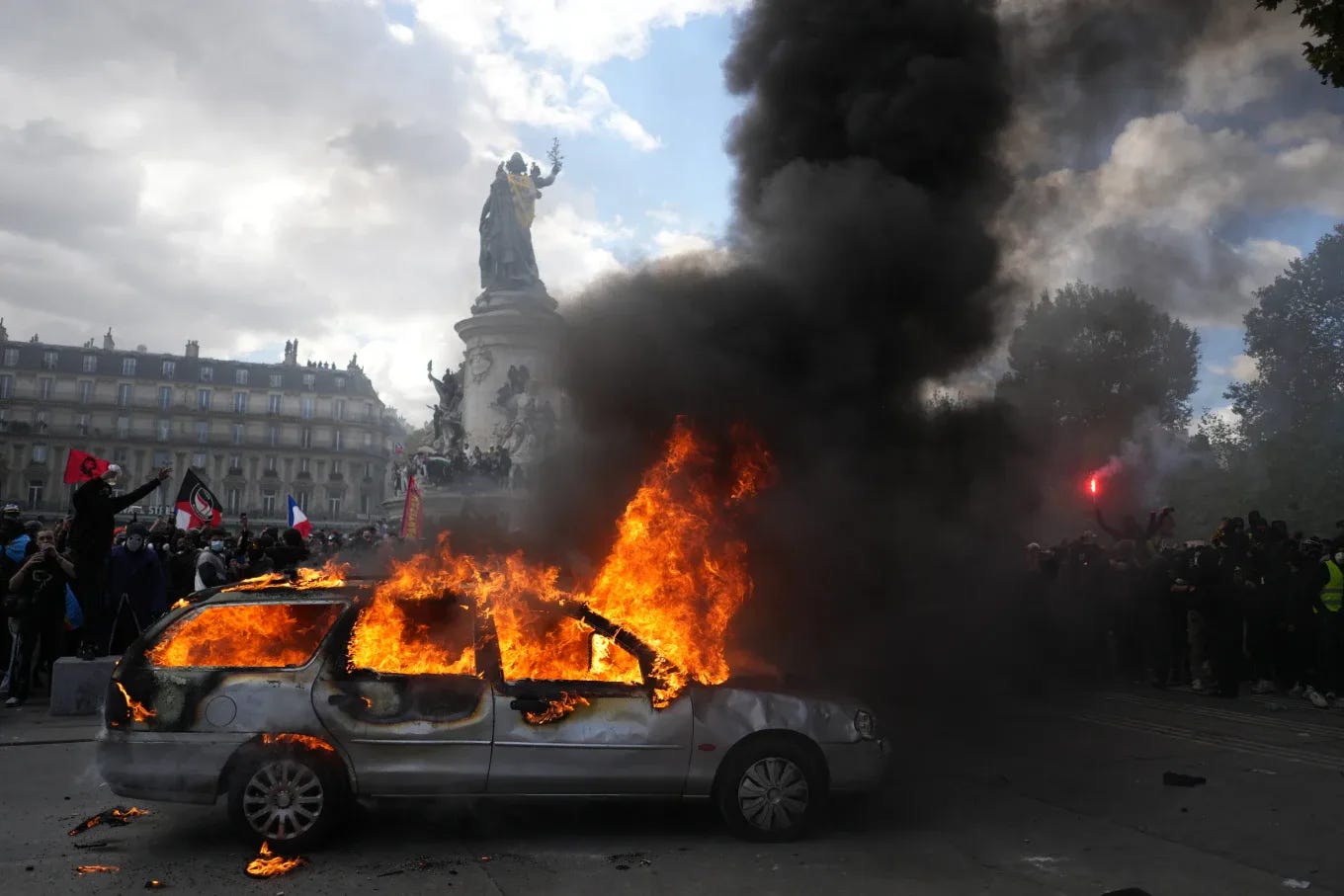
The fire reached the état civil, the civil registry, early. By Sunday morning the authorities were saying the old wing of Limoges town hall was almost completely destroyed inside, the registry and the wedding hall with it. For a hundred and forty-three years that building had recorded who was born in the city, who married there and who died. It had come through two world wars. It didn’t survive a Saturday afternoon in October, when masked figures broke the windows at the tail of a march against the cost of living and set the building alight while hundreds watched from the square.
Within a day France’s prime minister had written to the mayor promising state help to rebuild a building he called the symbol of a nation that refuses to be beaten or cowed. Thousands walked through Limoges that Sunday evening in a march of civic grief. The mayor blamed the hard left. In Rome, where the same weekend had turned violent, Italy’s prime minister spoke of hooligans exploiting legitimate protest. Elsewhere the images were read as a clash over migration, or as the long-awaited revolt against the establishment, and the photographs travelled faster than any of the explanations.
What the protesters had actually asked for was almost embarrassingly small. The movement began in mid-September at a lycée in Créteil, on the south-eastern edge of Paris, over teaching posts nobody had filled. Within a fortnight blockades had spread to hundreds of schools. A seventeen-year-old in Saint-Denis told a Reuters reporter that her school was overrun with rats, and that her classroom swung between stifling heat and freezing cold. Students wanted absent teachers replaced, crumbling buildings repaired, a university admissions system they could understand. Then the government published a 2027 budget raising education spending by less than inflation. Fuel prices rose. The unions came in over wages. A grievance about classrooms became a grievance about everything.
Across the Alps that weekend, hooded youths moved in fast groups through the streets around Milan’s cathedral, smashing windows and emptying shops. Police detained 271 young people on the Sunday alone. Of those taken in the day before, roughly four in five had been minors. The march they had slipped away from had been called against prices, fuel and taxes. In Brussels, earlier in the month, a national strike against budget cuts had also ended in clashes.
Children don’t loot a sports shop because of a theory. Still, there’s a pattern beneath these weekends that the competing stories miss. The OECD drew it plainly in 2018, in a report asking whether social mobility had broken down across its member states. On average, a child born into the poorest tenth of households would need four to five generations for the family to reach the mean income. In France the figure was more than six. Among member countries only Hungary showed more social determinism. When two of the organisation’s economists wrote this up the following year, they tied the number directly to the yellow vests. The upward mobility that raised postwar Europe has stalled for the whole of these teenagers’ lives. What they inherited was the expectation without the means: an assumption absorbed from parents and grandparents that each generation would live somewhat better than the last, set beside schools where the heating fails.
I was born in 1945, which makes me one of the first to see that promise kept. A boy from a council house in an East Sussex village could become a doctor, then a composer, then whatever I’ve become since. The sequence struck nobody as remarkable, because in those decades moving up seemed to be the ordinary course of a life. It took years of living elsewhere before I saw how peculiar that sequence was to one time and one place.
The same OECD tables that put France beyond six generations put Colombia at eleven, Brazil at nine, China and India at seven. Read from Asia, France’s figure sits closer to Delhi’s than to Copenhagen’s. This proximity is the part of the story Europe finds hardest to see. For most of humanity, across most of the last century, the confidence that a grandchild would outrun a grandparent was never written into the social contract. That confidence belonged to a regional arrangement, available to a minority of the world’s people. The bargain rested on cheap energy, on raw materials bought on favourable terms, on markets opened in other people’s countries, on an atmosphere treated as a free dump. Europe called the arrangement progress and assumed it described the direction of history.
What’s slipping away in Limoges and Milan is an exemption from limits that most of the world has never escaped. The loss of an exemption like this feels different from a loss everyone shares. It feels like theft. Two German sociologists, Carolin Amlinger and Oliver Nachtwey, have described a mood they call offended freedom, in which any limit is experienced as an insult and the remedy sought is freedom restored for oneself, with the limits redirected onto somebody else.
That redirection is where the political profit lies. One offer restores the exemption by pushing its cost outward, onto migrants and foreign rivals and anyone who can be portrayed as having jumped the queue. Another restores it by borrowing against a return of the growth that once paid for everything, with the bill posted to the children now protesting in the streets. Order is offered too, the reassurance that upward mobility will return once the vandals are cleared away. These offers come from political parties that despise one another. But they share a premise: that the exemption was normal and can be recovered. France chooses a president in the spring, and much of the continent votes within the year.
Something else was lost on Europe’s way up, and it rarely features in the calculations. Where upward mobility never arrived, people built forms of life around its absence. Rotating savings circles, the tontine of Dakar or the arisan of Java, pooled what households couldn’t manage alone. Kin networks absorbed shocks that no ministry would. These arrangements are often hard and sometimes cruel. They’re also how most of the world has lived with limits for as long as anyone can remember. Europe dismantled much of its own version of them during its socio-economic climb, trading the village and the extended family for the pension and the career. The young people of Saint-Denis now face what most of humanity has always faced, a future with no promised ascent, and they face it with neither the means of moving up nor the older scaffolding of mutual reliance that might have made its absence more bearable.
Somewhere in Limoges next spring, in whatever temporary office the city has found by then, a clerk will enter a new birth: a date, two parents, a place. The register can presumably be rebuilt from the duplicate kept at the courthouse. What the older books took for granted about every child they recorded, that it would end up better off than the parents named beside it, has no duplicate anywhere, and in those same weeks those parents will be asked, at the ballot box, to choose between candidates who each swear that expectation can be restored.