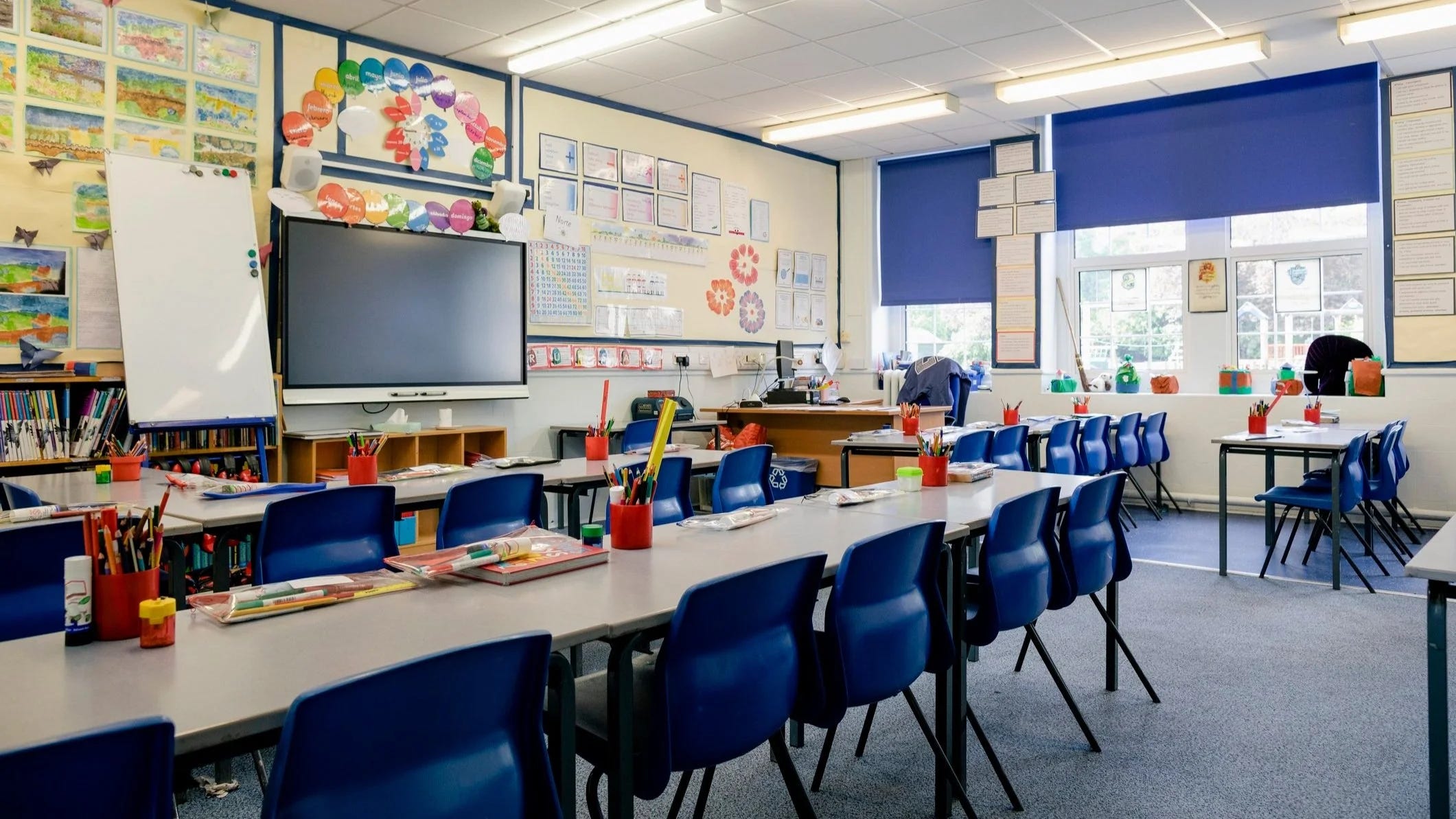
There’s a school just around the corner where I live in Isaan with a bell that’s still rung by hand — an iron rod struck against a piece of rail track, hung from a mango tree that has outlasted three head teachers. The sound carries across the rice fields, and children stop what they are doing and walk in the same direction, at the same pace, in the same rows. Nobody has told them how far apart to stand. They already know. Change the instrument — an electric buzzer, a whistle, a loudspeaker, a bell of actual bronze — and the choreography survives the change intact. Somewhere in the wiring of every child on the planet who has been to school, that same obedience to a sound has been installed, and installed so early that it now passes for maturity.
This is the front-loading system we have designed to educate our children. I want to be precise about what I mean, because the reformers keep getting this wrong, and their lack of precision is doing real damage. They look at the school and see something broken — underfunded, outdated, badly led, poorly incentivised — and they set about repairing it: new curricula, project-based learning, a tablet for every desk, a mindfulness period between algebra and lunch. Each reform assumes the same premise: that the purpose of the institution is sound and only the execution has failed. But the execution has not failed. The institution has succeeded, magnificently, at exactly what it was built to do — and what it was built to do was never, primarily, to educate. It was to instruct.
It was built to produce a workforce that would show up on time, sit in rows, wait to be called on, accept grading by people with more authority than insight, and mistake all of this for the natural order of things. In other words, it was built to manufacture the compliant, self-monitoring subject an industrial civilisation needs in order to keep extracting, producing and growing without the friction of people who inconveniently ask why. Bells, bells within bells — the school bell, the factory whistle, the office notification — are the same civilisational instrument tuned to different circumstances. Add a laptop to that room and you have not transformed the room. You have just modernised the cage.
Let me go further than is usually comfortable, because comfort has never been the register this argument can afford.
Stripped of any euphemisms in the prospectus, consider what a child actually learns across twelve years of formal schooling. She learns that knowledge arrives divided into subjects that don’t touch each other, because the timetable is the true curriculum and the timetable was designed for the convenience of an institution, not the coherence of a young mind. She learns that worth is measured, that measurement is comparative, and that comparison is public — so that anxiety about rank becomes, by fourteen, indistinguishable from personality. She learns that questions have owners: the teacher owns the questions worth asking, the textbook owns the answers worth having, and the exam owns the verdict on whether either has landed. She learns, above all, to wait — for the bell, for permission, for the grade, for the credential that will finally authorise her to begin the life the first eighteen years were meant to prepare her for, except that the life on offer at the end of the waiting is another version of the same room, with a performance review in place of a report card.
None of this is incidental to industrial economism. It is industrial economism’s nursery. A society organised around perpetual growth on a finite planet needs subjects who will not ask whether relentless production and consumption are the point, workers who will accept hierarchy as competence, consumers who will mistake acquisition for arrival, and citizens docile enough to leave the difficult questions to institutions that have already determined the answers to these matters. School is where that society trains its replacements. University simply adds debt to the arrangement, and casually calls the debt an investment.
I don’t say this as an outsider throwing stones at an institution I escaped. I sat in those rows. I learned to wait for the bell as well as anyone, and it took years of unlearning — most of it well after the age when unlearning is supposed to be complete — to notice how much of what I called my own judgement had in fact been issued to me, like a uniform, by people who never once asked whether it actually fitted. The instinct to defer to the person at the front of the room outlives the room by decades. I still catch it in myself: the pause before disagreeing with someone who has been introduced as an expert, the slight thrill of institutional approval, the reflex to translate a felt intuition into the register a committee will find credible before I trust it myself. That’s not a flaw in my biography. It’s the curriculum working exactly as intended, decades after the bell stopped ringing for me personally.
But now the ground on which this whole edifice was built is crumbling. The world of 1945 is already a distant memory.
Industrial schooling assumes a stable, linear future into which its graduates will be posted: careers with beginnings, middles and pensions; economies that grow because that’s what economies do; a biosphere absorbing whatever that growth requires without complaint. None of those assumptions is available to a child starting school today. Watersheds are drying or drowning depending on where we’re born. The labour market we’re being drilled to enter is being reorganised weekly by systems that can already do the sorting and summarising we spent our mornings memorising. And the civilisational operating system underneath both crises — economism, the conviction that value is what can be priced and growth is what value must do — is not a temporary pattern to be waited out. It is terminal, in the medical sense: not everywhere fatal at once, but failing systemically, in ways that compound.
To keep training children for the world the timetable assumes is malpractice.
So the question worth asking is not how to make the existing machine kinder, more inclusive, better resourced. Kindness applied to the wrong design only makes the wrong design more durable. The question is what kind of learning architecture would make better sense for a species who must, within a single generation, learn to live inside planetary limits, resist having their attention and their identity mined by systems built to do exactly that, and rebuild the trust between each other and between themselves and the living world that industrial economism has spent three centuries corroding.
I’m pretty sure the answer is not a blueprint. Blueprints belong to the mindset that produced the bell in the first place — the conviction that a sufficiently detailed plan, applied uniformly, will produce the desired human at the other end. What I can offer instead are prototypes: patterns sturdy enough to be tried, loose enough to be argued with, local enough to be built this year rather than legislated in some future decade that keeps failing to arrive. But before sketching any of them, I want to sit for a moment with an uncomfortable fact the reformers rarely mention, because it disciplines the excitement that always arrives with a fresh design. This is not the first attempt. It has been tried before, more than once, by people who were not naive, and the record of what happened to their attempts is where any honest prototype has to start.
Let’s begin with the physical construct itself, because it was never neutral.
Instead of a school, imagine a commons — a permanent, physical node in a neighbourhood or a bioregion, open across the whole of a life rather than fenced off for one age bracket. Part library, part workshop, part kitchen, part civic hall, part clinic. Governed not by a ministry but by the people who use it: a rotating circle of residents, elders, the young, a couple of officials willing to be outnumbered. Its first task is not instruction but attention — keeping a living map of the watershed, the food system, the housing stock, the health of the place, updated by the people who actually live inside those systems rather than by a survey conducted once a decade from a capital city. Its second task is to dissolve the wall between the ages: a six-year-old, a returning grandmother and a twenty-two-year-old apprentice working the same problem — a polluted stream, a broken well pump, a conflict between two families over water rights — because the stream does not care how old you are, and neither does the debt of repair owed to it.
You could start this modestly and honestly: an underused school hall repurposed, a governance circle of a dozen people, two or three domains that genuinely matter locally — food, energy, care — and a weekly gathering where questions and half-finished projects are brought into the open. Do that with any consistency for a year and you no longer have an idea. You have an alternative infrastructure, however small, standing next to the old one, drawing people away from it by being more alive.
Something close to this was tried in Devon, on an estate near Totnes, in 1926. Dartington Hall School dissolved the classroom’s authority almost entirely — no compulsory lessons, no examinations, a governing conviction that children could be trusted with their own time. It ran for sixty-one years, which is longer than most institutions survive doing anything difficult, and by the standard I am proposing it counts as a real success before it counts as a cautionary tale. But it closed in 1987, its roll collapsed by scandal and a headmaster at odds with the philosophy he had been hired to protect, at almost exactly the moment state schooling around it had begun absorbing a diluted version of its own language — child-centred, progressive — while quietly keeping the exam, the grade and the timetable intact underneath the new vocabulary. The husk was adopted. The organism that had grown it was not needed any more, and it starved.
The lesson is not that the commons is a bad idea. The lesson is that consistency alone was never going to be enough to protect it, and any design that assumes otherwise is repeating a sixty-year-old mistake in new materials.
Around such a commons, something like a guild takes shape — not a class, not a club, but a working cohort bound to a piece of the world it is actually responsible for stewarding. A stretch of river. A community kitchen. A cooperative clinic. A meshwork. The young join as apprentices and the old as something closer to journeymen, because competence here is not demonstrated on paper but in the state of the river five years on. A child who spends three years helping to bring a wetland back to health has studied ecology, history, hydrology, local politics, conflict and patience — more rigorously, and more truthfully, than any unit ever printed in a textbook, because the wetland does not grade on a curve and does not accept an essay in place of the work.
I watched a more recent version of this ambition fail in Bangkok, close enough that I served on its international advisory board rather than reading about it afterwards. This international school, with a campus to die for, built from scratch around design thinking, mixed-age cohorts, and teachers renamed learning designers, closed within six years — not through scandal, and not through a hostile ideological takeover, but because it failed to get the enrolments it needed to remain viable. It had even hedged against exactly this, keeping an American curriculum and university counselling running alongside the new vocabulary, in case the market would not accept the alternative on its own terms. The hedge was not enough. Parents who had themselves been trained by the very system the school was trying to leave chose, in sufficient numbers, to leave the school instead. Renaming the teacher doesn’t change who still gets to decide what counts as good work, and a market made of people schooled in the old measure will usually vote for the old measure, whatever the new one is called.
None of this, on its own, is proof against capture. A society skilled at colonising attention will hunt down the commons and the guild soon enough — arriving as a grant, a partnership, a platform offering to help scale what was never meant to scale. So a third structure has to sit alongside the first two — something closer to a studio than a classroom, where people practise noticing how their own perception has been shaped: by grief, by screens, by the stories they were handed before they were old enough to ask who benefits from those stories. Not mindfulness reduced to stress management, but a discipline of catching the hijack before it completes — the shame that arrives on cue when a notification lands, the certainty that arrives too easily when an argument confirms what you already believed. A studio like this trains people to hold more than one frame at once without collapsing into either cynicism or fresh conviction, and to treat encountering an unfamiliar idea, an unfamiliar person, an unfamiliar grief, as a right rather than an accident of algorithm.
This, too, has a history, and it’s a harder one to sit with because it didn’t stay contained within one school. William Tyndale Junior School, in north London, introduced genuinely progressive methods in the mid-1970s and lost the confidence of enough parents that its roll fell fast; the resulting public inquiry became a national scandal that ran for months, and the outcome was not a local adjustment but a tightening of central government’s grip on how every school in the country was allowed to teach. One school’s honest attempt at something different became the pretext for taking discretion away from all the others.
Any structure built to protect attention and worldview inquiry has to reckon with the fact that it will be judged, fairly or not, by whoever is watching for a reason to recentralise control — and that the watching does not require the experiment to fail on its own terms, only to be seen to fail by people already looking for permission to intervene.
Which is why the fourth piece has to come early rather than as an afterthought bolted on once the damage is visible: an explicit covenant governing what a learning commons will and will not permit its own tools, and its own governors, to do. Data stays as close as possible to the people it describes, rather than migrating to a server on another continent. Any system involved in learning sits inside a relationship — a mentor, a guild, a studio — never alone with a child and a screen. Slowness is treated as a feature in anything that touches a person’s sense of their own worth, not a delay to be engineered away. No predictive system, however elegant, is permitted to pre-judge a child’s potential before the child has had the chance to surprise it. And the governance of the commons itself is written down, publicly, before the first grant or the first press inquiry arrives looking for a reason to take it over.
I notice, writing this, that everything above still shares an assumption none of it has questioned: that the alternative has to prove itself against the world’s existing measure of success — parents choosing it, a ministry tolerating it, and a market sustaining it. Dartington was measured by enrolment and reputation. Tyndale was measured by a national press and a government looking for a mandate. The school in Bangkok was measured, in the end, by the same university-admission arithmetic it was trying to escape. Each of them tried to change the room while still being judged by people standing in the doorway of the old one.
There’s a college in a village in Rajasthan that never agreed to be judged that way at all. Barefoot College has trained rural people, most of them women, most of them without formal schooling, as solar engineers, since 1972 — more than fifty years now, without issuing a single degree. Its founder has said plainly that his own elite education nearly destroyed him, and that the literate, credentialed graduate of the formal system is not evidence that the poor can be lifted out of poverty but part of the mechanism that keeps them trapped in it. Nobody sits an exam at Barefoot College. Competence is proven when the panel lights the room or the pump draws water, and by nothing else. It never had Dartington’s problem, because it was never trying to keep a fee-paying clientele persuaded. It never had Tyndale’s problem, because no ministry considers it a precedent worth legislating against. It never had Bangkok’s problem, because the people it serves had already been discarded by the university-admission arithmetic and had nothing left to lose by refusing it.
This is the refathoming the whole argument has been circling without naming: not a gentler relationship between teacher and learner, but a different question about who ever had the authority to say what competence means, and whether that authority can simply be declined rather than negotiated. A guide who has swapped titles with a teacher but still holds sole judgement over what counts as good work has changed nothing that matters. A college that lets the well itself deliver the verdict has changed everything that matters, and asked no one’s permission to do it.
I don’t want to hand this a happier ending than it has earned. Barefoot College’s own chroniclers name its real vulnerability plainly: it has been built so tightly around one founder, now an old man, that nobody yet knows whether it survives the passing of the person who refused, on its behalf, to be judged by the old measures. Dartington was killed by dilution. Tyndale was killed by politics recentralising in the name of a scandal. Verso was killed by a market that never stopped wanting the old credentials. Rajasthan has simply not yet met whatever will kill it, and the people closest to it already know its name.
The mango tree is still there. The rail track still hangs from it. Somewhere a headmaster is deciding, this term or the next, whether to replace it with an electric bell, because the electric bell is what modernisation looks like from where he sits, and because nobody has asked him to imagine a school that doesn’t need one at all.
I keep thinking about the half-second between the strike of the rail and the moment every child in the yard turns in the same direction. That half-second is the whole civilisation, compressed. Somewhere between the sound and the turning, there’s still a child who has not yet decided to obey it — who is, for that half-second, simply curious about the noise. Everything I have tried to sketch here is an attempt to build a world with more of that half-second in it, and less of the turning that follows.
I don’t know if it will be enough — whether that half-second widens into something that lasts, or whether the sound simply finishes its work and closes over it for good. What I do know is this: four rooms, in four countries, across four decades, each tried to change what happened inside the walls while still answering to whatever stood outside them — a market, a ministry, a press. The first three were eventually pulled back by exactly the gravitational authority they had agreed to answer to. The one still standing never made that agreement in the first place.