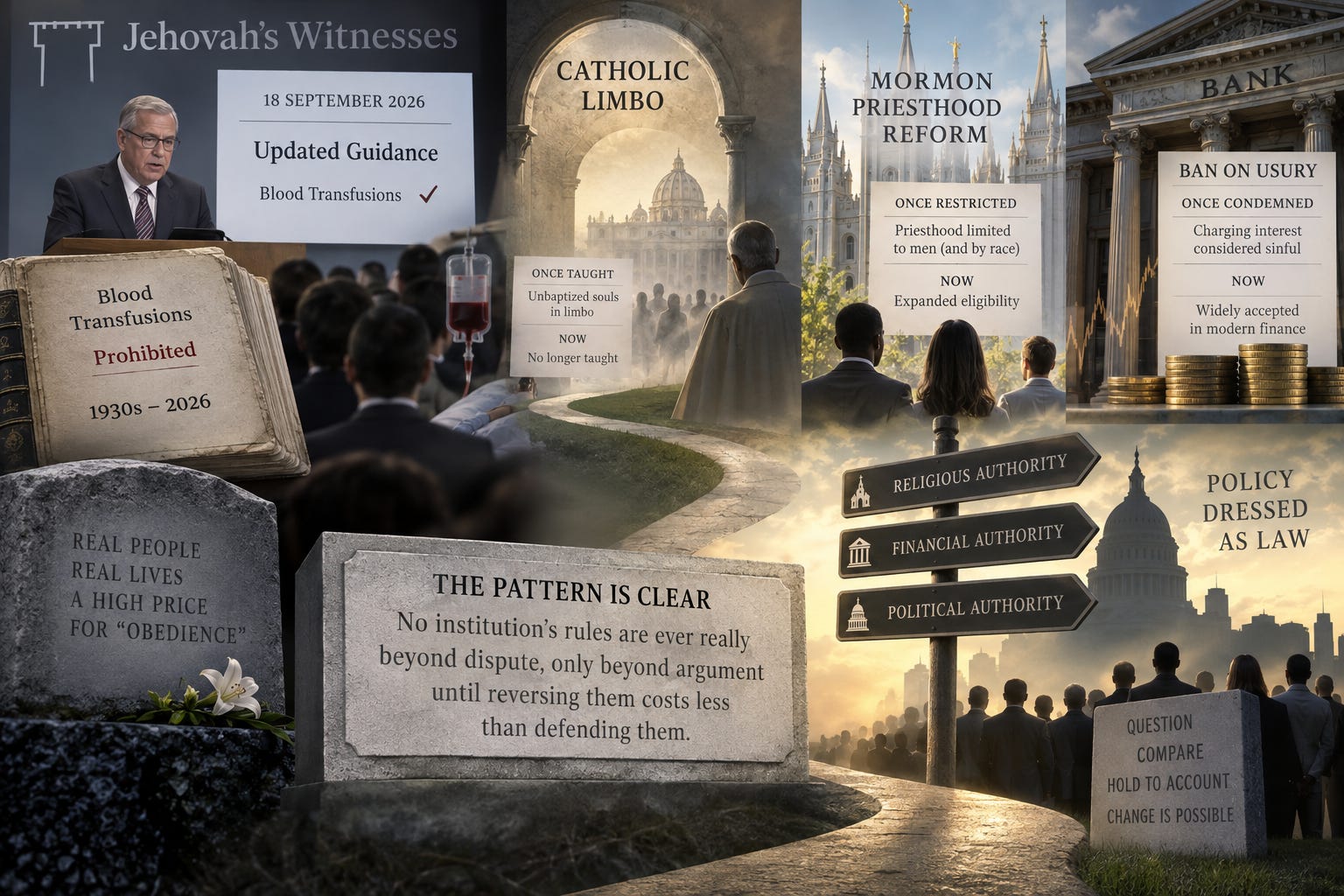
Synopsis: This essay uses the Jehovah’s Witnesses’ 18 September 2026 reversal of their blood-transfusion doctrine, quietly overturning decades of non-negotiable teaching that had cost lives, to argue that no institution’s rules are ever really beyond dispute, only beyond argument until reversing them costs less than defending them. Moving through Catholic limbo, Mormon priesthood reform and the ban on usury, I widen the case from one denomination to any authority, religious, financial or political, that dresses policy as law.
I was a chorister in my childhood, christened and confirmed, brought up inside the Church of England the way kids are raised within a culture or a language, the dogma absorbed before it can be truly understood or challenged. I left at thirteen, not out of frustration with archaic rituals or the music, much of which I found exquisitely beautiful, but because I had started examining what I’d been taught, methodically, and it simply came apart in my hands.
The nature of God seemed to shift depending on who was doing the explaining. So did the myths and rules assembled around him: it was always a male, by the way, which already seemed weird. I had noticed, even at that age, that things which are actually true don’t need their elements adjusted every generation to keep functioning.
The scale of what I was leaving wasn’t at all trifling. By one widely cited estimate somewhere between four thousand and ten thousand distinct religions are practised on this planet today. Across recorded history people have worshipped something in the order of eighteen thousand separate deities. Every one of those systems had adherents who were certain, not just hopeful, that theirs alone was real and the rest were superstition dressed in ceremony. Amun-Ra had priests. Zeus had temples that ran for centuries. Every god now reduced to a footnote in an undergraduate mythology course was once somebody’s absolute truth, the kind worth killing for and worth dying for.
With each god, a man steps forward from the desert or the temple precinct to say he speaks on the god’s behalf. He knows the god’s mind. He knows what the god forbids, what he rewards, what he will do to you if you disobey. He rarely arrives holding evidence. Instead, he arrives holding some kind of authority, and for most of human history that was sufficient to secure compliance.
Eventually the intermediaries do what intermediaries have always done. They draft strict rules. Because the rules are attributed to a source beyond human argument, they become impossible to question, test or renegotiate. Obedience is the whole of the transaction. Step outside it and you are cast out. Excommunicated and labelled heretic.
Take the topic of blood - a prerequisite for life in all mammals. For decades the Jehovah’s Witnesses sect forbade blood transfusions outright. This prohibition was never offered as a preference. It was doctrine, drawn from a scriptural instruction to abstain from exchanging blood with others and interpreted with a literalism no court would tolerate in an ordinary contract. A Witness who accepted a transfusion had sinned against God and could be shunned by his own family for it. The choice was set out unambiguously, with no middle ground: betray your God, or stay loyal to him and risk dying for that devotion.
People did die under that instruction. Mothers bleeding out after childbirth. Victims of accidents. Children whose parents refused, on their behalf, the one procedure that could have saved them. Nobody was keeping a public count of what obedience cost, so the true figure has never been known and probably never will be.
Then, on 18 September 2026, the Governing Body announced from its headquarters in Warwick, New York, that whether to accept red cells, white cells, plasma or platelets from another person is now a matter for each believer’s own conscience, and that each Witness must likewise decide for themselves whether to donate those components for someone else’s use. This followed an earlier ‘adjustment’ in March, which had already let members decide whether their own blood could be drawn, stored and returned to them during surgery.
Whole-blood transfusion itself stays forbidden, so this isn’t a complete about-turn. But four of the five prohibitions that stood as non-negotiable doctrine until last Friday are now eradicated for an organisation whose members number more than nine million across upward of two hundred countries. The change was described as a clarification, arrived at, the statement said, after extensive prayer.
A clarification, not a correction. Nobody used the terms wrong, or mistaken, or reversed. The scripture that forbade blood components for a hundred years and the scripture that now permits them have not changed a syllable between one Friday and the next. Only the men reading it have changed their minds.
Nobody outside the organisation forced this. No court, no rival denomination, no external tribunal pried the doctrine loose. The Governing Body that spent decades insisting the prohibition came from beyond human authorship is the same body, and the only body, permitted to say it has changed, using the identical claim to divine transmission it used to impose the rule in the first place. The office nobody may question is also the only office allowed to correct it.
Unbelievably, no apology accompanied this announcement. Nobody named the dead or the casualties of this doctrine. There was no acknowledgement that a generation of families had been handed an impossible choice on the authority of God, only for that authority to be handed quietly back to them, decades too late for the people who had already paid the price for their belief. There was a statement, a press contact, and the machinery of the organisation continuing exactly as before.
Believers themselves have since begin to murmur their disquiet. Comments from people who by every other indication remain within the faith, are asking plainly whether such a decision is built from a policy set by a governing board or a principle handed down from scripture. Once that doubt is expressed, by the self-same people trained to obey without question, the topic tends not to go away.
This isn’t confined to one denomination. The Catholic Church invented limbo, held unbaptised infants there in official teaching for the better part of a millennium, and in 2007 concluded it had never really been doctrine at all. The Church of Jesus Christ of Latter-day Saints barred men of African descent from its priesthood until a revelation arrived in 1978 and undid dogma that had stood, undisputed, since the nineteenth century. Congregations that once preached lending money at interest was damnation now run pension funds and mortgages like any other bank on the high street. In each case the eternal, unchanging law of God turned out, on inspection, to be manmade: temporary, negotiable, and revised the moment holding the line cost more than changing it.
None of this is really about God of course. It’s about what happens whenever an establishment persuades enough people that its instructions sit beyond dispute, whether they’re attributed to scripture, to the market, to national security, or to the unavoidable arithmetic of economic growth. An instruction presented as beyond argument can’t be verified, and an instruction that can’t be tested can’t be wrong, only inconvenient, until the day it becomes cheaper to change than to defend. Then it shifts, quietly, and the people who organised their lives, their deaths and their children’s deaths around its permanence are left to discover that the immovable law had legs all along.
Perhaps I am wrong, but I don’t think God updates his position. Institutions do, constantly, and a body able to reverse a matter of life and death without paying any cost for the reversal was never transmitting anything handed down from outside of itself. It was inventing its own terms, the way the rest of us improvise our way through uncertainty, except with the singular privilege of never being asked to show its working.
A few conclusions follow, and none of them stay confined to religion. First, any claim to a rule beyond dispute can be tested with a single, simple question: what happens to the rule once obeying it stops being convenient for the people enforcing it? If it bends, even slightly, it was policy wearing a disguise, not law. Second, the cost of that policy is never paid by the people who wrote it or defended it. It’s paid by families who obeyed while it stood. When the rule falls, they’re handed a press release, not restitution, not even an acknowledgement that anything was owed. Third, and this reaches well past one denomination, markets, states and corporations make the identical move: growth, security, taxation, the discipline of the bond market, each dressed as a natural law rather than choice. The signature is the same one that gave the Witnesses away. Watch for the moment a rule defended as immovable shifts anyway, and ask who is still paying for having believed it was fixed.
So I look at all this and tell myself I did well to leave organised religion when I did. My life has been simpler for not performing a credo I do not hold, in order to keep peace with people who never examine their own. It’s been safer, because no man in a suit gets to decide, on God’s behalf, what may or may not enter my bloodstream. And it’s been far less troubled, because I stopped running toward a paradise from which nobody has ever returned, while the one life I can actually verify kept passing in front of me.
I’m not asking anyone to follow my example. Believe whatever brings you peace, if it genuinely does. But be honest about one part of the arrangement: if a rule can change on a Friday, with a press release and no apology, it was never God’s rule to begin with. It was drafted by men, defended by men, and paid for, in blood and in grief, by the people who trusted it had come from a higher authority.