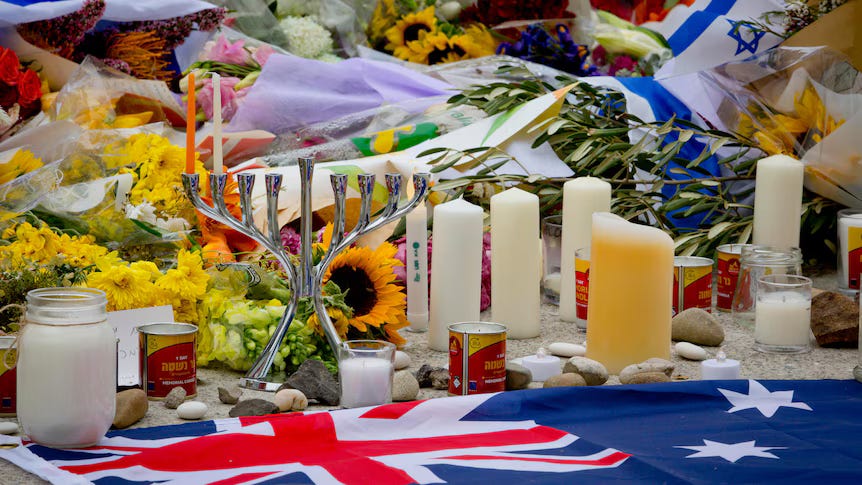
Bondi was an atrocity. It was also a symptom. Any enquiry that treats the symptom while the underlying condition deepens will leave Australia less safe, not more.
There is something worth attending to in just the name of the Royal Commission on Antisemitism and Social Cohesion. The conjunction performs a kind of explanation. It implies that antisemitism is the natural subject of an enquiry into social cohesion — that we can understand the fracturing of a society’s connective tissue by examining one of its ugliest symptoms.
This may be procedurally tidy. It is, I want to suggest, intellectually premature. And premature explanations carry their own dangers — not least the production of recommendations that treat symptoms while the underlying condition deepens.
I have made this argument as a formal submission to the Commission. But submissions to royal commissions have a way of disappearing into the institutional machinery, and this argument deserves more air than that. So here it is, written for readers rather than commissioners.
I write as an Australian who has spent the better part of three decades watching how societies hold together and how they begin to come apart — watching not from within Australian institutional life but from Bangkok, from cities across Asia-Pacific, the Middle East, and the Global South. From those vantage points, what Australians call social cohesion looks rather different than it does from Canberra or a Sydney courtroom. Distance is its own kind of instrument.
What Bondi actually reveals
The massacre at Bondi Beach on 14 December 2025 was an atrocity. The grief it visited on Jewish Australians and on the wider community doesn’t require qualification. What it does require — from an enquiry that will shape policy for years — is careful reading. Not of the perpetrator’s ideology alone, but of the social conditions in which that ideology found purchase and expression.
Antisemitic violence tends not to erupt into socially coherent communities. It doesn’t flourish where citizens feel genuinely connected to one another and to the institutions that are supposed to represent them. It takes root in specific soil — the soil that late-modern industrial economies have been cultivating for at least four decades: atomisation, institutional distrust, the commodification of public life, and the substitution of economic participation for civic belonging.
I am not arguing that the hatred responsible for Bondi was caused by neoliberal policy settings — causation in these matters is rarely that clean. I am arguing that the conditions which make such hatred communicable, recruitable, and actionable are not random. They are structural. And they will not be addressed by any number of recommendations directed at law enforcement guidance, border control protocols, or educational interventions, however well-crafted those may be.
If the Commission’s final report does not contain a serious, sustained account of how Australia’s social fabric was weakened before the attack, its recommendations will be managing the aftermath of a process they have not adequately described.
The single-axis problem
There’s a structural risk built into any enquiry framed around the experience of one community, however serious and well-documented that experience is. The risk is not that the community’s experience will be dismissed — on the contrary, the Commission has considerable institutional momentum behind Jewish Australian testimony, as it should. The risk is that its recommendations will be calibrated to that experience alone, while the broader architecture of social belonging goes unexamined.
In spite of protests from people like Pauline Hanson, Australia is a genuinely multicultural society, though the term “multicultural” has been domesticated to the point of near-uselessness — it tends now to mean a plurality of cuisines and festivals rather than a genuine negotiation of equal civic standing. Many communities navigating Australia’s social landscape — Aboriginal and Torres Strait Islander peoples, Muslim Australians, South and South-east Asian Australians, and Pacific Islander communities — carry their own histories of institutional exclusion, targeted hostility, and failed belonging. These are not equivalent experiences, and they should not be flattened into equivalence. But they belong to the same wider problem.
Australia has not yet developed the relational depth that real social cohesion requires. It has developed, instead, a sophisticated administrative apparatus for managing diversity — which is a different thing entirely.
A commission that recommends enhancements to hate-crime legislation, security protocols for religious gatherings, and curriculum content addressing antisemitism will have done something real. It’s certainly not nothing. But it will have left untouched the deeper question: what kind of society are Australians being asked to make cohere—and does that society, as currently organised, offer genuine belonging to anyone outside its inherited centre of gravity?
The civic commons
What has been progressively dismantled in Australia, as in most late-industrial democracies, is what I would call the civic commons: the shared institutional, cultural, and relational infrastructure through which diverse communities negotiate difference, build trust, and develop the capacity to act together.
Markets don’t produce this infrastructure. They consume it. The public institutions that once carried it — universities, broadcasters, local councils, neighbourhood associations, places of worship, even the physical architecture of shared public space — have been subject to three decades of deliberate erosion, privatisation, defunding, or instrumentalisation in the service of economic productivity. Into the space that erosion leaves, ideologies offering a substitute form of belonging — tribal, reactive, exclusionary — are predictably effective.
This is not peculiar to Australia. It’s a pattern visible across every society in which the civic commons has been similarly depleted. The specific ideological content varies; the underlying dynamic does not.
The Commission has the authority to name that dynamic. Its fourth term of reference explicitly invites recommendations for “strengthening social cohesion in Australia” beyond the specific antisemitism enquiry. The open question is whether it will use that authority—or be pulled towards the administratively convenient: recommendations that will be welcomed by the government, generate no controversy, and change nothing structurally speaking.
The question of trust
Social cohesion is, at its core, a problem of trust — not the generalised trust measured by social capital surveys, but the specific, earned trust that develops through repeated, reciprocal engagement across difference. Institutions can generate this trust or they can destroy it. Australian institutions have been destroying it, largely inadvertently, for some time: through the concentration of media ownership that narrows the range of legitimate public conversation; through the progressive insulation of political decision-making from genuine citizen participation; through the replacement of public deliberation with consultation processes that are, in the main, theatre.
The Royal Commission itself exists within this landscape. If its final report is read — as many Australians will read it — as a document that responds to one community’s genuine suffering while leaving the structural conditions of that suffering intact, it will have contributed, however unintentionally, to the erosion of the very trust it was established to repair. Communities that were not adequately heard will know they were not adequately heard. The distance between institutional process and lived reality will have widened.
I am not suggesting this outcome is inevitable. I am suggesting that it’s the default mode — the path of least institutional resistance — and that avoiding it requires the Commission to hold a larger frame than the one its name implies.
The frame is the finding
Australia is a society in which the conditions for genuine belonging have been structurally attenuated. Bondi is one catastrophic consequence of that attenuation. Future consequences, in forms we cannot yet specify, will follow unless the attenuation itself is addressed.
Royal commissions are rare instruments. They come infrequently, and they are taken seriously when they come. This one still has the opportunity to articulate what genuine social cohesion would require — and to place that articulation before a government and a public that have not yet been asked to face up to it plainly.
Get the frame wrong, and the recommendations, however well-intentioned, will address the wrong problem. Get it right, and there’s at least a chance that something durable might be built. The alternative is a well-received report that changes nothing structural — and a country that continues to mistake the management of diversity for the work of belonging.