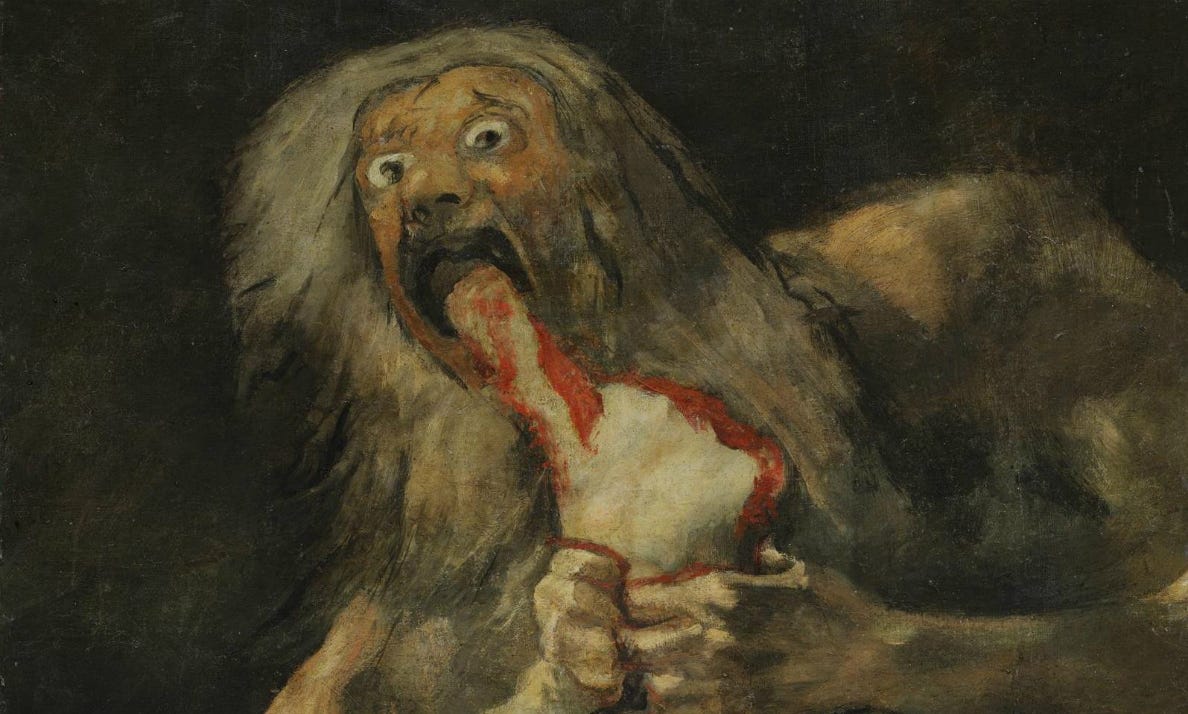
I know you thought I was joking when I suggested that every additional billionaire was a policy error. But think on this: the statistics are already receding into cliché. More than 3,000 billionaires. Eighteen trillion dollars in their hands. An 81 per cent leap in their combined fortune in just a few years. Enough, we’re told, to eradicate global poverty dozens of times over. These numbers no longer shock. We nod, briefly outraged, before scrolling on. That habituation – our capacity to absorb the grotesque as if it were the weather – is, I suspect, more dangerous than the numbers themselves.
What’s emerging is not simply “inequality” in the polite, technocratic sense. It’s the slow substitution of one civilisational mode by another: from societies that at least pretend to distribute power through ballots and public institutions, to societies in which money is the sole franchise that counts. We’re watching the crystallisation of an oligarchic order in plain sight – and then pretending it’s just the market doing its work.
In such a world, wealth is not merely accumulated; it is weaponised. It directs legislation. It edits the news. It calibrates police responses. It decides whose anger is heard and whose hunger is ignored. The result is not a drift but a lurch: away from the fragile experiment we call democracy and towards a system in which a few thousand individuals effectively govern the life chances of billions. We should at least have the courage to name that honestly.
The new priesthood of property
In earlier eras, power clothed itself in divine right, royal blood, party doctrine or imperial mission. Today it’s cloaked in what I describe as industrial economism – the belief that the highest purpose of society is continuous economic expansion, measured narrowly through financial indicators, detached from the health of people and planet.
Under this paradigm, billionaires are not simply rich individuals. They are the high priests of a faith that treats extraction as the highest virtue and accumulation as the sole proof of moral worth. Their fortunes become liturgical objects – market capitalisation, valuations, “unicorns” – to which we’re all asked to genuflect.
A curious inversion has occurred. People sleeping rough beneath flyovers in London or Lahore are framed as individual losers, while those able to hoard sums that no human being could ever meaningfully use are celebrated as visionaries. Poverty is psychologised; great wealth is sacralised. It’s a strange theology for a supposedly secular age.
Meanwhile, the calloused reality of daily life for large segments of humanity – rising food prices, precarious work, debt peonage, water that can’t be trusted, clinics that don’t exist, schools that crumble – is treated as an unfortunate side-effect of progress, to be ameliorated at the margins through philanthropy. We rarely ask: progress for whom? And towards what?
What makes the present moment so perilous is that this faith in the monetocracy has become global. Whether in Washington, Beijing, Nairobi, Jakarta, Singapore or Brussels, the dominant grammar of public policy is virtually the same: incentivise capital, placate markets, trust that the “benefits” will trickle down, then blame culture, corruption or character when they do not.
When that creed fuses with political office, media ownership and digital platforms, we arrive at something closer to a theocracy of capital than to any meaningful democracy.
From influence to occupancy
The assumption that “the rich have always influenced politics” is historically lazy and comforting. Of course they have. Yet influence is not the same as possession.
Today, billionaires are thousands of times more likely than ordinary citizens to hold political office. They own most major private media houses and control the platforms through which billions of us access news, gossip, and grievance. Their preferences have a vastly higher probability of being translated into policy than those of low- or middle-income citizens. None of that is conspiracy theory; it is documented in studies from the United States, Europe, Latin America and parts of Asia.
This qualitative shift matters. It erodes the thin membrane that once existed between private enrichment and public stewardship. In many jurisdictions, the line between a cabinet meeting and a board meeting has become indistinct, not only because politicians court donors, but because donors are the politicians. Regulatory agencies frequently resemble industry clubs. Central banks and finance ministries converse primarily with asset managers and banks, not with nurses, small farmers or street vendors.
If we were to describe such arrangements in another country – one we preferred to criticise – we would not hesitate to call it oligarchy. In our own settings we resort to euphemisms: “public–private partnerships,” “stakeholder capitalism,” “innovation ecosystems.” Behind the jargon lies a simple question: who actually governs us?
When one acknowledges that more than half of the world’s media companies and almost all of the largest social platforms are under the control of a handful of astonishingly wealthy individuals, the fantasy of an informed citizenry deliberating freely becomes harder to sustain. Algorithms are silencers as well as amplifiers, filtering what we see and what we never know we missed. Do we truly have public debates, or orchestrated spectacles in which the frames of discourse are designed by those who have the most to gain from the status quo?
Repression as economic policy
On every continent today, an increasingly familiar script is unfolding. Young people, burdened by debts they did not choose and futures they don’t trust, take to the streets. Communities long ignored by metropolitan elites breach the cordon of indifference. They protest the cost of food, fuel, housing, education; they name corruption and collusion between business and government; they demand that futile wars come to an end, and that the fruits of growth be shared, or at the very least that basic necessities be secured.
In Africa, Asia, Latin America and parts of Europe, these uprisings are growing more frequent and more inventive. They are framed by their participants as demands for dignity, not just for bread. Yet in too many cases the response from governments is not dialogue but more suppression: curfews, mass arrests, internet shutdowns, the careful criminalisation of dissent. It’s as if repression has quietly been added to the standard economic toolkit, alongside taxation and monetary policy.
In Nairobi’s Mathare settlement, where families queue for hours for unreliable drinking water while sprinklers keep an adjacent golf course perpetually green, inequality is not an abstraction. It’s a daily insult. One cannot live with that contrast and still honestly pretend that markets allocate resources efficiently. They allocate them according to power and status.
When such indignities pile up, rebellion is not a matter of ideological contagion. It’s closer to a reflex in any living organism pushed to the brink. That is why uprisings in one part of the world resonate with youth in another, even where histories and cultures differ. They share a visceral recognition that the present system is rigged, and that polite requests for incremental reform are treated as background noise.
The danger is not only that these rebellions will be crushed; it is that they will be selectively amplified, diverted, or co-opted by those with an interest in chaos for its own sake. When legitimate anger is ignored, people become susceptible to anyone who promises not just change but revenge. That, historically, is how demagogues and sectarian movements recruit: they arrive bearing simple stories for complex injuries.
The immune system of societies
Every living organism has an immune system. Societies are no different. When toxicity accumulates – whether in the form of gross disparity, corruption, state neglect or ecological devastation – the social body attempts to repair itself. Protests, movements, and even revolutions are not anomalies; they’re symptoms of deeper self-correcting impulses.
Whether that repair occurs peacefully, through deliberate rebalancing and renewal, or traumatically, through breakdown and violence, depends on a number of factors. History offers many examples of both. Where privilege tightens its grip and refuses to share power or resources, rupture becomes more likely. Where elites recognise that their own long-term survival depends on a degree of even-handedness, societies can recompose themselves.
At present, the omens are hardly benign. Rather than strengthening public systems of health, learning, shelter, ecological repair and civic life, many governments tighten the belt around ordinary citizens while loosening it for those already sated. Tax regimes are remodelled to soothe capital; public services are pared back to the bone; police and military spending swells. Voicing discontent is increasingly treated as a disturbance to “public order”, while composure in the face of hardship is praised as responsible citizenship.
What if, though, these policies are themselves the real source of instability? When a system repeatedly produces outcomes that most people experience as unjust or unlivable, how long can it sustain legitimacy? That is not just a didactic question; it’s a practical one. No regime, however clever its public relations or advanced its surveillance tools, can thrive indefinitely when vast segments of the population experience everyday life as a trap.
From this vantage point, billionaires are not the cause of our troubles; far fro it. They are, however, an extreme symptom. Their existence at current scale and speed of growth signals that the underlying rules of our economic game are misaligned with any defensible notion of human flourishing. We have built an incentive structure that rewards extraction and rent-seeking more lavishly than care, creativity, or custodianship of the commons.
The warning lights are flashing. Rising authoritarianism, collapsing trust in institutions, polarisation, ecological overshoot, and a global mental health crisis are not separate files. They are interconnected outcomes of a worldview that treats humans as disposable inputs and the Earth as an infinite quarry.
What kind of “development” devours its children?
For decades, policymakers have spoken of “development” as if it were a neutral ladder of progress. Nations climb it by liberalising markets, privatising assets, courting foreign investors, and orienting themselves towards export-led growth. Success is charted through rising GDP, inward investment flows and credit ratings. Yet in country after country we see a paradox. Economies expand, skyscrapers rise, luxury malls glitter, and still large portions of the population find themselves scrambling for basic necessities. Public debt balloons. Social fabrics fray. Young people, watching wealth accumulate in gated enclaves, no longer believe that diligence and talent will deliver security, let alone fulfilment. They are told to be patient while their lives are already half-spent.
When governments then reach reflexively for austerity – slashing health, education, public transport and environmental protections – in order to “reassure the markets,” they are not governing their people so much as managing expectations on behalf of creditors and the domestic elite. The language of “there is no alternative” masks what is essentially a political decision to prioritise balance sheets over bodies.
If we step back, the contradiction is unambiguous. We live on a finite, delicately balanced planet, and yet we have built an economic system that must grow perpetually - or collapse. We celebrate those who accelerate that extraction fastest, and then express surprise when social and ecological systems begin to fall apart.
Could it be that our notion of development itself requires a profound reimagining? If development does not secure clean water, nourishing food, education, shelter, meaningful work, cultural vitality and ecological resilience for all, what exactly is it developing?
Leadership as a shared awakening
In moments like this the temptation is to search for saviours: a new party, a more enlightened billionaire, a charismatic leader promising to “fix the system.” That habit of mind is itself part of the problem. It externalises responsibility, turning citizens into spectators.
When I speak of leadership, I’m not referring to individual leading actors at the apex of institutions. I’m speaking of a relational phenomenon that arises whenever people choose to co-create more life-affirming arrangements. Leadership, in that sense, is less about occupying office and more about expanding awareness and agency.
In communities across the world, one can already see this form of leadership at work. Youth groups reimagining civic participation. Women’s cooperatives designing local food systems. Indigenous elders safeguarding forests against mining. Informal settlement dwellers organising for land rights and services. Even in the belly of corporate and state bureaucracies, there are individuals experimenting quietly with different ways of working, measuring, and deciding.
These initiatives are often dismissed as peripheral or utopian. Yet they may be the embryonic organs of a different civilisation – one in which well-being, reciprocity and ecological integrity displace growth-at-all-costs as the measure of success. They are not “solutions” in the tidy managerial sense, but living experiments that expose the poverty of our current imagination.
To be clear: none of this denies the role of policy, law or institutional reform. However, unless those are grounded in a deeper re-evaluation of what we are here to do together as a species, they tend to be cosmetic. Changing the crew on the same sinking vessel is not transformation; it is choreography.
The prophecy we are writing
The text I was pondering writing, describing today’s trajectory, was a prophecy of societal collapse and widespread human suffering. It’s not hyperbole. On the contrary, it’s one plausible reading of current evidence. Yet prophecies, in most traditions, are not fixed forecasts. They are warnings meant to be heeded – invitations to change course.
The convergence of extreme wealth concentration, democratic hollowing, ecological breakdown and proliferating repression does point towards a future of greater volatility, harsher regimes, and frequent convulsions. The signs are already visible from Port-au-Prince to Paris, from Johannesburg to Jakarta. It would be foolish to assume that any nation is immune simply because it is currently affluent or armed.
At the same time, crises loosen the soil in which new forms of understanding can take root. When established narratives fail so visibly – when people see that “doing everything right” within the system still leaves them stranded – curiosity grows. That curiosity is dangerous to elites, which is why they work so hard to control our attention. But it’s also our greatest resource.
The real warning, then, is not only about billionaires, nor even about inequality come to that. It’s about the continued dominance of a worldview that cannot imagine value beyond price, success beyond personal accumulation, or intelligence beyond technical cleverness. So long as that worldview governs our institutions, the system will keep producing the same pathologies, however much we tinker at the edges.
The alternative is not a sentimental return to some imagined past, nor a one-size-fits-all ideology imposed from above. It’s a plural flowering of ways to live well together within planetary limits – rooted in local cultures yet informed by a global awareness of our interdependence. It is leadership as an emergent property of communities, not a commodity to be bought or sold.
You and I are not bystanders in this drama. With every budget we endorse, every narrative we repeat, every habit we normalise, we participate in either consolidating the rule of wealth or in composting it.
If we persist in treating extreme concentration of wealth and power as a relatively harmless curiosity – an interesting feature of late capitalism rather than an existential threat – then the prophecy will write itself in hunger, repression and recurring turmoil. If, however, we recognise that we are living through a civilisational inflection point, we might still have time to choose differently: to turn away from an economic religion that devours its own children, and towards forms of life that do not require such sacrifices.