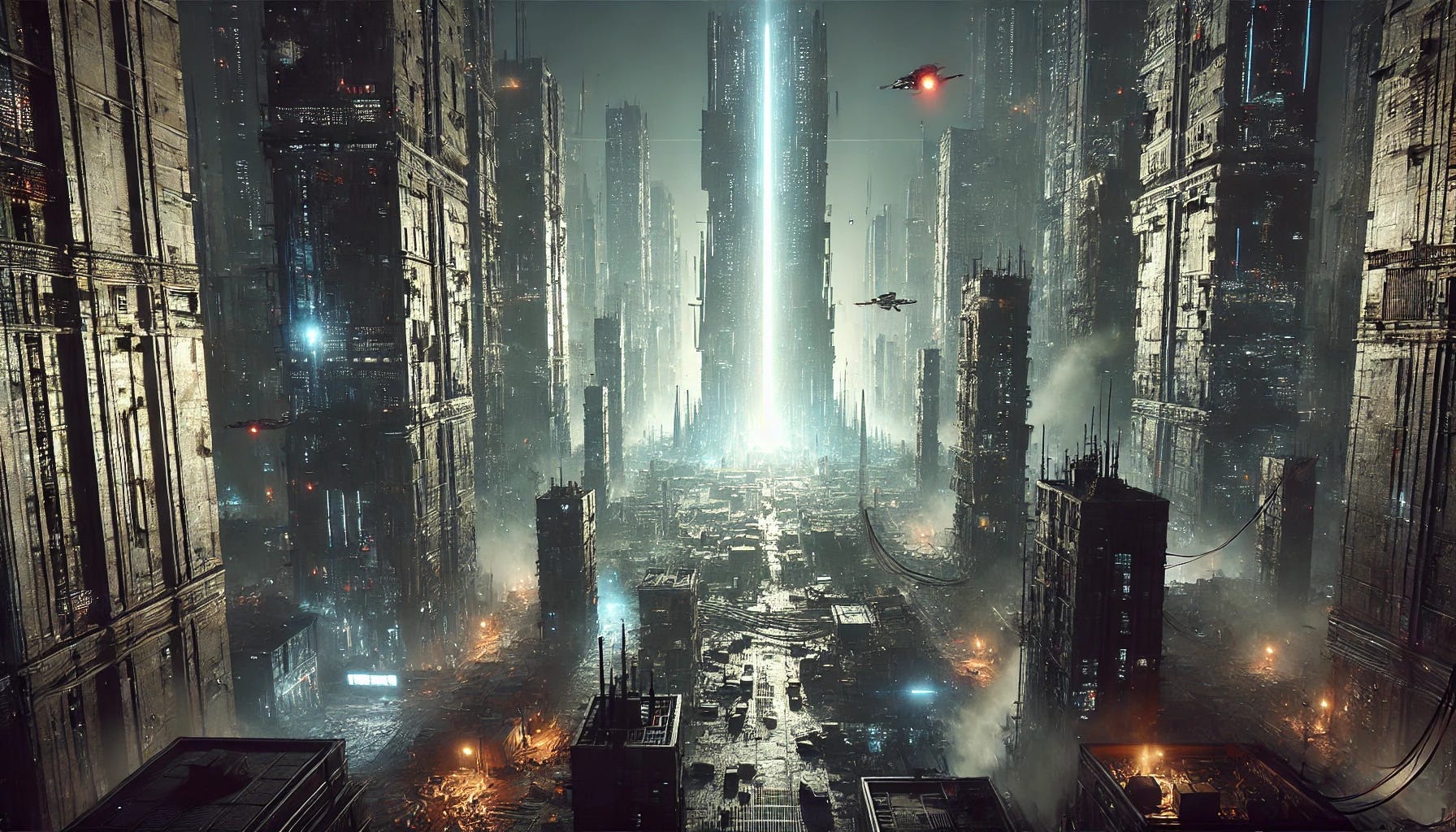
We no longer drag chains along the ground, which is precisely why so few of us recognise that we remain bound and in servitude. The plantation has been paved over, wired, and lit with LED efficiency. Overseers now bear titles like minister, governor, regulator, CEO, risk officer, HR partner, and compliance manager. Whips have been refined into spreadsheets, credit scores, performance reviews, tax notices, and quietly devastating phrases such as “breach of policy” or “insufficient funds”. The slave hut has been upgraded to the mortgage-financed apartment. The plantation store is called a supermarket. The master’s house is a bank. We call this civilisation.
The ancient arrangement hasn’t disappeared; it’s become more elegant. It has learned to bill the enslaved for the cost of their own subjugation, to reframe coercion as “public order”, and to baptise obedience as “civic duty”. It has perfected the art of turning captivity into common sense.
We live inside a system I have long described as industrial economism: a globalised, extractionist world-system that reduces life to transactions and relationships to contracts, while presenting this reduction as the pinnacle of rationality. It’s become so ubiquitous that it no longer presents as an ideology at all but as reality itself. Like fish in water, we rarely see the medium in which we’re condemned to swim.
We no longer need to ask if slavery survived abolition; we need to recognise it in the figure that wears our clothes, borrows our speech, and quietly commandeers our hands to tighten its bonds.
Paying for Our Own Chains
Every durable system of slavery must resolve the same logistical problem: who will pay for the guards?
Old regimes answered crudely. The master purchased whips and guns. Troops, mercenaries, informants and jailers had to be fed, clothed, and bribed from the surplus squeezed out of the enslaved. This was costly and unstable. Rebellions, desertions, arson, flight: all were daily risks. As Charles Tilly’s historical work on European state formation makes clear, the modern state evolved precisely by mastering this problem of organised coercion financed through extraction from those coerced.
The contemporary solution is breath-taking in its simplicity. The population now funds its own surveillance, its own discipline, its own confinement.
Police salaries are paid from taxes. Prison construction is underwritten by government bonds serviced by taxpayers. Armies are equipped from budgets that no citizen can lawfully refuse to support. Courts, border agencies, intelligence services, regulatory bodies – the entire architecture of compulsion – is maintained through compulsory contributions collected under threat of penalty, seizure, or incarceration.
Refuse to participate and you meet the same primitive truth that haunted older forms of bondage: your body can still be taken. What has changed is that the invoice is itemised, the processes are routinised, and the whole exercise is narrated as a reasonable exchange. We’re told we are purchasing our own safety.
The genius of this apparatus lies in its moral inversion, as well as its economic efficiency. Violence is translated into “law enforcement”. Occupation becomes “security”. The silent, everyday threat that undergirds taxation, policing, and military power is buried under the language of protection. This is what Hannah Arendt saw with unnerving clarity: domination passing from the visible theatre of command into the anonymous corridors of administration, where decisions become “procedures” and human agency dissolves into “requirements”.
A guard shouting instructions is easy to recognise. A system of forms, deadlines, permits, and penalties is harder to resist precisely because it doesn’t present itself as a will that can be opposed. It presents as inevitability.
The Ritual of Consent
To keep such an arrangement stable, raw force is never enough. People must be given rituals that allow them to misrecognise their own subjection as participation - the participation of an upright citizen.
Elections serve this function with almost liturgical precision. We are invited periodically to choose between candidates pre-selected by party machines, donors, and institutional interests. We may change the faces administering the system, but we are not permitted to vote on the system itself: on whether taxation should be voluntary, whether militaries should exist and in what capacity, whether the surveillance architecture should be dismantled, whether property relations should be inverted.
Robert Michels’ dissection of organisational oligarchy remains unnervingly apt a century later. In his study of European socialist parties and unions, he observed that once any organisation reaches a certain scale, technical and tactical necessities – the need for specialised knowledge, coordination, and continuity – push decision-making into the hands of a small managerial elite. Over time, that stratum consolidates into a caste: it controls information flows, frames the options members are allowed to see, sets internal rules, and presents its own continuity as synonymous with the organisation’s survival.
This is the “iron law”: not a moral failing, but a structural gravitation. The more complex the institution, the more its daily operation depends on permanent officials, experts, and negotiators. Members can still be consulted, canvassed, even mobilised theatrically, but they no longer set the terms of engagement. They ratify what has already been filtered, edited, and packaged.
Transposed to contemporary governance, the pattern is obvious. Parliaments and parties change complexion; cabinets reshuffle; prime ministers, presidents and ministers come and go. The machinery underneath – treasuries, central banks, finance ministries, security apparatus, senior civil services, corporate lobby networks, global financial institutions – persists with remarkable continuity. It is there that long-term commitments are designed, budgets assembled, trade and investment regimes negotiated, and the acceptable range of policy debate quietly fixed.
Within such a structure, voters can replace administrators, but they can’t refuse the underlying fiscal and coercive architecture that binds them. You may dislike the current government, but you are still compelled to fund, through taxation and mandatory fees, the police forces that can arrest you, the courts that can prosecute you, the prisons that can cage you, and the military that can conscript or dispossess you. No ballot paper invites you to annul your obligation to underwrite those institutions. No referendum allows you to declare: “I withdraw my financial consent from being monitored, disciplined, and, if necessary, subdued.”
That is where Michels’ insight cuts deepest. Even where formal democratic procedures exist, they operate within an oligarchic shell. The same narrow complexes of political, bureaucratic and corporate elites draft tax codes, design welfare regimes, license surveillance, contract private security and military suppliers, and decide what proportion of public wealth will be channelled into armaments, intelligence operations, carceral expansion, or debt service. You may alter the personnel at the edges of that system; you don’t get to step outside its compulsory reach without colliding with its monopoly on legitimate violence.
To attempt to “vote away” the coercive power of the state is therefore to confront not a single ruler, but a layered, self-protecting organism whose survival depends upon maintaining exactly that power. At that moment, the democratic costume slips and the iron law is revealed for what it has always been: an explanation of why, under industrial economism, participation is permitted, even encouraged, so long as it never threatens the prerogatives of those who administer the cage.
Participation thus becomes a rite of allegiance – a way of periodically declaring that the prison is, in some sense, ours. The ballot box operates as a confessional booth where citizens are invited to confess that they are free, even as the material conditions of their lives suggest otherwise.
This is not to say that elections are meaningless theatre. When you are inside a cage, the temperament of the guards matters. But the bars remain, and the keys stay with those who design the cage, not with those who walk its corridors every few years with coloured slips of paper.
Wage Labour and the Discipline of Exhaustion
The older slave knew he was owned. The modern worker has been granted a more sophisticated status: formally free, but structurally compelled. You can, in theory, decline any job. You cannot easily decline the necessity of securing food, shelter, and healthcare in economies where these essentials are thoroughly commodified. Karl Marx captured the paradox incisively: people appear to act freely while unconsciously replicating the self-same structures that strip them of autonomy. When survival depends upon the sale of one’s time, labour becomes an invisible leash. It does not need to chafe physically. It bites into hours, dreams, imagination, health.
The wage system is a masterpiece of control because it merges compulsion with apparent choice. You apply for work. You sign the contract. You clock in and out. At each step you can be told you consented. Yet walk away from this “freedom” and you collide with the fundamental violence of deprivation: eviction, hunger, untreated illness, social exclusion.
Time becomes the ultimate currency of captivity. Long working hours, unpaid overtime, frantic gig labour, and multiple jobs to cover basic expenses, colonise the capacity to reflect, to organise, to become politically dangerous. Exhaustion replaces chains. By the time you have navigated the commute, the performance review, the targets and the metrics, there’s barely a residue of attention left to question the scaffolding within which all of this takes place.
Industrial economism doesn’t simply extract surplus value; it commandeers the rhythms of life. It reaches into circadian cycles, family rituals, intimacy, parenting, and community, reorienting them around production schedules and quarterly results. In such conditions, the idea of resistance comes to feel extravagant, even irresponsible. Rest becomes the only rebellion most people can imagine.
Debt as Perpetual Lien on the Future
If wage labour secures the present, debt colonises the future. Mortgages, student loans, microcredit, credit cards, and tax arrears extend obligation across decades. They tether unborn years to past signatures. The debtor carries an invisible brand stamped not on the skin but on the calendar. Each month brings its tithe.
Sociological research across diverse economies shows a consistent pattern: high personal debt correlates with reduced political participation, heightened risk aversion, and greater conformity to institutional expectations. The indebted citizen lives with a constant, low-grade apprehension: any misstep could trigger a domino run of penalties, repossessions, and social disgrace.
Debt turns the free exit that theory promises into a practical impossibility. In principle you can walk away from a toxic employer, an abusive landlord, or an unjust jurisdiction. In practice, you hesitate – not only because of immediate survival needs, but because default carries long shadows, such as ruined credit, restricted mobility, exclusion from housing markets, visa complications, and sometimes even imprisonment.
The old slave was collateral on the master’s balance sheet. The modern debtor is collateral on theirs. The effect is remarkably similar. Future labour is pre-committed. Choices are truncated in advance. Even rage must be moderated, because one’s credit rating – a kind of secular karma score – haunts every transaction. Debt thus becomes the secular sacrament of industrial economism: a promise etched into financial code that binds living beings to the perpetuation of a system that treats them as variables in an actuarial table.
Comfort as a Technology of Captivity
Harsh coercion quickly breeds revolt. Far more durable is a captivity softened with comforts. Contemporary consumer culture provides compensatory pleasures in lieu of genuine agency. The supermarket aisle, the streaming platform, the smartphone app store, and the social media feed all function as vast soothing devices. You may not control the conditions of your work, but you can choose among dozens of snack flavours and thousands of entertainment options. You may not own the means of production, but you can endlessly customise your digital avatar.
Herbert Marcuse’s warning about “false needs” remains unsettlingly prescient: industrial consumer culture generates desires that fit precisely within its productive capacity, offering satisfactions that sedate more than they liberate. The rush of a new purchase, the brief solace of comfort food, the narcotic immersion of screens – all help to smooth the rough edges of systemic constraint.
Marcuse’s point was not simply that people buy things they don’t really need. He was going much deeper. He was asking how a system that exhausts bodies, erodes communities, and degrades ecosystems can still secure the emotional consent of those it exploits. His answer was ruthless: by fabricating needs that can only be met by the very apparatus causing the harm, then teaching people to experience the meeting of those needs as happiness.
“False needs” in his sense are not trivial whims; they are internalised imperatives aligned with industrial economism’s priorities rather than with human flourishing. The need for the latest device, not because anything essential has changed but because obsolescence has been engineered. The need for constant connectivity, even when it frays attention and sleep. The need to “treat oneself” after a brutal week, by consuming more of what will make next week equally brutal. These needs are cultivated through advertising, social comparison, planned obsolescence, and the subtle prestige economies of brands and lifestyles.
Empirical research in marketing and consumer psychology corroborates much of this. Campaigns are deliberately designed to attach products to insecurities, aspirations, and identity. A car is sold as status, virility, or freedom, not simply a machine fopr getting from A to B. A cosmetic is sold not as pigment, but as acceptability. A holiday is sold as proof of success, not an opportunity to rest and recover. In each case, a vague disquiet is named and then momentarily eased by purchase. The underlying emptiness is left untouched, because to address that directly would threaten the system’s demand for endless consumption.
In this way, industrial culture turns discontent into fuel. Boredom, anxiety, loneliness, and status anxiety are not unfortunate side-effects of the world-system; they are productive conditions. They drive traffic to platforms, footfall to malls, demand for pharmaceuticals, and uptake of digital distractions. Every discomfort becomes an opportunity for commodified relief.
Comfort food is a textbook illustration. Ultra-processed products are engineered to deliver rapid hits of sugar, fat, and salt that spike reward circuits. They soothe, briefly, the stress produced by overwork, social precarity, and fractured relationships. Yet the very health impacts – obesity, diabetes, heart disease – then feed medical and wellness industries, which in turn offer more products and programmes to manage the damage. At no point is the original pattern of life that made such consolation necessary placed in question.
Screens complete the loop. The architecture of contemporary digital platforms is intentionally addictive. Infinite scrolls, variable rewards in the form of likes and notifications, algorithmic curation tuned to outrage and novelty – all are calibrated to keep users engaged for as long as possible. Here too, people are not simply “choosing entertainment”; they are seeking to anaesthetise pain: the drudgery of work, the numbness of debt, the hollowing-out of community. The more attention flows into these channels, the less is available for sustained reflection on why so much anaesthesia is needed in the first place.
Marcuse feared that such a system would eventually produce what he called “one-dimensional” individuals – people whose capacity to imagine forms of life beyond the existing order has been dulled. If happiness is equated with access to commodities, and freedom with the ability to choose among brands, then the possibility of a life organised around non-commodified values – reciprocity, beauty, contemplation, sufficiency, shared abundance – starts to look either childish or threatening.
What makes his diagnosis so disquieting today is not simply that it appears so accurate, but that it has been normalised. The idea that whole industries are devoted to meticulously cultivating dissatisfaction in order to sell temporary relief is hardly controversial; it’s described openly in business schools and marketing textbooks. Yet this knowledge rarely translates into political or existential refusal. We go on shopping, scrolling, snacking – and blaming ourselves for the lingering emptiness.
In that sense, false needs are not illusions we can dispel with a single insight. They are woven into habits, urban design, work cultures, and social expectations. To recognise them is not to step outside them, but to begin the slow, awkward work of disentangling genuine wants – for connection, meaning, joy, security – from the products we have been trained to treat as their substitutes.
Industrial economism thrives on our confusion between the two. The more thoroughly we equate comfort with liberation, the safer the cage becomes for those who profit from its bars.
Psychologically this is ingenious. If the prison provides wide-screen entertainment, climate control, and instant gratification on demand, the urgency to dismantle it wanes. The captive begins to fear the discomfort of freedom more than the degradation of confinement.
Under such conditions, critique itself is rapidly absorbed as style. The rebel image is printed on T-shirts, revolutionary slogans are used in advertising, “edgy” branding borrows from insurrectionary aesthetics. Resistance is turned into a consumer preference. The energies that might have reconfigured the architecture of power are channelled into taste. The plantation, in other words, has learned to decorate its fences beautifully.
Prisons of Perception
The most enduring chains are conceptual. If people can be persuaded that what they experience daily is the only conceivable reality, then overt force becomes an occasional supplement rather than a structural necessity. Plato’s allegory of the cave speaks directly to this: humans raised from birth within a narrow theatre of shadows will defend that theatre as reality itself. Attempts to describe a world beyond the cave are met with incredulity, mockery, or rage. The prisoners see the messenger’s dissonance as madness rather than as evidence of their own incarceration.
Modern industrial societies have refined this perceptual imprisonment. Michel Foucault’s analysis of disciplinary institutions shows how surveillance migrates from the external eye to the internalised gaze. Schools, offices, hospitals, and prisons share a repertoire of techniques: timetables, examinations, performance metrics, surveillance devices, and ubiquitous feedback. Under their influence, individuals begin to monitor themselves. They anticipate punishment and so adjust behaviour pre-emptively.
The Panopticon is not only a prison design; it’s a cognitive architecture. Once it settles into the nervous system, no guard need be present. The subject polices their own thoughts, edits their speech, moderates their feelings, not because someone is visibly watching but because someone might be watching.
Kafka adds another dimension: opacity. The most paralysing authority is not the tyrant who declares his will openly, but the faceless bureaucracy that issues contradictory directives from undisclosed locations via incomprehensible rules. In The Trial, the protagonist never learns the nature of his alleged offence, yet he is crushed all the same. Today, algorithmic decision-making magnifies this experience: credit scores, risk assessments, pre-emptive policing, social media moderation, e-visa applications – all increasingly governed by opaque systems that cannot be interrogated meaningfully by those they judge.
This ambiguity is itself a method of control. Fear of stepping over invisible boundaries breeds caution. Uncertainty about who is responsible diffuses anger. People end up pleading with functionaries who can “only follow procedure”, while those designing the procedures remain insulated from scrutiny.
Philip K. Dick’s image of a “black iron prison” gives this a metaphysical twist: a structure of reality enforced not only by bars and bullets but by stories, symbols, and recurring patterns that shape what can be thought. In such a world, the “empire” does not require a single emperor. It persists as an operating system embedded in language, education, and media. Change the personnel, keep the code.
Game Theory in the Slave Quarters
Many who sense all of this still comply. Why? Game theory offers part of the answer. In multi-player situations governed by asymmetric power, it’s often rational for each individual to accept injustice rather than risk solitary defiance. The loss from rebellion, borne alone, outweighs the probable gain. Everyone waits for everyone else. Each person calculates privately, concludes that the personal risk is too high, and returns to work, to debt payments, and to docile consumption.
This is not cowardice. It’s a reasonable response to a structure that punishes dissent efficiently and rewards conformity modestly - but reliably. It also feeds on mistrust. When social bonds are weak – when I don’t believe my neighbours, colleagues, or fellow citizens will stand with me – resistance appears futile. Collective action withers not because people are ignorant but because they are cautiously fearful.
The system is aware of this. It cultivates conditions in which rebellion is individually irrational and collectively unlikely. Just enough comfort to discourage desperation; just enough punishment to maintain fear; just enough fragmentation to keep people isolated; just enough theatre of reform to preserve hope that change can be delegated upward rather than built sideways. Under these circumstances, even those who recognise their own slavery can end up defending the arrangement as “the only realistic option”.
Manufactured Isolation
Historic slave revolts depended on dense networks of trust – family, clan, guild, village, secret societies, religious communities. Such webs made it possible to plan and coordinate, to hide fugitives, to share resources, to transmit stories of resistance.
Industrial economism systematically corrodes these organic structures. Extended families are scattered by labour migration. Traditional neighbourhoods are hollowed out by speculative property markets and forced evictions. Communal spaces are replaced with private consumption spaces: shopping centres, gated estates, paywalled platforms. Housing insecurity, precarious employment, and individualised welfare systems all push people into transactional relationships with institutions rather than reciprocal relationships with each other.
Sociological studies in very different countries – from the US and UK to Japan, Brazil, and South Africa – show declines in many forms of social capital: trust in neighbours, long-term association memberships, participation in local voluntary groups. As people become more reliant on state agencies and corporations for survival, they become less capable of organising outside those frameworks.
Isolation is not only social. It’s also cognitive. The information ecology most people inhabit is fragmented, torrential, and utterly shallow. News cycles fixate on sensational events, celebrity dramas, scandals and polarising controversies. Structural analysis is crowded out by outrage and trivia. Algorithms prioritise what keeps eyes on screens, which is rarely calm reflection or complex critique. The result is a population that feels overwhelmed, scattered, emotionally agitated, and yet strangely powerless. Attention is dissipated rather than focused. Prison walls remain invisible because the gaze rarely lingers long enough on the texture of everyday life to discern patterns of confinement.
When the Captive Defends the Captor
Long-term captivity doesn’t merely constrain behaviour. It rewires attachment. Psychologists studying hostage situations, abusive relationships, and cult dynamics have long observed a disturbing trend: under continuous dependence, combined with intermittent kindness, captives often develop strong bonds with their captors, sometimes even defending them passionately against external criticism. The label “Stockholm Syndrome” is crude, but the underlying dynamics are widely documented in clinical and criminological research.
Transposed to a societal scale, this produces citizens who passionately defend institutions that consistently harm them – not because they’re in any way stupid, but because the psyche under pressure seeks coherence. It’s less painful to believe that one’s rulers are fundamentally benign, that corporations “care”, that banks are “partners”, that militaries “serve the nation”, than to live with the chronic dissonance of loving what destroys you.
Industrial economism cultivates this attachment through a mixture of fear and reward. Moments of crisis – pandemics, wars, economic crashes – are used to reinforce narratives of dependency: only strong institutions can save you. Only experts can guide you. Only the existing order, with a few tweaks at the edges, stands between you and chaos.
Meanwhile, those same institutions profit from the crises they help generate. Industries that contaminate environments later sell purification. Food systems that promote disease fund treatments. Tech platforms that fracture attention offer mindfulness apps. States that launch or abet destructive wars subsequently award reconstruction contracts to corporations embedded in the same military–industrial nexus that supplied the weapons, turning cities reduced to rubble into fresh markets for cement, surveillance systems, logistics, and financial services. Governments that create insecurity expand police and military budgets in response. Harm and relief are woven into a single, profitable loop.
Little wonder that psychological confusion deepens. The hand that strikes is the hand that holds the painkiller. Loyalty and resentment intermingle. Over time, orientation weakens. Escape begins to feel both dangerous and ungrateful.
Freedom as Story, Not Condition
In such a world, freedom survives most vividly in language. We speak of “free markets”, “free elections”, “freedom of choice” – phrases repeated so frequently they acquire the aura of catechism. Yet when examined closely, each tends to refer to freedoms exercised within tightly controlled parameters.
You are free to choose between employers, but not free from the obligation to sell your labour. You are free to shop among multiple brands, but not free from participation in an economic system that requires continuous consumption to avoid collapse. You are free to vote among parties whose core economic assumptions rarely diverge in any fundamental way. Freedom thus becomes a narrative overlay. It functions less as a description than as a ritual affirmation. The schooling system teaches its contours. Ceremonies, anthems, and public holidays stage its myth. Media repeat it. Those who question its accuracy are portrayed as extremists, malcontents, or fantasists.
At this point, the more interesting question is not: “Are we free?” but “Which story about freedom has been installed in us, and whose interests does it best serve?”
When exit from the dominant system is ‘legally’ possible but ‘practically’ unachievable without incurring severe sanctions, then “choice” becomes a theatre piece performed inside the prison yard. You may select your spot in the courtyard. The walls are not up for ballot.
Crack in the Wall: Recognition
Does it follow, then, that there’s no way out? Lenin’s sharp insistence that an oppressed class which does not seek its own capacity for force “deserves” slavery has been interpreted as a call for armed uprising. Yet even he assumed something more primordial: recognition. An awareness that one is, in fact, oppressed. Without that, nothing follows – no organising, no strategic thinking, no trialing alternative arrangements.
Industrial economism works tirelessly to prevent that first recognition. Not by hiding every abuse – which is impossible – but by breaking the connection between personal suffering and world-system analysis. If you’re exhausted, it’s because you are not resilient enough. If you are poor, it’s a failure of individual hustle. If you’re anxious, you need therapy or medication, not a new civilisation.
What remains after the system has done its work rarely looks like overt brutality. It looks like lives narrowed to managed survival. People who once had rich capacities for curiosity, artistry, care, and contemplation reduced to units of labour and consumption. Communities so preoccupied with making ends meet that the horizon of imagination contracts to the next bill, the next deadline, the next small relief.
This is damage, not mere hardship. Hardship can build solidarity and courage. Damage erodes them. Damage makes people doubt their own perceptions, distrust their own impulses to push back, resent those who still dare to dream beyond the confines.
And yet, cracks do appear. When enough people, in sufficiently different circumstances, start noticing the same distortions; when workers in factories and offices, villagers displaced by dams, students saddled with unpayable debts, farmers crushed by input costs and climate volatility, migrants navigating predatory borders, all begin to see that their separate pains rhyme – then recognition starts to coalesce into something more than private despair.
At that point, leadership – in the sense I use the word, as a collective phenomenon, not as the heroics of isolated individuals – becomes possible. Not leadership to capture the existing apparatus and drive it more efficiently, but leadership to reimagine what it means to live together without captivity as the organising principle.
Beyond the Industrial Maze
The metaphor of a maze is apt because it holds two truths at once: the structure constrains movement, and yet there are also junctions, dead ends, vantage points, and, somewhere, exits. The problem is that those exits are not signposted. They must be discovered, sometimes built.
Industrial economism would have us believe that there is no outside, no beyond what is there today. That history has culminated in this peculiar arrangement of perpetual growth within finite ecosystems, commodification of almost everything, and governance by opaque alignments of state and corporate power. Question this, and you will quickly be accused of romanticism, primitivism, utopianism or, as in my own case, dangerously naive idealism.
But what if the real naivety lies in assuming that a civilisation premised on endless extraction from both people and planet can continue indefinitely? What if the very resilience of the present system – its ability to absorb critique, to rebrand itself, to offer small reforms while maintaining its core logic – is precisely what prevents us from developing the capacities we will need when it inevitably hits its ecological and social limits?
The point is not to indulge in apocalyptic fantasies, but nor is it to retreat into nostalgia for some imagined golden age. It’s to question whether obedience to a collapsing order is sane.
If slavery today is sustained by belief, distraction, isolation, and dependency, then the earliest forms of practical resistance are likely to look mild and distinctly unheroic: communities rebuilding mutual aid networks that reduce reliance on predatory institutions; people redesigning local economies to value sufficiency over endless accumulation; families and groups reclaiming time from wage labour to restore play, and intergenerational learning; networks that protect whistleblowers, dissidents, and those who experiment with new forms of governance perhaps. None of them exactly world-shattering projects.
These are not yet revolutions. They are, at best, rehearsals – fragile, incomplete, often messy. But rehearsals matter. They create muscle memory. They accustom people to acting together without waiting for permission from those who profit from their passivity.
The first act of escape from modern slavery, then, is not a storming of palaces. It’s a refusal to let the system define the meanings of safety, success, and sanity. It’s a decision – repeated in countless quiet rooms and noisy streets across the planet – to trust our own perception of the cage, even when official narratives insist we are already free. From there, the real work begins: not simply tearing down the walls, but learning again how to live without needing them.