Alexander Downer has a right to be worried about debt. In a recent reflection on Australia’s rapidly expanding public debt, he points to a problem that has become strangely normalised across all Western democracies. When the Howard government left office in 2007, federal government debt had effectively been paid off. Today, Commonwealth debt has passed the trillion-dollar mark. The figures are sobering. The interest bill alone now consumes tens of billions of dollars that could otherwise be directed towards public purposes, and across the Western world governments are accumulating liabilities at a rate that would once have been regarded as politically reckless.
Downer’s warning deserves to be taken seriously. But there’s something missing from his calculations: private debt. Once private debt enters the picture, the nature of the problem changes profoundly. The question is no longer simply how much the Australian government owes. It’s how much debt the Australian economy as a whole has accumulated, who owns that debt, what the borrowed money has been used for, and whether the productive capacity of the economy is sufficient to service it.
This is a much more uncomfortable question, because Australia isn’t just a country with a government-debt problem. It is a highly leveraged economy. Households hold enormous mortgage liabilities. Businesses borrow. Governments borrow. Banks borrow. Investors borrow. Superannuation funds and financial institutions hold government securities, foreign investors hold Australian debt, and Australian investors hold claims on foreign economies. Debt isn’t simply sitting inside government balance sheets. It runs through the entire architecture of modern capitalism. And this is where the conventional debate becomes misleading.
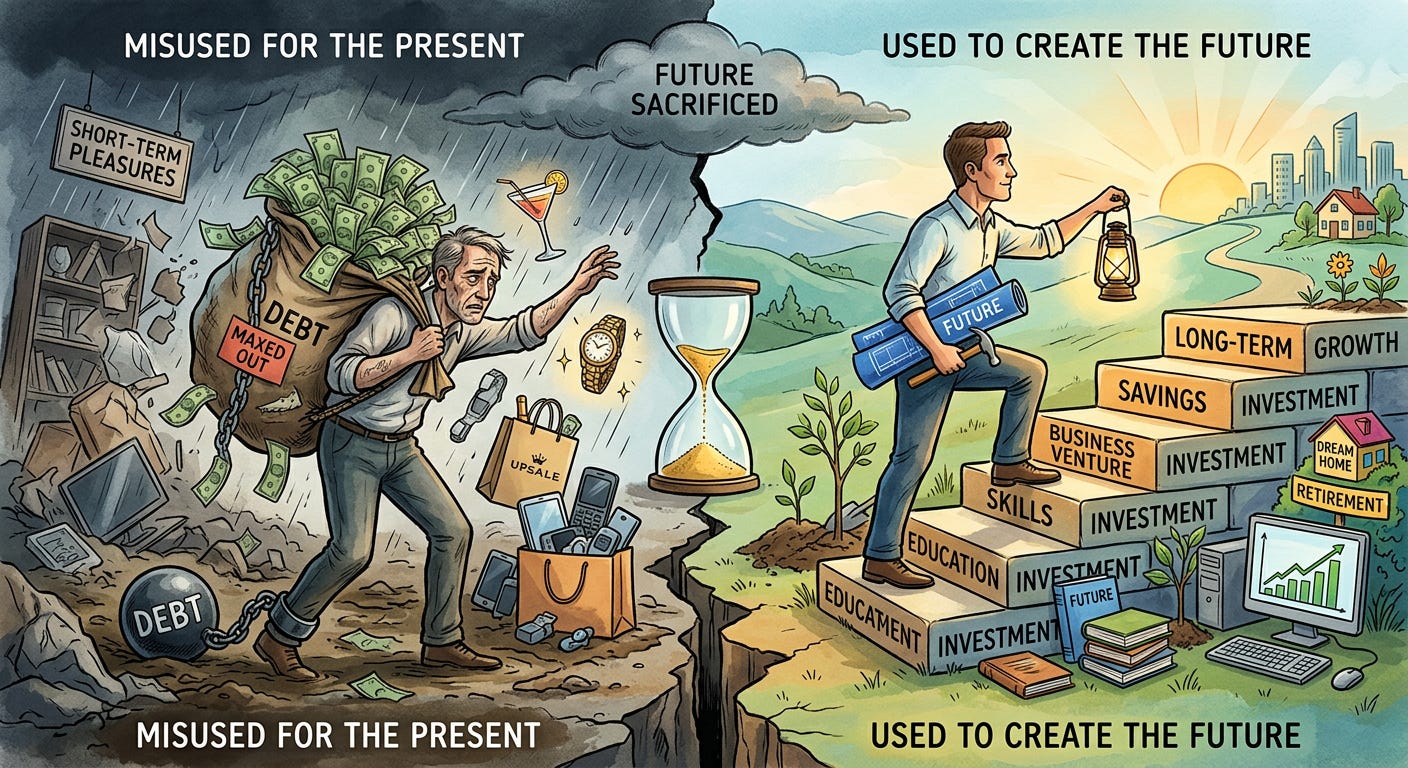
I’m not an economist and I have even been lovingly called financially dyslexic. But even I can appreciate the fact that debt isn’t inherently destructive. Borrowing to build something that increases future productive capacity can be perfectly rational: a government that borrows for transport infrastructure, energy systems, water infrastructure, research capacity or education may be creating assets whose economic value extends far beyond the life of the debt. The same is true of private borrowing. A company that borrows to develop a productive enterprise can create future income with which to service that borrowing, and a household borrowing to acquire a home acquires an asset as well as a liability.
The crucial question therefore isn’t simply how much debt we have. It’s what we did with that money. This distinction is fundamental. A society can borrow heavily and become more productive, innovative and prosperous. Or it can borrow heavily to maintain current rates of consumption, inflate asset prices, postpone structural reform and preserve an economic model whose underlying productivity is waning. The balance sheet may look superficially similar. The consequences are not.
Australia’s household sector is particularly important. For decades, easy credit and rising property prices have become deeply embedded in the Australian economic model. Housing has become something more than shelter in the Australian psyche: it’s an enormous financial asset class. When house prices rise, existing owners feel wealthier, banks expand lending, construction surges, governments receive additional revenues, consumers borrow against rising equity, and financial institutions earn interest. The cycle is self-reinforcing.
But it has a dangerous characteristic. Debt can create the appearance of prosperity before the underlying economy has actually generated the prosperity. What matters more than the level of that debt is the pace at which it grows. Spending in any period depends not just on income but on how much new credit is being drawn down. An economy can be riding fresh borrowing rather than earning its growth. When the pace of new borrowing slows, spending falls first, before any debt is defaulted on and before a single loan turns bad. The contraction arrives before anyone has identified a cause.
Australia is not unusual in this. Household debt tied to rising property values has become the load-bearing factor of growth in economies as different as China’s and Canada’s, and the mechanism travels far more widely than the countries usually blamed for it.
This is precisely why interest rates matter so much. When rates rise, the consequences are not confined to Canberra. They reach directly into millions of household budgets: the same interest-rate increase that makes government borrowing more expensive also increases mortgage repayments, reduces discretionary spending and places pressure on businesses whose customers are already under financial stress. Thus the public and private debt problems interact. Government debt isn’t occurring in isolation from household debt. It’s occurring inside the same financial system.
Corporate borrowing is more difficult to characterise, because debt can be either productive or destructive. Borrowing to invest in new technology, research, productive capacity or expansion can increase future output; borrowing to finance acquisitions, financial engineering or asset speculation can do something quite different. The important issue is less the leverage itself than what leverage is doing to the productive economy. This brings us to the uncomfortable possibility that Australia has been accumulating debt without accumulating sufficient productive capacity to match it, which is a much more serious problem than the headline figure for Commonwealth debt suggests.
This may be the question we should be asking. Australia has accumulated extraordinary quantities of debt across government, households and business, so what have we got in return? Have we built an economy capable of generating dramatically higher productivity, transformed our infrastructure, created globally competitive industries, substantially increased our research and development capacity, or built an education system capable of producing the capabilities an increasingly technological economy requires? Have we solved the housing crisis, created the energy system the next century will need, increased the resilience of our economy? Or have we largely used debt to maintain an increasingly expensive status quo?
That’s a very different conversation. If debt has financed productive transformation, it may be an investment. If it has financed consumption and asset inflation while productivity stagnates, it becomes something closer to a mortgage on the future.
There’s another awkward problem. Debt creates two sides of a balance sheet, and every liability is somebody else’s asset. When the Australian government issues a bond, someone buys it. When an Australian household takes out a mortgage, a bank acquires an asset. When a company borrows, somebody else owns the corresponding claim. This means the issue of who owns the debt is at least as important as the question of who owes the money.
Government bonds are held by Australian banks, superannuation funds, institutional investors, the Reserve Bank and foreign investors. The interest paid on those bonds doesn’t disappear. It becomes income for their owners. This introduces a question almost completely absent from the public debate: what distributional consequences arise from an economy in which debt is increasingly central to the creation and distribution of wealth? Those who own financial assets receive interest; those who borrow pay it. Those who own property benefit when credit expansion drives property prices upwards; those trying to enter the property market face increasingly formidable barriers. Those with capital can leverage it. Those without capital increasingly have to borrow it. Debt therefore isn’t only an accounting phenomenon. It’s also a mechanism through which claims on future income are distributed.
Downer invokes Greece as a warning of what happens when governments lose the confidence of financial markets, and that warning is valid, though the Greek experience needs to be treated carefully. Australia is not Greece. Australia has its own currency, its own central bank and substantially greater monetary sovereignty. Greece’s crisis was bound up with the architecture of the eurozone, banking instability, external imbalances and the loss of its ability to use monetary policy and currency depreciation in the way a sovereign currency issuer can. Nevertheless, Greece demonstrates something of vital importance: once a government loses the capacity to finance itself on acceptable terms, choices that were previously political become financial necessities. Cuts become compulsory. Taxes rise. Public services deteriorate. Pensions are reduced. Wages fall. Economic sovereignty becomes constrained by the demands of creditors. That’s the danger Downer is pointing towards.
But there’s another hazard. If governments respond to excessive public debt with indiscriminate austerity at a time when households are already heavily indebted, they can weaken the very economy upon which debt repayment depends. Reducing expenditure is not automatically the same as improving an economy. The objective should not be austerity for its own sake. It should be productive transformation.
Downer is also correct in stating that governments can’t simply solve every debt problem by creating money. If monetary expansion substantially exceeds the economy’s capacity to produce goods and services, inflation can erode purchasing power. But once again the simplistic version of the argument is inadequate. Money creation becomes especially dangerous when it’s used to finance consumption without increasing productive capacity; money directed towards genuine productive investment is a different proposition altogether. The distinction matters because the central challenge is not the quantity of money alone. It’s the relationship between money, debt, productive capacity and real wealth - a relationship that has been increasingly obscured by modern financial systems.
This is why I think Downer’s argument should be pushed further. We shouldn’t just ask whether governments are spending too much. We should also ask why governments, households and businesses have become so dependent upon borrowing in the first place. Why does an advanced economy require ever-increasing levels of debt to sustain growth? Why has rising property wealth become so central to household security? Why does economic growth appear increasingly dependent upon credit expansion, when productivity growth has failed to keep pace with financial expansion? Why are governments borrowing to finance recurrent expenditure rather than generating sufficient revenues or reprioritising spending? And perhaps most importantly, who benefits from the perpetuation of this system?
These are questions that cannot be answered by attacking one political party, one government or one newspaper. They go deeper than partisan politics. The left can demand more government spending, the right can demand lower taxes, the centre can promise fiscal responsibility. But if the underlying economic architecture continues to rely upon expanding credit, rising asset values and perpetual growth in debt, the political arguments become different ways of managing the same underlying system.
Ernest Hemingway’s famous description of bankruptcy, gradually, then suddenly, has become a cliché in discussions about debt. But clichés sometimes survive because they contain an element of the truth. Debt crises rarely begin on the morning the crisis becomes a headline. They develop incrementally: a little more borrowing, a little higher interest bill, a little more dependence on refinancing, a little more household leverage, a little more asset inflation, a little less productive investment, a little more of tomorrow’s income committed to paying for yesterday’s consumption. For years, nothing appears to happen. Then, quite abruptly, interest rates rise. Asset prices fall. A currency weakens. Banks become cautious. Investors demand a higher return. Consumers stop spending. Refinancing becomes more expensive. Suddenly the accumulated fragility becomes visible. The mistake is to assume that because the system has survived so far, it will necessarily continue to survive.
The conventional debate asks how much a government should spend. It should be asking a more fundamental question. What kind of economy are we financing? If Australia is going to borrow, we should be particularly demanding about what that borrowing produces. If households are going to owe enormous mortgages, we should ask whether our housing system is creating homes or leveraged financial assets. If businesses are going to borrow, we should ask whether the capital is improving productivity or just increasing financial returns. And if government is going to borrow, we should ask whether the expenditure creates enduring public value or just postpones difficult political choices.
And whenever new debt is created, we should ask the question that almost never gets asked: who ultimately owns the claim on the future income that will repay it? That’s the debt beneath the debt.
From my perspective, as a futurist rather than an economist, the real danger is not that Australia has borrowed a trillion dollars. It’s that we may have constructed an economic system in which government, business and household debt have become structural substitutes for productivity, investment and genuine wealth creation. If that is the case, then simply cutting spending will not solve the problem. Nor will printing money. Nor will raising taxes. Nor will blaming governments of one political persuasion or another.
We need to change what the economy is for. Debt should finance the creation of future capacity, not the consumption of future income. And that distinction may determine whether the debt mountain remains manageable, or whether gradually, then suddenly becomes more than just a convenient metaphor.