Discover the collection of Richard’s books which delve into the complexities of our world, challenge conventional thinking, and illuminate the path to a future of boundless possibilities.
The Civilisation That Forgot How to Think is a work of philosophical anatomy. Its argument is deceptively simple: the most consequential crisis facing humanity is not climate change, governance failure, or technological disruption — it’s the progressive erosion of the cognitive and moral capacities required to respond to any of them adequately. The book does not add to the long shelf of crisis literature. It asks the prior question: what kind of thinking does this moment require, and what has happened to our capacity to produce it?
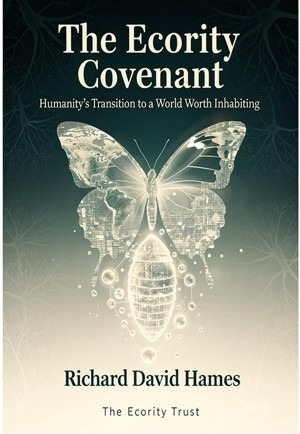
The Ecority Covenant offers a conscious alternative to the current paradigm of industrial economism: metamorphosis through the fusion of ecology, security, and integrity. The book outlines six dimensions of a regenerative civilisation and invites readers to become “imaginal cells” of a world worth inhabiting.
A philosopher’s reckoning with civilisational dissolution and the possibility of genuine renewal, told across eighty years of lived witness and eleven dialogues that move from unflinching diagnosis to the philosophical foundations of a different way of inhabiting the world.
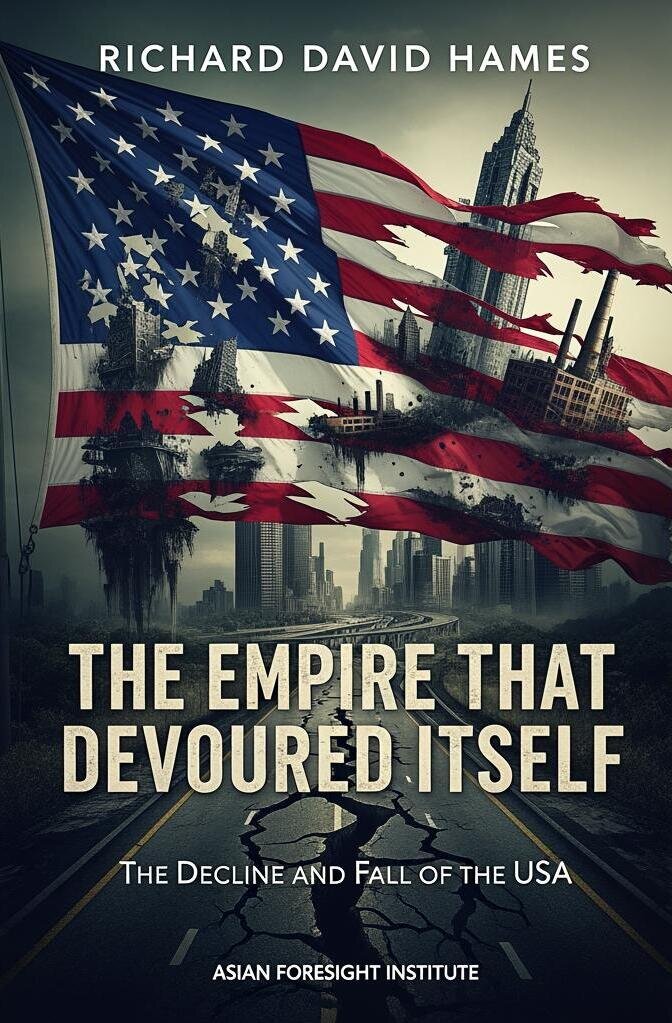
Empires end. What’s less understood is how empires end from within—by systematically consuming the conditions that made them powerful, not through conquest or collapse. The Empire That Devoured Itself traces this process with forensic precision, following the cascade of American imperial self-destruction from the theology of chosenness that made it inevitable, through the war economy that institutionalised it, the surveillance architecture that insulated it from accountability, and the Coalition of the Apocalypse that has now accelerated it beyond any previous reckoning.
The crises converging on us now—ecological breakdown, democratic erosion, and the fracturing of shared reality—are not failures of policy, technology, or political will. They are the consequences of a worldview: a set of assumptions about what is real, what matters, who counts, and what time is for that has become so pervasive it is no longer visible as a worldview at all. It exerts its pull the way gravity does — without announcement, felt everywhere, located nowhere.
The Tuning of the World is a work of civilisational diagnosis and design. It argues that the cascading crises of our age ? ecological collapse, institutional failure, and the erosion of meaning and security ? are not separate emergencies but symptoms of a single, ageing operating system: a five-hundred-year-old story that treats the Earth as raw material and sovereignty as the highest political virtue.
Planetary Intelligence defines the principles of ecority – ecological security – why industrial economism has dismantled them, and why their recovery — already underway in communities around the world — is the most consequential work of the current civilisational moment.
The wars being fought across the Middle East, the tensions in the Taiwan Strait, the conflict in Ukraine, the erosion of democratic institutions across the world’s largest democracies — these are not separate crises. They are expressions of a single structural feature of the current human situation, for which our analytical frameworks have not yet found adequate language.
For well over fifty years, we’ve gathered at summits, signed accords, and launched initiatives—yet the crises keep deepening. Not because we lack good ideas, but because our world-system doesn’t simply resist change; it absorbs it. That’s the hijacking syndrome: genuinely transformative ideas are stripped of their disruptive core, repackaged in the language of industrial economism, and sold back as progress.
The pursuit of a reimagined mode of leadership has, for decades, been suffocated by our global obsession with administrative hygiene. Since the mid‑20th century, we have witnessed a stealthy abdication in which the messy, soulful arts of statesmanship and diplomacy were traded for the more sterile, mechanical surrogate of management.
The Last Humans: The Heretic’s Guide to What Comes Next is a sequence of 20 essays, neither manifesto nor memoir, neither prophecy nor polemic. It is an attempt to trace the faultlines running beneath our feet – the deep fractures in how we have organised existence itself – and to ask what might be built once we stop denying the tremors indicating collapse and the need for renewal.
Nothing in our world springs fully formed from nothingness. Every aspect of our reality – from the countries on our maps to the values we hold dear – was once just an idea in someone’s mind. These ideas were shaped by specific circumstances and needs. But once they took hold, we quickly accepted them as just the way things are, and in time, they congealed into the status quo. We now live among these human creations. So deeply entrenched have they become that we mistake them for the laws of nature. The Normalcy Illusion asks a simple but unsettling question: what if the world you call “normal” is the very thing putting us at risk?
This book begins with a heresy: what if “leadership” as we’ve been sold it is not our salvation, but part of the machinery driving us toward collapse?
Drawing on decades of work with presidents, CEOs, generals, activists and communities across the world, the author argues that modern leadership has become the priestcraft of an industrial religion: endless growth on a finite planet, permanent militarism, ruthless competition, and the worship of heroic (usually male) decision‑makers while the real lifegivers of society—nurses, teachers, community organisers, Indigenous custodians, artists—are sidelined.
Absolution without Remission: The Psychic Contract asks you to look past Donald Trump the man and into the mirror.
Rather than treating Donald Trump as a one‑off aberration, this book uses him as a lens to expose the deeper bargain our civilisation has struck with itself: a psychic contract that promises power without responsibility, grievance without self‑examination, and absolution without change. It shows how this deal plays out not only in American rallies but also in Modi’s India, Erdoğan’s Turkey, Netanyahu’s Israel, Brexit Britain, Davos boardrooms, and beyond.
This book sits in a parallel universe between genres. It’s not the unadulterated truth about present circumstances involving the kidnapping of the President of Venezuela. It’s not a conventional work of history or political science, but neither is it fiction. It sits in the domain of strategic foresight.
Teaching Silicon How to Feel is a field guide to the one question almost nobody in tech is asking: what happens when we train increasingly powerful systems on a civilisation built on inherited trauma, structural cruelty and industrial-scale indifference to suffering? Philosopher-activist and futurist Richard David Hames takes readers into the shadow side of progress – from slavery, genocide and colonialism to drone warfare, extractive capitalism and algorithmic bias – to show how easily yesterday’s atrocities can become tomorrow’s training data.
In a series of urgent observations, iconic futurist, Dr Richard Hames and globally awarded innovator, Adam Jacoby highlight 50 failings that are eroding our humanity.
From systemic failures to human behaviours, Hames and Jacoby provide single page, easily digestible summaries of the flash points that are affecting the trajectory of the human condition.
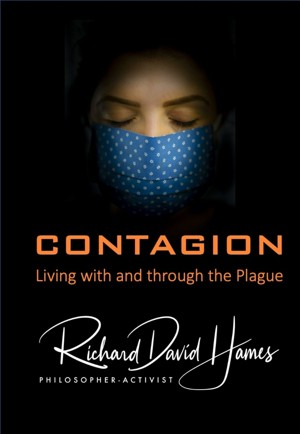
Contagion is a compelling anthology of ten essays written during the height of the COVID-19 pandemic. Addressing the diverse impacts of the crisis, these essays delve into topics spanning life, death, mental health, the economy, and more. Through the lens of the pandemic, the anthology explores the evolving nature of truth and knowledge amidst a world grappling with crippling uncertainties.
The Unacceptable Gift delves into humanity’s indifference to looming existential threats – like nuclear proliferation, the climate crisis, unregulated AI, and machine intelligence. It examines the power of propaganda, the cognitive avoidance of issues we find too shocking to consider, and our blind faith in technology. The book challenges prevailing notions, urging readers to embrace cautionary approaches to the unknown and reconsider societal norms in order to navigate into calmer waters and more secure futures for succeeding generations.
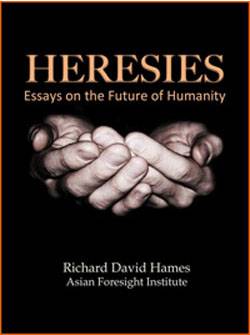
Heresies are seminal ideas that are at fundamental variance with the established order. Over the many years of advising governments and corporations, Richard has often been branded a heretic and has invariably taken this as a compliment. In the quest for alternative wisdom and new ways of knowing, this short book of essays examines the future of humanity from a mindfully contrarian perspective.
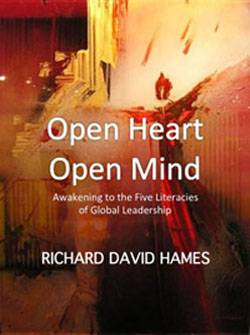
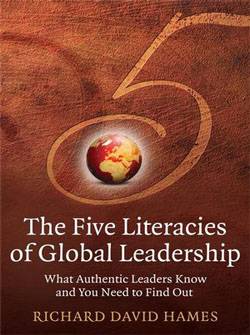
The 10 years of action research that ultimately gave rise to The Five Literacies of Global Leadership (published by Jossey-Bass in 2007) shattered outdated myths and preconceptions concerning what constitutes effective leadership. Open Heart – Open Mind is a primer for government and business executives who want to access and practice Five Literacies leadership in their own organisations.
New research has exposed our leadership paradigm as an outdated mess of flawed models and practices. By working with great leaders and observing their common attitudes and behaviours, Richard has cracked a universal code based on intelligence, appreciation and collaboration. This code unlocks five literacies for the praxis of effective global leadership..
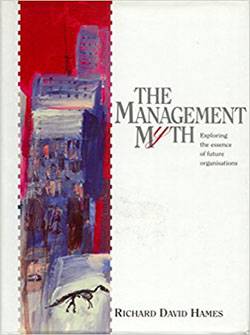
The Management Myth not only explores alternative ways of thinking about the world in which we work, but it also highlights the impact of technological and global change and brings together in a highly perceptive and challenging way the key issues, dilemmas and paradoxes confronting today’s organisations.
Drawing from the principles of ecological systems and social science, this book explores a new way of organising human interactions and interdependencies, one which gives meaning to our work and dignity to our lives. It offers tools that individuals and organisations can use to restore the pre-eminence of social and intellectual capital.