We live, let’s be honest, in a world that appears to be losing its mind. We watch cruelty delivered by algorithm and call it entertainment. We scroll past famine and war between adverts for extravagant goods we don’t really need. We build systems that measure human worth in productivity and profit, that reward the loudest voice and punish the gentlest, that turn neighbours into suspects and strangers into enemies. And most days we go along with it, even those of us who see through it, because the machine is large and we’re tired, and it’s just easier to go along with the madness than to resist.
We know something has gone fundamentally wrong. We feel it in the low hum of dread that accompanies the morning news, in the way we flinch at kindness because we have learned to suspect its motive. A civilisation that can map the genome and photograph the edge of the observable universe has somehow forgotten the simplest truth: what a life is, and what it’s for.
So it’s time—perhaps now more than ever—to ask one of the oldest questions again. What is life, if not the sum of our experiences?
We spend so much of our existence planning for the ordinary, while anxiously hoping and waiting for the extraordinary—the milestone, the triumph, the lottery win, the transformation. Yet life is lived mostly in the spaces between such events. A morning coffee sipped in silence, the commute shared with strangers, the Monday afternoons that blur into a trance impossible to remember in any detail. These are not the pauses between life but the substance of it. And woven among them, like threads of gold through plain cloth, come the moments of pure rapture—falling in love, standing on a mountain summit, swimming with dolphins, holding a newborn, hearing music that stops your breath—as well as moments of unmitigated suffering and trauma. Life is all of it. To prize only the heights is to misunderstand the journey entirely.
In many ways, it’s not education or privilege or even freedom that makes life interesting, but what you do with opportunities as they present themselves, and even if you see them in the first place. Credentials can be accumulated; circumstances can be inherited. But neither guarantees a life worth recounting, or one that others remember. Some of the most accomplished people on paper lead the narrowest of lives, while others with few advantages squeeze remarkable richness from modest means. The difference lies not in the hand dealt but in the willingness to play it—to say yes when a door opens, to take the unfamiliar path, to remain curious long after the world has stopped demanding it of you. This is a state of mind. Opportunity rarely announces itself with fanfare. More often it arrives disguised as inconvenience, risk, or an invitation that’s easy to decline. The art of living is learning to recognise it anyway.
This is why the most engaging people are those who have challenged themselves, given unstintingly to others, pursued an ambition, or had severe difficulties to overcome. Struggle forges character. A person who has never been tested has never had to discover who they are beneath the surface of comfort. Those who have strived—whether they succeeded or failed—possess a depth of character that can’t be faked under any circumstances. They know fear and have met it head on. They know doubt and have acted in spite of it. Their stories have texture. Their empathy is earned, never assumed. Even failure, so dreaded in the pursuit, becomes a gift in retrospect, because it teaches what success never can: resilience, humility, and the surprising discovery that we can endure far more than we ever imagined.
So what, then, is life all about? Perhaps this: it’s an ongoing unfolding; an act of conception. We’re each given raw material—time, circumstance, temperament, chance—and asked to make something of it. Not something perfect, not something impressive or exceptional by the standards of others, but something authentically ours. The meaning of a life is not found but invented, composed choice by choice, risk by risk, kindness by kindness.
And yet, this vision of life as self-creation must not become another burden for those who are already struggling—and we must be honest, too, about why so many struggle. The madness of the world is not an abstraction. It lands upon each of us. The outcast is rarely outcast by accident; more often she is pushed—by cruelty we tolerated, by indifference we mistook for neutrality, by a world that had no use for her and told her so. If you are suffering—if you are lonely, grieving, ill, cast out, or simply exhausted by the effort of continuing—then hear this: your life is not failing because it hurts. The pain you bear is not evidence of a life wasted but of a life deeply felt. The outcast, the broken-hearted, the ones sitting in the dark while the world seems to celebrate without them—you are not excluded from the story of living. You are at its very heart. Some of the deepest lives ever lived looked, from the outside, like defeat. Vincent van Gogh sold almost none of his paintings. Countless caregivers, prisoners, refugees, and quiet sufferers have fashioned lives of staggering meaning that no one will ever recount. Worth is not measured in witness.
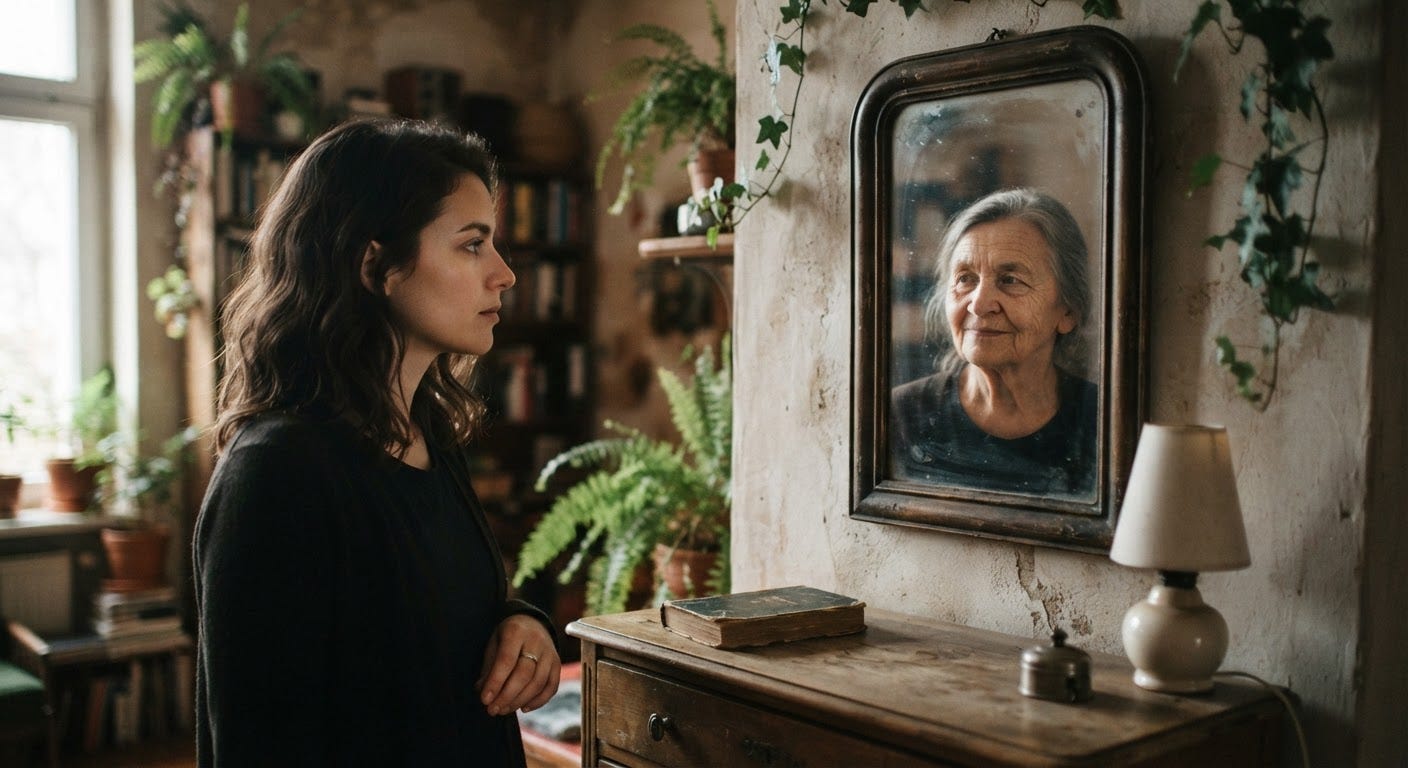
For here is the deeper truth beneath everything I have said so far. None of us lives alone. None of us could. We speak of “making something of ourselves” as if the self were a solitary project. But it’s not. We are family—all of us—bound together in a constellation of relationships so vast and so intimate that we can never fully comprehend the whole. We exist only in affiliation: with those whose hands raised us, fed us, taught us our first words; with nature, whose air moves through our lungs and whose ancient elements became our very bodies; with our ancestors, whose survival across unthinkable hardship is the only reason we draw breath today, and whose voices live on in our gestures, our languages, our unexamined habits of love; and with those who will follow us, who will inherit the world we shape and remember—or become—the traces we leave behind. You are a link in a chain stretching backward to the first flicker of life and forward into a future you will never see. You cannot break that belonging. It doesn’t have to be earned and can’t be lost.
Teilhard de Chardin gave a name to the layer of thought and consciousness that envelops the earth: the noosphere. We might call it, more simply, the sphere of presence—the invisible commons of mind, memory, grief, hope, and love in which every human life participates, whether it knows it or not. Every act of kindness ripples outward through it. Every generous deed changes someone else’s life for the better. Every suffering shared with another lightens it. No life is invisible here, because presence itself is the medium, and to exist is already to contribute. The hermit shapes it. The dying child shapes it. The forgotten and the celebrated are equally woven in. When you feel most alone, you are in fact held—by the dead who dreamed you into being, by the living who need you in ways they may never say, by the unborn who will stand on ground your life prepared for them.
So if you can do nothing else today, do this: remain. Stay connected. Your presence is not a neutral fact; it’s a thread that others are quietly holding too. And if you are well, and strong, and life is kind to you—then your work is clear. Reach toward those on the margins. The human family is only as whole as its most wounded member, and we don’t get to choose which of us belongs. We belong to each other. That’s not a sentiment. It is the oldest truth of our species.
The world may not come to its senses in our lifetime. Perhaps it never has been sane, and every generation’s task is simply to refuse the madness in its own small corner: to decline the cruelty that is offered as normal, to keep a human face in a time of masks. Sanity was never something the world would hand us. It is something we practise—one act of decency, one hand extended, one refusal at a time.
In the end, we will not measure our lives by what we avoided or what we were handed, but by what we attempted, what we loved, what we survived, who we held and who held us, and how fully we showed up for all of it—the mundane and the ecstatic alike. To live well is simply to refuse to be a spectator in our own existence, and to refuse to let anyone around us believe that theirs is expendable. We are the sum of one another. We always have been.
So stay. Stay for the ordinary mornings—for the coffee going cold while you watch the light move across the wall, for the face of someone who loves you still asleep in the half-dark. Stay for the people who would search every crowd for you and never stop looking. The world is mad, and it is beautiful, and it’s not finished with you yet. And one day, long from now, someone who comes after you will speak your name at a kitchen table, and their voice will soften when they do, and they will not be able to say exactly why. That’s the whole of it. You were here, and it mattered, and it goes on mattering.