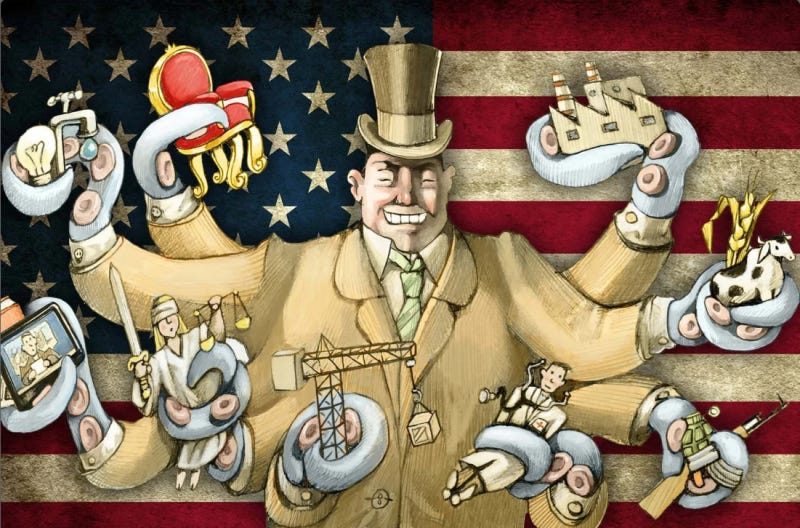
In today’s global socio-economic environment, the concept of democracy as a genuine representation of the people’s will has been effectively dismantled. It no longer works as intended anywhere in the world. The stage is no longer the scene of competing ideologies or visions for the future but of elite oligarchic factions vying for control. The main game, a frankly embarrassing struggle between those who seek stability and those who thrive on chaos, only intensifies an urgent need to critically examine the unholy alliance between capitalism and democracy.
The oligarchs who desire stability benefit from maintaining the status quo, having amassed wealth and influence under existing systems. They work to preserve these structures, sustaining the illusion of democracy through managing media narratives, manipulating electoral processes, and influencing policy decisions. Their goal is to create a semblance of order and legitimacy, ensuring their interests remain protected and unchallenged. Conversely, other oligarchs perceive chaos and the deconstruction of the state as opportunities for further power consolidation. These actors exploit political and social unrest to dismantle regulatory frameworks, erode public trust in institutions, and widen the gap between the elite and the general populace. For them, destabilisation is a strategic advantage, reshaping the political and economic landscape to entrench their authority still further.
Through this lens, we can better appreciate the growing disillusionment with democratic systems across the globe. As traditional checks and balances falter, the gap between the governed and those in power widens, leaving citizens feeling marginalised and lacking confidence. The battle between stabilising and destabilising oligarchs often becomes the central narrative, pushing effective policymaking into the margins and overshadowing genuine democratic engagement.
In this milieu, the challenge for those who still believe in the egalitarian ideals of democracy is formidable. It requires recognising the reality of oligarchic dominance and mobilising to reclaim democratic spaces and structures. This involves fostering political literacy, building grassroots movements, remodelling the media to report and educate rather than entertain and obfuscate, and advocating for other systemic reforms that prioritise transparency, accountability, and equity. It’s a call to action for citizens to resist the forces of apathy and cynicism, envisioning and working towards a genuinely democratic future that’s representative and inclusive. Positive deviance offers a viable way forward.
Positive deviance from capitalism is not only an economic choice; it’s an act of defiance against a system perpetuating oligarchic supremacy. This is essential if we believe true democracy actually matters. As my colleague Adam Jacoby has argued, democracy and capitalism as currently practiced cannot coexist. The two are incompatible, and the relationship has become abusive.
Much like Václav Havel’s rebellion against political oppression, those who choose to deviate from capitalism must confront the myths sustaining both its economic and political frameworks. Havel’s idea of “living in truth” becomes a guiding principle—a conscious rejection of the deceptions and rituals that uphold a system rooted in fear, conformity, and false necessities. It’s an act of reclaiming autonomy from an oligarchic order disguised as democracy. The foundational myths of capitalism—endless growth, competition as a natural state, and the reduction of all value to price—are mirrored by the illusion of democratic choice. Oligarchs seeking stability preserve an economic status quo that serves their interests, while those thriving on chaos reshape the landscape to their advantage.
To deviate positively from capitalism is to challenge these foundational myths: the belief in endless growth, the conviction that competition is the natural state of human existence, and the notion that human worth is measured solely by productivity or consumption. Such deviation involves withdrawing consent from performative rituals equating economic success with moral virtue and human flourishing, exposing systemic untruths, and debunking the narrative of a neutral market.
Living differently becomes a hallmark of this positive dissent, crafting communities and practices that prioritise reciprocity, sufficiency, and care over accumulation and extraction. These communities become a testament to the possibility of a life valuing connection, empathy, and viability over relentless profit pursuit. They offer a counter-narrative to the oligarchic struggle, proving that alternative systems are not only possible but already in practice.
Examples of such positive deviation abound. Mahatma Gandhi’s philosophy of nonviolent resistance and economic self-reliance offers a powerful model of dissent from the dominant industrial paradigm. Similarly, the Mondragon Corporation, a federation of worker cooperatives, operates on principles of democratic decision-making, shared ownership, and solidarity, challenging the myth that economic systems must be synonymous with hierarchy. The transition town movement exemplifies grassroots innovation in response to climate change, fostering local food systems, renewable energy projects, and community-led economic models. E. F. Schumacher’s advocacy for human-scale economies and the open-source software movement further illustrate how collective effort and shared knowledge can drive technological advancement.
Yet an ominous reality emerges from these and other examples: the choices seem to narrow to tyranny or revolution. The erosion of democratic institutions by oligarchic forces suggests that without significant intervention, the path leads to an entrenched rule by the few. Tyranny in this context is not just authoritarian rule but a subtle dominance where economic and political systems are manipulated to serve elite interests at the expense of the public good.
The alternative is revolution. This need not be violent or destructive. It can be a profound metamorphosis achieved through a collective awakening and insightful mobilisation. It’s a call for third-order change that reclaims democratic spaces and structures, fosters political literacy, builds grassroots movements, and advocates for reforms that prioritise transparency, accountability, and equity. This revolution is about reimagining democracy and capitalism to serve the collective good, ensuring that systems are inclusive, representative, and work together smoothly.
Ultimately, any critique of democracy’s demise serves as both a warning and a rallying cry. It exposes the consolidation of power within oligarchic hands while highlighting the potential for resistance and renewal. Through acts of positive deviation from capitalism, we chart a course toward a future where the well-being of people and the planet takes precedence over profit and power, navigating the territory between tyranny and revolution toward a genuinely democratic and equitable society.