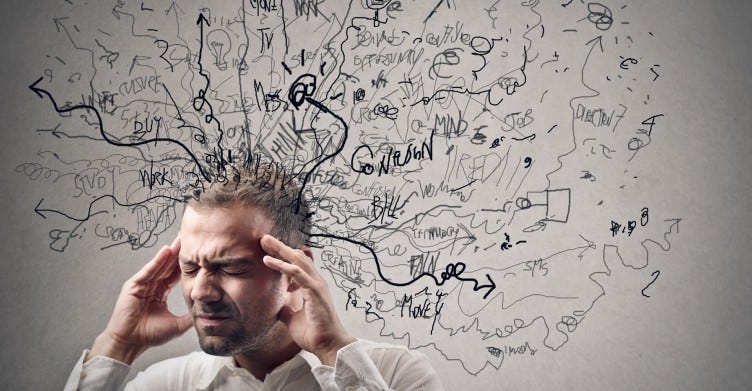
If you stand still for long enough – in New York’s traffic, a London supermarket queue, a homeless shelter in Paris, a farmer’s market in Australia, or a migrant processing centre on the US–Mexico border – you can feel it. A low‑frequency hum of disquiet. People are not simply tired or overworked. They carry a vague psychic concussion. It shows up as edginess, irritability, vague dread, or the urge to withdraw and not be bothered by anyone or anything.
We have language for the symptoms – burnout, loneliness, polarisation, mental health “crises” – but no honest shared vocabulary yet for the underlying condition. That’s partly because this particular ailment indicts the civilisational logic we have been taught to admire, defend and export.
Loneliness and the erosion of trust offer more than random side‑effects of this condition. They are data points. They are signalling that the dominant civilisational logic for human society – industrial economism, with its obsession with growth, extraction, and competitive self‑advancement – especially how these are so religiously practised in the West, is now colliding with biological, psychological and ecological limits.
The question that haunts me is not whether this system is failing. Evidence of structural failure is everywhere: declining trust in governments and media; rising loneliness even in densely populated cities; ecological overshoot; permanent war zones. The more vital question is whether human beings, shaped by this machinery for several generations, can alter its trajectory before it collapses under its own contradictions. This is not a new question; I have posed it before, on many occasions. It’s far from being just an academic puzzle. It goes to the root of what we believe a human being is, and what we suspect we might become.
The industrial imagination and the incredible shrinking self
From early childhood, in most societies now wired into the global economic machine, we are trained to experience ourselves primarily as economic actors in some form or other: owners, producers, consumers, investors, entrepreneurs, human capital, talent. Those words are sectarian. They have quietly displaced older identities such as neighbour, elder, apprentice, custodian, pilgrim, healer, storyteller – that once anchored people in mutual obligation and meaning.
Research from various countries indicates that loneliness has been increasing across age groups, not only among the elderly but among younger people who are constantly connected via digital platforms yet report feeling isolated and sad. That can be explained partly through technology and urbanisation, but there’s also a deeper philosophical wound analysts are noting. If I am no more than a self‑optimising unit in an international commercial market, then every other person becomes a potential rival, a resource, or an audience. Under those conditions, trust no longer feels like a natural default. It becomes either a luxury or a tactical instrument.
Based on neoliberal capitalism, the paradigm of industrial economism treats each human being as an interchangeable component in an intricate supply chain. Its moral grammar leans heavily upon abstraction: efficiency, productivity, competitiveness, shareholder value, national security, border control. But abstractions cannot hug you when your life collapses. They don’t sit with you in the night when grief floods in. They don’t stand beside you when you refuse to comply with something you know to be wrong.
We have built systems that reward abstraction while quietly dismantling all the informal, relational structures that made life agreeable, or at least bearable – extended families, guilds, cooperatives, local commons, religious and cultural institutions that, at their finest, provided a real sense of belonging and continuity. Many of those older institutions were suffused with patriarchy, hierarchy and abuse, so their decline is in some respects a blessing. Yet industrial economism has not yet replaced their connective tissue with anything remotely adequate. It has offered instead: financial products, managed identities, scripted participation.
The result is a society that is technically sophisticated, digitally integrated and emotionally malnourished. You can feel that malnourishment as a rising anxiety in the air.
The erosion of trust as a rational response
When people say, “nobody trusts institutions any more”, there is an implied nostalgia for some golden age when governments, churches, corporations and media organisations were reliably benevolent and honest. Over my own lifetime I have never seen convincing evidence that such an age ever existed. What has changed is not necessarily institutional virtue, but visibility and scale. Digital media makes hypocrisy and corruption far easier to expose. Institutions that once spoke from behind a curtain of mystique are now constantly filmed, leaked and memed.
If you live in a country where politicians promise integrity and then approve contracts for their friends; where banks are bailed out while ordinary households are evicted; where religious leaders preach compassion while withholding it in practice; where social media companies profit from rage and envy while speaking lyrically about “connection” – why would you trust those institutions? In that sense, the loss of trust is not only understandable; it might be a sign of increasing discernment. The trouble is that discernment, in the absence of credible alternatives, easily degrades into corrosive cynicism. You can see that cynicism manifesting in many regions: collapsing voter turnout; the growth of conspiracy cultures; a contempt for “experts”; the eager embrace of autocratic strongmen who promise simple answers to dynamically complex situations.
What’s often missed is that this breakdown in trust is happening across the entire eurocentric world, not exclusively of course, and invariably in different local guises. In some places it shows up as fragile states and warmongers. In others it appears as technocratic managerialism that’s lost contact with ordinary lives. In yet others it’s visible in social movements that have energy but lack coherent, integrative visions beyond protest. Trust turns out to be a civilisation’s invisible infrastructure. When it corrodes, everything slows or breaks – from public health campaigns to ecological restoration to everyday civility on the street. That erosion of trust, combined with rising levels of loneliness, forms a vicious circle: the more isolated we feel, the less we trust; the less we trust, the more we retreat into isolation.
How one idea of progress is re-writing what it means to be human
Philosophers have long debated whether humans are fundamentally selfish or cooperative, rational or irrational. That debate, fascinating as it can be, becomes a diversion if it distracts from what I take to be a more urgent line of inquiry: what kinds of humans are we methodically coaching each other to become – through the way we organise work, learning, technology, power and story?
Industrial economism is not just an economic model. It’s a vast behavioural training regime, enforced through incentives, institutions and the stories we tell each other about “success”. It makes certain traits adaptive and others maladaptive. Ambition, constant availability, individual attainments, upward mobility, instrumental networking, a capacity to disregard the suffering of others – these are rewarded. Stillness, deep listening, fierce loyalty to place, and a refusal to commodify relationships – these are treated as charming hobbies or obstacles to success. If this is accurate, then our current anxiety is not evidence of human weakness so much as a predictable psychological response to being shaped for purposes that run counter to our deeper needs for connection, meaning, integrity and love. We’re suffering because we’re not machines – yet we are groomed and governed as if we were.
What intrigues me is that even within this machine, we keep smuggling in acts of non‑compliance. Parents sacrifice careers for their children’s well‑being. Communities organise mutual aid when formal systems fail. Workers quietly sabotage targets they know to be unethical. Artists and scientists risk reputations to speak inconvenient truths. None of this fits the standard competitiveness script, yet it persists everywhere. Is that stubborn undercurrent of defiance evidence that the human condition is more resilient than the machinery trying to reprogram it? Or are we simply watching the last sparks of an older, more relational humanity flicker amid the brutalism of a post‑human economy? I don’t know. The evidence arguably points both ways.
Can we redirect the trajectory – or are we passengers?
The assumption that “we” can always choose a collective course correction is seductive. It flatters our sense of agency. But a civilisation is not a car, obedient to a single driver’s touch. It behaves more like a vast, ageing organism, held together by habits, stories, debts and infrastructures that cannot simply be turned around on command. By the time we notice that something is seriously wrong, countless reflexes and routines are already locked in, defending the very patterns that are making us sick.
On the one hand, history shows that entrenched systems can and do change: empires fall; slavery is outlawed in many regions; women secure legal rights that were once unthinkable; global agreements are reached that reduce certain forms of harm. On the other hand, the same history is crowded with examples of civilisations that mistook momentum for destiny and slid into collapse while insisting that minor reforms and a few surface tweaks would suffice.
As far as we know, the scale and tight coupling of today’s global systems – money, logistics, media, weapons, political authority – are unprecedented. That makes deliberate redirection both more necessary and much more difficult. Local experiments often get absorbed, neutralised or commercialised. Radical critique is turned into branding or lifestyle choices. Dissent is monitored, channelled, or pitted against other dissent. So when people ask whether humanity can “shift the trajectory”, I’m invariably tempted to respond with an alternative question: who exactly do we imagine is holding the steering wheel? There is no single “we”. There are clashing elites, fragmented publics, and billions of people simply trying to get through the week. Global governance structures exist, but their legitimacy and capacity are openly contested.
Yet to conclude from all of this that we’re powerless would be equally misleading. Single acts, when they resonate with some deeper historical readiness, occasionally unlock transformations that previously seemed unlikely. That appears to have happened with certain anti‑colonial movements, with some public health advances, and with the rapid diffusion of digital technologies. The trouble is that such tipping points are easier to recognise in retrospect than to engineer in advance. That leaves us in an awkward position: we know that change is inevitable; we don’t know right now whether it will be consciously guided or catastrophically imposed.
Perhaps a more honest way to frame the issue is not “Can we shift the trajectory?” but “Under what conditions have humans, in the past, been able to alter destructive systems and, if so, do analogous conditions exist or seem possible today?” That opens up more pragmatic lines of inquiry: about education, about narrative, and about the distribution of power and attention.
Education as manufacture vs education as liberation
If industrial economism is a training regime, then education is its principal factory. In almost every country plugged into the global market, formal schooling is organised around competition, individual grading, standardised testing, and credentials. Its implicit purpose is to sort, plug, and play people into an economic hierarchy. This classifying system feeds loneliness in several ways. Children quickly learn that peers are rivals, that failure is shameful, and that curiosity not rewarded by marks is a distraction. They also learn to internalise authority: the curriculum is what counts; everything else is extracurricular at best, subversive at worst.
If your early years are spent in environments where your innate desire to connect, think divergently, explore, and invent is constantly filtered through assessment, it’s hardly surprising if, as an adult, you find it difficult to trust either your own intuition or the motives of others. You have been marinated in conditional acceptance. There are, of course, countless teachers who resist this logic, smuggling in experiments in co‑learning, mentoring, ecological literacy, critical thinking and emotional competence. Such efforts are often frail, dependent on a few individuals, at the mercy of policy swings. But they’re significant because they reveal that humans can be educated for relationship rather than for rivalry.
If those small experiments were to proliferate and federate, could they generate social tipping points that substantially alter the broader trajectory? Or would they be endlessly marginalised by the gravitational pull of the existing system? Once again, I don’t know. But it seems to me that any serious attempt to address the anxiety hanging in the ether must interrogate how we train our young to perceive themselves and each other.
Technology: prosthetic connection or industrialised distraction?
It’s tempting to blame digital platforms for the epidemic of loneliness. And, of course, we do. There’s growing evidence that heavy use of algorithmically curated social media is associated with increased feelings of isolation and depression, particularly among younger people. Recent policy responses, such as Australia’s Online Safety Amendment (Social Media Minimum Age) Bill 2024, which from 10 December 2025 banned under 16s from most social media platforms in an effort to protect youth mental health, reflect this concern. But to simply demonise technology misses the point.
Technologies are amplifiers. They extend whatever intent and worldview shaped them. When tools are designed primarily to maximise engagement, extract data and sell attention, they will inevitably bend human communication towards performance and manipulation. Different tools are possible: ones built to support collaboration, shared learning, and genuine dialogue. Those nourish connection. The trouble is that industrial economism prefers the former kind of tool. It’s not a coincidence that many of the world’s largest technology firms derive most of their revenue from advertising and surveillance. In such an environment, every human interaction is a potential data point, every friendship a revenue stream, every anxiety an opportunity for monetisation.
Under those conditions, it would be astonishing if loneliness were not increasing. We are encouraging people to curate identities rather than inhabit relationships. The resulting mistrust – “Is this person talking to me, or to the algorithm behind me?” – seeps into offline life as well.
Could we build and adopt technologies that reverse this dynamic, fostering thicker, slower, more reciprocal forms of connection? By all means. Small‑scale examples already exist: community‑owned platforms, encrypted mutual aid groups, citizen science networks, participatory budgeting tools. But these remain peripheral compared to the mainstream platforms that structure daily attention for billions. Whether that imbalance can be overturned without deeper shifts in ownership, the law and cultural aspiration is an open question.
Power, precarity and the psychology of withdrawal
Loneliness is not only an emotional state; it’s also a survival strategy. When life feels precarious – when jobs can vanish overnight, when health costs can ruin families, when proposed contracts can drop off the radar, when conflicts can erupt suddenly – people naturally narrow their circles of trust. They retreat into family, clan, or ideology. In societies marked by long histories of colonisation, caste, or ethnic division, this narrowing is intensified by memory. Past betrayals teach communities to be wary. Promises from governments, corporations or international agencies sound hollow when previous promises brought dispossession or exploitation.
In such contexts, talk of rebuilding trust can sound like a call to forget. Yet trust without memory is naivety. The challenge is to forge forms of trust that are not rooted in amnesia but in mutual accountability. That requires redistributing power, not just expressing good intentions. Here we hit a raw nerve. The dominant economic order relies on vast asymmetries of power – between employers and workers, between creditors and debtors, between countries that issue reserve currencies and those that must borrow them, between those who own platforms and those who supply the content. To admit that these asymmetries generate loneliness and mistrust is to admit that they are not merely “market outcomes” but forms of harm.
Is there any historical evidence that those who benefit from such asymmetries have, without major pressure, voluntarily redesigned systems to reduce their own dominance? I am not aware of many convincing cases. Most significant shifts in power relations seem to have arisen from sustained mobilisation, sometimes peaceful, sometimes violent, often messy.
That raises another uncomfortable prospect: if the present anxiety continues to grow without credible, shared projects of renewal or redesign, it will be harvested by those who promise security in exchange for obedience. That pattern is already visible in parts of the world where authoritarian politics has grown by weaponising loneliness and mistrust, offering belonging through exclusion and meaning through conflict. In that sense, our collective withdrawal into echo chambers is not a private matter. It’s a political resource waiting to be exploited.
Beyond despair and optimism: another stance
When people survey the state of the world, and feel overwhelmed by ecological overshoot, gross inequality, psychological distress, and technological upheaval, for instances, they often oscillate between two unhelpful moods: blind optimism and paralysing despair. Both are ways of avoiding responsibility. Optimism waves away complexity with faith that “things will work out”. Despair declares the game lost and forfeits agency.
A different stance might begin with radical honesty: acknowledging the depth of systemic dysfunction, the weight of historical injustices, and the fragility of the biosphere, without in any way using those acknowledgements as a licence for passivity. That stance does not offer comfort. It invites maturity.
From that place, the epidemic of loneliness and erosion of trust can be read not only as problems to be fixed but as diagnostics of a civilisation out of alignment with the human condition. They reveal where the organising logic – endless expansion, competitive individualism, instrumental use of everything and everyone – collides with the requirements of a livable, dignified life.
If we accept that diagnosis, then the question of “shifting the trajectory” can no longer be confined to policy tinkering, mindfulness apps, or corporate well‑being programmes. It becomes a civilisational inquiry: what forms of economy, governance, education, technology and story might actually honour our need for belonging, meaning and reciprocity, at the same time recognising the planetary limits we have so casually ignored?
I don’t possess a blueprint. In fact blueprints are part of the problem: they presume that complex living systems can be engineered differently from the top down. What I see, instead, are a myriad scattered experiments – indigenous land stewardship; community‑anchored health systems; cooperative enterprises; regenerative agriculture; restorative justice practices; translocal networks of mutual learning – that hint at different logics. Each is partial. None is scalable in its existing form to the entire planet. But taken together, they reveal that “there’s no alternative” is more a slogan of convenience than a serious statement of fact.
Whether these experiments can cohere into a counter‑trajectory before the present one collapses under its own weight is a question that will not be answered in summits or think‑tanks. It will be answered in the ways people choose to relate – or not – to each other and to the living world.
The risk and necessity of heresy
To say that industrial economism is toxic to the human condition sounds provocative in polite company. It disturbs those who have built their identity and career on the assumption that this system, with some cleaning and greening, can endure indefinitely. I have intelligent friends who insist that capitalism will endure. I disagree. But heresy, in times of systemic breakdown, is often no more than the refusal to lie politely.
If loneliness and mistrust are now woven into everyday experience from Manchester to Milan, and from San Fransisco to Stockholm, then the story that “progress” is steadily improving human life needs to be interrogated. Progress for whom? Measured by what? At what cost, and to which relationships?
Perhaps the most subversive idea we can entertain is also a simple one: that the human being is not a cog in the machinery of production, not a consumer‑producer algorithm in a planetary factory, but a relational, meaning‑making creature whose well‑being depends on trustworthy bonds with others and with the more‑than‑human world. If that’s true, then any civilisation that systematically undermines those bonds, while preaching efficiency and growth, is at war with its own foundations. It can expand GDP, refine its algorithms, strengthen its armies, electrify its fleets – and still generate a psychic climate in which people feel chronically alone, suspicious and afraid.
Where does that leave us? In a liminal space. Old certainties are fraying; new narratives are embryonic. Suspended in the ether, anxiety is not only a symptom of decay; it’s also a signal that the mythology of industrial economism is losing its grip on our imagination.
Whether that loosening leads to regression into more brutal forms of domination, or to the slow cultivation of more life‑honouring ways of being together, is as yet unresolved. It will depend, in part, on how rigorously we’re prepared to question the stories that made this moment seem inevitable – and how courageous we are in inventing practices and institutions that treat trust and connection not as exploitable resources, but as the essential fabric of a future worth inhabiting.