Conventional accounts of the Indo-Pacific’s transformation are not automatically wrong. They are incomplete, however, in ways that matter enormously.
Orthodox accounts run, roughly, as follows. A rising China is pressing against the limits of the post-1945 American-led order, testing maritime boundaries, extending economic leverage, and building the military capacity to contest regional primacy. Washington is responding by reinvigorating alliances, deepening the Quad, anchoring AUKUS, and framing the contest as a civilisational choice between liberal democracy and authoritarian capitalism. Japan has shed decades of strategic reticence and is doubling defence spending, acquiring counterstrike capabilities, and positioning itself as a genuine security provider rather than a passive beneficiary of American extended deterrence. South Korea is navigating the impossible geometry of economic dependence on China and security dependence on the United States, edging toward greater alignment with the democratic camp while watching the Korean Peninsula’s northern half deepen its entanglement with both Moscow and Beijing. India is pursuing strategic autonomy as a doctrine, refusing to be conscripted into either camp while drawing selectively on partnerships with Washington, Tokyo, and Canberra. Middle powers across Southeast Asia are hedging, ASEAN is straining under the weight of divergent interests, and Europe is discovering — belatedly — that its prosperity is entangled with an Indo-Pacific order it has spent decades treating as someone else’s problem.
No doubt this is a serious account. It reflects actual dynamics, genuine competition, and real consequences for anyone with interests in the region.
What it ignores, or cannot discern, possibly because the patterns are so dynamic, is the underlying architecture that’s shifting tectonically.
Five things the standard accounts refuse to name
I. The gravity of ghosts
The most consequential forces shaping the Indo-Pacific are not the ones analysts map but the ones they cannot see – worldviews sedimented into institutional architecture, treaty systems, alliance obligations, and bureaucratic habits that continue to exert gravitational pull long after the conditions that produced them have vanished. The Cold War didn’t end in Asia the way it ended in Europe. It mutated, relocated, and in several theatres simply continued under different nomenclature. The San Francisco system of bilateral hub-and-spoke alliances was designed for a world in which American primacy was uncontested and Asian agency was minimal. That world has not existed for thirty years. Yet the architecture persists, and with it the cognitive templates through which policymakers interpret what they are seeing.
Beijing navigates the South China Sea through a cartography of humiliation that stretches back to the Opium Wars. Washington interprets Chinese maritime claims through a template of Soviet expansionism that was already obsolete when it was first applied. Japan’s strategic culture is simultaneously haunted by imperial memory and shaped by a constitutional settlement imposed from outside. These are not simply historical grievances. They are active cognitive architectures that filter what each actor perceives as a threat, a provocation, or an opportunity. The analysis that ignores them mistakes the surface movement of ships and statements for the actual dynamics of the theatre.
II. The identical operating system
The framing of US-China rivalry as a contest between liberal democracy and authoritarian capitalism obscures something that neither side has any interest in acknowledging: both civilisational projects are running on the same underlying software. Industrial economism – the operative world-system that treats perpetual growth as the primary metric of civilisational health, that externalises ecological and social costs as acceptable inefficiencies, and that subordinates future generations to the preferences of present shareholders and voters – is not a Western pathology exported to Asia. It’s the shared substrate of every major actor in the region’s strategic competition.
China’s Belt and Road Initiative is industrial economism prosecuted at a continental scale. America’s Indo-Pacific Economic Framework is industrial economism defended behind a democratic brand. Japan’s growth strategy, South Korea’s export model, India’s infrastructure ambitions, ASEAN’s development consensus — all operate within the same fundamental logic. The rivalry is real: there are genuine contests over supply chains, military positioning, technological standards, and political influence. But the contestants share the same civilisational assumptions that are producing the planetary emergency within which those contests are being prosecuted. This is not a footnote. It’s the central fact that makes the competition, however it resolves, an insufficient response to the actual situation.
III. The absent third obligation
Every framework for regional order – ASEAN, the Quad, AUKUS, the Indo-Pacific Economic Framework, the various bilateral treaty structures – is constructed around two recognised categories of obligation: obligations to sovereign states and obligations to markets. Future generations hold no institutional standing. Living systems have no seat at the table. The ecological commons — the Mekong and its tributaries; the Himalayan water towers feeding a billion and a half people; the South China Sea fisheries already in severe depletion; and the monsoon systems on which South Asian agriculture depends — appear in strategic analysis as background conditions or, increasingly, as flashpoints for territorial competition. They don’t appear as rights-holding entities whose viability is a precondition for any durable regional order.
Any genuinely viable civilisational architecture must respect three simultaneous obligations: being beneficial to each person, being syntrophic for living systems, and honouring future generations. No regional framework currently operating in the Indo-Pacific satisfies all three. Most satisfy one partially. The consequence is not just philosophical incompleteness. It’s that the architecture being constructed — whatever its political settlements — will prove structurally unable to address the conditions that will determine whether the region is habitable in fifty years.
IV. The migration of the sacred
Beneath the geopolitical competition, something is happening in the cultural and spiritual landscape of Asia that receives almost no attention in strategic analysis. Yet it is shaping the political possibilities available to every actor in the region. The cosmological frameworks that organised life for centuries — the Confucian relational ethic, the Dharmic understanding of cosmic order, the various Buddhist traditions of the middle way, and the Taoist attunement to natural process — have been systematically eroded by a century of modernisation, colonisation, and the global spread of secular instrumental reason. What has replaced them is not, in most cases, a coherent alternative. It is a vacuum.
Vacuums of meaning do not remain empty. They are filled, and in the contemporary Indo-Pacific they are being filled by three primary forces: ethnonationalism, which recovers the sacred through blood and soil and civilisational grievance; techno-utopianism, which projects the sacred onto technological transcendence and positions AI and biotechnology as the new eschatological horizon; and civilisational revivalism, which reconstructs a useable past — whether Han civilisation, Hindu civilisation, or Japanese civilisational exceptionalism — as a source of legitimating authority for present political projects. All three are responses to the same underlying displacement. All three carry significant dangers when prosecuted at a state scale. And all three are actively shaping the strategic behaviour of the region’s major actors in ways that no purely materialist analysis of interests and incentives can adequately capture.
V. The wayfinding deficit
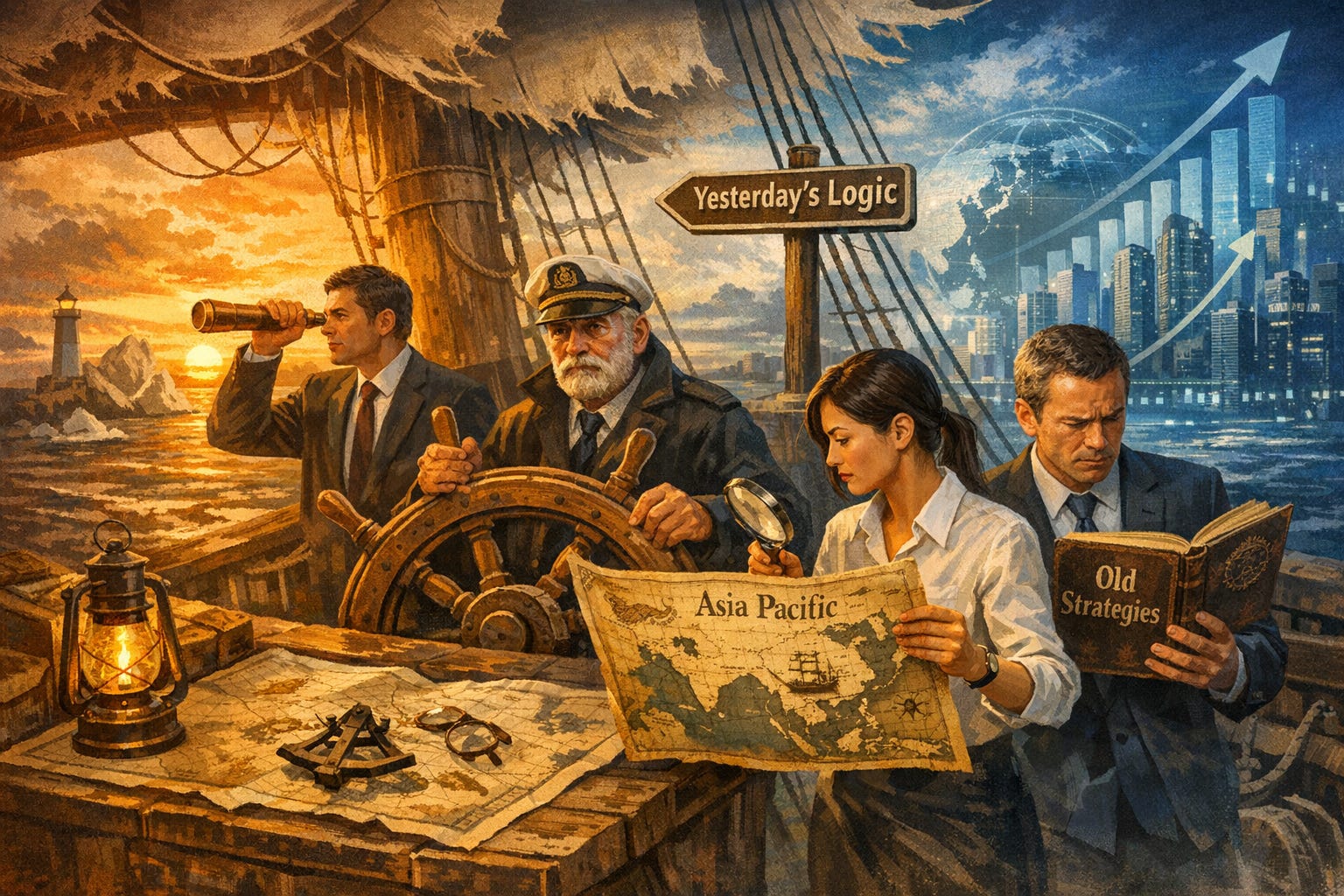
The Pacific master navigators understood something that no contemporary strategic actor in the region appears to have recovered: that navigation in genuinely open water requires orientation by the stars, not instruments calibrated on yesterday’s charts. The instruments – GDP projections, force posture assessments, trade flow models, and electoral polling – are not useless. But they are calibrated on assumptions derived from the world as it was, not the world as it’s becoming. When those assumptions no longer hold, the instruments continue to produce readings. The readings are simply wrong.
What the Indo-Pacific lacks — more than it lacks missiles or supply chain resilience or democratic solidarity — is a capacity for civilisational wayfinding: the ability to read the actual conditions of the present moment, including the conditions that no existing framework was designed to perceive, and to navigate toward genuinely liveable futures for the whole of the region’s human and non-human communities. This requires a mode of collective sense-making that builds complexity rather than reducing it, that moves toward living systems rather than against them, and that holds the obligations to present people, future generations, and the ecological substrate simultaneously rather than sequentially or in permanent trade-off.
No state in the region is doing this. Some civil society actors, some indigenous knowledge communities and some scattered networks of scientists and philosophers and artists are doing approximations of it. But at the level of strategic architecture, the wayfinding deficit is total. The stars are visible. No one is reading them.
These five theses do not replace the analysis of alliances and rivalries. They are the underlayer without which that analysis mistakes secondary dynamics for the primary ones. The question the Indo-Pacific actually poses is not which bloc prevails. It’s whether the civilisational intelligence needed to navigate a planetary emergency can emerge from within a region whose most powerful actors are simultaneously racing to dominate one another and running on the operating system that produced the emergency in the first place.
That is the real strategic reconfiguration. Everything else is positioning within it.