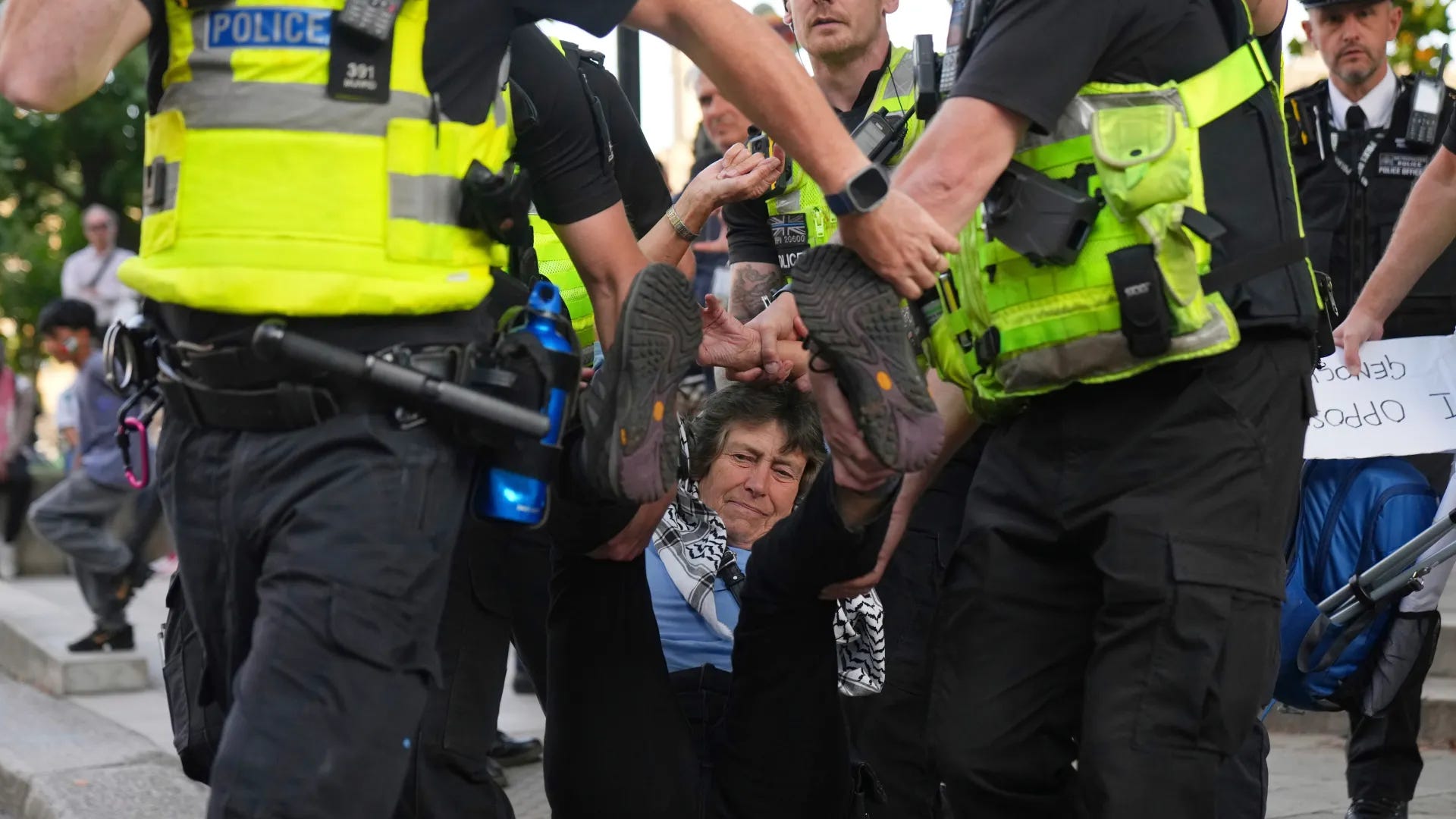
There’s a particular kind of political dishonesty that operates entirely within legal practice. It needs no show trials, no secret police, no suspension of habeas corpus. It needs only the patient accumulation of injunctions, sentencing guidelines, and remand decisions – each of these is defensible in isolation and each points in the same direction when assembled into a regimen. The recent report by Queen Mary University on the imprisonment of climate and Palestine-solidarity activists in Britain describes exactly this modus operandi. Its implications extend well beyond the cases it documents into issues about the essence of democracy, what laws are for, and what a society is conveying about itself when it reaches for detention as its primary response to citizens acting on convictions the evidence overwhelmingly supports.
These are the most serious questions a functioning democracy can be asked to confront, and the answers now emerging from Britain’s courts and parliament are deeply unsettling: revealing a structural drift, incremental and self-reinforcing, toward a system of managed consent that retains the external trappings of democratic legitimacy while systematically hollowing out its substance.
The Architecture of a Number
Begin with the numbers, because they are not abstractions. Two hundred and eighty-six people are imprisoned. One hundred and thirty-six combined years of custodial time. One in three were sentenced to six months or more. One in five to more than a year. An average detention of twenty-eight weeks in the cases where data was available. Behind each figure is a person who made a decision — to block a road, occupy a building, cut a fence at a weapons factory, or hold a placard outside an oil terminal — and who subsequently encountered the full weight of a legal apparatus that has been, over the course of roughly a decade, methodically reconfigured to make that kind of decision ruinous.
The numbers acquire a different character when set against one specific finding: in sixty per cent of cases, the final sentence was more lenient than the time already spent in remand awaiting trial. This is not an anomaly, nor is it an administrative failure. It is a pattern, and patterns in legal systems are never accidental. In practice, what it means is that punishment was administered before the verdict — that the presumption of innocence, which is not merely a legal nicety but the foundational premise of any justice system with a claim to legitimacy, was routinely suspended for a particular category of defendant. This category was not defined by the severity of the alleged offence. It was defined by the political character of the action that gave rise to it.
This is the first, most fundamental implication for democratic life: that equal treatment before the law — another foundational premise, stated in every civics text, inscribed in every constitutional tradition — does not appear to have operated in these cases. This is not a question of whether individual judges were biased or not. It’s whether the system as a whole treated a class of defendants differently because of the political content of their behaviour. The evidence assembled by the Queen Mary researchers suggests strongly that it did.
The Civil Injunction as Political Weapon
The most structurally significant finding in the report is not about criminal law at all. It concerns the civil injunction — a remedy designed to resolve disputes between parties with competing legal interests. Civil injunctions have nothing to do with the curbing of political expression. Contempt of court charges accounted for forty per cent of all imprisonment cases in this study. Of those, the overwhelming majority — thirty-two per cent of all incarceration cases — had nothing to do with courtroom conduct. They arose from the breach of civil injunctions obtained by private corporations and public bodies specifically to prevent protest activity.
Let’s pause for a moment on the mechanism in use here. A corporation — say, an energy company, or a weapons manufacturer — applies to the civil courts for an injunction restricting protest activity at or near its premises. The civil courts, applying the standard of balance of convenience rather than the criminal standard of proof beyond reasonable doubt, grant the injunction. Protesters subsequently act in a way that breaches the injunction’s terms. They are then liable for contempt of court — a charge that carries no jury trial and can result in imprisonment. The criminal penalty is real. The criminal process, with its higher evidentiary standards and its guarantee of jury deliberation, is absent.
What this means is that private actors with sufficient legal resources can effectively criminalise protest through a civil route, bypassing the safeguards that criminal law provides. The weapons manufacturer doesn’t need to persuade a jury of twelve citizens that the person cutting its fence deserves imprisonment. It needs only to persuade a civil judge, on the balance of convenience, that an injunction is warranted. The rest follows automatically. As David Whyte, professor of climate justice at Queen Mary University and one of the report’s lead researchers—whose prior work on corporate crime and state impunity gives him a particular vantage point on how law is selectively deployed—observed, private companies are effectively imposing injunctions which lead to large numbers of people going to jail.
Clearly, this is not a minor procedural quirk. It represents a fundamental distortion in the relationship between legal remedy, democratic accountability, and the distribution of power. A civil injunction, deployed in this way, is not neutral. It’s a tool available to those with the resources to seek it, wielded against those without equivalent access to legal remedy. It converts corporate interest directly into coercive state power, through the intermediary of a court process that was never designed to bear that weight. The sixty-nine people imprisoned following Warwickshire Borough Council’s High Court injunction in response to Just Stop Oil’s campaign at Kingsbury oil terminal – some imprisoned simply for holding placards – illustrate the endpoint of this logic with distressing clarity. Holding a placard is, in most democratic traditions, the paradigm case of protected political expression. That it can now lead to imprisonment through a civil law route, without jury trial, in response to an injunction obtained by a public body rather than a court conviction for a criminal offence, marks a significant departure from any robust grasp of what democratic rights mean in practice.
Remand as Pre-emptive Punishment
The report describes remand as “the first line of attack”, and the language, though sharp, appears to be justified by what the data shows. In principle, remand before trial serves a specific and limited purpose: to ensure that a defendant appears for trial and doesn’t commit further offences in the interim. It’s not supposed to function as punishment. It’s certainly not supposed to function as a deterrence mechanism of a class of political activity. It is emphatically not supposed to produce outcomes more severe than the eventual sentence — which, in sixty per cent of these cases, it did.
The “Filton 24” illustrates the remand dynamic at its most extreme. These were individuals charged with offences connected to a Palestine Action protest at a factory near Bristol operated by Elbit Systems, an Israeli weapons manufacturer. They spent up to eighteen months in custody before trial — three times the standard pre-trial limit of six months — before most were bailed after the first cohort of six defendants were cleared of aggravated burglary. Of that initial six, two were subsequently acquitted of criminal damage as well. Eighteen more defendants continue to face charges arising from the same events.
Eighteen months in custody before trial. Acquittal. No sentence to serve because there is no conviction. The eighteen months simply disappear into the procedural record as time served awaiting a trial that ended in acquittal. From the perspective of the individual, this is an extraordinary deprivation of liberty for a person who, the jury ultimately decided, had committed no crime. From the perspective of the system, the question that demands an answer is what purpose those eighteen months served — if not punishment and if not ensuring trial appearance, then what? The most parsimonious answer is that it served the purpose of removing these individuals from political activity for an extended period during which their cause remained live and contested.
Whether or not that was the intention of any particular magistrate or judge making remand decisions, it was the effect. And in legal systems, effects accumulate into precedents, precedents shape behaviour, and behaviour shapes the landscape within which future decisions are made. A system that consistently produces pre-trial detention of political activists well beyond what eventual sentences warrant is a system that has developed, through whatever combination of design and drift, a mechanism for the pre-emptive suppression of political activity. That this mechanism operates within formally correct legal procedure makes it even more insidious, not less.
The Erosion of Legal Defence
The report also points to a pattern of judges removing legal defences that would otherwise be available to defendants. This dimension of the picture is less immediately dramatic than the remand statistics or the injunction mechanism, but in some respects it’s the most significant for the long-term health of democratic institutions.
The right of a defendant to advance a defence — including a defence that invites a jury to consider the political or moral context of the alleged act — is not a technicality. It’s the mechanism through which the law remains in dialogue with the society it governs. Jury acquittals in cases of civil disobedience have historically performed a critical democratic function: they signal, through the most direct form of popular deliberation available within the legal system, that a community’s moral sense has diverged from that which the law formally requires. The acquittal of the Tongan Six, who toppled a statue during Black Lives Matter protests. The acquittals of those who damaged BAE Systems aircraft destined for Indonesia during the East Timor crisis. The Kingsnorth power station case in which a jury accepted that defendants had a lawful excuse for causing damage because of the greater harm of climate change. These moments are not failures of the legal system. They are the legal system operating as it is supposed to operate in a democracy — responsive to something larger than the letter of the law.
When judges remove the legal defences that make such outcomes possible, they are not simply applying the law more consistently. They are contracting the space within which democratic deliberation can occur inside the courtroom. They are insulating the law from the society it governs. The jury, which remains one of the few genuinely democratic institutions within the legal system — twelve citizens, selected at random, required to reach a verdict by consensus — is being progressively bypassed or constrained in precisely the category of cases where its deliberative function is most vital.
The result is a legal system that becomes increasingly self-referential: applying its own standards to its own procedures, cloistered from external democratic pressure, and producing outcomes that are formally correct but substantively at odds with the convictions of large portions of the society it ostensibly serves.
The Majority View Problem
David Whyte’s observation that many of the imprisoned protesters were “reflecting a majority rather than a minority view” cuts directly to a central problem of contemporary democratic theory that the report, perhaps inevitably, does not fully develop but which deserves attention.
In the standard account, democratic legitimacy derives from majority consent expressed through electoral means. Laws passed by elected parliaments carry democratic authority because they reflect, at least indirectly, the preferences of the majority. On this account, prosecuting people for breaking laws enacted by a democratic parliament is not anti-democratic — it is democracy enforcing its own decisions.
But the account is incomplete in ways that matter enormously for the cases under examination. Electoral majorities are blunt instruments. They produce governments with general mandates to govern, not specific authorisation for each policy decision those governments subsequently make. The relationship between an election result and any particular piece of legislation, enforcement priority, or prosecutorial decision is attenuated to the point of near-invisibility. A person who voted for a government primarily on grounds of economic management has not, by that vote, endorsed the jailing of climate activists. A person who voted for a party whose foreign policy position on Gaza they broadly oppose has not, by that vote, consented to the prosecution of those who act on the conviction they share.
This gap between electoral mandate and explicit policy outcome is precisely the space that direct action and civil disobedience have historically occupied in democratic societies. They are not anti-democratic; they are mechanisms through which democratic pressure is applied to specific decisions, at specific sites, in real time, without waiting for an electoral cycle that may be years away and that will, in any case, produce a general verdict rather than a precise one. The long tradition that runs from Thoreau through Gandhi through the British Suffragettes through the American civil rights movement through Greenham Common has always understood itself as democracy operating through non-electoral channels — forcing a reckoning that the ballot box, by its nature, cannot provide.
When the activists imprisoned under this report’s findings acted on their convictions about climate breakdown or the arms trade with Israel, they were acting on positions held by majorities of the populations they came from. The polls on Gaza are consistent, and they are unambiguous. The scientific consensus on climate breakdown is, as a matter of institutional fact, not seriously contested. What was being suppressed was not fringe opinion or dangerous extremism at the edge of political life but one form of democratic activism – imperfect, disruptive, sometimes illegal, but constitutive of the tradition of civic seriousness that has driven every significant democratic advance of the past two centuries.
The subject this raises is uncomfortable and unavoidable: if democratic legitimacy requires not only a formal electoral process but some correspondence between the exercise of state power and the actual convictions of the population, then a system that imprisons people for acting on majority views, using laws passed by governments elected on other grounds, has a democratic legitimacy problem that no amount of procedural correctness can conceal or resolve.
Managed Democracy
There’s a concept in political science, developed initially in the context of post-Soviet Russia, called “managed democracy” — a system that retains the forms of democratic legitimacy, including elections, legislatures, and courts, while systematically and deliberately constraining the range of outcomes those institutions can produce. Managed democracies hold elections, but structure the conditions under which they occur to produce predictable results. They permit dissent but manage its costs to ensure that it remains within acceptable limits. They operate courts but orient those courts toward the protection of the structural interests that the system serves.
The concept was developed for post-Soviet contexts very different from Britain’s. Applying it to a country with deep democratic traditions, an independent judiciary, a free press, and genuine electoral competition requires substantial qualification and care. Britain is not Russia. The comparison, taken too far, becomes tendentious and ultimately counterproductive.
But the concept names a direction of travel — and the pattern documented in the Queen Mary report fits that direction of travel with uncomfortable precision. What has been built in England and Wales, through a decade of accumulating anti-protest legislation, expanding civil remedy for corporations, and the progressive removal of legal defences, is a system calibrated to make certain forms of democratic seriousness prohibitively costly. Not impossible. Nothing so crude in a country known for its etiquette. Simply expensive enough in years and trauma and professional consequence that the rational calculation tips against it. The goal, whether consciously intended or produced by structural drift, is not to eliminate dissent but to price it beyond the reach of ordinary men and women while leaving it available as a theoretical freedom.
This is the scaffold of a managed democracy: one that tolerates the dissent it can contain and incarcerates any dissent it cannot. One that performs democratic legitimacy through its procedures while systematically contracting the space within which democratic pressure can be applied to the decisions that matter most. One that answers the question “Are you free to protest?” with a formal yes while ensuring that the practical answer, for anyone who protests seriously enough to threaten entrenched interests, is prison.
What the Silence Reveals
There’s a further dimension to this that the report documents but doesn’t fully convey: the question of what the state’s choice of response reveals about its relationship to the underlying causes that motivated the protests in the first place.
On climate: the scientific consensus is hardly ambiguous. The trajectory of breakdown is documented, modelled, and updated continuously by institutions whose credibility is not seriously challenged by any government. The people imprisoned for blocking roads or disrupting fossil fuel infrastructure were acting on the same knowledge base that those governments’ own scientific advisers were drawing on. The state’s response was not to engage with the substance of the concern. It was to imprison the people raising it.
Regarding Gaza: the International Court of Justice has found that the claim of genocide is plausible enough to warrant provisional measures. Multiple UN bodies have documented violations of international humanitarian law. The International Criminal Court has issued arrest warrants for senior Israeli officials. The people imprisoned for protesting arms sales to Israel were acting on a reading of the situation that international law itself, in its most authoritative institutional expressions, has substantially endorsed. The state’s response was, again, not engagement with the substance but prosecution of those who acted on it.
What a government chooses to prosecute is a political statement. The decision to imprison climate and Palestinian activists is not a neutral application of law to their behaviour. It’s a statement about which concerns are to be treated as legitimate and which are to be treated as threats. It’s a statement about whose interests the legal system is configured to protect. A statement about where the boundaries of acceptable democratic expression run — and, by implication, about who has the power to draw them.
Governments don’t reveal their deepest commitments in their manifestos or their speeches but in what they choose, when pressed, to defend. A government that responds to people acting on the conviction that arms sales to a state committing genocide are wrong, not by engaging with the claim but by imprisoning those who act on it, has revealed something crucial about its own relationship to the question of genocide. A government that responds to people acting on the conviction that fossil fuel infrastructure is incompatible with a liveable future, not by accelerating the transition but by jailing those who try to force one, has revealed something important about its own relationship to the question of liveable futures.
These revelations are among the most significant political facts produced by the pattern this report documents. They deserve more attention than they have received.
Toward a Reckoning
The report is a diagnostic document, pure and simple. And diagnosis is where it stops. It doesn’t prescribe remedies, and this essay will not overreach in that direction either. But the diagnostic findings have implications clear enough to state plainly.
A democracy that uses remand as pre-emptive punishment for political activists is not administering justice — it is exercising control. A democracy that allows private corporations to obtain civil injunctions that carry criminal penalties for breach, bypassing jury trial and the safeguards of criminal procedure, has allowed a transfer of coercive state power into private hands that ought to be deeply troubling across the political spectrum. A democracy that progressively removes legal defences in cases involving civil disobedience is contracting the space within which democratic deliberation occurs, insulating the law from the society it governs. A democracy that imprisons people for acting on majority views while those views go unaddressed by its elected representatives has a legitimacy problem it cannot resolve through procedural reassurance.
None of this is to conclude that Britain has ceased to be a democracy. Traditions run deep, British institutions retain genuine independence in many domains, and the fact that a Queen Mary University report documenting all of this can be published and discussed freely is itself evidence of the space that remains. But the direction is unmistakable and not an accident.
The two hundred and eighty-six people whose cases this report documents were not the enemies of democracy. They were, in most cases, acting on the conviction that the present course is lethal — for the planet, for a population under bombardment, for a civilisation that has consistently chosen the comfort of managed continuity over the disruption of sincere reckoning. The appropriate response to that conviction, in a democracy worthy of the name, is not prison. It is argument, engagement, and the serious institutional work of governing for the future rather than just administering the present.
That the response has instead been incarceration tells us more about the health of British democracy than any election result or parliamentary debate. It is worth reading with some care and considerably more urgency than the political mainstream has so far managed.