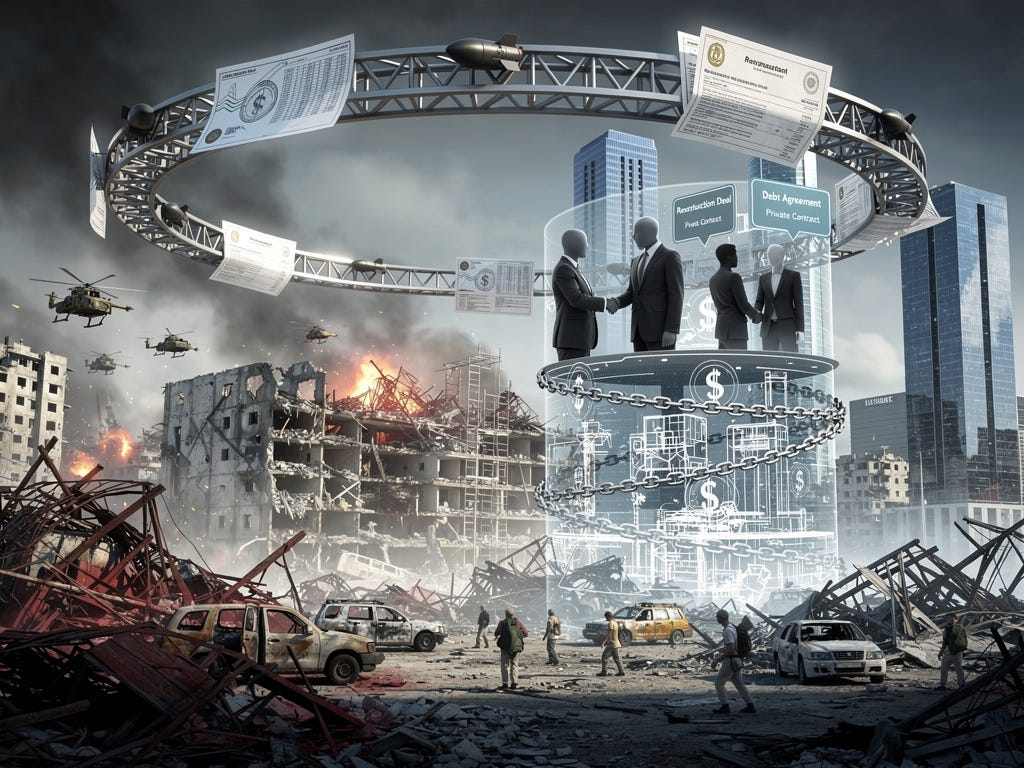
Every war contains the architecture of the next one. That’s not a flaw in an otherwise ideal design. It is the design. The reconstruction-debt cycle that inevitably follows every major military intervention is not an accident of poor planning — it’s the continuation of extraction by other means: the same interests that profit from the destruction contract to rebuild what was destroyed, at rates determined by the destroyers, financed by obligations that bind the destroyed for generations.
But there’s a version of this argument that slides from a critique of military aggression into a critique of military resistance — and the slide matters enormously. The person who says war is never the answer from the comfort of a country that has not been invaded in living memory is saying something categorically different from the person who says it while their city is being bombed. The first is a moral position. The second would be a kind of suicide. And the philosophical tradition that can’t hold that distinction in focus tends to privilege, in practice, the continuity of the powerful over the survival of the attacked.
The hardest cases for absolute pacifism are not invented. Rwanda. Cambodia. The Warsaw Ghetto. Srebrenica. In each of these, the world’s commitment to non-military intervention — or its simple indifference — did not preserve peace. It preserved the operational freedom of those committing atrocities. Non-intervention is not neutrality. It is a choice, and its consequences are written in the same ink as any other choice.
What this means is that the proposition, as stated, is doing two different jobs simultaneously — and it does neither with full precision. As a critique of the military-industrial complex, of great power aggression, of the manufactured consent that turns resource wars into liberation narratives, it’s not merely correct but urgently, vitally correct. The world has been catastrophically harmed by the assumption that hard political problems yield to military force and by the institutional architecture that keeps that assumption economically rewarding for a small number of people and devastating for a large number of others.
But as a universal moral law — war is never the answer, in all cases, for all parties, under all conditions — the proposition breaks against a simple and devastating asymmetry. Not every party to a war chose to become one. Some people are not answering a question they formulated; they are answering a question that arrived at their door, uninvited, in the form of an army. To tell them that violence is never the answer is to conflate the aggressor’s action with the defender’s response — to hold both to the same moral standard while ignoring the fact that one of them created the situation and the other is simply inside it. Absolute pacifism, applied without that distinction, does not distribute its demands equally. It places the entire burden of moral restraint on the person already absorbing the violence.
The more honest claim — and I believe the deeper one — is that war is never a sufficient answer. That's what military force can do, when it can be justified at all, is to create a pause. A space. An interruption of the momentum of destruction long enough for something else to become possible. What that something else requires is entirely different in kind: the slow, unglamorous, institutionally complex, politically contested work of building conditions in which violence loses its utility.
That work has no spectacle. It doesn’t produce victory parades or triumphant narratives. It proceeds through trade agreements and transitional justice mechanisms and educational reform and land redistribution and the patient renegotiation of historical grievances – through all the things that get called “soft” by people whose definition of hardness is measured in kilotons. And it is, almost everywhere it has succeeded, what has actually ended wars. Not the winning. The building that came after, and sometimes before, the win was even possible.
The question that war can’t answer is the question of what people are willing to live with and alongside. That is at once a political question, a philosophical question, a question about identity and memory and the stories communities tell about who they are and who their neighbours are. No army has ever answered it. Armies have occasionally, at great cost, created the conditions under which it could begin to be asked.
There’s a civilisational failure encoded in how rarely we invest in that asking — in the diplomacy that never becomes a crisis, the reconciliation that never becomes front-page news, and the infrastructure of coexistence that is invisible until it breaks. We spend lavishly on the apparatus of destruction and call it security. We spend almost nothing on the apparatus of non-destruction and call it idealism.
The proposition “war is never the answer” is, at its best, a refusal of that accounting. A refusal to accept that the default response to human conflict must be the one that kills the most people and produces the fewest durable solutions. It is a demand — undisciplined in its absolute form, but profound in its direction — that we become serious, finally, about the harder work.
The answer to war is not pacifism as a posture. It is politics as a genuine vocation: the art of building worlds in which the question that war cannot answer has already been answered by other means, before anyone reaches for a weapon.
We have been reaching for weapons for ten thousand years. We know how to do that. The question is whether we have yet become serious about learning the alternative — which is not peace as absence, not the silence after the guns stop, but the active, unglamorous, perpetually unfinished labour of building worlds that don’t require the question to be asked in the first place.
That world is not utopia. It is simply what competent civilisation looks like. We have never quite managed it – not because the knowledge is absent, not because the capacity is beyond us, but because the decision has never quite been made. Not collectively. Not in the places where decisions of that magnitude actually land.
And so the question waits. Larger, now, than any army assembled to avoid it.