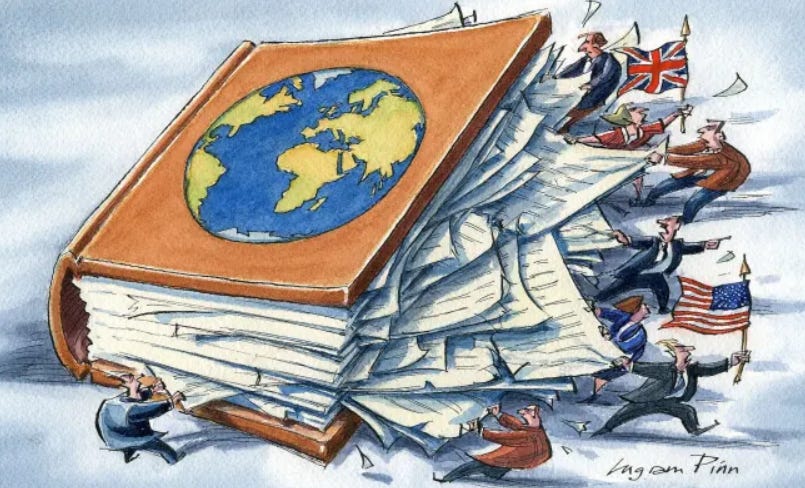
The current 'rules-based' world order, shaped by an incumbent elite patriarchy within the Western powers following the end of World War 2, reflects a system that, while advancing a certain number of assumed geopolitical norms and socio-economic principles, has deliberately perpetuated imbalances that unreasonably impact countries across the Global South, including those within the BRICS group - Brazil, Russia, India, China, and South Africa.
Indeed, one of the most compelling factors drawing nations in to membership of the BRICS community is an intention to rebalance the international order so as to attend to the long-term effects of colonialism, correct historical injustices, and create a more equitable and inclusive global system aligned with contemporary experiences.
Their dream of a more equitable and peaceful world is not a plea to the West for reform; nor does it come from a position of deference or fear. It is an act of pure defiance, a direct invitation to the West to evolve to a more advanced level of ecological inclusion, integrity and security - summed up in a portmanteau term: ecority.
The modern international system evolved during and after the colonial period, with European powers crafting rules and institutions that primarily served their own interests. The political, economic, and social structures of many countries in the Global South were molded by colonial exploitation, and these effects continue to implicitly shape their development and global standing today.
Despite formal decolonization, many former protectorates still face systemic barriers to growth and true independence, via inequitable contracts with their former masters. The frameworks imposed by colonial powers invariably favoured their own interests, leaving a legacy of unfairness that still endures. Not just content with that form of humiliation, the West has contrived to keep in place a psychological narrative implying ineptitude, corruption, and inferiority among its former colonies.
Currently, the global monetary system is characterized by significant disparities. So-called 'developed' nations, typically former colonial powers guided by the United States which we can collectively call the Global North, wield the majority of economic and financial influence, while countries in the Global South (i.e. by inference the 'non-developed' nations) grapple with debt burdens, trade imbalances, and limited access to technologies and markets.
Politically, institutions like the United Nations Security Council with its passive observers and anachronistic veto powers, the World Bank, and the International Monetary Fund, all reflect historical power structures that no longer align with today’s dynamics. Many countries in the Global South lack any kind of representation in these bodies, thus limiting their ability to influence decisions that impact their own lives, future economies, and stability.
Moreover, the impacts of the climate crisis, in the broadest sense of that term, disproportionately affect the Global South, despite these countries historically contributing less to greenhouse gas emissions, soil erosion, and the extinction of species. The current global climate framework often fails to adequately address the needs and capacities of these nations, perpetuating existing injustices.
Addressing these issues is not just a matter of fairness. It's also the pursuit of historical justice, which can be considered a moral duty. A rebalanced world order must recognize and rectify the inequalities created by colonialism, incorporating reparative measures and equitable participation in global governance. This might include the reform of some international institutions to ensure fair representation of countries from the Global South and elsewhere. And there can be no doubt that expanding the UN's Security Council, and regenerating the IMF and World Bank to reflect contemporary geopolitical realities would go a long way to enhancing the voices of historically marginalized nations.
But even that is insufficient. Liberation of the Global South is now urgent and necessary. New institutions are needed, with the architecture evolving from the dispossessed this time.
Economic fairness demands the comprehensive restructuring of global policies to support ecological sustainability and economic sufficiency everywhere, but particularly in the Global South. This involves implementing fair trade practices, providing debt relief, and improving access to technology and markets to ensure that all countries can participate equally in a global economy marked by managed contraction.
In the realm of climate action, the global agenda must be adjusted to offer greater support and flexibility for 'blameless' nations and islands. The West has a moral obligation to increase financial and technical assistance for climate adaptation and mitigation, removing any barriers to self-actualization previously imposed though conquest and repression. We must also accept the burden of responsibility in the so-called 'developed' world for industrial economism - the conditions manufactured by our fixation on economic growth, competition, and the folly of bulk production, bulk consumption, bulk waste and bulk pollution - that has caused the climate to heat up and act with such catastrophic volatility.
A new rules-based order is essential not only for justice but for global stability, peace, prosperity, and the promise of an inhabitable environment. By addressing the historical legacies of colonization and ensuring equitable representation and participation in global governance, we can create a more just and effective international system. A system of inclusion and ecority. The BRICS alliance and countries in the Global South advocate for these reforms not merely for their own benefit but for the betterment of the global community as a whole. It is imperative that we include these new voices in any forward-looking schema.