A coach in a gymnasium in Lima tells a squad of eleven-year-old girls, minutes before a regional match, that the team on the other side of the net are their enemies for the next ninety minutes. Not rivals. Not opponents. ‘Enemies’ — a word he reaches for because it burns hotter, and nobody in the room flinches, not the parents folding their arms along the benches, not the referee checking her whistle, because everyone present has absorbed the same grammar since their own childhoods: sport as war carried out by gentler means, in a vocabulary none of them invented and none of them can quite set down.
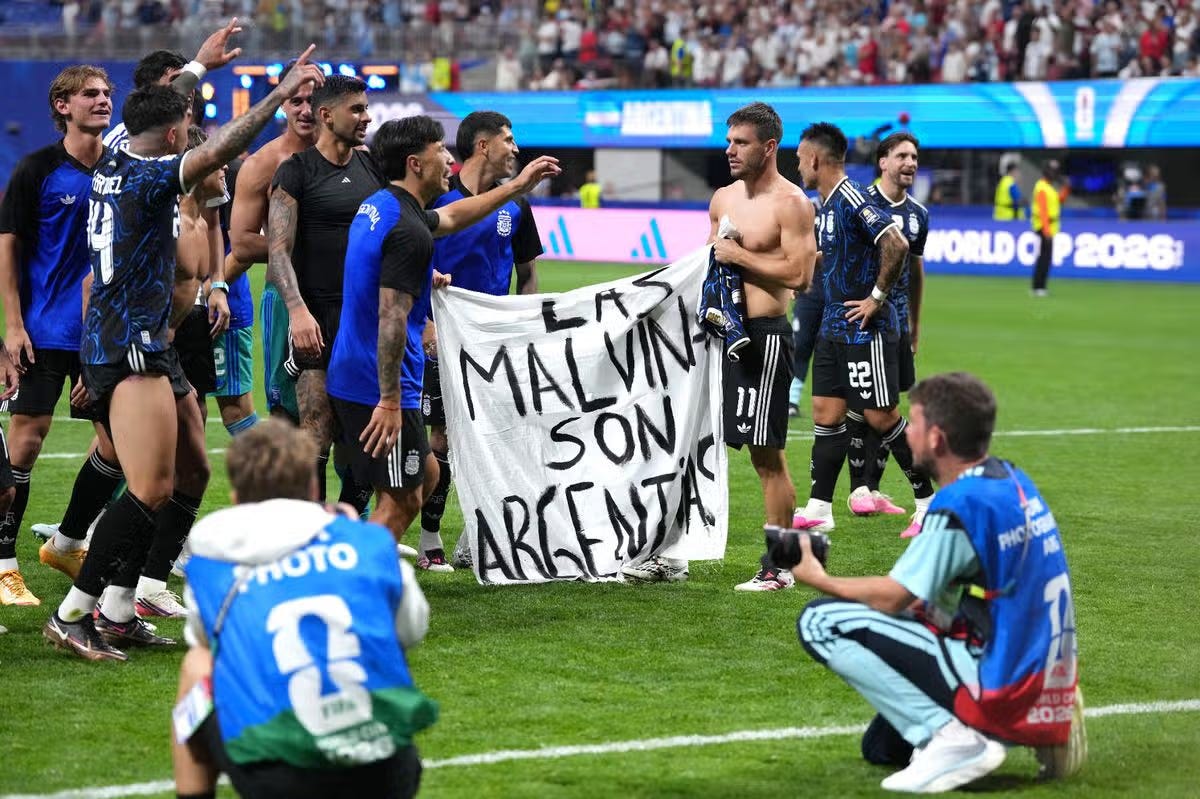
Days before this article was written, inside a stadium in Atlanta, the national anthems of England and Argentina were both drowned out by opposing supporters before a World Cup semi-final that neither crowd needed translated for them, both sets of fans booing one another before the match even began. In that same fixture, David Beckham sat as a spectator and was jeered by thousands of Argentine supporters, most of them not yet born the last time he set foot on a pitch against their country, the reaction widely linked to his 1998 red card against Argentina. That red card came thirty-two years after an Argentine captain, sent off at Wembley for arguing a decision he thought rigged against him, refused to leave the pitch and sat instead on a carpet reserved for a passing Queen, while the England manager of the day dismissed his opponents afterwards as animals. A sending-off old enough to have grandchildren, and it still knows precisely which stranger to boo on sight, in a stadium built decades after everyone involved in the original offence had retired or died.
Off the pitch in this same tournament, Argentina’s continued success produced its own grammar of grievance — a running accusation of favouritism, fixed officiating, and conspiracy, offered by critics who seemed unable to describe dominance except as a wrong requiring correction, with the reigning champions becoming the most polarising and scrutinised team of the year off the field even as they kept winning on it. Messi, asked to account for a title his side had not yet lost, could only answer that nothing had been handed to them, telling the team’s detractors, “Nothing was handed to us” — a sentence that should never have needed defending in any fairer grammar than the one on offer.
This is the pattern I keep returning to: not that hatred and rivalry exist — they always have and will — but that the language available for describing ambition, difference, and even excellence has narrowed until competition and enmity are nearly the only registers left standing. A boy cannot be told he loves a subject without being told he is good at it, better than someone else. A nation cannot describe its recovery from disaster without framing it as a war it intends to win. Even reconciliation reaches for the enemy’s tongue – a ceasefire, a war on poverty, a campaign for peace – as though peace has no native vocabulary of its own and must borrow its verbs from the very thing it opposes.
Words like ‘compete’ carry an older, gentler ancestry than their current use suggests. The Latin root, competere, meant to strive together — a shared reaching, not a mutual destruction. Something drained that mutuality out over the centuries in which markets needed share to be taken from somebody, in which growth required a loser standing opposite every winner, in which scarcity was manufactured as a permanent condition rather than treated as an occasional emergency. Language did not cause that reorganisation of the world. But it hardened around it, the way sediment hardens around whatever falls into a riverbed, until the metaphor became indistinguishable from the ground itself. We no longer notice we are standing on rock that used to be water.
And this is where the difficulty deepens, because language of this kind resists reform the way a keystone resists removal — take it out, and the whole arch around it groans. A government that stopped naming enemies would lose the fear that manufactures obedience. A corporation that stopped speaking of domination would unsettle shareholders whose faith depends on hearing the vocabulary of conquest recited back to them each quarter. A football federation that stopped selling the ancient grudge would find the stadium half as loud and the broadcast rights worth half as much. None of these institutions are staffed by people who privately believe hatred is good policy. Yet each is bound to a vocabulary that keeps regenerating the very conflict it claims only to be managing, and none can put it down first without appearing to concede – which is, of course, exactly the trap the vocabulary was built to set.
Here I have to stop and look at my own voice. In trying to describe the machinery of this language, I have already reached for hardened, borrowed, regenerating, trap, grudge, and animals – combative words recruited to make a case against combat. This is not an oversight to edit away, because there may be no clean vocabulary standing outside the one under examination, waiting to be adopted instead. Trying to think one’s way out of a grammar while still thinking inside it resembles trying to redesign a building from within its own foundations — every tool reached for was poured from the same concrete now being dismantled. Perhaps that’s the most honest admission I can make here: the case against the language of war is being argued in a soldier’s vocabulary, because for now it is the only one fully built and standing.
So who moves first, if the large institutions cannot? Perhaps nobody moves first in any way that photographs well, because the shift, if it comes, will not arrive as a treaty or a slogan or a ministry established for the purpose. It may arrive instead in a grandmother choosing a gentler name for a difficult neighbour before her grandchildren are old enough to notice the alternative existed. In a teacher who marks an essay for its argument rather than its capacity to demolish an opposing one. In a translator sitting with two possible words for an hour and choosing the one that carries no blade. In a commentator who describes a semi-final without once reaching for the vocabulary of siege and loses half his audience to a rival broadcast that still knows how to make a crowd feel it is at war. None of these acts will be recorded as historic. Each is small enough to be missed by anyone looking for a movement, a manifesto, or a leader to interview.
It would be comforting to end here with a plan — three steps towards a gentler tongue, a framework to adopt, a body to petition. I have none to offer, and I am not certain one exists in any form that would survive contact with the world it hopes to enter. What I notice instead is that every language humans have ever spoken has changed without permission and without a schedule, shaped by the accumulated weight of ordinary refusals nobody thought worth recording at the time — a word quietly retired here, a metaphor left unrepeated there, a stadium, somewhere, decades from now, standing for its anthems in something other than mutual jeering.
Whether enough such refusals gather before the vocabulary of conquest finishes writing this century in its own image is not something any of us will know from inside it, standing as we do on ground we cannot yet feel hardening beneath our feet.