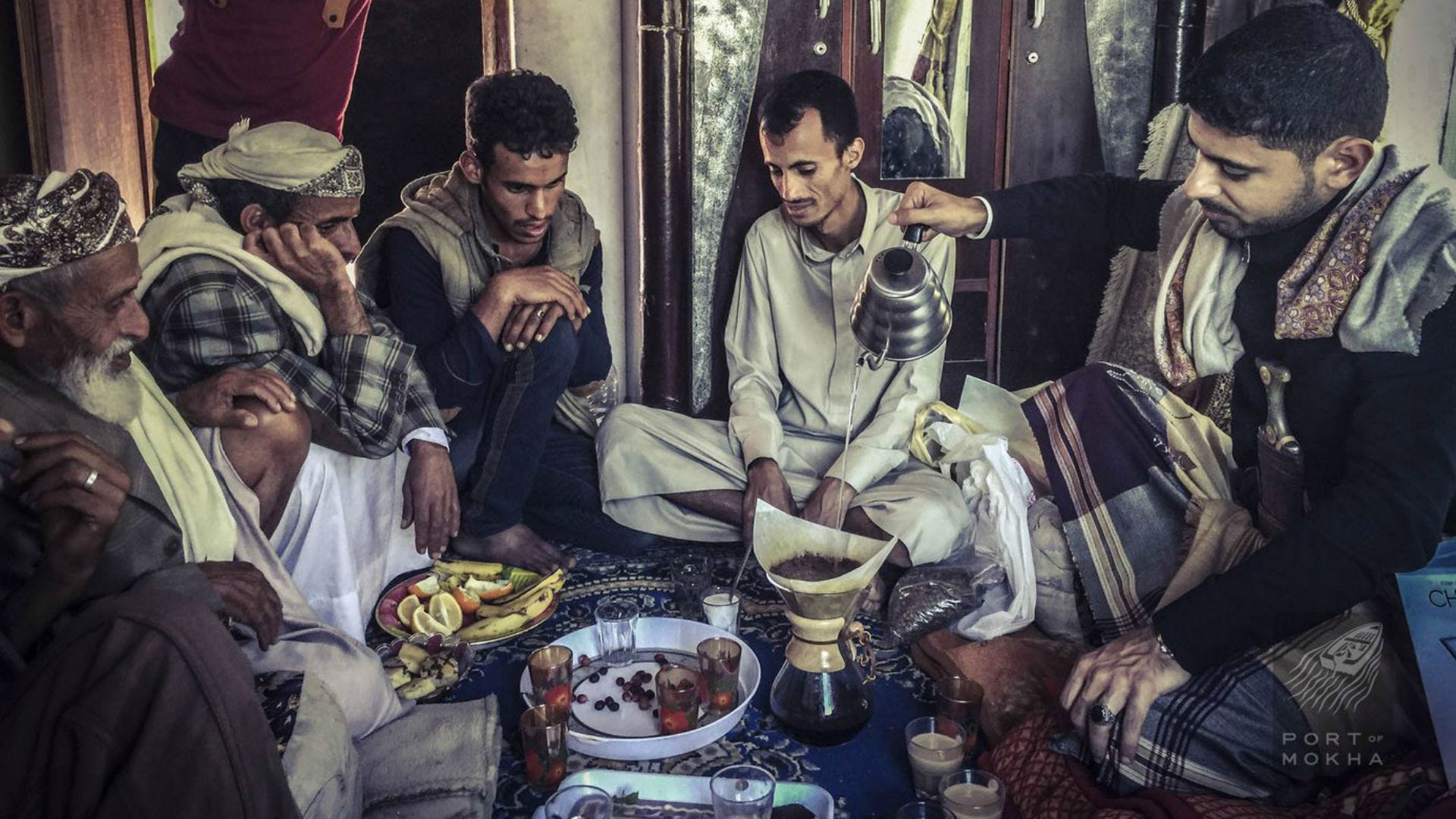
Before it was ever a front line, Mokha was just an aroma. For the better part of two centuries the small harbour on Yemen’s Red Sea coast was where the world came for coffee. Gujarati merchants and Ottoman agents kept warehouses there; Dutch and French captains rode at anchor offshore waiting for the beans to come down from the highlands, where Sufi brotherhoods had first brewed the black infusion to stay awake through the hours of nightly devotion. Out of that one harbour a word went into every language on earth. Cuttings smuggled to Java became the plantations of the Indies; the highlands of Vietnam now grow more of the crop than anywhere except Brazil. This morning, in Lagos and Karachi, in Modena and Melbourne, someone ordered a drink named for a Yemeni port they couldn’t place on a map.
On 11 September 2026, twenty-five years to the day after the towers came down, that port changed hands. Ansarallah — the Houthis, in the shorthand of the wire services — took Mokha, and within a day the barren volcanic island of Perim, which sits in the throat of the Bab el-Mandeb like a stone in a windpipe. Officers of Yemen’s internationally recognised government told reporters they were stunned that the Saudi air force had not seriously tried to stop the advance. Coincidence is no argument. But anniversaries hold up mirrors at angles nobody chose, and it’s hard to look away from this one.
On the evening the towers fell, a former Israeli prime minister was asked by a New York newspaper what the attack meant for his country’s relationship with America. His first answer was that it was good. He heard himself, retreated, and rephrased — sympathy, a strengthened bond. A great deal has been made of that slip over the years, most of it to the effect that he was gloating. In fact he was stating something more useful and far more chilling: describing a mechanism accurately. A wounded polity becomes a permissive one. Grief loosens the joints. Requests that could not be made on the tenth of September could be granted on the twelfth.
Every household in every culture knows this. An organism under attack raises its temperature to burn out the intruder; and sometimes the fever outlives the infection and keeps burning, and the body begins consuming its own tissue. Physicians in the Ayurvedic, Galenic, Chinese and Unani traditions all have a name for that second condition. Politics has none.
A retired American general later described being told, weeks after the attacks, that the intention was to bring down seven governments in five years: Iraq, Syria, Lebanon, Libya, Somalia, Sudan, Iran. He called it a coup carried out inside policy. That same list now circulates as proof of design. Look at the seven and a pattern is undeniable — each was, in its own way, a holdout against Israeli regional primacy and a sponsor of Palestinian claims — and the inference many draw is that Washington’s wars were Israel’s wars, subcontracted.
There’s no argument that the alignment is real. It’s as visible from Sana’a as from Tel Aviv. What I distrust is the blueprint, because a blueprint flatters everyone in the story. It grants the architects a competence the results have never supported and grants the rest of us the retreat of villain. What the seven-country list may actually record is something far stranger than a plan: the moment when permissions loosened by grief met a set of institutions that had each, for its own reasons, been waiting to be permitted. Israel’s strategic wish-list, the Pentagon’s appetite, the Gulf monarchies’ fear of Tehran, the order books of the arms industry, the careers of a generation of officials. None of these needed to command the others. A vine doesn’t conspire with the wall it climbs. It finds the wall already standing.
Yemen is where this becomes decipherable. In 2015 Washington was negotiating a nuclear agreement with Iran that Israel and most of the Gulf loathed. In the same season it gave Riyadh what it needed to bomb Ansarallah — targeting intelligence, mid-air refuelling, munitions, diplomatic cover. One of the officials who made that decision later admitted they had expected a long and ugly war and proceeded anyway. Read from Sana’a, the bombing was the side-payment for the deal. Hundreds of thousands dead by the United Nations’ reckoning, most of them from hunger and disease behind a blockade, a cholera epidemic of a scale not seen in modern records. And the movement the fever was meant to burn out came through it hardened, the way certain seeds will germinate only after fire.
Eleven years on it holds the coffee port and the island in the strait. It has declared the sea safe for every flag except the Saudi one, and sits within a short sail of an American base in Djibouti. With Hormuz already constricted by the war Washington and Israel opened against Iran in February, both of the narrow doorways through which Gulf oil reaches the world are now contested. You don’t need to live within a thousand kilometres of either to feel it. It arrives as the price of diesel in Lagos, of urea in Punjab, of freight out of Haiphong, of the ship carrying your country’s rice.
Follow the pipeline. On the day Mokha fell, Saudi Arabia shut its East-West line after drone strikes that Riyadh claims came from Iraqi soil. Baghdad dismissed commanders in Maysan province, sealed a crossing with Iran, and — through the militias formally embedded in its own security forces — denied that anyone had done anything. Nobody has claimed the strikes. Washington says Iran was probably — a word that measures how much proof is missing — behind them. Underneath all of it lies an arrangement almost nobody outside Iraq discusses. Since 2003 the proceeds of Iraqi oil, nine tenths of what the state lives on, have been deposited in an account at the Federal Reserve Bank of New York, and pallets of banknotes flown back to keep a cash economy breathing. In April the US Treasury held one such flight on the ground — half a billion dollars — to press Baghdad over the militias. This was never aid. It is Iraq’s own harvest, stored in another man’s granary, and any tenant farmer in Sindh or Mindanao knows what it means when the landlord keeps the key. Twenty-three years after the invasion, the key has not been returned. Iraqi ministers have asked publicly by what right a country with its own long record of financial scandal lectures anyone on probity. The question was received in Washington as impertinence, which is what honest questions become when the powerless ask them.
And then the reversal. On 24 August, after forty-seven years, Syria was struck from the American list of state sponsors of terrorism, and the group its president once led — al-Nusra, later Hayat Tahrir al-Sham — was removed from the terrorist designations that same afternoon. The reasoning was offered candidly by the senators who backed it: Ahmed al-Sharaa had cut the road by which Iran supplied Hezbollah, and had thereby done Israel and America a service. Sanctions that had crushed Syrian households through a decade of war were lifted in payment for geopolitical utility. A man on whose head Washington once placed a bounty is now received as an ally. Meanwhile the same government fights Iran and negotiates with it in the same season — a war, a ceasefire, a memorandum whose terms have been reported but not seen, threats resumed. The designation of terrorism was never a compass pointing at conduct. It’s a weathervane, and the wind has moved.
Set the stated purposes of the past quarter century beside the results. Security generated a strait in hostile hands. Deterrence produced a toughened adversary. Financial custody manufactured a client that shelters the militias it was meant to restrain. Counter-terrorism created a former jihadist as the region’s newest friend. The gap between the words and the outcomes is where the actual logic of this order lives, and the logic is not a secret held by a cabal. It is a metabolism. Institutions that were fed on permission have learnt to keep the fever running, because the fever is what feeds them. If you live in Hanoi or Lima, no one ever asked whether an American wound should govern the cost of your fuel. It does anyway.
The Ottoman factors and Dutch captains who made Mokha rich imagined the trade to be permanent. Within a century Java and then Brazil had emptied the harbour, and the port settled back into sand. Words outlived the commerce by three hundred years.
The men who built the arrangements of 2001 also assumed permanence, and the conditions that sustained them — deferential monarchies, open sea lanes, a dollar no one dared refuse — are being renegotiated by people for whom none of them planned. The Sufis of the highlands drank the black infusion so as not to sleep through the hours when, they believed, the world is at its most permeable. Something is keeping the whole region awake now. Nobody has yet said what it’s watching for.