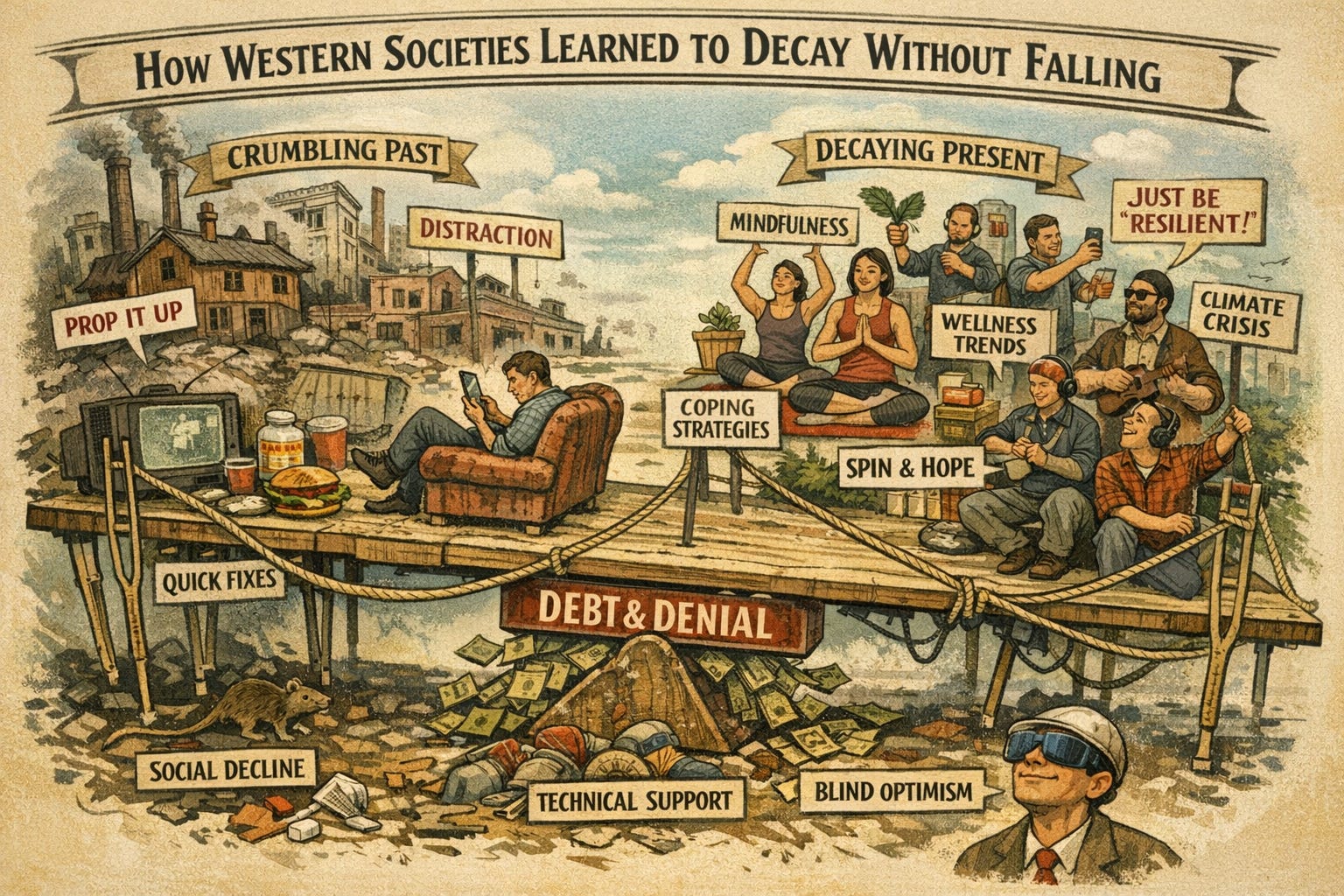
There’s a moment, somewhere between the third platform announcement and the apologetic shrug of the man beside you, when you stop being angry about the cancelled train. The anger requires a belief that things ought to work. That belief has quietly left you. You wait. You rebook. The surprise is gone, and its going has taught you nothing, which is a problem.
I have watched this absence settle into people across three continents, and it always wears the same face. A mother in an American city runs the tap for a minute before she trusts it near her child. She has stopped thinking of this as a precaution; it’s simply how water comes now. A clerk in a European ministry nurses a payments system written in a language she was not yet born to read. She has learned which days it will fail and plans her week around its moods. An Australian in a city ringed by fire checks an emergency app that has not refreshed since morning and has stopped expecting the official channel to know before she can smell the acrid smoke for herself. None of this announces itself. There are no tanks at the crossroads, no smoke above the parliament. The lights stay on. And yet something has gone out of these places that their citizens can feel in the body before they can name it in words — a withdrawal of the old confidence that the ground beneath public life would hold.
We have no honest word for what they are living through. The vocabulary we possess for the failure of states was built for other people’s countries.
When the academy speaks of a failed state, it points to Mogadishu in the early 1990s, to Kabul at any of its several unravellings, to a Syria dissolving into its own war. The failed state, in this telling, can’t hold its territory, can’t keep its citizens from one another’s violence, and can’t deliver the minimum that makes a state worthy of the name.
For half a century the science of state failure has counted what can be dated and filed — the civil war, the coup, the genocide, the regime collapsing into the rubble of its own legitimacy. The instruments were built to catch the rupture, the moment a country can be said, on a particular morning, to have come apart. They register nothing of a failure that keeps no such calendar, that arrives not as an event but as a slow withdrawal of capacity no single year is responsible for.
By that measure Britain has not failed. Neither has France, nor Germany, nor the United States. They tax. They vote. They pay pensions more or less on time, field armies, host the summits, and mint the currencies that the rest of the world still holds. Hold them against Somalia, and the comparison is almost absurd. And so the question dies before it can be asked, because the only word we have for it visibly does not fit, and we mistake the failure of the word for the absence of what it should have named. The failure is there. It has simply learned to move slowly.
In 2016 Jan Techau reached for a phrase to describe what was happening to parts of Europe, and the phrase was “sophisticated state failure”. He meant states that have stopped performing their core work well but can’t collapse because they are too rich, too complex, and too deeply stitched into the wider weave of alliances and markets to come apart in any single dramatic motion. The sophistication is not a matter of culture or cleverness. It’s a matter of buffering. Such a state can borrow against its future for a very long time. It sits inside blocs and treaties that catch it when it stumbles. It inherited, from a more capable era, a stock of roads and laws and institutions solid enough to absorb decades of neglect before that neglect becomes visible. The buffer doesn’t prevent the failure. It conceals it. It delays it. It allows a polity to fail sideways — to decay along a gradient so gentle that no single year ever looks like the year it broke.
Britain is the clearest specimen now alive. Sam Freedman has described, with the patience of someone watching a slow tide, a country whose democratic machinery turns over exactly as it always has while the services that machinery exists to provide come apart underneath it. A health service running through every season at the edge of what’s safe, and often past it. Schoolchildren sent home because the concrete in their classroom ceilings might fall on them. Councils declaring themselves insolvent in all but name and cutting the libraries, the bus routes, and the care visits until the social fabric in a given town is worn through to the thread. Infrastructure decisions deferred so long that the deferral becomes the decision. And around all of this, undisturbed, the rituals of a functioning democracy proceed. The elections come and go. The budgets pass. The deterrent patrols its deep water. A foreign observer reading only the constitutional surface would see a polity in relatively good order. A citizen waiting eleven hours on a hospital corridor trolley knows otherwise, and the gap between those two readings is the precise shape of the failure.
The American case folds the same contradiction into a single map. At the centre stands a state of almost unimaginable capacity — the largest military our species has built, the laboratories and exchanges that set the terms for everyone else, an appetite for shaping the world in its totality. Travel outward from that centre, toward where the people actually live, and the capacity thins like topsoil down a hillside. Bridges carry their loads on borrowed time. In Flint, in Jackson, families learned that the water authority and the word of the state could no longer be taken together on trust. School districts pass the hat for pencils. Whether you inhabit a competent country or a failing one comes to depend, with a precision that should dismay, on your postcode. The United States is not collapsing. It is sorting itself, quietly and continuously, into zones that work and zones that have been let go, and draping over the whole arrangement the flag of a single, confident, unbroken power.
Cross to the European core and the failure changes its accent again. Germany, France, and Italy are not in crisis in any way a news desk would recognise. They are something harder to photograph: economies that have forgotten how to grow, energy systems and railways and bridges ageing faster than they are renewed, political centres hollowing as the edges fill. Techau saw the German predicament early — a country that may wake to find the American security guarantee withdrawn while its own defences remain an unfinished thought and its political culture so allergic to decisive motion that caution has hardened into paralysis. The European Union refines this into an art. Its regulatory craftsmanship is the envy of the world and frequently deserves to be. Yet on the questions that will decide whether the continent remains an author of its own future or becomes the object of other people’s plans — migration, energy, the capacity to act as one body in a dangerous decade — the decisions arrive late, arrive compromised, and arrive technically immaculate and practically bloodless. The failure here is rarely the absence of policy. It’s the failure of timing, the failure to ripen a choice before the moment for it has passed.
Lay the three cases side by side, and the same organism shows through three different skins.
Each of them is living off inherited strength. The roads, the universities, the bureaucracies, the very reputations for competence — these were laid down in the middle of the last century by people who believed the future was something you built and paid for. The generations since have drawn on that capital and replenished it thinly, sacrificing the slow, unglamorous work of maintenance to the short rhythm of the electoral cycle and the long superstition of fiscal restraint. You can run a civilisation on its inheritance for a surprisingly long time. You can’t run it forever.
Each of them has dissolved responsibility across so many hands that no hand can be made to hold it. Power is split between the local and the regional, the national and the supranational, until every failure has four authors and therefore none. The council blames the ministry, the ministry blames the treasury, the treasury blames the markets, and the citizen on the cancelled platform blames, in the end, only their own foolishness for having expected better.
And each has become brilliant in some chambers and derelict in others within the same body. The state that can’t keep lead out of a child’s drinking water can still place a weapon on the far side of the planet within the hour. The competence has not vanished. It has migrated — toward the spectacular and the obscenely strategic, away from the daily and the near. This is the cruellest signature of the syndrome, because it lets the state point endlessly at its own working parts as proof that the failing parts cannot really be failing.
Underneath all three runs the quiet machinery of adjustment. Because nothing crashes, expectations bend. What would have been a national scandal in 1975 becomes, in 2026, simply the way things are. The citizen lowers the bar a notch each year, so gradually that no single notch is worth a protest, and the cumulative descent never registers as a fall. A people can be governed downward almost indefinitely, provided each increment is small enough to step over.
There’s an old distinction in the failed-state literature between the wounds a country inflicts on itself — corruption, faction, the rot of its institutions — and the wounds delivered from outside by war or markets or the interference of stronger hands. The interesting thing about the West now is not that one kind dominates but that the two have begun to feed each other. A political class trained to harvest the next quarter cannot steward the next half-century; that’s the wound from within. Meanwhile the world outside delivers its shocks faster than any quarterly mind can absorb them — the heaving of global capital, the turning of demographic tides, the acceleration of the machines, the great geopolitical furniture sliding across the tilting deck. The state caught between a domestic clock set to months and an external clock set to decades can’t reconcile the two, and the failure to reconcile them is experienced far below the level of grand strategy, as the ten-thirty train that simply doesn’t come.
You can watch the contradiction in motion. A Britain that left its union without a settled idea of what would stand in its place. An America straining to underwrite the security of half the planet while the agreement at home about why it should do so frays toward nothing. European states that want the American shield overhead and the Chinese market beneath their feet and have not let themselves notice that these two desires are pulling in opposite directions. Strategic incoherence at the summit, lived as daily dysfunction at the base. The unprocessed passport is the foreign policy, arriving in the mail.
Why, then, do we struggle so to name something so widely felt? Partly because the West still pictures itself as the template of the working state, and failure is a word it keeps for the accounts of others; the eye can’t easily turn a diagnostic gaze upon the face it has always seen in the mirror. Partly because the instruments we trust to read a nation’s health — the growth figure, the bond yield, the order of battle — are blind to the quality of an ordinary morning, to whether the bus came, the operation happened when needed, and the form was answered by a human being who could help. And partly because to admit the depth of the erosion is to indict not a villain but a system, and the indictment of a system wins no election, whereas the naming of a few bad leaders wins several. Those who measure these things study what can be dated and filed: the coup on its day, the war in its year. Sophisticated state failure keeps no such calendar. It is ambient. It’s the difference between a heart attack and a long illness whose first symptom is only that the patient no longer climbs the stairs they used to climb and has forgotten that they ever did.
The stakes of this are not administrative. They are civic, and they reach to the root of what a state is for. A government exists, before it does anything else, to be trusted with the things a person cannot secure alone — the water, the road, the care of the sick, the keeping of the peace. When it can no longer reliably do these things but goes on asking for the trust regardless, it spends coins it has stopped minting. The trust does not vanish evenly. Those who can afford it withdraw into private versions of the failing public goods — their own water, their own schooling, their own guards at their own gates — and in doing so remove both their money and their attention from the commons upon which they have quietly given up. Those who can’t afford the exit are left inside the decaying shell, and some of them, reasonably enough, begin to listen to whoever promises to make it whole again by force. The hollowing of the competent state is the most fertile ground there is for the strongman, who offers, in place of the slow, boring work of repair, the intoxicating fiction of restoration.
And all of this arrives precisely when the species can least afford states that cannot act. The breakdown of the living systems, the acceleration of the machines, the fracturing of the old global order — every one of these demands public institutions capable of coordinating across decades, of repairing what they have built, of holding a steady purpose against a moving horizon. A polity that can still send a carrier to the far side of the world but can’t guarantee clean water to the child three miles from its parliament is not a healthy thing wearing a temporary ailment. The sophistication of its failure is not a mitigation. It is the disease’s most accomplished disguise.
So return to the platform and to the man beside you who has stopped being angry. The cancelled train, the brown water, the system that fails on Tuesdays, the queue that should not exist — we have been taught to file these as irritations, the friction of any large society, the price of the modern. But these are not friction. They are the early language of an incapacity that has not yet learned to speak plainly, and we have grown so fluent in stepping over them that we no longer hear what they are saying.
Which leaves a reckoning that is finally yours and mine and not the academy’s to make for us. What is the failure you have quietly decided to live with? Which small failure did you step over this morning without breaking stride? And at what unmarked point does the sum of all those steps stop being the ordinary wear of a flawed but repairable country and become instead the slow, sophisticated, almost comfortable failure of the place you thought you lived in — the place you may already have left without once moving house?