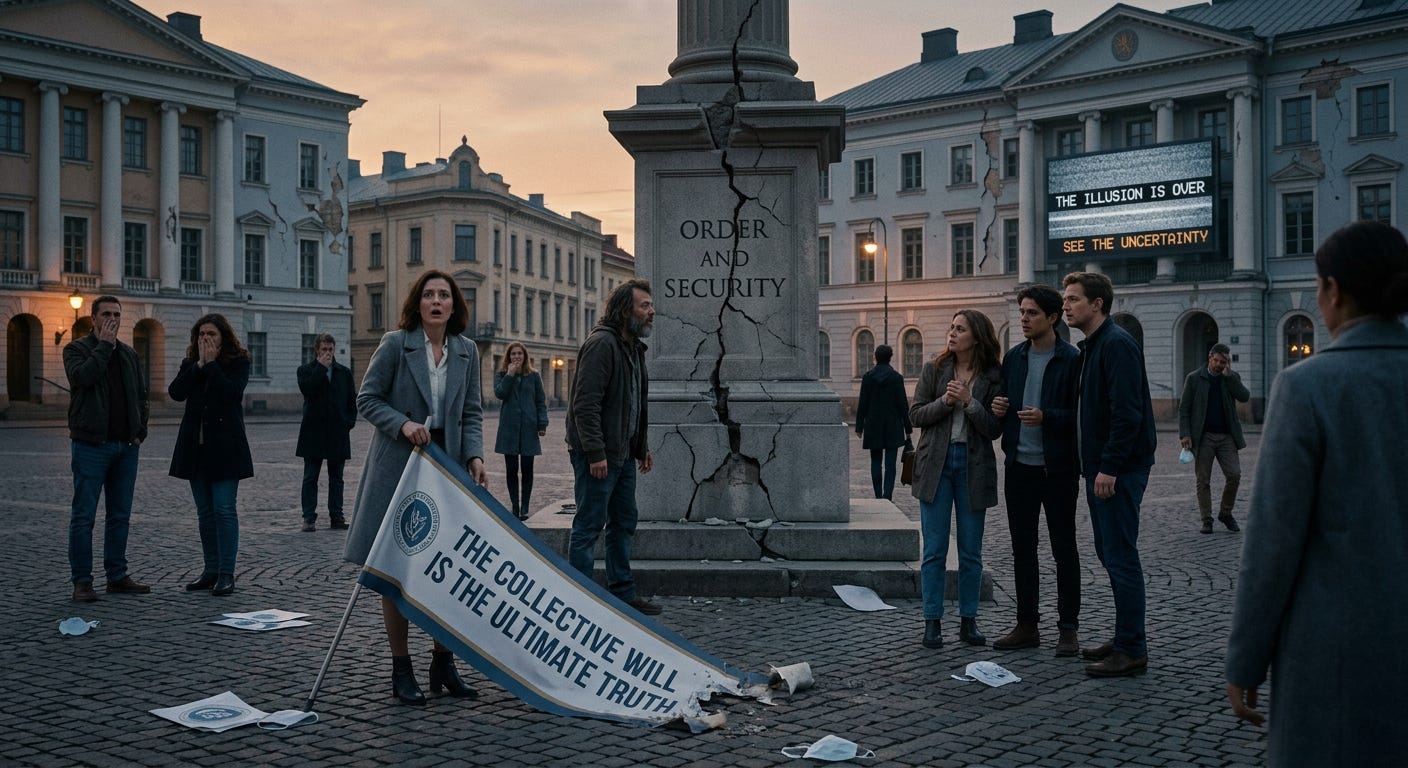
In my experience, people rarely wake up from illusion because truth arrives soothingly at a time of their choosing. More often that not, awakening begins when the story holding our reality together cracks: a political myth fails, an institution loses legitimacy, a private self-deception becomes unbearable, or a collective narrative no longer explains the uncertainty that we’re actually living through.
In the context of today’s fragmenting world, my title phrase is particularly resonant. Societies depend on a dominant narrative hosting an array of associated memes. Some are noble: human rights, democracy, progress, equality before the law, and the dignity of work, for example. Others have proven to be deceptive: that markets invariably reward merit, that technology automatically improves life, that nations are unified wholes, that endless growth has no ecological cost, that those in power are basically accountable, that history is moving in a single upward direction...
A “lie” here doesn’t have to mean a straightforward falsehood. It can just mean a false coherence: a story that makes the world feel stable while hiding contradictions under the surface.
For much of the late twentieth and early twenty-first century, most Western societies lived inside grand narratives: globalisation would integrate the world; liberal democracy had “won”; the internet would democratise knowledge; economic growth would lift all boats; institutions would manage crises competently. These narratives did contain some elements of the truth. But they also concealed exclusions, resentments, exploitation, loneliness, ecological damage, and deep inequalities.
The rupture begins when lived experience no longer matches the official story. And in that context, today’s world feels disjointed and even hostile because many inherited narratives are breaking at once.
People no longer inhabit a single public square. They live inside different media realities, political tribes, algorithmic feeds, and moral vocabularies. One person’s “truth” is another person’s propaganda. One group’s liberation is another group’s loss. One nation’s security is another’s oppression. The fracture is not only geopolitical or economic; it is epistemic. We are divided over what is real.
This fragmentation can be truly scary. When the falsehood breaks, it doesn’t automatically reveal truth. It may reveal confusion, rage, conspiracy, nihilism, or nostalgia. A cracked illusion can produce awakening, but it can also produce panic. That’s one of the central dangers of our moment: people know that something is wrong, but they don’t agree on what the fabrication was.
For some, the lie was that elites could be trusted. For others, that capitalism would provide dignity; that national identity was stable; that colonial histories were past; that technology would connect rather than isolate; that nature could be endlessly consumed without consequence. The result is a world of competing awakenings.
Awakening often begins with a feeling of discomfort or alienation rather than information. A person sees an image of war that cannot be reconciled with official language. A worker realises loyalty will not protect them from disposability. A young person notices that the promised future — home ownership, stability, ecological safety, meaningful employment and social contribution — has been withdrawn. An increasingly sceptical citizen watches self-styled leaders defend principles selectively. A community discovers that institutions meant to protect them have ignored them or, worse still, acted against them.
The rupture is the moment when language fails. Words like “freedom,” “security,” “development,” “growth,” “neutrality,” or “peace” begin to sound hollow when reality contradicts them. This is why crises of trust are the most destabilising. Once people suspect that public language is masking private power, every statement becomes suspect.
Yet this suspicion is also the beginning of consciousness. To awaken is to stop mistaking the script for reality. But a fracture in a lie is not the same as the arrival of wisdom. When old certainties collapse, people become vulnerable to new myths. The collapse of trust can be exploited by demagogues, influencers, extremist movements, and commercial platforms that profit from outrage and fear. A person who discovers one deception may conclude that everything is deception. That is not awakening; it’s disorientation and it’s a common pathology in today’s world.
True awakening requires more than disbelief. It requires discernment. It’s easy to declare, “Everything they told us was false.” It’s harder to ask, “What is true, what is partially true, who benefits from each story, and what responsibility follows from knowing?”
In a fragmenting world, the awakened person is not simply the one who rejects official narratives. It’s the one who resists replacing one comforting fiction with another.
Digital life has accelerated the fracturing of shared realities. Smartphones expose hypocrisy instantly. Social media allows suppressed voices to speak. Leaks, citizen journalism, and independent media can challenge institutional lies. But the same systems also multiply illusion. Algorithms reward emotional certainty over patient understanding. Deepfakes, propaganda, and selective editing make reality feel unstable. The result is a paradox: we have more access to information than ever before, yet often less shared confidence in the truth.
The fracture in the lie has become continuous. Every day, some new scandal, atrocity, contradiction, or revelation breaks through the surface of our discontent. But constant exposure can numb rather than awaken. If everything is crisis, nothing is transformative. Awakening therefore requires our critical attention, not just exposure. It requires the capacity to remain morally responsive without being consumed by spectacle.
At the global level, the phrase speaks to the collapse of simplistic worldviews. For example, the concept of a single “international community” guided by consistent principles looks increasingly fragile. Wars, climate injustice, migration crises, economic coercion, and selective applications of human rights have revealed deep double standards. Many people around the world are awakening from the lie that the so-called ‘global order’ is neutral. They see that law, morality, and sovereignty are often interpreted through power. This doesn’t mean those ideals are worthless. It means they must be rescued from hypocrisy.
A mature awakening doesn’t abandon justice because it has been applied selectively. It demands that justice become less selective.
The phrase also has an intimate meaning. The fragmenting world outside mirrors a fragmentation within the self. Many people are awakening from private lies: that productivity equals worth, that constant connectivity equals belonging, that cynicism equals intelligence, that comfort equals meaning, that success protects against despair. The crises of this age — ecological anxiety, economic precarity, political extremism, loneliness, spiritual exhaustion — have forced many to question inherited definitions of a good life. The fracture may appear as burnout, grief, anger, or simply disillusionment. But beneath it is a possibility: to live less falsely.
In this sense, awakening is not only political. It is existential. It asks: What have I consented to? What have I ignored? What comforts depend on someone else’s suffering? What future am I pretending will arrive on its own?
Fracture is painful because lies are not only imposed on us; they also shelter us. They provide belonging, identity, and emotional order. To lose them is to lose a world. That’s why societies often resist awakening. They prefer denial, scapegoating, nostalgia, or repression. But when the gap between myth and reality grows too wide, fracture becomes inevitable.
The more profound question is what comes next. A fractured lie can lead to authoritarianism: people seek a strong voice to restore certainty. It can lead to nihilism: people decide nothing is true and nothing matters. It often leads to tribalism: people retreat into smaller realities. But it can also lead to renewal: people build more honest forms of community, politics, knowledge, and care.
“Every awakening begins with a fracture in the lie” captures the strange and exquisitely painful threshold of our age. We are living through the breaking of many illusions: about progress, power, identity, technology, nature, and even truth itself. The world is fragmenting because the old stories no longer hold, yet new shared meanings have not fully formed.
But fracture is not the end. It’s both an opening, and an invitation. The task is not to celebrate collapse, nor to cling to obsolete myths. It is to pass through disillusionment without surrendering to despair. An awakening worthy of the name must move from exposure to responsibility, from suspicion to discernment, and from fragmentation to a deeper and more honest solidarity.
The lie fractures first. Then comes the harder work: learning how to live truthfully in the ruins.