Synopsis: Pedro Sánchez held up the UN Charter at this week’s General Assembly and called for the veto to be abolished. Yet the book in his hand contains the lock on its own revision: no amendment passes without the consent of all five permanent members. The essay argues that the United Nations was never built to place law above power. It was built to make the great powers of 1945 comfortable enough to join. It remains indispensable as a platform for cooperation, but it is powerless to restrain the states that sit above it — as Gaza, Ukraine and the gap between Trump’s “spoils” and Sánchez’s “strength of law” make plain. The UN was a prototype, never a destination. What a planetary civilisation now needs is the imagination to build the institution the Charter only promised.
There was something almost unbearably symbolic about Pedro Sánchez walking to the podium of the United Nations this week carrying a small blue book. Not a speech. Not a flag. Not a photograph of a dead child. The UN Charter itself — the document upon which the post-war international order was supposedly constructed. He held it up for the room to see, and then he spoke.
La humanidad tardó siglos en sustituir el derecho del más fuerte por la fuerza del derecho. Humanity took centuries to replace the right of the strongest with the strength of law. And then Sánchez delivered the sentence that should have stopped the room: Y no podemos ser la generación que recorra ese camino en sentido contrario. We cannot be the generation that walks that road backwards.
It was beautiful. It was necessary. He went further than most leaders in that hall have ever dared — calling for the veto to be abolished, insisting that no state, however mighty, should sit in judgment on a dispute to which it is itself a party. And yet the speech was profoundly inadequate, for a reason buried inside the very book he held aloft. Turn to Article 108. An amendment to the Charter comes into force only once two-thirds of the membership has ratified it — and those two-thirds must include every one of the five permanent members of the Security Council. The veto guards the door to its own abolition. Sánchez was asking five governments to consent to their own demotion, invoking a document that grants each of them the right to refuse. This is the design we have spent eighty years declining to examine. The United Nations was built to make the great powers of 1945 comfortable enough to join, and the lock on its own revision shows how thoroughly that comfort was engineered into its foundations. It has been hiding in plain sight ever since, and we have built an entire civilisational self-image on top of our refusal to look at it closely. No wonder it is failing to live up to our expectations.
The United Nations presents itself to the world as an organisation of sovereign equals: one hundred and ninety-three nations. One Assembly, one Charter, one human family. It’s a compelling image, and it’s sustained by genuinely magnificent theatre. But it’s a fiction. Five states possess permanent seats on the Security Council — China, France, Russia, the United Kingdom and the United States — and those five possess the veto. One government can therefore prevent the Security Council from taking substantive action even when virtually the entire rest of the world disagrees.
This is not an administrative oversight, nor some unfortunate corruption of the founders’ original vision. It is the intended architecture. The United Nations was born from a world worn out by disastrous wars, empire, nationalism and genocide. The deal struck at its founding was brutally simple: the great powers would participate, but they would not participate on equal terms. The price of their participation was privilege. Ironically, humanity created an institution dedicated to the proposition that law should constrain power, while simultaneously ensuring that the most powerful states retained extraordinary protection from precisely that constraint.
This was perhaps the necessary compromise of 1945. Without it, there would likely have been no organisation at all. But we have spent eighty years mistaking a compromise for a constitution — mistaking the terms under which power agreed to be housed for a system capable of governing it.
This is why I have little interest in the increasingly fashionable argument that the United Nations is simply useless. It isn’t. The UN remains indispensable to enormous amounts of human cooperation: humanitarian relief, refugees, development, public health, peacekeeping, international diplomacy, global standards, the coordination of aid. The organisation and its associated institutions perform work that rarely makes headlines precisely because it continues to function. The mistake — the conceptual error at the heart of so much commentary on this subject — is to confuse the UN’s extraordinary usefulness as a platform for cooperation with its capacity to restrain geopolitical power. Those are entirely different propositions, and we have allowed them to blur together.
The UN can coordinate. It can convene, document, deliberate, condemn and plead. But when the interests of powerful states collide with the rules of the system itself, the system discovers the boundary of its own authority, and discovers it in public. The sovereign state remains sovereign. The great power remains great. The blue book sits on the table; the clause that could rewrite it answers to the gun.
We have spent decades telling ourselves a comforting story: that international law replaced the law of the jungle. It didn’t. It might have moderated the jungle slightly. It possibly civilised some of its hard edges, created expectations, established norms, and gave smaller states a language with which to challenge larger ones. These are real achievements, and I don’t wish to minimise them. But international law never abolished power, and perhaps this is the uncomfortable truth we have avoided for too long. International law without an independent capacity to enforce it remains partly dependent upon the goodwill of those powerful enough to evade it.
That doesn’t make international law meaningless. It makes it conditional. Conditional law is unusually fragile, because the moment powerful states discover that the rules apply differently according to circumstance, alliance or strategic necessity, the authority of the entire system begins to dissolve. Not immediately, and not dramatically — almost imperceptibly. One exception, then another, then another. Eventually the exception becomes precedent, the precedent becomes policy, and policy becomes normality. Empires rarely announce that they are abandoning their principles; civilisations are even less inclined. They simply become accustomed to violating them, and the adapting is so gradual that each generation believes itself to be living in continuity with the last.
Sánchez named the forces he believes are dismantling multilateralism with three striking words: egoísmo, ignorancia, crueldad. Selfishness, ignorance, cruelty. As a diagnosis of the present moment, they land hard. But turn those words back upon the institution itself and they become rather more uncomfortable.
What is selfishness, if not a global security architecture in which five governments retain permanent privileges denied to the other one hundred and eighty-eight? What is ignorance, if not pretending that a geopolitical architecture designed in the aftermath of the Second World War adequately represents a society transformed by decolonisation, demographic upheaval, technological revolution and the emergence of entirely new centres of power? And what is cruelty, if we repeatedly proclaim the universality of human life while allowing geopolitical convenience to determine which suffering becomes an emergency and which becomes background noise? The United Nations didn’t create these contradictions. It institutionalised them — and then draped them in the language of universality.
There is, in this context, the curious case of representation. Sánchez asked why, after eight decades, the United Nations has never had a woman as Secretary-General. It’s an extraordinary question, and it becomes more extraordinary the longer one sits with it: an organisation that has spent generations preaching equality, inclusion and representation has never entrusted its highest executive office to a woman, nor has a Latin American held it since Javier Pérez de Cuéllar of Peru. Sánchez’s call for a Latin American woman is symbolically powerful. But again, the deeper irony is institutional. The Secretary-General is presented to the world as the representative face of the international community, yet the appointment is shaped profoundly by the Security Council. The symbolism whispers humanity; the machinery shouts power. There, in miniature, is the United Nations.
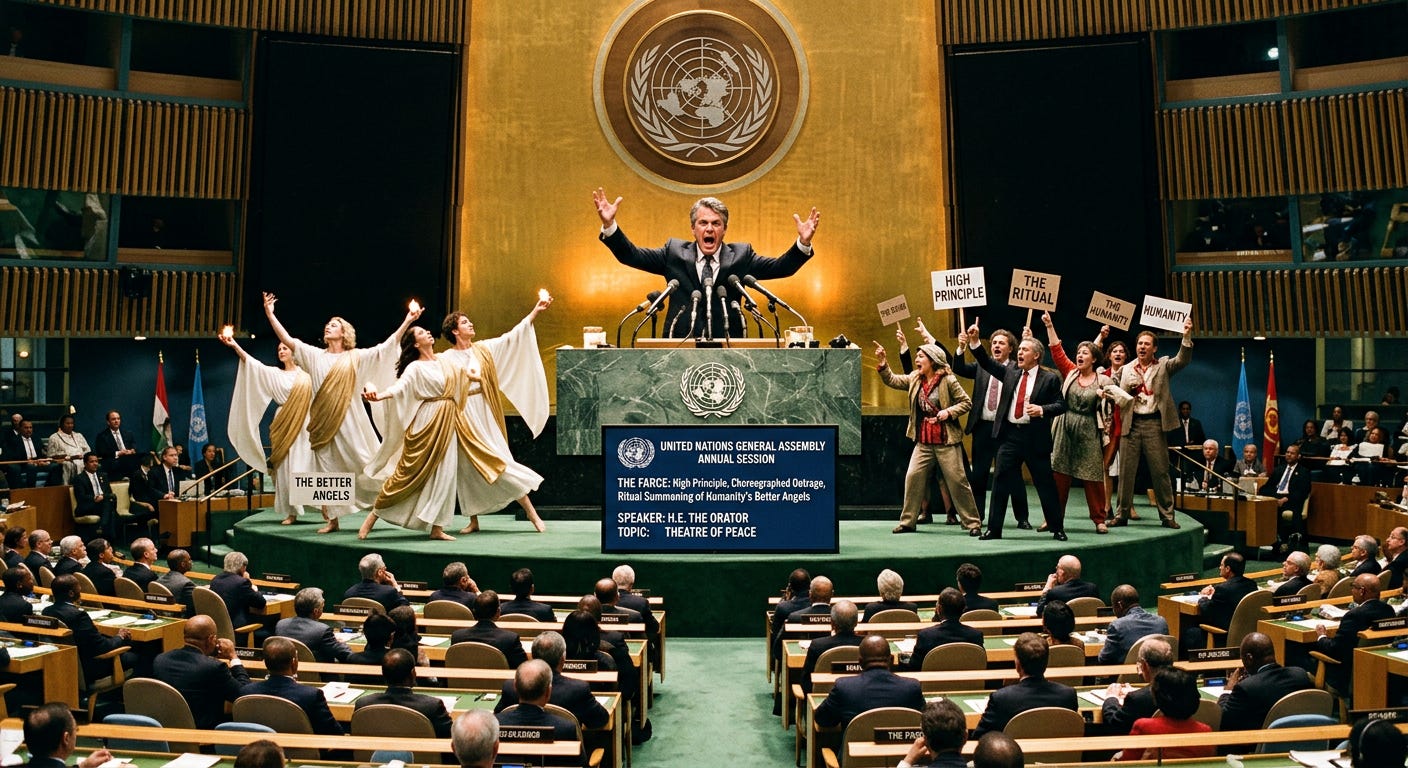
Perhaps this explains the peculiar atmosphere of the General Assembly. Every year, leaders fly to New York and perform sovereignty in front of one another. They speak of peace, justice, human rights, development, climate, security, international law, and humanity. They speak magnificent words beneath magnificent architecture, and then they return home to the infinitely less magnificent realities of national self-interest.
It is theatre. And it is tragic theatre. But it’s not only that. Words matter because words create norms; norms matter because norms create expectations; expectations matter because they constrain behaviour — at least sometimes. The tragedy is that we have gradually confused the performance of international legitimacy with the existence of international accountability. They are not the same thing. A system can produce an abundance of the former while remaining almost entirely devoid of the latter, and I would argue that this is increasingly the condition in which we find ourselves.
The juxtaposition this week was almost too perfect to invent. Donald Trump stood at the same podium and declared: “To the victor belong the spoils.” The following evening, Sánchez invoked the opposite principle — that the strength of law must replace the right of the strongest. There, in two sentences separated by a single day, was the entire argument about the future of the international order. Two communities of political thought: one says power creates legitimacy; the other says legitimacy must constrain power. The United Nations was supposedly created for the second task. But its architecture remains profoundly dependent upon the first. And perhaps that’s why the speeches sound increasingly disconnected from the world outside the building.
We can debate institutional design until the cows come home, but eventually abstractions acquire bodies. A dead child. A demolished hospital. A displaced family. A city reduced to rubble. Hostages. Refugees. A population being starved and slaughtered. This is where the language of international law ceases to be philosophical and becomes visceral.
Sánchez explicitly described Israel’s actions in Gaza as genocide and named Benjamin Netanyahu. Others reject that characterisation, including Israel, which has repeatedly denied allegations of genocide and argued that its military campaign is directed against Hamas rather than Palestinians as a people. The legal and political disputes surrounding that terminology are serious, and they deserve serious treatment. But something even larger is happening beneath the argument. The world is watching what happens when international institutions confront a conflict in which major powers have radically different interests. The world notices every time those institutions appear incapable of translating their principles into consequences. And every time another layer of credibility is stripped from the international order. The issue is therefore larger than Gaza. Gaza has become one of the places where the credibility of the entire system is being tested, in front of a global audience that is drawing its own conclusions.
Ukraine revealed another fracture of the same kind. The Charter prohibits the use of force against the territorial integrity or political independence of states, subject to narrowly defined exceptions. The General Assembly overwhelmingly condemned Russia’s invasion. Yet the Security Council could not impose collective action against Russia, because Russia itself is a permanent member with veto power. Again: the rule exists, the institution exists, the violation exists — and the enforcement mechanism collides with power while the world watches. None of this is necessarily an argument for abandoning the UN. It is, however, an argument for becoming intellectually honest about what the UN actually is and can legitimately do.
Perhaps that’s what we have been avoiding all these years. The United Nations is not the governing body of humanity. It’s an organisation of sovereign governments. That sounds like a semantic distinction; it isn’t. Governments pursue national interests and compete against each other in that regard. Humanity has no government, no army, no treasury, and no sovereign authority. Humanity has needs and aspirations. The UN has member states. And the gap between those two things is where much of our contemporary political dysfunction resides.
We have created planetary problems while retaining national institutions. A warming climate doesn’t recognise borders. Artificial intelligence doesn’t recognise borders. Cyberwarfare, pandemics, ocean degradation, financial contagion — none of them recognise borders. Yet our ultimate mechanisms of authority remain largely trapped inside territorial sovereignty. We’re trying to govern a planetary civilisation with eighteenth-century political containers. Not only is this futile, the mismatch is becoming dangerous in ways that compound with every passing decade.
So the question we should really be asking is not whether the UN is good or bad, nor whether we should abolish it, nor even why it doesn’t put an end to wars. The deeper question is this: what kind of institution does a planetary civilisation actually require? Because the world of 1945 no longer exists. The permanent members of the Security Council were selected according to the distribution of military and geopolitical power after the Second World War, and that world has changed beyond recognition. India has become the world’s most populous country. By 2050 a quarter of the world’s population will be African in origin.
The economic centre of gravity has also shifted dramatically. China has become a central global power. The Global South is increasingly unwilling to accept a world-system in which sovereignty is formally universal but influence remains profoundly hierarchical. And yet the constitutional skeleton of the international order remains remarkably resistant to the metamorphosis that’s required. We’re living in the present, with eyes on the future, while governing ourselves through the institutional assumptions of the past.
Perhaps the UN’s greatest failure is not what it has done. Perhaps it’s what it has prevented us from imagining. For eighty years we have treated the United Nations as though it were the destination of political evolution. It isn’t. It was a prototype — a magnificent, imperfect, historically vital prototype, but a prototype nonetheless. The little blue book was never the achievement. It was the promise: a promise that humanity might eventually develop institutions capable of placing law above power; that sovereignty would not become an excuse for barbarism; that human rights would not depend entirely upon geography; that war would cease to be the default instrument through which powerful states settled disputes; that humanity could somehow become more than the sum of its competing governments. We have spent eighty years congratulating ourselves for having come up with the promise. Perhaps it’s time to admit that we never finished building the institution capable of keeping it.
I don’t want the United Nations dismantled. I want something far more demanding: I want us to stop worshipping it. Institutions become dangerous when they become sacred, and the UN should be interrogated — its veto, its representational architecture, its financing, its accountability, its relationship with the great powers, its capacity to enforce international law, its very conception of sovereignty. Not because multilateralism has failed, but because it’s too important to leave trapped inside an architecture designed for another century.
Perhaps Sánchez was right. Perhaps we really are at a civilisational bifurcation point. But the choice is not simply between international law and the law of the strongest. There’s a third possibility: that we finally recognise the institutions we inherited were never designed for the world we have become — and then build something worthy of the world that is coming. Because I’m pretty sure the next generation won’t ask whether we gave enough speeches about peace, nor how eloquently we invoked the Charter. They will look backwards at this liminal moment and ask something much simpler: when we discovered that the architecture of our civilisation no longer worked, did we have the imagination to change it? That little blue book can’t answer that question. Only we can do that.