Our golden labrador, Myer, died today, quite suddenly. She was only six years old. When we lose someone we love, even if it’s only a pet, the feeling can be almost unbearable.
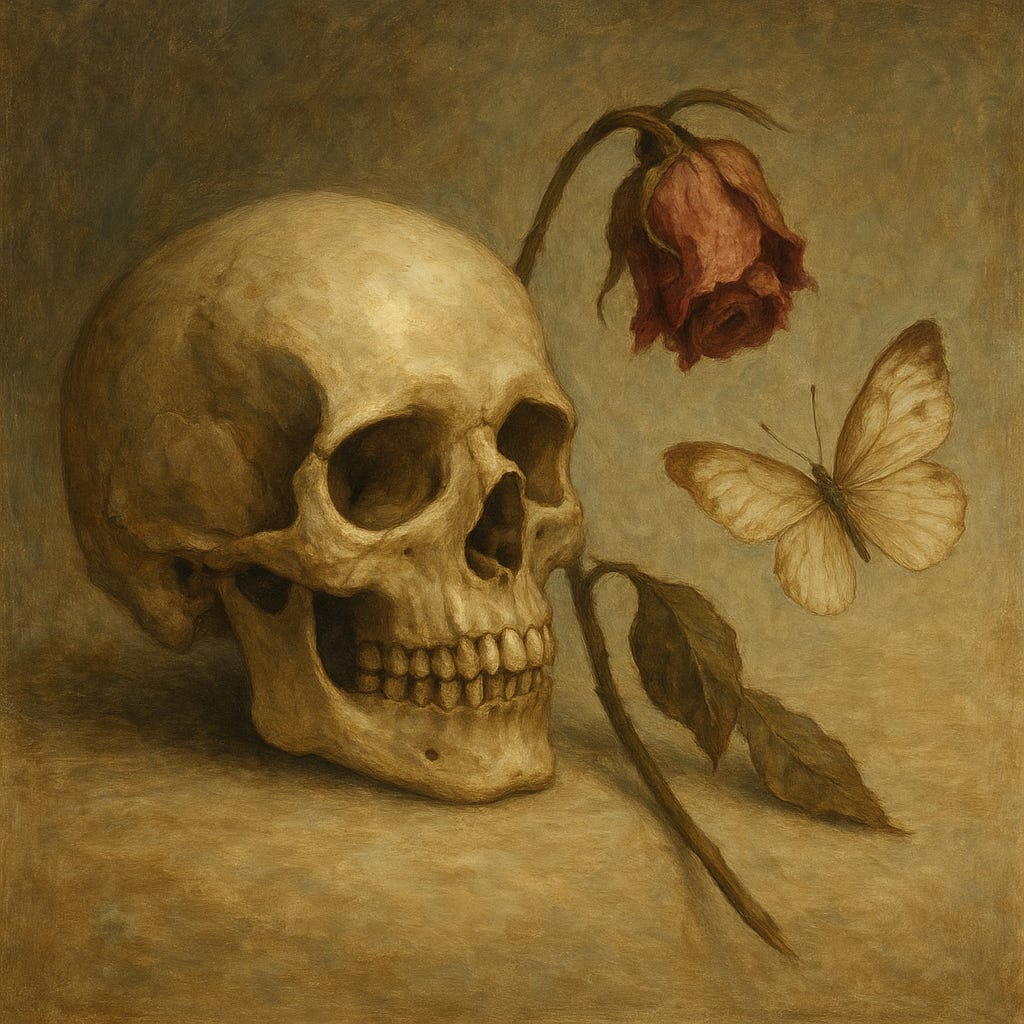
We inhabit a reality in which permanence is the greatest illusion. To live is to be transient, to journey across a fleeting arc from emergence into dissolution. Yet we construct edifices—relationships, careers, possessions—as though they might somehow shield us from impermanence. The paradox is that even in our most intimate moments, when we become acutely aware of love’s intensity or friendship’s warmth, we’re simultaneously brushing up against the inevitability of loss. It is in this juxtaposition that life reveals both its cruelty and its grace.
When death crosses our path—whether in the quiet passing of a cherished animal companion or the devastating loss of someone central to our identity—we are confronted with the surreal indifference of the cosmos. The sun refuses to dim in solidarity with our pain. Birds continue their morning chorus as if nothing has shifted. Traffic hums, markets open, strangers laugh. Existence, on the surface, flows unperturbed. Meanwhile, within us, a fissure has opened. In this rupture we glimpse an uncomfortable truth: the collective pulse of life is too vast to bend to individual sorrow, and yet it’s precisely our encounter with grief that reconnects us to that pulse in profoundly human ways.
Time, curiously, exhibits dual qualities in grief. In one breath it stops—the stillness heavy, oppressive, thickened by absence. Memories flood back not with gentle nostalgia but with an urgency that commands: this mattered. A wagging tail, the squeeze of a hand, the familiar timbre of a voice—small details gain monumental significance. Yet almost imperceptibly, time’s current resumes its flow. Routine insists upon itself: tasks, obligations, and commitments tug us forward. On the surface, this feels callous—a betrayal of what we cherish most. Yet perhaps this quiet insistence is less a betrayal than biology’s mercy, enabling us to keep faith with the living, to pull breath into our lungs even when it becomes a struggle to do so.
There is danger, of course, in becoming stranded—anchored to loss as though fidelity demanded paralysis. But life itself rejects such inertia. The universe is motion, ceaseless unfolding. To live is to move, and in movement the fabric of meaning is preserved. Moving on is not abandonment; actually, it’s integration. The person or creature we loved does not vanish into irrelevance; they are reconfigured as our companion in memory, woven into the evolving narrative of who we are becoming.
And as the edge of sorrow blunts, the world we once accused of indifference begins to reveal its healing constancy. Light once more falls through leaves in a way that feels generous. Laughter returns, tentative at first, then authentic. Seasons wheel, blossoms flare into being, and we begin to recognise that life’s continuity is not a mockery of our loss but its reconciliation. For transience is not merely tragedy—it’s the raw material of beauty. Without impermanence there could be no poignancy, no urgency, no wonder.
Those we have loved and lost remain irrevocably part of us. Whether a dog whose exuberant presence softened the harshness of our days or a friend whose counsel once tethered us to hope, they endure within our consciousness not as ghosts but as threads woven inseparably into our own becoming. Their absence refines our attention, reminding us that every shared glance, every fragment of joy, is precious precisely because it will pass.
Thus life teaches us its most difficult and most vital lesson: to live fully is to live knowingly within the ephemerality of being. To carry grief not as a burden that cripples but as a reminder that love is the force binding us to one another and to the fragile astonishment of existence. Loss does not sever that bond; it amplifies it. And so we walk forward—wounded, yes, yet also more awake—aware that we, too, will one day be woven into the timeless rhythm that continues long after we are gone.