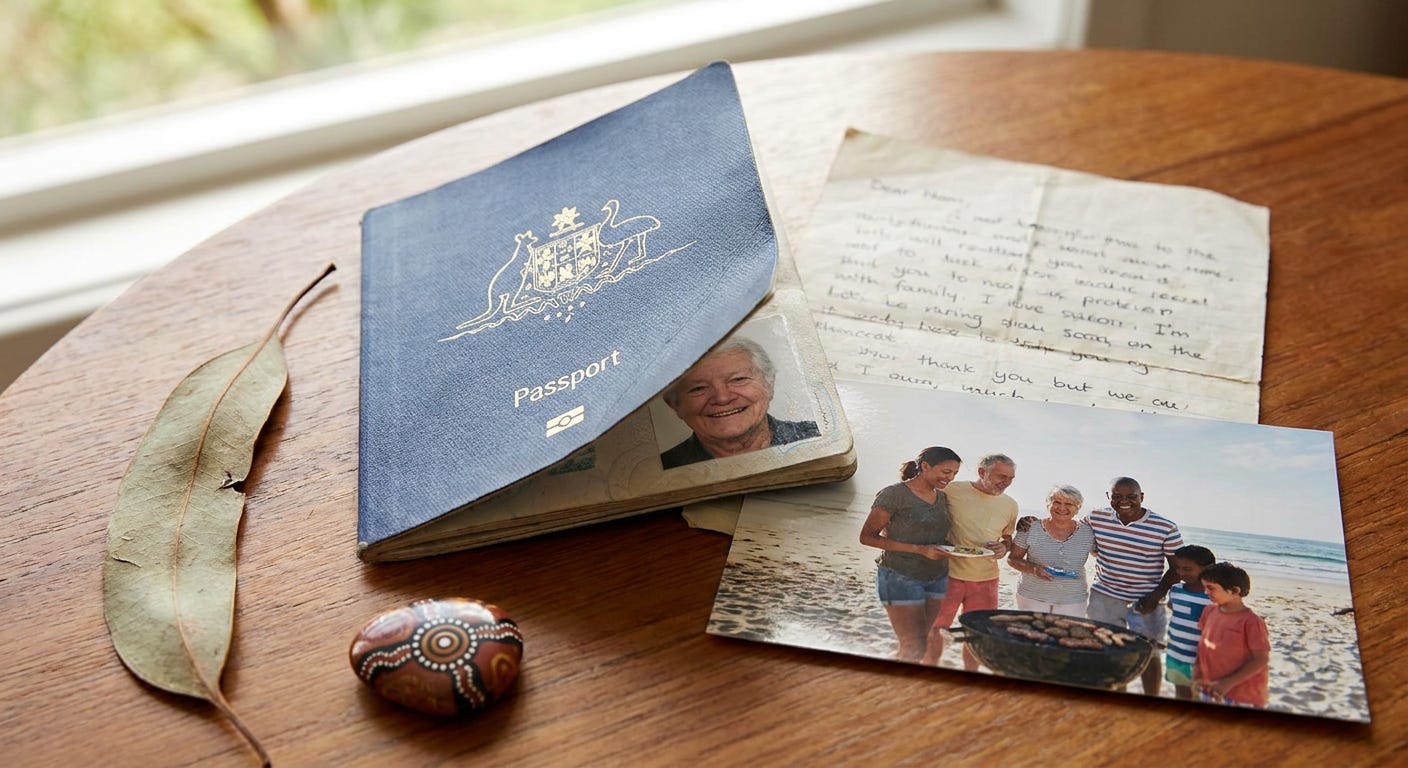
Today I collected my new Australian passport from the embassy here in Bangkok. It is, by any material reckoning, a modest thing — a small blue booklet of laminated pages, biometric data, and an unsmiling blandness of a photograph that flatters no one. Yet I held it with something close to reverence. Not for the artefact in my hands but for what it represents beyond the document itself.
I have lived and worked outside Australia for most of the last twenty years — across Southeast Asia; before that, in the cities that have shaped the particular kind of global thinker I have become. Bangkok, Shanghai, Paris, and Modena. In none of those places did I stop being Australian. In most of them, I became more so.
This is the first paradox of expatriate identity: distance often clarifies rather than erodes. The person who remains at home inside a culture absorbs it through daily immersion, rarely needing to name it, least of all challenge it. The person who leaves finds it crystallising precisely because it’s no longer ambient. You begin to notice the Australian in yourself the moment you encounter what you are not: the European weight of accumulated history, the American compulsion to perform nationhood loudly, continuously, as though belief requires constant renewal, and the Asian deference to hierarchy that operates beneath the surface of every social exchange. Against all of that, something specific in you sharpens. The directness. The instinct to puncture pretension. Ease with strangers. The ‘g’day’ and a smile that’s not a greeting so much as a small declaration — “I see you, I hold nothing against you, let’s begin from here.”
What I am not describing is patriotism in the conventional sense. That word has been captured — by politicians, by culture vultures, by the whole apparatus of managed nationhood that confuses a country with its government, its policies, and its reputation in the league tables of international competitiveness. Australian politicians across the spectrum have a particular talent for betraying the essence of the culture they claim to embody, substituting a thin civic inventory of so-called values, rights, obligations, and the architecture of the nanny state for the thick, uncodifiable temperament that actually holds the country together. You cannot write that kind of coherence into legislation. You can’t lecture it into immigrants at citizenship ceremonies. The moment you try to define it officially, it retreats.
The real Australia is horizontal, not vertical. It organises itself through the shoulder-to-shoulder logic of shared experience rather than through top-down instruction. Its foundational gesture is the informal one: the shelved formalities, the deflating joke aimed at whoever is taking themselves too seriously, the genuine interest in the stranger’s story. The larrikin tradition is not, as its critics suggest, simply anti-intellectual or anti-authoritarian. At its best, it’s a defence of the human scale against the inhuman one — a refusal to let power, status, or doctrine determine the worth of a person before you have actually spoken with them.
That disposition, carried into the world’s more stratified environments, is either profoundly irritating or profoundly liberating, depending on which side of the hierarchy you occupy.
Australia is a young country in ways that matter more than the calendar suggests. The geology is ancient, among the oldest on the planet, and the First Nations inheritance is deeper still — a civilisational presence measured not in centuries but in tens of millennia, carrying knowledge systems that industrial modernity has only recently begun to take seriously as knowledge systems rather than anthropological curiosities. But the modern national project is adolescent, still negotiating what it is, still without the finished story that older cultures mistake for wisdom.
That unfinished nature is, I have come to believe, one of Australia’s genuine assets. Europe carries its own grandiosity like a family heirloom — exquisitely beautiful, burdensome, impossible to put down. America performs itself into exhaustion, trapped inside a founding mythology that the country has been failing to live up to in various directions since approximately 1776. Australia hasn’t yet calcified into a fixed account of itself, which means it retains a certain permeability to the new, an openness that feels casual but runs structurally. The multicultural reality of contemporary Australian life — the genuine kinship across origins that you find in the cities as well as the bush and the instinctive curiosity rather than suspicion — is not the result of policy. It is the culture expressing its own deepest reasoning.
Pauline Hanson is still with us, One Nation still drawing its faithful, and Clive Palmer having reinvented himself yet again as Trumpet of Patriots — a name that manages to be simultaneously absurd and revealing. Peter Dutton campaigned his way to the loss of his own seat, taking the Coalition to its worst result in living memory. The party then elevated Sussan Ley as its first female leader — only to oust her nine months later, the conservative faction installing Angus Taylor in her place, as though the lesson of the election had been insufficient conservatism rather than terminal irrelevance. The Liberal Party, in other words, looked at the wreckage and decided to dig deeper into the rubble. The anxiety about immigration — the vain effort to preserve what remains of a British and European inheritance that was itself always a selective fiction — belongs to the same unease. Australia was never simply an outpost of the Home Counties transplanted to the antipodes. It became something else the moment the first settlers encountered a land and a people that refused to behave as the imperial imagination had scripted them. And then there is the weaponisation of language itself — the way certain labels get deployed not to name a thing but to end a conversation. I have been accused of antisemitism by people who read what they wanted to see rather than what I wrote. I raise it not for sympathy but because it is diagnostic. When a culture is under pressure, the first casualty is precision — words evacuated of their historical meaning and redeployed as instruments of closure, aimed at anyone whose analysis of power refuses the approved categories. The accusation becomes the argument. The label substitutes for the engagement. That is not moral seriousness. It is the adolescent’s last resort: if you cannot answer the question, discredit the person asking it. And yet, for all of this, the record primary vote for minor parties and independents is not a symptom of democratic decay. It is the horizontal culture declining, at last, to keep pretending that the vertical one is working.
All of these tensions – the nativist reflex, the collapse of the old political architecture, the immigration panic, and the degradation of public language – are real. But they are not signs of a country in decline. They are signs of a country in transition, which is a harder and more necessary condition. The adolescent doesn’t become an adult by resolving these tensions cleanly. The adolescent becomes an adult by moving through them with enough honesty to arrive somewhere genuinely new.
What Australia has that most nations its age do not is the raw material for exactly that arrival. The First Nations wisdom that industrial modernity is only beginning to hear. The multicultural weave is already producing, in the cities and increasingly beyond them, a genuinely new kind of human community — not the melting pot of the American fantasy, which dissolved difference into a single performed identity, but something more like a living braid, each strand distinct, the whole stronger for the distinction. The geographic position that places it at the intersection of the world’s most consequential century. And underneath all of it, the horizontal temperament — the instinct for the human scale, the discomfort with unearned authority, the ‘g’day’ to the stranger — that is, if anything, the quality the world most needs modelled right now.
The world’s first truly global nation is not a destination Australia has reached. It is a possibility Australia has not yet refused.
In my work I have sat in rooms across Asia, Europe, the Middle East, and beyond – advising governments, corporations, intelligence services, and institutions of every scale and disposition – and what travels with me, what people register before they have quite identified it, is something recognisably Australian in the way I engage. Not the accent alone, which reveals my English schooling and upbringing rather than the distinctive Australian twang. Something in the register: the absence of ceremony, the willingness to say the thing that the room is thinking but hasn’t found permission for, the preference for the precise observation over the elegant equivocation. Global in the substance, Australian in the tone. These are not in tension. Indeed, the tone is part of what makes the global work credible.
There’s a concept in philosophy of mind that distinguishes between “knowing that” and “knowing how” — propositional knowledge and the embodied, procedural kind that lives in gesture rather than a statement. Cultural identity of the deepest sort is of the second kind. You don’t carry Australia around as a set of propositions about what Australians believe or value. You carry it as a way of moving through life, a default setting in your engagement with other people, and a reflex toward the egalitarian and away from the hierarchical that operates below the threshold of conscious decision.
I am more Australian outside Australia than I am when I am home, partly because the contrast illuminates what home actually is, and partly because the exercise of living in the world has clarified which parts of the inheritance I actually wanted to keep. Not all of it – no culture hands you only treasure. The tall poppy syndrome in its defensive register, the occasional parochialism, the reluctance in certain quarters to claim intellectual ambition without apology. Those I have set aside with some gratitude for the distance that made the setting aside possible. What remains – the warmth, the directness, the instinct for the human scale, the discomfort with unearned authority – these I carry without embarrassment, through every room, on every continent, in every conversation that matters.
The passport expires in a decade. What it represents does not expire at all. My heart still leaps when I board a Qantas flight. My spirit still soars when I watch the Wallabies play their hearts out for yet another loss to the All Blacks. My body visibly unwinds when I land in Melbourne after nine hours in the air — not the relaxation of arrival so much as the relaxation of recognition, the particular ease of being somewhere that requires nothing of you by way of explanation. You are already understood here, in the cellular way, before you have opened your mouth. The taxi driver calls you, mate. The barista doesn’t ask how your day is going as a formula; she actually wants to know. The sky is that specific Australian blue, ruthless and clean, that no other latitude quite produces. None of this is nationalism. It is something older and quieter — the body’s memory of where it was made, persisting across every border crossed, every departure lounge, every foreign city that became briefly home. You carry your country the way you carry your mother tongue: not as an ideology, but as the deepest layer of how the world sounds when it makes sense.