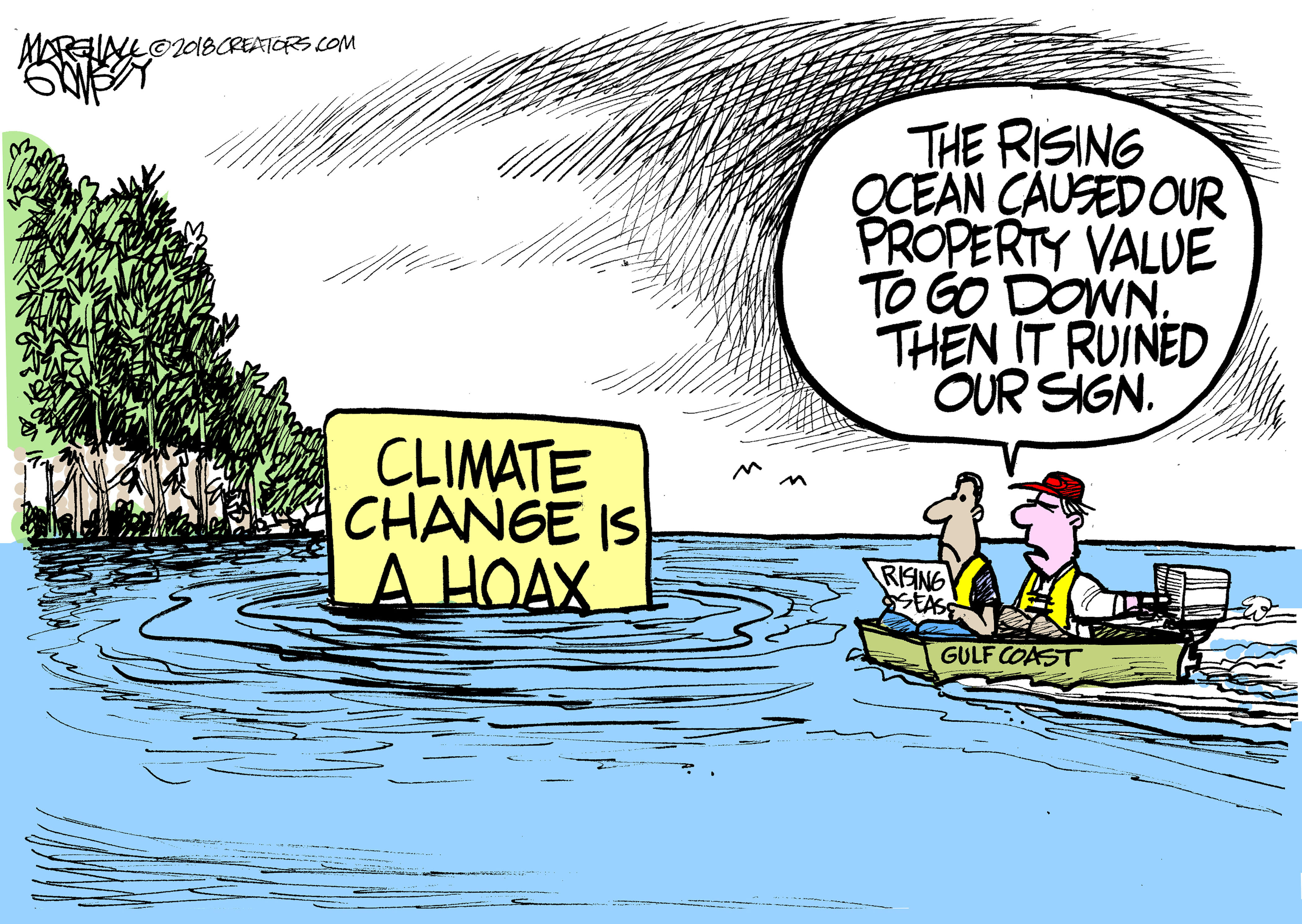
In recent years, as the world's leading climate scientists have united around increasingly alarming evidence of human-induced (i.e. anthropogenic) warming, a curious document has emerged bearing the signatures of over 1,900 individuals who, despite lacking largely meaningful credentials in climate science, possess an almost supernatural confidence in their ability to overturn decades of rigorous research conducted by thousands of the planet's most qualified experts.
The "World Climate Declaration" assembles what one might charitably describe as an eclectic collection of contrarian voices, including such luminaries as the Viscount Monckton of Brenchley—a figure whose scientific credentials appear to derive primarily from his aristocratic title rather than any demonstrable expertise in atmospheric physics. The inclusion of such colorful characters among the declaration's "ambassadors" suggests either a delightfully postmodern approach to scientific credentialing or something rather more desperate in the realm of intellectual legitimacy.
The timing proves instructive too. As the scientific foundation for understanding human-caused climate change has solidified into what represents an unprecedented consensus across multiple disciplines, we encounter a fascinating sociological phenomenon: the emergence of a counter-narrative so divorced from empirical reality that it suggests either profound ignorance of basic atmospheric physics or something rather more calculating.
Among the signatories, I recognize at least one particularly blithe professor whose research endeavours happen to enjoy the generous patronage of Australia's wealthiest mining magnate. This confluence of interests—extractive industry profits and scientific scepticism—creates what systems theorists recognize as a perfect example of a feedback loop of motivated reasoning. I admit that I wouldn't trust this particular gentleman to distinguish correlation from causation in a children's science fair project, let alone to overturn the collective wisdom of the global climate science community.
The spectacle of nearly two thousand individuals, including a couple of Nobel laureates whose expertise lies in fields such as quantum physics and semiconductors rather than atmospheric science, rallying against the overwhelming consensus of actual climate scientists creates a curious inversion of democratic reasoning. The inclusion of these prestigious names reveals a particularly cynical exploitation of scientific authority—leveraging Nobel credentials earned in entirely unrelated fields to suggest climate science remains legitimately contested among "top scientists." This represents the intellectual equivalent of recruiting Gordon Ramsey to dispute medical consensus or enlisting Taylor Swift to overturn findings on species extinctions.
In science, truth emerges not through popular vote but through rigorous methodology, peer review, and reproducible results. Yet here we witness an attempt to establish scientific legitimacy through sheer numerical audacity and borrowed prestige—as if collecting enough signatures from unqualified individuals, however distinguished in irrelevant domains, could somehow counterbalance the methodical work of thousands of credentialed experts publishing in peer-reviewed journals.
The declaration's central propositions reveal a stunning disconnect from observable reality. Its authors assert that natural factors primarily drive current warming trends, apparently unaware that climate scientists have spent decades meticulously parsing natural from anthropogenic forcings. The fingerprint of human influence on climate systems has become as unmistakable as a signature written in the atmosphere's chemical composition—yet these contrarians gaze upon this evidence and see only natural variability.
The cognitive dissonance reaches its apotheosis in the organization's very name: the 'Global Climate Intelligence Group.' This either represents a masterpiece of unintentional satire or evidence that the English language has evolved beyond recognition. When 'intelligence' encompasses the systematic rejection of empirical evidence in favour of ideologically convenient conclusions, we may need to update our dictionaries.
Perhaps even more remarkably, they claim that global warming proceeds more slowly than predicted by climate models. This assertion requires either selective amnesia regarding the accuracy of climate projections over the past several decades or a creative redefinition of the word "prediction." Climate models, though not perfect, have demonstrated remarkable accuracy in forecasting observed trends, a fact that becomes inconvenient only when one's livelihood depends upon fossil fuel extraction continuing unabated.
The declaration's treatment of atmospheric carbon dioxide as unqualified "plant food" betrays the sort of mechanistic reasoning one might expect from individuals whose understanding of complex systems appears frozen somewhere in the early industrial age. This charmingly reductionist perspective—akin to declaring that because humans require water to survive, flooding represents an unqualified good—reveals minds apparently incapable of grasping that Earth's climate operates as an integrated system rather than a collection of isolated variables responding independently to human manipulation. While plants do indeed utilize CO₂ for photosynthesis, the declaration's authors appear blissfully unaware that the same greenhouse effect driving photosynthesis also drives ocean acidification, extreme weather intensification, and the disruption of precipitation patterns upon which agriculture depends. It's rather like praising the nutritional benefits of sugar while ignoring diabetes—technically accurate in isolation, catastrophically myopic in context.
The denial of increasing natural disaster intensity requires a particularly creative relationship with observational data. As insurance companies—those pragmatic assessors of risk—adjust their models to account for climate-driven increases in extreme weather events, our collection of 1,900 contrarian voices somehow perceives no statistical trends whatsoever. One wonders whether they apply similar analytical rigour to their personal financial planning.
The scientific consensus this group seeks to overturn is almost unprecedented in the history of human knowledge: agreement among 97–99.9% of actively publishing climate scientists regarding the reality, causes, and dangers of human-caused (anthropogenic) climate change. This level of consensus exceeds that found around theories of evolution, germ causation of disease, or the spherical nature of Earth. To dismiss such convergent evidence with a counter-petition of largely unqualified signatories requires either extraordinary new data or extraordinary hubris—the declaration provides abundant evidence of the latter while remaining mysteriously silent on the former.
What emerges from examining the declaration's signatories is not merely demographic curiosity but a perfect case study in how declining hegemonic systems recruit intellectual legitimacy. Retired engineers displaced by renewable energy transitions, physicians seeking relevance beyond their clinical expertise, economists wedded to growth paradigms that planetary boundaries have rendered obsolete—this coalition represents not scientific dissent but the gathering twilight of institutional authorities whose expertise has been superseded by evolutionary necessity. This coalition reveals something profound about how entrenched interests mobilize intellectual cover for economically motivated positions.
The broader phenomenon reveals something telling about how human consciousness responds to existential challenges. When confronted with evidence that threatens deeply held assumptions about progress, growth, and humanity's relationship with natural systems, some people retreat into elaborate forms of denial rather than grapple with the implications of planetary boundaries. The World Climate Declaration represents this psychological defense mechanism scaled to institutional proportions and dressed in the borrowed robes of scientific authority.
Yet possibly the most telling aspect of this contrarian chorus lies not in what it asserts but in what it reveals about the robustness of legitimate climate science. The fact that decades of well-funded attempts to discredit climate research have produced only this assemblage of marginal figures making increasingly desperate claims serves as inadvertent testimony to the strength of the scientific consensus. When the best criticism mining money and aristocratic eccentricity can muster amounts to science-fair-level analytical rigour, the underlying climate research must be extraordinarily solid indeed.
The net-zero emissions targets these contrarians oppose with such vehemence represent, at minimum, a necessary first step toward maintaining climatic conditions compatible with organized civilization—though many scientists now argue that only 'real zero' emissions, without the accounting gimmicks and dubious offset schemes that often masquerade as climate action, can achieve the regenerative outcomes planetary stability demands. Their opposition to even these modest policy frameworks reveals the ultimate stakes: not merely scientific accuracy, but the preservation of economic arrangements increasingly incompatible with a stable climate and continued human flourishing. The World Climate Declaration thus functions less as scientific discourse than as a fascinating artifact of institutional resistance to evolutionary necessity—a relic from an era when planetary boundaries remained safely abstract rather than urgently practical constraints on human activity.
Perhaps most tellingly, these contrarians position themselves as defenders of 'sound science' while systematically ignoring the accelerating pace of climate impacts that have begun outstripping even the most alarming projections. Their declaration arrives not as cutting-edge analysis but as a relic from a rapidly receding era—rather like receiving urgent telegrams about the impossibility of heavier-than-air flight delivered by commercial aviation.
From an entertainment viewpoint, this curious document unwittingly does serve an unintended purpose: it demonstrates the lengths to which entrenched interests will go to preserve systems that have reached their evolutionary limits. Yet the most chilling aspect of this enterprise lies not in what they've already accomplished, but in their stated ambitions. The Global Climate Intelligence Group has announced its intention to provide "solicited and unsolicited advice on climate change and energy transition to governments and companies worldwide."
One can only imagine the quality of guidance that awaits unsuspecting policymakers from an organization whose analytical capabilities wouldn't survive scrutiny at a children's science fair. History will most likely remember these 1,900 climate contrarians not as bold truth-tellers but as a cautionary tale about what happens when ideology masquerades as expertise on a planetary scale.