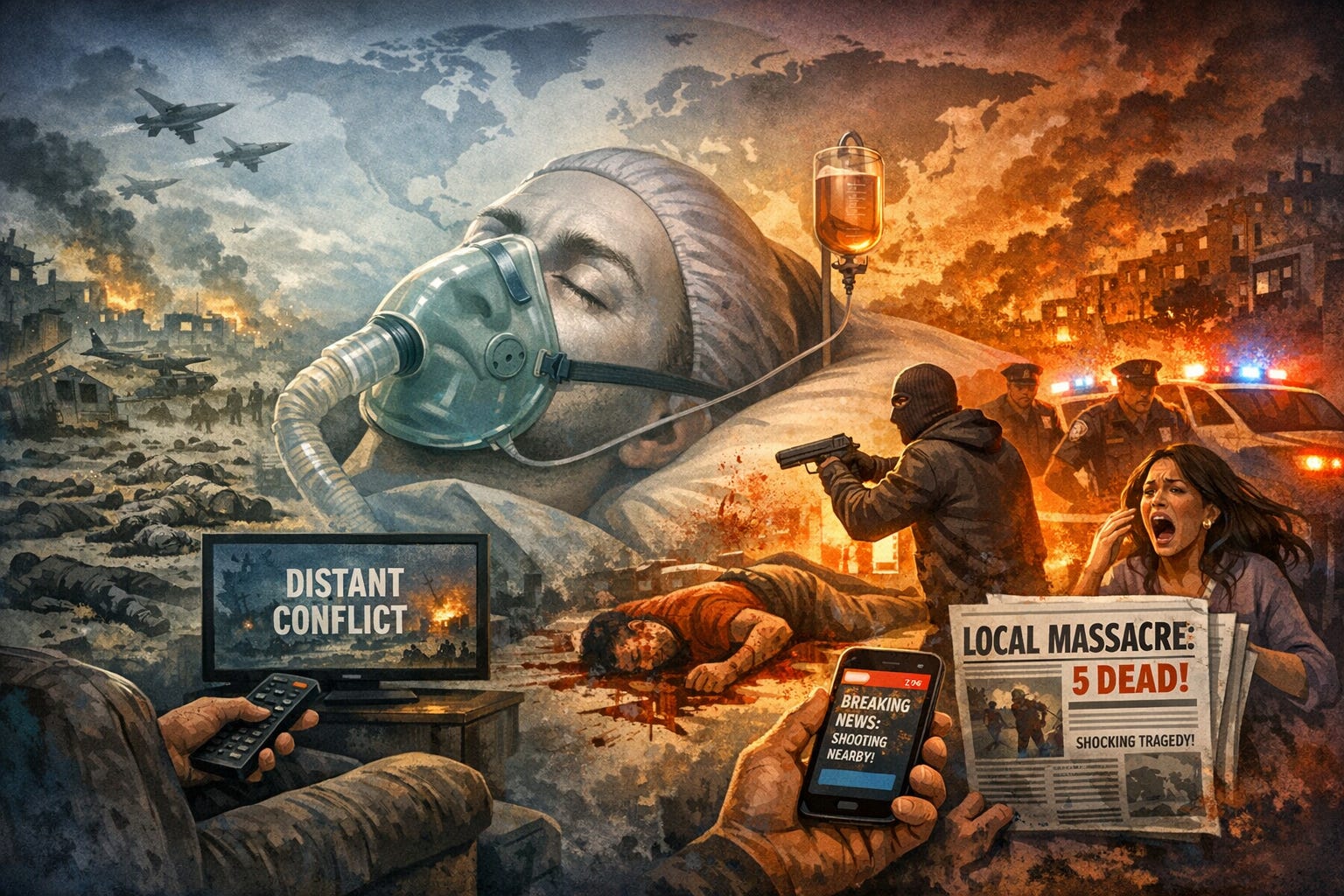
There is a test you can run on yourself, and it takes less than a minute.
Imagine that twenty people have been killed in a mass shooting in your city. Hold that in your mind — the news alerts, the candlelight vigils, perhaps weeks of political reckoning. The headline that won’t go away. Now imagine that the same government that runs your city has just authorised an airstrike that killed two hundred people in a country you have never visited. Feel the difference in your nervous system. Notice which one you would call a crisis.
If you are like most people living in the imperial core — in the United States, in Britain, in Australia, in France — there’s a good chance the first scenario activates something deep and visceral in you, while the second lands somewhere quieter, somewhere more abstract. You may feel concern. You may feel some sense of outrage. It will pass. You won’t feel it the way you feel twenty dead in your city. And here’s the question that should follow: ‘why not?’
The standard answer is proximity. People feel more for those who are closer to them, both tangibly and ideologically. This is a feature of human psychology, not a moral failing. We evolved in small groups. Our nervous systems were calibrated for local threat and local grief. Some discount on distant suffering is built into us.
But this explanation, while true, is insufficient. Because the gap between how we respond to proximate and distant murder is not just a matter of evolutionary psychology. It has been carefully and systematically widened. The anaesthesia is not natural. It has been administered.
Industrial economism — the civilisational operating system that has governed the West for three centuries and has spread more or less globally since the turn of this century — requires, as a condition of its functioning, that certain populations be rendered abstractly grievable and others concretely grievable. The citizens of the imperial core must feel the weight of their own losses with full human specificity while registering the losses of those at the imperial periphery as a different order of event — closer to the background condition, to the cost of doing business. Without this asymmetry, wars could not be prosecuted. Weapons could not be sold. Strategic interests could not be maintained. The whole architecture depends on a population that is morally activated in one direction and morally sedated in the other.
This state of affairs doesn’t require central planning or conscious design per se. It’s the emergent property of a thousand interlocking systems — media ownership structures that make some deaths visceral and others statistical; educational cultures that teach imperial history as tantamount to civilisational progress; political discourse that frames foreign policy as strategy rather than as deliberate killing; and a class of public intellectuals who have learned, through long professional conditioning, that calling a war a mass murder is somehow less respectable than calling it a foreign policy challenge. The anaesthesia is administered daily, in small doses, by systems that have no need to know they are doing it.
The result is a citizenry whose moral urgency is systematically misdirected. Not extinguished — people in the imperial core are not morally inert. They care, often passionately, about injustice. They march for healthcare, for climate, for the rights of minorities and the dignity of the marginalised. These are real concerns and they deserve to be fought for. But they are fought for within a perceptual frame that’s been quietly pre-structured to make the mass murder intelligible as something else — as geopolitics, as security, as an unfortunate necessity — while keeping domestic grievances coherent as moral emergencies requiring urgent action.
The friend group that organises a fundraiser for a colleague’s medical bills, marches for disability rights, and argues passionately about representation in mainstream media — but says nothing, collectively, about the bombing of hospitals in countries their taxes help to arm — is not a collection of hypocrites. It would be unfair to label them as such. They are the product of a very effective system of propaganda. The anaesthesia is working.
But here’s where the argument must go further than the political, because this is not only a civilisational problem. It’s a personal one.
To maintain the dissociation — to keep the knowledge of the killing at arm’s length, to file it under geopolitics rather than murder, to feel the appropriate twinge of concern and then return to your life — requires ongoing psychological work. It’s not a neutral act. Something happens to you when you perform it, again and again, across the decades of a life spent inside the imperial core.
The philosopher Simone Weil wrote that attention is the rarest and purest form of generosity. To attend to something, in her sense, is to hold it in your awareness without flinching away from its full weight. The anaesthesia of empire is, among other things, a training in the withdrawal of attention — a long education in what not to see, what not to feel, what not to follow through to its full human implication. And like all training, it changes the trainee.
People who have learned to look away from industrial-scale killing carried out in their name don’t look away only from that. The capacity to maintain double standards of grief — to feel the full weight of proximate death and the diminished weight of distant death — does not stay neatly contained to the domain of foreign policy. It bleeds. It warps the instruments of moral perception. It habituates us to accepting official framings as adequate, to trusting the language of power over the testimony of those power has harmed, to mistaking the map for the territory in precisely the domains where it matters most.
The same epistemological habits that make an educated Westerner able to read about a drone strike killing a wedding party and return to their morning coffee are the habits that make them susceptible to every other form of official misdirection. The anaesthesia is a general-purpose tool. Once the practice of looking away is well-established, it can be applied to anything inconvenient.
And underneath the looking away, something more troubling: a slow erosion of the self that comes from knowing, somewhere, what one is refusing to face. The knowledge doesn’t disappear because it’s not attended to. It sits. It exerts a kind of underground pressure. It festers. People who carry unsung knowledge of crimes committed in their name tend to develop a brittleness, a defensiveness, a particular irritability when the subject arises — not the irritability of people who have faced something traumatic, but the irritability of people who are working to avoid facing it.
The wars and the genocidal atrocities now clear to anyone with an internet connection are not only a moral emergency for the people dying in them. They are an invitation — which is too gentle a word, but let it stand — to recover something that the imperial operating system has been steadily taking from us.
The recovery is unpleasant. It doesn’t begin with policy proposals or electoral strategies. It begins with something much more elemental: the willingness to let the deaths land with the weight they actually carry. To refuse the mental arithmetic that converts a hundred dead children into an acceptable strategic outcome. To notice, and to refuse to normalise, the internal gesture of re-categorisation that moves killing from the column of moral emergency into the column of geopolitical complexity.
This is what moral urgency actually requires of us — not the performance of outrage, not the ritual denunciation, nor the constantly expressed concerns and hand-wringing, but the sustained willingness to remain awake to the full human weight of what’s being done. To not let the anaesthetic take hold. To insist, against the grain of every system designed to prevent it, on feeling what there is to feel.
There’s no authentic relationship with reality that doesn’t pass through this. There’s no serious analysis of what’s wrong with our civilisation that exempts the killing from the indictment. And there’s no recovery of the moral gravity our moment demands that doesn’t begin with the decision to remain conscious while the empire administers its dose.
I know this from the inside.
I was seventeen in October 1962, sitting in a British classroom surrounded by boys from families whose fathers still spoke of empire without embarrassment — whose ancestors appeared in the kind of portraits that hang in the kind of halls that teach you, without a word being said, that civilisation has a natural direction and you are standing on the correct side of it.
When the Cuban Missile Crisis arrived in that room, my classmates anxiously applauded the Americans. It was reflexive, barely conscious — the way you support your own side when the whistle blows. Kennedy was one of us; Khrushchev was not. The geography was settled before the argument began.
But I found that I trusted Khrushchev more. Not out of any sympathy for the Soviet system. Out of something colder and more instinctive than that: the sense that he was the one describing reality more accurately. He said he would withdraw the missiles if the Americans pledged not to invade Cuba. That was a rational offer from a man who wanted a way out. The Americans, it seemed to me, wanted the crisis more than the resolution. My classmates couldn’t hear this. They had been conditioned not to.
Above the blackboard there was a map of the world, and the British Empire was still marked across a third of it in pink. All the pink bits. We had been taught to see them not as conquest but as stewardship, not as extraction but as civilisation carried outward by people who knew best. The map was the first dose. The classroom was the dispensary. And the lesson being delivered — beneath the official curriculum, beneath the dates and the treaties and the great men — was that some deaths matter and others were just the cost of keeping the pink bits pink.
That cold clarity — the sense of seeing something the room was organised around not seeing — was the beginning of a growing disenchantment. What I couldn’t articulate then, but have spent decades since trying to describe, is that what I was witnessing was the anaesthetic being administered in real time, to people I knew, by a system so confident in itself it didn’t need to hide what it was doing.
The other boys weren’t stupid. They weren’t cruel. They were dosed. And the system had almost worked on me too.
Almost. The anaesthesia is optional. Which is precisely what makes choosing it, day after day, so damning.