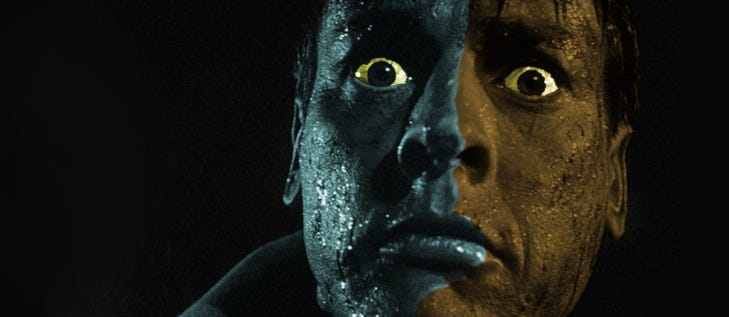
In the movie Invasion of the Body Snatchers, the horror was never the alien. It was the moment a face you knew — a wife, a neighbour, the man who sold you groceries — kept every facial feature intact while something behind the eyes went missing. The film worked because it withheld a diagnosis. You never learned the mechanism. You only watched the town empty out from the inside, one familiar face at a time, until pointing at your neighbour and screaming became the only rational act left.
A psychiatrist watching Gaza has reached for that film to describe eight million Israelis. Dissociation, she says — a survival mechanism turned pathology, a whole population that has severed action from conscience and found comfort in atrocity. The “human” part remains. The moral compass has been replaced by something cold and efficient. What’s left, she writes, is a collective degradation so deep it defies belief.
It’s a serious argument made by someone trained to notice suffering. On that basis alone it deserves to be taken seriously enough to be examined rather than taken for granted.
Dissociation, clinically, is what one nervous system does when a specific threat exceeds what a specific mind can hold — memory splits from affect and self splits from body. The dissociation is involuntary, protective, individual. Scale that word to a nation and it stops describing a pathology. Instead it becomes decoration: a professional vocabulary borrowed to dress a verdict that was reached before the diagnosis was written. No population shares a nervous system. No population dissociates in unison. What can be said in unison is only ever an average, and averages are where the individual citizen vanishes — which is precisely the disappearing act the argument accuses its subject of performing.
Such a diagnosis effectively does to eight million people exactly what it accuses them of doing to Gaza’s children. It stops seeing them.
Hundreds of thousands filled Israeli streets in a nationwide strike this August, demanding the war end and the hostages come home. More than a hundred thousand reservists have simply stopped showing up for call-ups, some citing exhaustion, some citing conscience, one telling a journalist he refused an order to burn a family’s home because they would one day come back to it. A former prime minister has written, in an Israeli newspaper, under his own name, that his country is committing war crimes. A former army chief of staff has accused his successor’s soldiers of executing a campaign of ethnic cleansing. None of this fits inside a finding of collective soullessness. So the diagnosis simply doesn’t mention it. An argument that has to delete its counter-evidence to survive isn’t describing a society. It’s fabricating one, out of the bits that were useful.
This is an old blueprint. Cast a population as having lost its soul, its conscience, or whatever the era’s vocabulary supplies, and every member becomes interchangeable with its worst actor, guilty by membership rather than by act. The same design has been pointed at Jews with lethal frequency across centuries. That history doesn’t forbid criticism of a state’s conduct, but it should make anyone reaching for whole-population soullessness check which door they’ve just walked through, because the door doesn’t care what side of a conflict you’re standing on when you use it. The Hutu radio that called Tutsi neighbours cockroaches wasn’t describing insects. It was performing the removal in language first, so the removal in fact would feel like housekeeping.
Hannah Arendt is invoked in the original argument and then, oddly, contradicted by it. Her unsettling discovery in Jerusalem wasn’t that Eichmann had been drained of all morality by some alien force. It was that he hadn’t been. Ordinary faculties, intact conscience, functioning empathy for the people in his own dining room — all were present, all were compatible with organising deportations, because the atrocity ran through distance and paperwork and incrementalism rather than through any special void where a soul should be. That finding of banality was far more disturbing than demonic possession, not less, because it left no population exempt by constitution. Only a body snatcher requires an alien. Eichmann required nothing but an office and a schedule.
What actually explains a society’s capacity to look past children under rubble is duller than possession and harder to escape. Distance from the act, information curated by people with an interest in curating it, decades compressed into slogans, threat framed as permanent and existential until every response reads as survival rather than a choice create the conditions needed for that to happen. That mechanism runs on infrastructure, not metaphysics — and it’s not a mechanism unique to one government, one war, or one people. It is available everywhere there’s a population, a screen, and a story convenient enough to stop asking what the screen is leaving out.
The movie, you will recall, ends with the last human left standing in the street, pointing at the crowd, screaming the truth, and being taken for the one who’s changed. That was the warning. Not that his neighbours might be hollow. That the certainty of having spotted it is itself worth diagnosing.