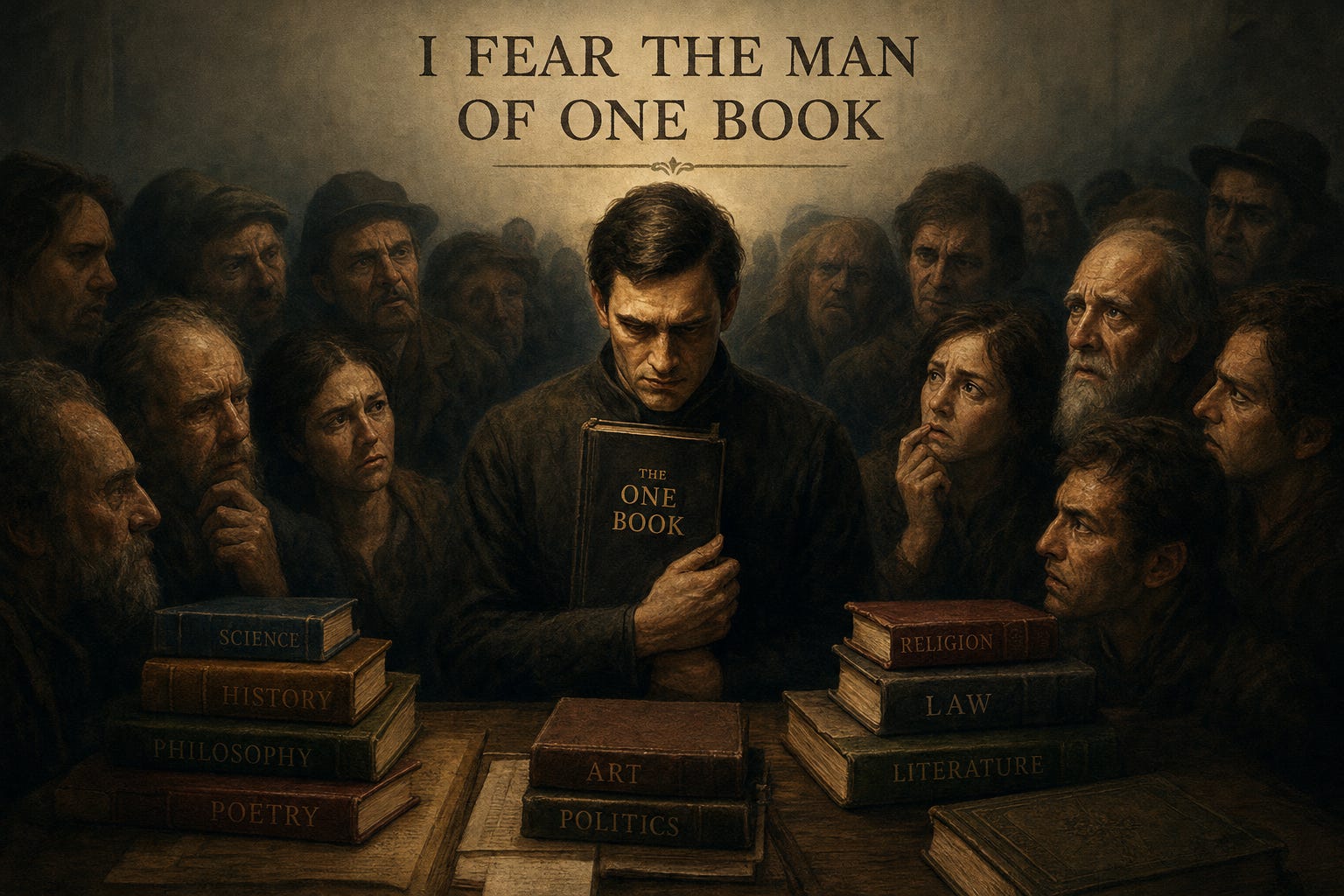
There’s a phrase attributed to Thomas Aquinas — although whether he coined it or inherited it, nobody can be entirely sure — that’s survived eight centuries without losing a gram of its unnerving precision. Timeo hominem unius libri. I fear the man of one book.
Aquinas, if he did say it, was almost certainly not talking about himself. He was the most voracious synthesiser of his age — a man who read Aristotle and Augustine and Averroes and Maimonides and wove them together into an architecture of theological reasoning so comprehensive it took centuries to deconstruct. He was afraid of the person who had stopped there. Who had found one source, and only one source, sufficient to explain everything. Who had in fact mistaken the termination of their own curiosity for the outer boundary of available truth.
The phrase has been domesticated over the centuries into a harmless piece of wisdom about intellectual breadth — a reminder to read widely, to avoid ideological silos, and to seek out perspectives that challenge your assumptions. All of this is true, yet none of it is the point. The point is sharper and stranger and, if you sit with it long enough, genuinely difficult to absorb without a certain light-headedness.
The man of one book is not just narrow. He is threatening in a very specific way: he has found certainty. And certainty, in a complex and irreducibly ambiguous world, is always a form of savagery against reality – a refusal to remain open to what the world is actually doing, what it’s actually saying, what it might actually require. The single book, held as adequate, doesn’t just limit understanding. It actively excludes it. And the exclusion is, by design, immune to correction — because any evidence that might correct it can be dismissed as coming from outside the authorised text.
What I have always found extraordinary — and I use that word in its most precise sense, meaning genuinely difficult to account for — is that this dynamic, which Aquinas was apparently already worried about in the thirteenth century, remains not simply present but dominant eight centuries later.
We are a species that has split the atom, sequenced the genome, sent machines to the surface of other planets, composed symphonies, and developed mathematical frameworks for describing the curvature of spacetime. We have produced thinkers of such rigour and reach that their work takes lifetimes to fully comprehend. We have, in short, demonstrated beyond any reasonable doubt that our cognitive apparatus is capable of engaging with reality at a depth and precision that would have seemed miraculous to any previous generation.
And yet. A significant majority of human beings alive today organise their grasp of the cosmos, of ethics, and of their obligations to one another and to the living world around texts written between two and four thousand years ago by people who didn’t know that the Earth orbits the Sun. Texts that are held to be not only wise — wisdom accumulated across generations is a different matter and genuinely valuable — but also divinely authored, which is to say, final, complete, and beyond the scope of the kind of interrogation that produced every other form of understanding we possess.
I find this astonishing. I have found it astonishing for most of my adult life — and the astonishment began earlier than that. Somewhere in my early teenage years, something shifted. I became sceptical of the one-book syndrome before I had a name for it: the precise quality of certainty. I encountered people whose understanding of the world had been sealed inside a single authoritative source and who seemed, paradoxically, less troubled by the complexity of reality than everyone else. I understood, dimly at first and then with increasing clarity, that the absence of any deep-seated concern was the problem. That the questions the sealed book didn’t raise were precisely the ones worth asking. That suspicion cost me some comfort and changed the course of my life, and I have never regretted either.
I find it no less astonishing today, which perhaps says something about the inexhaustibility of the phenomenon. It’s not that I find the people who hold these beliefs unintelligent — many of them are demonstrably brilliant. The history of theology, for example, contains some of the most rigorous intellectual work ever done, precisely in the service of making one particular text coherent with itself and with observable reality. It’s that I find the initial step of declaring any text immune to fundamental questioning so structurally bizarre, yet so consequential, that I can’t look at it without a kind of incredulous fascination.
The move has a logic, of course. It always has a logic. The logic runs something like this: the universe is vast, human understanding is limited, and the questions that matter most resist empirical methods entirely. In that vacuum, a source claiming authority beyond human limitation looks like an answer. The hunger for that kind of authority is real. The questions it responds to are real. The comfort it provides is real.
But notice what the logic requires you to do. It requires you to accept, as a precondition of the comfort, that a certain text — this one, not that one; this version, this interpretation — has a status that places it outside the domain of ordinary human investigation. And it requires you to accept this not because the text has earned that status through the kind of sustained engagement with evidence and argument that we use to establish the credibility of every other claim about reality, but because the text itself, or the tradition that grew up around it, asserts the status.
This is the shift that produces the man of one book. Not the reading of a text, not the deep engagement with it, not even the organising of a life around its precepts — all of these can coexist with genuine intellectual openness. The dangerous step is the declaration of exemption: this text is not subject to the same scrutiny as other texts, these claims are not subject to the same standards of evidence as other claims, and these questions are not open questions. The book is closed. Not in the sense of being finished, but in the sense of being sealed.
What the sealed book produces, historically and presently, is a particular kind of mind: highly capable within its authorised domain, genuinely sophisticated in its internal reasoning, and structurally blind to anything that can’t be expressed in the vocabulary the text provides. A mind that can produce exquisite commentary on a passage about mercy while remaining unable to perceive the institutional cruelty being conducted in the name of the doctrine the passage supports. A mind that can reason with great precision about the nature of the divine while remaining immunised against the most basic question: how do you know? The response to which is invariably one of having faith, which neatly sidesteps the question.
And here the phenomenon deepens into something even more curious. A significant portion of the people guided by the one book have not, in any serious sense, read it. They carry its authority without its content — shaped by a tradition of interpretation, by the teachings of intermediaries, by the ambient cultural pressure of a community organised around the text’s supremacy, but largely unacquainted with what the text itself actually says. The book need not be read to be sealed. The authority operates independently of the knowledge. Which means that what’s being defended, in many cases, is not even a text but a posture — an orientation of certainty whose object is almost incidental.
That immunisation is the key. Science, philosophy, history — all self-correcting in principle, because all treat questions as open and evidence as binding. The sealed book inverts both conditions by design.
The errors of the sealed book are not self-correcting, because the framework explicitly places its foundational claims beyond the reach of the mechanisms that would correct them. Error, in this system, is not a signal that the foundational claim might be wrong. It’s a signal that the interpretation needs adjustment, or that the believer needs more faith, or even that the questioner is in the grip of forces hostile to the truth.
This is a remarkably robust architecture for the preservation of belief in the absence of evidence. It is also, from the perspective of a species trying to navigate genuinely complex and genuinely urgent conditions, a catastrophe. Not because the beliefs themselves are necessarily harmful in every case — some of them, detached from their claims of exclusive authority, contain real moral wisdom accumulated over centuries of human social experience. But because the epistemic posture they require — the declaration of a domain immune to questioning — is precisely the posture least suited to the conditions we now face.
Those conditions are complex in the technical sense: they involve the interaction of multiple systems across multiple scales in ways that produce emergent behaviour that no single framework, however ancient and however sophisticated, has the categories to describe. What they require is not certainty but the disciplined maintenance of openness – the willingness to keep questioning, to keep revising, to keep following the evidence wherever it leads even when it leads somewhere uncomfortable.
Aquinas, who spent his life in the service of a sealed book, somehow also produced a phrase that identifies the sealed book as the thing most worth fearing. This is either a profound irony or profound self-awareness, and I am genuinely uncertain which. Perhaps both. He was, after all, a man of many books — someone who knew that even the most authoritative text required the friction of other texts to yield its meaning. Perhaps what he feared was the loss of that friction. The mind that has stopped arguing with itself. The certainty that no longer needs to earn its confidence.
Eight centuries later, that fear seems entirely warranted. We’re a species of extraordinary cognitive scope as well as a demonstrated appetite for sealing ourselves inside frameworks that place our most consequential beliefs beyond scrutiny. The astonishment this produces in me has not diminished with familiarity. If anything, it has deepened — because the cost of that appetite, measured in the quality of thinking available to us at the moment when the quality of thinking most urgently matters, has never been more visible.
Timeo hominem unius libri. The fear is not of the book. It is of what we do to ourselves when we decide that one book is enough.