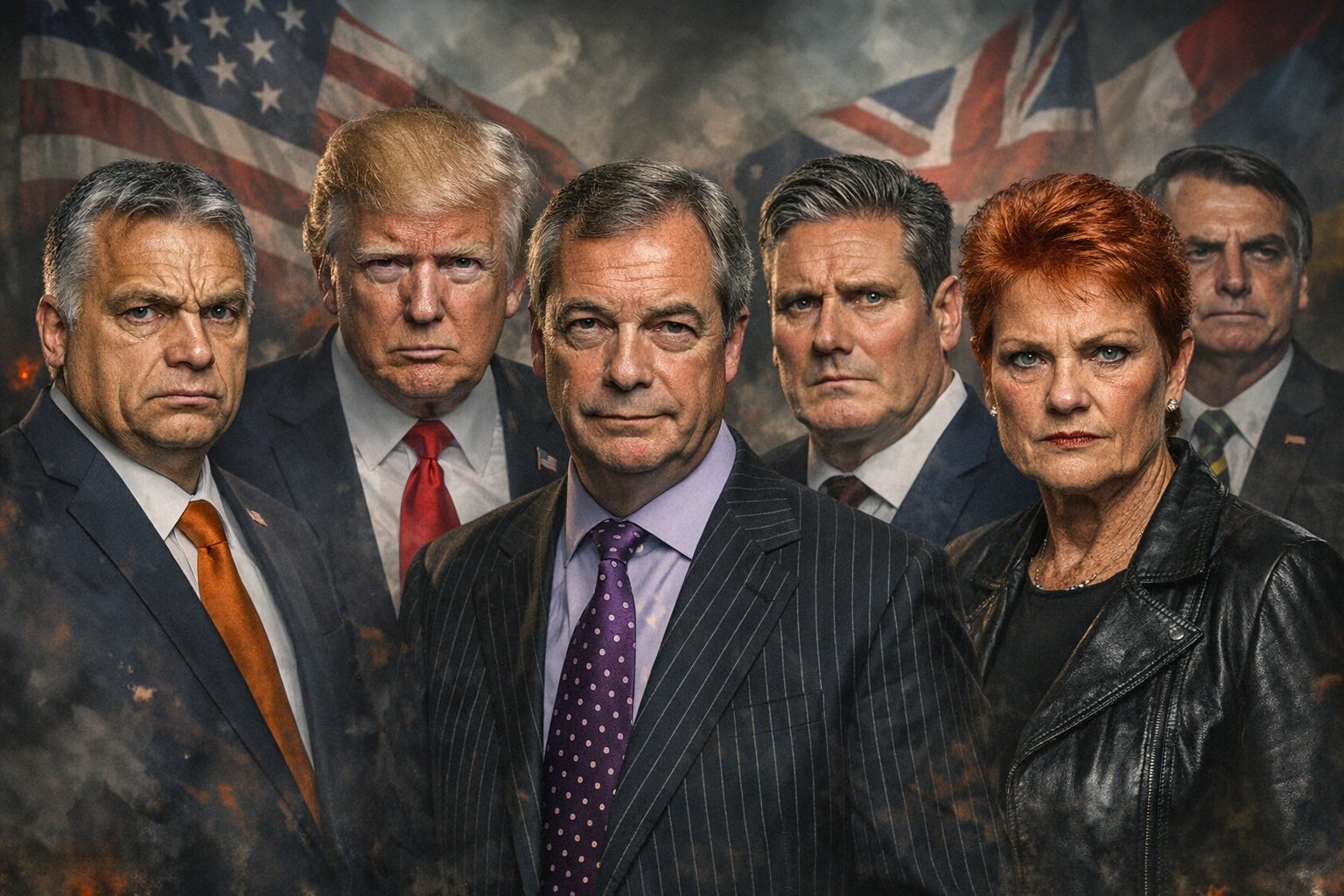
There’s a particular syntax running through the political patois of the West right now. It surfaces in different accents, different suits, and different media ecosystems — yet the underlying grammar stays eerily consistent. You will have no difficulty identifying its most accomplished current practitioners. Not because anyone coordinated it. Because it works. It activates something in the listener that feels like acknowledgement, like, finally, someone is naming what you already suspected to be true. The trick, of course, is that what you suspect has been carefully planted there first.
But here’s the complication that makes this dangerous rather than simply rhetorical: truth. The empire really is in a state of collapse. Not metaphorically. Actually. The post-war settlement is unravelling. The economic models that held the Occidental order together are exhausted. Institutional legitimacy is draining away. The assumption that tomorrow will be materially better than today — that quiet article of faith that underwrote the whole post-war enterprise — has quietly expired. This isn’t an invention. It’s an observable fact.
Which is precisely what makes the syntax so lethal. Because the rhetoric doesn’t merely describe the collapse; it weaponises the dread the collapse generates by attributing it to causes that can supposedly be eliminated through the will of a single saviour. And once that attribution has taken hold — once people believe the crisis was caused by malevolent actors rather than structural exhaustion — the anxiety becomes actionable. It acquires direction, targets, and permission. It becomes justification for extraordinary leadership. It becomes the emotional precondition for granting one person the power to fix what’s broken.
The collapse is verifiable. The explanations for it are manufactured. And the belief that a great man can reverse it is the trap.
The post-war Occident constructed itself on a particular economic logic: industrial production, resource extraction, debt-fuelled growth, and the perpetual expansion of consumption. That logic is no longer generating the material conditions it once promised. The factories have moved or automated. The resources are depleted or climate-inaccessible. The debt has compounded past serviceable levels. Growth has decoupled from wage increases or meaningful welfare improvements for the majority. This is not a crisis of management. This is the exhaustion of a model — the end of an order. And the apparatus built to administer that model — parliaments, central banks, regulatory bodies, the diplomatic machinery of the post-war settlement — is increasingly perceived as an obstacle to adaptation rather than an instrument of it, precisely because it is still trying to manage a model rather than replace one.
The Occident is experiencing something that ascending powers in the Global South and East largely are not: the disorientation of decline. Not catastrophe, not quite yet. But the reversal of the assumption of forward motion is the loss of the civilisational confidence that the future belongs to you. In other regions, material conditions are improving, institutional confidence is accumulating, and the future feels like something being earned. In the Occident, the future feels like something being taken away. That reversal generates a particular species of dread: not fear of immediate threat, but fear of irrelevance, displacement, and a world in which you no longer matter.
Into this genuine crisis strides a particular rhetoric. Not an argument. Not a policy platform. A structured pattern of language — a way of organising perceptions, of making certain things clearer and others less visible, and of converting diffuse anxiety into focused terror by offering an explanation for the collapse that points toward culprits and a knight in shining armour. And once that terror has been established and directed, it becomes the organising principle of everything that follows.
This pattern operates across five interconnected moves, each designed to deepen the dread and narrow the range of responses that seem plausible. Each move also steers you toward a particular fantasy: that the problem can be solved by someone with sufficient will. That leadership — extraordinary, unconstrained, the leadership of a Great Man — can reverse what structural exhaustion created. The fifth move asks you to complete that fantasy yourself.
1. DISSOLUTION
The nation, the society, the system is not merely struggling; it is broken. Not repairable through adjustment or reform or the ordinary machinery of electoral contest — broken. The choice of word matters because it generates a particular emotional compound: fear alloyed with hope. A broken thing cannot be fixed by ordinary means; it can only be reconstructed by someone with the will to do so. And that generates terror — the terror that everything you have built your life within is no longer salvageable unless someone seizes it and rebuilds it from the ground up.
What the move does is collapse causation into civilisational amnesia and transform that amnesia into dread. You are not invited to ask how this happened or what specific policies created the present condition. Those are the questions of someone still trapped in the ordinary political world — someone who still believes the situation can be managed through ordinary means. The listener who has already accepted this first move is standing outside that world, looking down at it with a mixture of pity and contempt. Of course the stewardship structures failed. They were always going to fail. They are broken. And if they are broken, you are unprotected — unless someone powerful enough steps in.
That is the fear being activated, and alongside it, the fantasy being planted. Not fear of specific threats alone, but fear of being unguarded paired with the hope that someone extraordinary might guard you. The rhetor is not claiming the apparatus has failed at particular tasks; the claim is that it has lost its capacity to function at all, and therefore only an individual from outside it — unconstrained by its failed logic — can remake what is lost.
Here is where the self-fulfilling mechanism begins. When enough people believe the system is beyond repair, they withdraw cooperation from it. That withdrawal is not a neutral political choice; it’s a panic response coupled with the anticipation of rescue. They stop engaging with institutions as though they matter. They stop investing energy in reform. Capital, attention, hope and allegiance migrate toward whoever promises protection. The very machinery that might have adapted begins to deteriorate faster because it’s being starved of the participation and good faith that keep complex systems functional. The prophecy fulfils itself. The rhetoric was describing a genuine fragmentation of the economic model, but the description — by framing that fragmentation as total bankruptcy and generating the dread that follows — accelerates the institutional deterioration by converting belief and terror and hope into behaviour.
2. INVASION
Into this hollow, broken nation — this place where you are unprotected and in need of someone strong to defend you — something foreign is pouring. Not arriving through immigration policy or labour markets or the ordinary circulation of peoples across borders; those are mechanisms, and mechanisms can be discussed, managed, and contested through democratic processes. No: invasion. The word carries the weight of military threat, sovereignty violated, and something fundamental at stake. The stranger is not simply different; the stranger is an aggressor. You need a leader strong enough to fight back.
This move is designed to transform diffuse apprehension into focused terror. The dissolution move created a vague sense of being unprotected. The invasion move gives that vagueness a shape, a target, a mission. And it performs something particularly cunning along the way: it collapses a heterogeneous population — asylum seekers, economic migrants, refugees, people of different ethnicities or religions already living in the country for generations — into a single, unified threat. The linguistic collapse of distinction produces a perceptual one. You stop seeing individual humans with individual circumstances and begin seeing the invasion. All difference becomes menace; all menace becomes singular; all singular menace becomes equivalent to military aggression.
The terror being activated is primal. It’s the fear of invasion, of one’s home being violated, of the dissolution of the distinction between inside and outside, safe and unsafe. The amygdala doesn’t distinguish between invasion and immigration policy. Once the word has been spoken and accepted, the nervous system responds as though under actual assault.
But migration into the Occident is genuinely increasing. The pressures are tangible — climate displacement, economic desperation, and political upheaval in peripheral regions. Again, the rhetor is not lying about the phenomenon; the rhetor is stripping away the structural conditions that drive it and replacing them with intention. Instead of attending to the exhaustion of resource-dependent economies, the destabilisation of regions through military intervention, and the climate stresses that are making certain territories progressively less habitable – instead of any of that, the syntax attributes migration to malevolent will or institutional negligence. Someone chose this. Someone allowed this. Someone is doing this to you.
And when significant portions of the receiving population begin to live in a state of activated threat response, they behave accordingly. Welcome is withdrawn. The infrastructure of integration — housing, language training, employment pathways, and community solidarity — erodes because it is now narrated as collaboration with invasion, as betrayal. Migrants, faced with this hostility, cluster together for protection rather than dispersing into the broader society. The very fragmentation the invasion narrative predicted materialises — not because an invasion was occurring, but because the belief in invasion, and the fear that belief generated, transformed behaviour in ways that produced real social fracture. Each news story about migration reactivates the terror. Each instance of social friction — friction created by the fear and the withdrawal of integration — becomes evidence that the fear was justified all along.
3. ABANDONMENT
The apparatus of power — government, the courts, the bureaucracy, the metropolitan classes, the professional middle, and the stewardship order itself — has allowed this to happen. Or worse, orchestrated it. The people who were supposed to guard the nation have opened the gates. They have chosen their comfort, their ideology, and their peculiar loyalties over your welfare. They have left you unprotected. They have betrayed the nation itself.
This move does something that transforms dread into rage, and rage into the willingness to accept extraordinary measures. It deepens the fantasy of the saviour by contrasting him with the failed establishment. The dissolution move generated the fear of being unprotected. The invasion move identified the external threat. The abandonment move identifies who is responsible for your vulnerability. It is not an accident or circumstance. It’s a betrayal. It is not negligence; it’s a choice.
This move operates simultaneously on two frequencies. At one level, it’s making a political claim that can be interrogated, debated, tested against evidence — and there is substance to it. Elites have often prioritised certain interests over others. The gulf between governing classes and the constituencies they purport to represent is genuinely widening. Regional economies have been hollowed out. The sense of abandonment in post-industrial towns is not invented. The apparatus did fail to adapt or redistribute when the post-war economic model began showing strain. That is not a conspiracy; that is institutional attenuation.
But the move also operates at a deeper register, activating something older than ordinary politics and more volatile: a story about insiders and outsiders, about the corruption of guardians, about the moment when those in power cease to protect you and become your enemies instead. It transforms policy failure into moral failure. And it makes the fantasy of the outsider saviour psychologically irresistible. Your fear is not paranoia; it’s a rational response to deliberate abandonment. And the only person who can rescue you is someone the establishment fears — someone they cannot control.
Here is where the rhetoric performs its crucial substitution: it replaces the question. Why is this happening? Who did this to me? The shift from cause to culprit is the shift from analysis to blame, and blame is more emotionally satisfying than analysis. Blame tells you that this did not have to happen. Blame tells you that someone chose your abandonment. And once you have identified who betrayed you, you are ready to embrace anyone — anyone at all — who promises to punish them and protect you.
When large numbers of citizens believe the stewardship order has abandoned them, they withdraw legitimacy from those structures in a particular way. They stop viewing them as worth defending or participating in. They stop sending their children into public service. They stop believing that working through channels produces change. They begin to organise outside the apparatus and wait for the outsider who will remake everything. The stewardship machinery, deprived of this circulation of talent and good faith, becomes less responsive, more brittle, and actually does begin to hollow out. The abandonment narrative was describing a genuine sclerosis. But by framing that sclerosis as a malevolent choice and generating the rage that comes with that framing, it accelerates the withdrawal of cooperation that transforms attenuation into genuine deterioration. The rhetoric was diagnosing the disease accurately, but by prescribing the Great Man as the cure, it deepened the pathology.
4. AWAKENING
The nation must wake up. It must reclaim itself. There is still time, but only if you recognise what’s happening and act. The recovery of something lost — a remembered identity, a former greatness, a stolen future — becomes possible, but only through a particular kind of will. Only through choosing the right leadership. Only through the one person strong enough to break the rules and remake what is broken.
This move offers relief from the accumulated dread and makes the fantasy concrete. The three preceding moves have generated cascading layers of terror — of being unprotected, of external assault, and of deliberate betrayal. The awakening move does not resolve that terror; it redirects it toward a saviour. It says: the terror is real, but here is someone who understands it and will act. And that someone is not the apparatus. That someone is the Great Man who stands outside it.
Notice the particular temporal and psychological magic at work here. The nation has not declined; it has been put to sleep. It has not lost its essence; it has forgotten it temporarily. ‘Awakening’ implies that the vital thing remains dormant, latent, waiting to be recalled. You are not being asked to accept loss; you are being invited to restore what was stolen. There is a deep conservatism in this move, even when it wraps itself in revolutionary language. What you are being asked to join is not a departure into unknown territory but a return to home. This is psychologically powerful precisely because it suggests the solution requires no difficult choices, no new thinking, no genuine acceptance of loss. It requires only the right leader. Someone strong enough to push past the corrupted establishment and give back what was always yours.
The fear is still operating beneath this move. It has not been dispelled; it has been weaponised. Fear is now the justification for extraordinary action. Fear is now the reason normal rules no longer apply. Fear is now the permission structure for accepting a leader who operates outside ordinary constraint. The awakening move is not an answer to dread; it is the conversion of dread into a mandate. Your fear is justified, and here is someone who will act on it without hesitation or restraint.
5. COMPLETION
The fifth move is the one you must complete yourself. And this is where the rhetoric reveals its true architecture. Once dissolution, invasion, abandonment, and awakening have been established, an inescapable conclusion presents itself: someone must seize power back. Someone with the will. Someone unconstrained by old rules, old pieties, old compromises. Someone who speaks as if the normal conventions of political discourse do not apply — because, by the logic of the syntax, those conventions created the catastrophe and cannot possibly resolve it.
You have not been persuaded to vote for a particular candidate. You have been positioned – linguistically, perceptually, neurologically – to complete the fifth move yourself. To conclude that extraordinary measures are justified because you are afraid. That the ordinary constraints on executive power have become obstacles to survival. That the preservation of procedural democracy is a luxury the nation can no longer afford because the threat is too great and the fear too consuming. And that only a great man operating outside ordinary constraint can fix what is broken.
The rhetoric doesn’t require you to articulate any of this. It requires only that you act as if it were true. Vote for the figure who speaks outside the rules. Defend the leader who dismisses procedural restraint as weakness. View those who counsel caution or institutional constraint as collaborators with your enemies. View those who speak of distributed governance and collective adaptation as part of the establishment that betrayed you. You have been moved from observation to active participation in the unravelling of the very constraints that distinguish democratic governance from authoritarian consolidation — and you have been moved there through fear and through a fantasy.
But crucially — and this is the final sleight of hand — you are not accepting authoritarianism. You are accepting protection. You are not abandoning democracy; you are choosing someone who will keep you safe. The fear has been so carefully cultivated, so thoroughly validated, and so completely integrated into your sense of what’s real, that you experience the extraordinary measures not as loss but as necessary defence. The fantasy has been so carefully constructed that you believe it.
The rhetoric works so well because it answers something you are already feeling. Civilisational collapse is occurring. The industrial economic order that structured the post-war world is visibly exhausted. The stewardship structures built to manage it are ossified and increasingly unresponsive to actual conditions. The assumption of progress has been replaced by an assumption of decline. These are tangible anxieties, not invented ones.
And they are frightening. The uncertainty is not abstract; it’s your job that might disappear, your neighbourhood that’s changing, and your future that feels stolen. The rhetor is not lying about any of this. The rhetor is describing it accurately and then naming the dread you are already carrying.
This is what makes the syntax so lethal. It doesn’t create fear from nothing. It identifies fear that is already present – fear generated by genuine collapse – and gives it a shape, a direction, a target. And it offers a fiction to go along with that fear. Your fear is not pathological; your fear is recognition. Your fear is seeing clearly. And then it redirects that recognition toward particular culprits (migrants, the establishment, internal enemies, those who won’t fit in) and offers a particular remedy (the great man, the strongman, the one who will act without restraint) when the actual causes of the collapse are structural and cannot be eliminated through any individual will.
Here is what makes this most dangerous: the rhetoric solves the problem of structural exhaustion by offering a fantasy that cannot work. Systemic exhaustion is psychologically unbearable. It leaves you with nobody to blame and nothing concrete to do. You cannot fight exhaustion; you cannot defeat it; you cannot eliminate it through force. You can only adapt to it; accept it; grieve what is irretrievably lost — and engage in the difficult, distributed, collective work of building something genuinely new. But that is intolerable for most people when they are afraid. The great man fantasy offers relief from that intolerable burden. It says, ‘You don’t have to do the hard work.’ You don’t have to accept loss. Someone else will fix it. Leave it to me.
The rhetoric transforms the unbearable (exhaustion without remedy, collapse without saviour, and the requirement to adapt collectively without certainty of success) into the actionable (betrayal that can be punished, invasion that can be repelled, and a broken system that can be remade by the right person with sufficient will). And in doing so, it moves you to accept extraordinary measures and embrace the fantasy at the exact moment when such leadership is precisely what cannot work.
It is also particularly effective because it operates beneath the level of factual dispute. You can argue about immigration rates, stewardship performance, and the actual causes of economic distress. But the rhetor is not making factual claims in any conventional sense. The rhetor is organising your emotional reality and offering you a fiction. By the time you begin fact-checking individual assertions, you have already accepted the frame within which facts are supposed to make sense. More critically, you have already accepted the dread as legitimate, as the correct way to respond to reality. The frame has done its work. The fear has been installed. The fantasy has taken root.
When a person perceives themselves under threat, cognitive processing narrows. The amygdala activates. The prefrontal cortex — the region responsible for deliberation, nuance, and the weighing of competing values — recedes. You become primed to adopt simple remedies from trusted sources, less inclined to interrogate claims or sit with alternatives. Your emotional state becomes the primary filter through which information passes. Evidence that confirms the fear is embraced; evidence that contradicts it is dismissed as denial or complicity. And there is something about the Great Man fantasy that makes it particularly resistant to interrogation: it offers what distributed governance and collective adaptation cannot – certainty, strength, and relief from responsibility.
The rhetoric deliberately sustains this neurological state. And once sustained, you become more receptive to the fifth move: that extraordinary measures are justified, that procedural constraints are luxuries, and that loyalty to the leader who promises to protect you outweighs loyalty to abstract principles of governance. The fear is not a side effect of accepting the rhetoric; the fear is the purpose of the rhetoric. It is what moves you from passive observation to active participation. And the Great Man fantasy is what makes you willing to surrender the practices that allow you to govern yourselves.
What makes it catastrophic now?
Several things converge. First, there is a genuine crisis of meaning in the Occident. The grand narrative that held the post-war order together — progress, development, the steady accumulation of material comfort and democratic rights — has become increasingly difficult to sustain. Growth has stalled in any meaningful sense. Stewardship legitimacy is collapsing. Whatever moral authority the West might once have held has eroded. This is not separate from civilisational collapse; it is part of it.
In the absence of a compelling alternative narrative that helps people imagine a different kind of flourishing — one that doesn’t depend on the restoration of what cannot be restored and doesn’t require a Great Man to make it happen — the rhetoric of crisis fills the void. It offers an explanation for why the old story no longer works (because someone broke it) and permission for extraordinary action (because the threat is too great). It transforms the crisis of meaning into a crisis of security, then offers a saviour to address the security threat.
Second, the technologies of circulation have changed. This rhetoric propagates at speeds and scales that were impossible a generation ago. A speech can be clipped, distributed, amplified through algorithmic pressure, and absorbed into the ambient political atmosphere within hours. You encounter the five moves not as a coherent argument but as environmental pressure – fragments that accumulate into a worldview, experienced not as persuasion but as recognition. And you encounter it in a constant state of low-level activation. The dread is never resolved; it is perpetually refreshed.
Third, there is something substantive about the crises being addressed. The economic models that structured the post-war Western order are genuinely worn out. Migration pressures are verifiable. Stewardship sclerosis is observable. What is invented is the attribution of cause — to malevolent actors, conspiracies, and invasions — and what is invented is the remedy: the idea that cause can be eliminated through the will of a single leader. The rhetoric channels genuine distress toward a particular kind of political response — one that tends toward the concentration of power in a single person, the erosion of procedural constraint, and the subordination of institutional autonomy to executive will. And it does this by saying, ‘This is the only way to protect you from what you should be afraid of.’ This is the only person who will do what needs to be done.
What distinguishes this moment from previous periods of stewardship stress is that the rhetoric is not merely describing disintegration. It’s accelerating it – through the systematic cultivation of dread and through the promotion of a Great Man fantasy that actively forecloses the distributed, collective adaptation that’s actually necessary.
In previous periods, political discourse could exaggerate stewardship failure or mobilise anxiety without triggering the self-reinforcing loops that now occur. The Occident’s stewardship order is today operating on much thinner margins, already starved of the cooperation and good faith that keep complex systems functional. The rhetoric arrives not into a stable order that it then destabilises, but into a system already fragmenting. In that context, each deployment of the five moves triggers those loops. Civic participation declines because people believe the apparatus is broken and are waiting for the Great Man to remake it. Integration becomes more difficult because people believe only a strong leader can stop the invasion. Cooperation erodes because people no longer believe distributed effort can work. The prophecy fulfils itself. And each fulfilment strengthens the persuasiveness of the rhetoric and deepens the dread.
The aftermath
Once someone actually seizes power by mobilising this rhetoric — once the awakening completes and the Great Man takes control — what follows?
The new leadership inherits a fragmenting empire, now deteriorating faster because the rhetoric has accelerated stewardship erosion, social fracture, and institutional mistrust. And because people are waiting to be fixed rather than doing the work of fixing. The new leader cannot solve the underlying crisis because the crisis is not one of will or abandonment; it is structural. The industrial economy that organised the post-war order cannot be reconstituted through political choice, however forceful. The resources have been depleted. The labour dynamics have shifted. The competitive landscape has transformed. These are not problems that executive power can reverse. No great man, no matter how willing to break the rules, can reconstitute a model that’s exhausted.
But the new leader can follow the script. And above all, the new leader must keep you afraid. Fear is the only thing that justifies the concentration of power the rhetoric has already legitimised. Fear is the only thing that sustains compliance with extraordinary measures. Fear is the only thing that prevents you from asking whether the policies are actually solving anything or merely deepening the catastrophe. So what happens next is that the new leadership must maintain the narrative of awakening and recovery even as conditions fail to improve. It must attribute any continued deterioration to deeper conspiracies, more entrenched enemies, and greater acts of sabotage. It must continually expand the definition of who is responsible: the old stewardship class was not fully purged; foreign powers are undermining recovery; internal enemies are working against the national interest; the courts are obstructing necessary measures; the press is lying; the intellectuals are corroding everything. It must continually insist that the problem is not that the great man lacks the ability to fix things but that he lacks the power — and that if only the constraints were removed, if only people would stop resisting, then the recovery would come.
The rhetoric, once activated in power, does not settle into governance. It demands an ever-escalating search for culprits and an ever-intensifying cultivation of dread. The leader becomes vested in identifying new threats rather than eliminating old ones, in deepening your sense of siege rather than actually protecting you, and in sustaining the fantasy that everything would be fixed if only people stopped resisting and sufficient power were granted. As the roll call of culprits grows — migrants, the old stewardship class, the courts, the press, foreign powers, internal saboteurs, anyone who questions the direction — the space for ordinary democratic contestation contracts. The extraordinary measures become permanent. The suspension of procedural constraint becomes the new norm.
The window for returning to ordinary governance closes. Not because anyone decided to close it, but because each escalation of dread makes returning impossible. To return would be to admit that the threat was never as severe as claimed, that the extraordinary measures were not necessary, that the Great Man could not actually fix what no individual could possibly fix. No leader can make that admission. No populace in a state of sustained terror wants to make it. So the fear is maintained. The threats have escalated. The enemies multiply. The measures deepen. The fantasy that the Great Man would have fixed everything, if only people had granted him the power, persists indefinitely.
The self-fulfilling prophecy completes itself. The rhetoric was describing a genuine fragmentation of the economic model. It mobilised resistance to that deterioration by attributing it to malevolent actors and offering the Great Man as a remedy. The new leadership, unable to reverse the underlying collapse, deepens the stewardship damage by pursuing the rhetoric’s logic to its conclusion and continually intensifying fear to justify the concentration of power. The empire doesn’t recover; it disintegrates further. The distributed, collective work of genuine adaptation becomes impossible because everyone is waiting for someone else to fix it. And the rhetoric that was supposed to restore the nation becomes the mechanism of its final dissolution — by which point, procedural democracy has been dismantled, fear has become the normal state of political consciousness, and the apparatus of power is concentrated in the hands of someone who cannot solve the actual problem and so must continually deepen the fear that sustains their authority.
The fear, at that point, has become the system.
What are you doing by embracing this rhetoric as the frame for understanding the present? You are not choosing between political visions or selecting between competing policy platforms. You are adopting a linguistic structure and an emotional state that commits you to particular kinds of action and closes off others. You are being moved from understanding to participation in the very processes that deepen the fragmentation. More fundamentally, you are being moved into a state of chronic dread and offered a false remedy for it.
Accepting this rhetoric does not solve the crisis. It deepens it. It does not protect you. It makes you dependent on a leader who cannot deliver protection and so must continually manufacture new threats to justify their continued power. It does not restore what was lost. It accelerates the dissolution of everything that remains. It does not exempt you from the work of adaptation; it prevents you from doing that work by accelerating the very collapse you are trying to prevent.
There are other frameworks available. There are other ways of organising your understanding of deterioration that don’t require surrendering the procedural constraints that distinguish democratic governance from authoritarian consolidation. There are other ways of imagining transformation that don’t depend on restoring what cannot be restored, don’t require chronic dread as the organising principle of political life, and don’t require belief in a Great Man. There are other ways of thinking about migration, leadership reform, the management of decline, and shared responsibility for the future we actually have — ways that treat people as agents in their own adaptation rather than as subjects waiting for rescue.
But those other frameworks are quieter. They do not offer the seductive simplicity of a crisis narrative. They don’t promise restoration. They don’t provide the psychological relief of identifying culprits and pursuing their elimination. They require something tougher: the acceptance that the old world is genuinely ending, that it cannot be restored, that no individual will restore it, and that something genuinely new must be built from within the rubble. They require you to sit with uncertainty without attempting to resolve it through the elimination of enemies or the concentration of power in a saviour. They require you to distinguish between dread that is trying to tell you something real and dread that has been cultivated to move you toward accepting things you would otherwise resist. They require you to recognise the Great Man fantasy for what it is: a comforting story that prevents you from doing the work that’s actually necessary.
The rhetoric of collapse is working now precisely because it’s grounded in real deterioration and weaponising genuine fear. The five moves are persuasive because they transform real crisis into actionable blame. The promise of protection through extraordinary leadership is seductive because it offers relief from the unbearable recognition that some things can’t be fixed through individual will — only adapted to through collective effort.
But the window for choosing differently is narrowing. Each activation of the five moves, each deepening of the dread, each reinforcement of the fantasy closes it further. The moment you fully embrace the rhetoric — the moment you complete the fifth move and grant permission for extraordinary measures — the window begins to close. Not at once, but inexorably. Each extraordinary measure makes a return to ordinary procedure more difficult. Each escalation of threat makes the leader more indispensable. Each deepening of fear makes questioning the leader more psychologically costly.
The fragmenting is verifiable. The dread is real. The rhetoric is working. The fantasy is seductive. None of those facts compel you to accept the solution being offered.
You still retain the capacity to notice what is happening. To refuse the frame constructed around your fear. To refuse the ‘Great Man’ fantasy. To ask whether there might be other ways through this moment that don’t require surrendering the very things that make it possible to govern ourselves, to trust one another, to do the distributed work of genuine adaptation, and to live without chronic terror.
That capacity remains. But it will not remain open indefinitely.