Synopsis: Our dread of the future may be less a failure of imagination than an accurate reading of the present. Defeating dystopia asks for judgement about what is enough, exercised within our obligations to the living world.
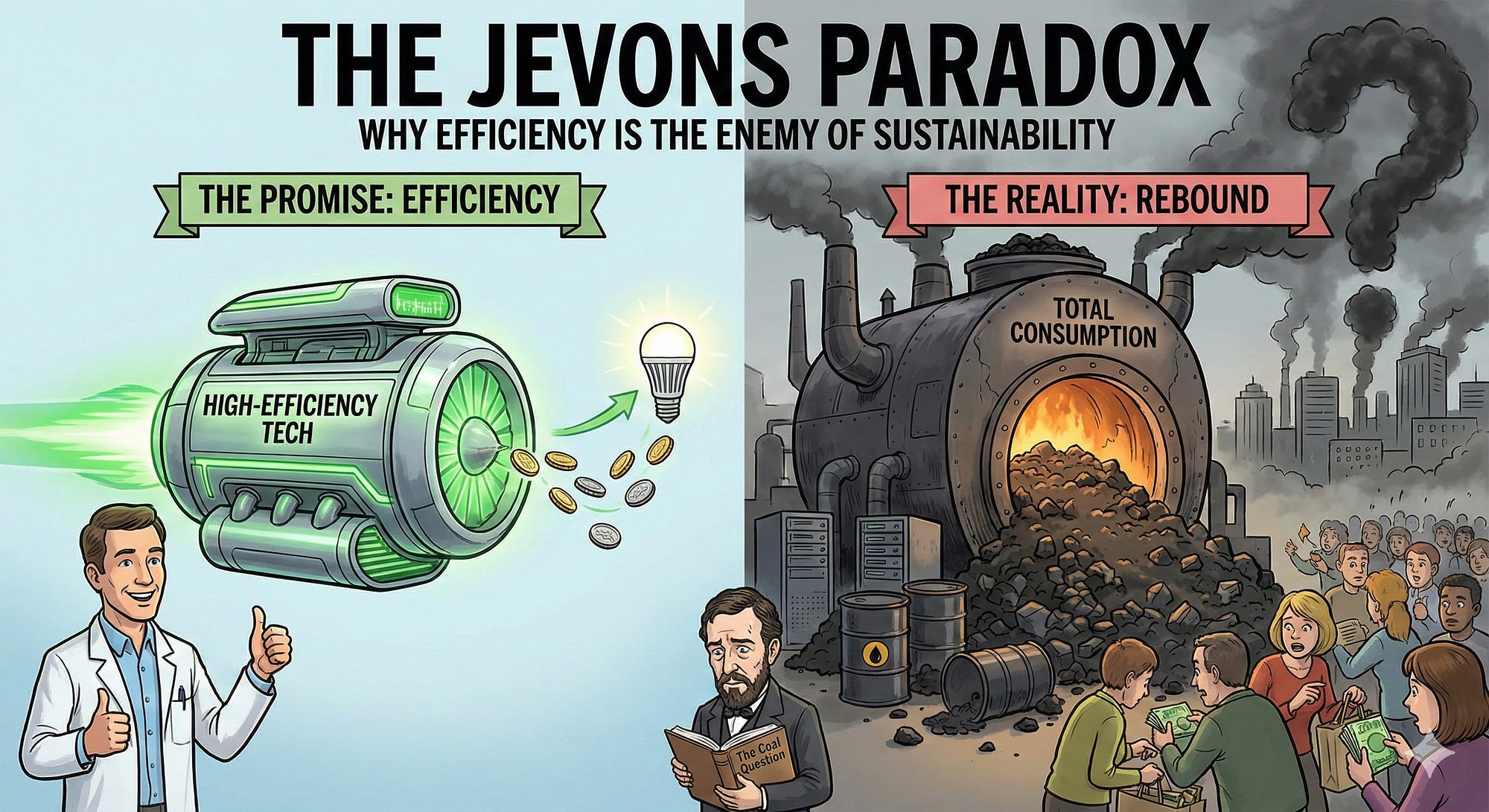
In 1865 a twenty-nine-year-old lecturer in Manchester published a book warning that Britain’s prosperity was being dug out of a finite seam. William Stanley Jevons had done the sums on coal. The cheap and accessible seams feeding the mills, the railways and the fleet wouldn’t last, and he argued that every improvement in the steam engine would hasten their exhaustion. Cheaper power found new uses for itself. As engines grew thriftier, the nation burned more.
The book found its way to Gladstone, who took it seriously enough to raise it in Parliament. Soon afterwards a Royal Commission was set up to estimate how much coal remained.
Jevons was wrong about the ending. Dear coal never strangled British industry. Oil and then gas displaced it, and pits closed with much of their reserves still in the ground. Yet the mechanism he identified, efficiency feeding appetite, was accurate, and the catastrophe he feared did arrive, although through an entrance he wasn’t watching. He spent his anxiety on what was left beneath Britain. The damage was accumulating in what had already gone up the chimneys.
A forecast, then, can be right in its instinct and wrong in its plot. That distinction matters far more than it first appears.
Samuel McKee’s recent essay for the Institute of Art and Ideas, “Our Culture Needs to Defeat Dystopia”, starts from a complaint few would contest. The stories we tell about tomorrow arrive shrouded in apprehension: intelligences that slip their leash, cities surrendered to the sea, states that watch everything that moves. The future has become a drama to dread rather than an ideal to design, create and relish. McKee wants that imaginative energy restored, and he looks for it in the possibilities science and technology keep opening.
His appeal is timely. A civilisation that can imagine only catastrophe risks becoming incapable of collective ambition. Fear is a poor foundation for a shared project, and a culture that has stopped believing in tomorrow will not invest in it.
I accept nearly all of that. What I can’t accept is the diagnosis beneath it, which treats dread as a failure of imagination, a mood that better stories might lift from a quagmire of despair.
Jevons suggests another reading. His pessimism came out of arithmetic, which held even when the forecast didn’t. A good deal of contemporary gloom has the same origin. People sense, often without a vocabulary for it, that the arrangements governing their lives are producing outcomes those in charge seem unable, or unwilling, to arrest.
Dystopia in this sense seldom comes as rupture. It accumulates. Platforms engineered with extraordinary sophistication are tuned for engagement rather than understanding, because engagement is what can be sold. Housing, the precondition of a settled life, has become in much of the world a vehicle for speculation, so that rising prices are reported as good news to people who will rent into middle age. Each arrangement looks reasonable from inside the decision that produced it.
Over time such arrangements stop looking like choices at all. They harden into a manufactured normalcy: recent and contingent ways of organising life that have come to seem as unarguable as gravity.
Our instruments of measurement do much of the hardening. When Simon Kuznets presented the first official estimates of national income to the US Senate in 1934, he cautioned that a nation’s welfare could scarcely be inferred from them. Within a generation the measure he’d built to describe a depression-era economy had become the scoreboard for national success. It records the clean-up of an oil spill as growth, and the treatment of illness caused by pollution as growth. Unpaid care, a river returning to health, an afternoon among friends don’t register at all. A society that steers by such an instrument drifts toward whatever it rewards, and then calls the drift progress.
I’ve had my own share in the pessimism McKee laments. Around 2006, teaching at Dhurakij Pundit University in Bangkok, I developed a suite of scenarios for the city’s future with water. Every one of them was negative. The research I was working from showed parts of the city around the Port subsiding by almost eight millimetres a year, and I couldn’t in conscience paint a hopeful picture over numbers like those.
Was that a failure of imagination? I don’t believe so. Looking back, the darkness and the pessimism were the two most accurate elements in the work. What was missing lay elsewhere. The scenarios described where the city was heading with some precision; they had far less to say about who had set that heading, whose interests were served by holding it, and what the city might decide to do instead. Like most foresight of their kind, they treated the future as a destination to be mapped rather than a set of intentions to be debated. A futurist can be scrupulously honest about the terrain and still leave the most important question unasked.
That unasked question is where optimists and pessimists turn out to share ground. One camp trusts technology to rescue the future; the other expects it to ruin it. Both put the technology at the centre and leave human purpose to be settled by whatever arrives next. McKee’s remedy, more vivid stories of scientific possibility, keeps that arrangement intact while brightening its mood.
We aren’t short of futures. Every season brings fresh ones, fully rendered, from laboratories and investment prospectuses. What has withered is the faculty for choosing between them: the capacity to ask what a given capability is for, who gains from it, and what it will cost the living systems beneath it.
That faculty once had a home. The oldest traditions that asked of what a good life consists, Greek, Buddhist and many Indigenous among them, rarely confused it with a life of maximal acquisition. Modern research has wandered back toward the same ground. Since Richard Easterlin’s work in the 1970s, studies have repeatedly suggested that once incomes pass a certain level, further growth in national wealth doesn’t reliably lift reported life satisfaction. The literature is contested and easily overstated. Yet the broad finding keeps resurfacing: beyond the meeting of basic needs, people locate their wellbeing in health, relationships, security, autonomy and purpose, all of which an economy can nourish or erode, and none of which it produces automatically.
Sufficiency begins there. It asks how much is enough for a dignified and flourishing life, and whether pursuing more beyond that point leaves anyone better off. It’s easily mistaken for austerity, and in the wrong hands it can become exactly that: restraint preached to those with too little by those with too much. Any philosophy of enough deserves suspicion when it’s urged chiefly on the poor. Its moral authority depends on the reverse order, with essential needs met universally first and the burden of restraint falling hardest on those who’ve accumulated most.
Understood that way, sufficiency gives possibility a purpose. Jevons returns here with full force. Efficiency set loose inside a system committed to endless expansion accelerates the journey without ever questioning the destination. Only a settled sense of enough allows an efficiency gain to be taken as relief, as time or as rest, instead of being fed straight back into further consumption.
Fragments of this already sit inside the rules some governments live by. Thailand’s national development planning has drawn on a sufficiency philosophy for more than two decades. Wales passed legislation in 2015 obliging public bodies to weigh the long-term consequences of what they decide. Neither example is complete, and both have their critics. But they show that an institution can be required to ask what is enough, a question long left only to philosophers.
Sufficiency on its own, though, still measures enough against human needs. Ecority asks what lies beneath those needs. Ecology plus security, delivered with integrity: the word insists that no security is real which depends on degrading the systems that sustain it, and that the economy is a subsystem of the biosphere, never its proprietor.
Earth system science has reached a similar conclusion via its own route. The planetary boundaries framework, first set out in 2009, identifies processes, among them climate, biodiversity, freshwater and the nitrogen and phosphorus cycles, that hold the planet in the stable state in which agriculture and cities emerged. Successive assessments suggest humanity has already moved beyond several of them. Interpreted through Ecority, those boundaries stop looking like obstacles for engineers to route around and become the terms on which any lasting prosperity has to be negotiated.
Law has begun, haltingly, to follow. In 2017 New Zealand’s parliament recognised the Whanganui River as a legal person, giving statutory form to the Māori understanding of the river as an ancestor and an indivisible whole. Enforcing such recognitions has proved difficult wherever they’ve been tried. What they register is a shift in the moral imagination, a first admission that the living world might hold standing of its own.
In practice Ecority puts three questions to any proposed technology, investment or policy. What does it owe the people alive now, including those who’ll bear its costs without having been asked? What does it owe generations not yet born, who’ll inherit its consequences? And what does it owe the living systems on which both depend? Those obligations, the trimunary, are less a checklist than a discipline of attention. Applied honestly, they would reorder a great many priorities currently presented as inevitable.
Artificial intelligence is the obvious place to apply them, partly because optimism and dread now gather there most densely, and partly because it reproduces Jevons’s coal problem with uncanny fidelity. Each gain in computational efficiency is greeted as a saving. So far those savings have tended to be swallowed by soaring demand for computation, while the energy, water and minerals behind the digital world keep mounting beneath the soft metaphor of the cloud. Whether these systems help clinicians find disease earlier or keep a teenager scrolling past midnight will be decided by ownership, purpose and limits, and never by the technology itself.
Jevons couldn’t picture the danger that actually came, because his frame recognised a single kind of catastrophe, the catastrophe of running short. A civilisation endangered by its own abundance lay beyond the imaginable. Our stories have inherited his blind spot. In the dystopias, disaster is scarcity: the water fails, the harvest fails, the machines take the work. In the optimistic counter-narratives, rescue is abundance, more energy and more intelligence and more of whatever is on offer, delivered faster.
Missing from both shelves is a story in which a society capable of having more decides, deliberately and without catastrophe forcing its hand, that it has enough, and finds the decision opens far more than it closes. We’ve barely begun to imagine how such a society would feel from inside, what its ambitions would be, whom it would honour and what it would refuse to build. Until we can do that, the prophets of ruin and the evangelists of progress will go on describing a future whose priorities were settled long ago, in arrangements neither camp thought to challenge.