I was recently asked on a podcast to describe what I see as the key elements of today’s world and what has changed over my lifetime. This was in the context of the looming collapse of our civilisational model, which I have written about consistently.
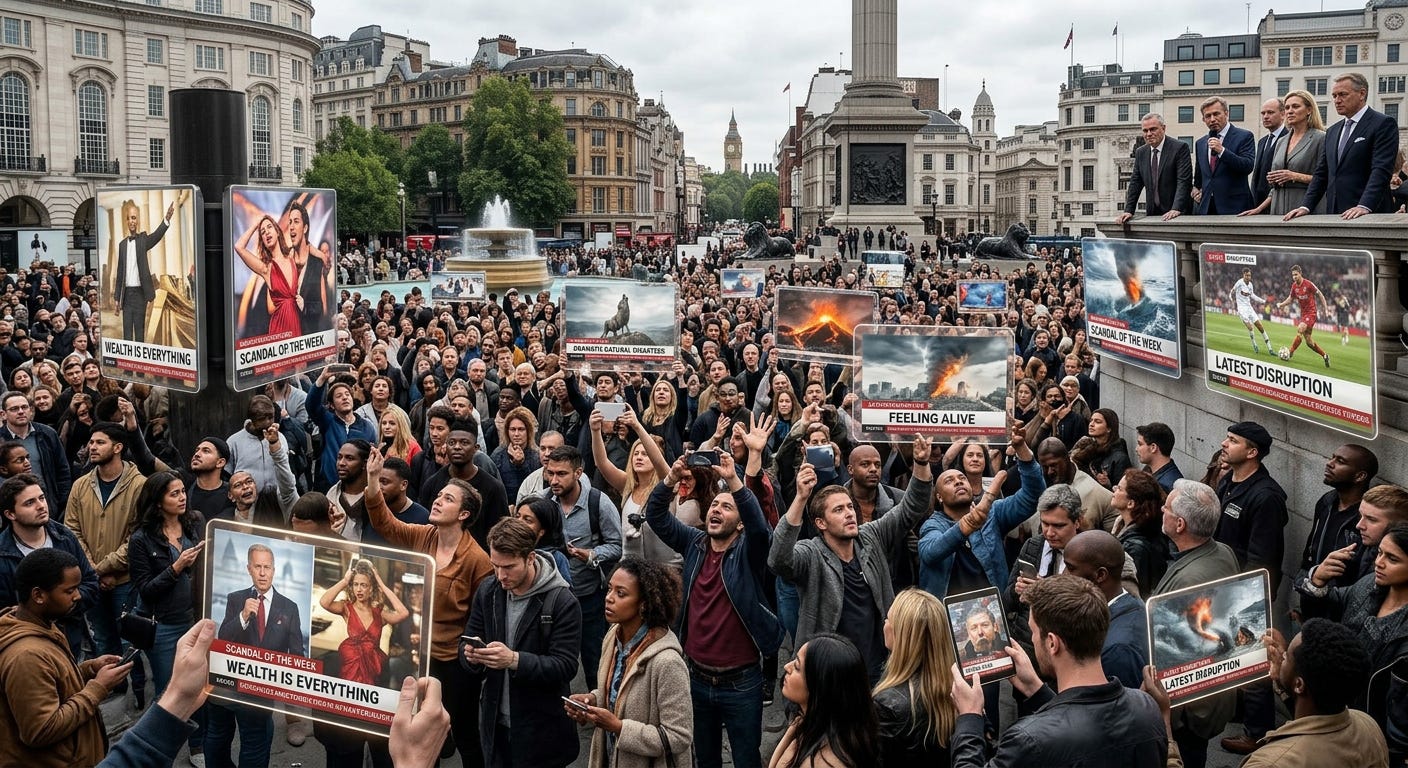
My assessment is a society masturbating on materialism – one that has given up thinking for itself and needs a steady supply of vicarious thrills, scandals, and disruptions in order to feel genuinely alive. A society governed by an elite infatuated with power yet suspicious of wisdom; addicted to wealth, tuned to fear and paranoia, and mostly indifferent to human suffering. We have lost any true sense of what it means to be human and are now incapable of imagining anything other than that which prevails in the here and now.
Our minds have been colonised by ideas from previous eras that act like gravity, keeping us stuck in old paradigms. Meanwhile, the capacity to generate anything beyond an obsession with economic growth – apart from division, hatred, and the destruction of anything or anyone who stands in our way – has tapered to almost zero. This is why I believe a civilisational “replacement” with something “better” is an illusion. What’s needed is a genuine metamorphosis of our basic operating principles if our species is to survive its own toxicity.
Charmed by Materialism and Distraction
One of the hallmarks of the modern world is our collective surrender to materialism and shallow distraction. Society today gorges itself on consumer goods and entertainment as if these were life’s sole purpose. From the incessant parade of new gadgets and fashions to the dopamine drip of social media, we are constantly chasing the next trivial thrill. It often feels as though we’re trying to fill a spiritual void with shopping sprees and screen time. In earlier decades, people still talked about big ideas or the public good in everyday life; now our conversations and minds are dominated by celebrity gossip, viral memes, and advertising slogans. We seek meaning in the next purchase, the next spectacle, the next scandal – anything to briefly feel something in an otherwise numb existence.
This fixation is more than harmless fun – it has anaesthetised our capacity for independent thought. When I look back to my youth, I recall a time when critical thinking and active learning were encouraged as virtues. People read books, debated politics or philosophy, and had the patience to ponder life’s important questions.
Today, that habit of thinking for oneself has eroded. In its place, a passive consumption of prefabricated opinions prevails. We often let algorithms and influencers tell us what to desire, what to believe, and what to fear. Our mental muscles for scepticism and reflection have atrophied. A society transfixed by flashy distractions loses the ability to question the status quo. In surrendering our attention to constant stimulation, we give up a little bit of our agency and humanity. A populace that no longer thinks for itself is easy prey for manipulation – and indeed, that plays directly into the hands of those in power who prefer an uncritical, pliant public.
The Elite: Power Without Wisdom
Compounding the problem is that our society is steered by an elite that has lost any moral compass. Those at the helm – be they political heavyweights, corporate magnates, or media barons – are largely infatuated with power and addicted to wealth. We are governed (directly and indirectly) by a class of people for whom more is never enough. They hoard riches and influence with a pathological fervour, often confusing their net worth with their human worth. But while they excel at accumulating power, they are singularly suspicious of wisdom.
Wise counsel, humility, long-term thinking, genuine expertise – these have little place in the rooms of high authority today. If a truth or idea doesn’t serve their immediate interests, it’s dismissed. In boardrooms and government cabinets, cleverness and ruthlessness are admired, whereas wisdom and ethical reflection are viewed with mistrust.
This ruling elite is also tuned to fear and paranoia, which they readily transmit to the masses. To maintain their grip, they stoke an atmosphere of perpetual threat. We are told to fear the outsider, fear the other political tribe, fear anything that might upset the existing order. By amplifying divisions and anxieties, those in power keep people distracted from the elite’s own failures and excesses. A society on edge is easier to control. And so we live under those who prefer to divide and rule rather than unite and uplift.
Perhaps most egregious is the indifference to human suffering that has become normalised at the top. Our elite decision-makers insulate themselves from the real-world consequences of their actions. Global supply chains that exploit sweatshop labour, policies that leave millions without healthcare or food, wars that devastate civilian populations – all these are abstract numbers on a spreadsheet to those in charge. There is little genuine empathy flowing downward from the penthouses of wealth and power. The humanity of ordinary people becomes an afterthought. As long as quarterly profits rise or elections are won, the pain endured by faceless others – whether across the ocean or in our inner cities – barely registers. This callousness trickles down and sets the tone for society at large: success is measured in wealth and dominance, not in how well we care for each other.
The result of these attitudes is a world startlingly similar to a neo-feudal order. Despite the promises that free markets and technological progress would enrich everyone, we have instead created a system where a tiny minority enjoys unimaginable opulence while a growing majority struggles. Today, a handful of billionaires own as much wealth as the poorest half of humanity. In fact, the richest 1% have accumulated extraordinary gains – over $33 trillion in new wealth since 2015 to be precise, an amount that could end global poverty 22 times over. Yet instead of using such wealth to alleviate suffering, it remains concentrated in the vaults of the elite. We are essentially witnessing kings and lords in designer suits presiding over a new serfdom. This grotesque inequality is both a product of, and fuel for, the broader civilisational malaise I a2015,scribing. It exemplifies power without wisdom – a world where capability has increased, but character has not.
A Culture of Fear and Fragmentation
Under these conditions, it comes as no surprise that our social fabric is frayed by fear, paranoia, and division. We live in a culture of pervasive anxiety and increasing isolation. The news cycle bombards us daily with reasons to be afraid – terrorism, crime, economic collapse, pandemics, you name it. Political factions amplify these fears, often deliberately, to paint the world in terms of existential threats. Technologically mediated echo chambers then magnify our worst suspicions.
The result is a populace that is chronically on edge, quick to see enemies or conspiracies at every turn. Trust – the very glue of a functional society – has become a scarce commodity. Many no longer trust governments, the media, science, or even their neighbours. When fear reigns, tribalism thrives.
Indeed, society has atomised into hostile camps. We splinter ourselves by ideology, race, religion, nationality, or any number of identities, and then proceed to loathe those on tidentities andPublic discourse has degenerated into a gladiatorial sport of us versus them, leaving no room for nuance or mutual understanding. We have become adept at hating – fueled by leaders and pundits who often frame every issue as a battle for survival against an evil opposition. In this climate, empathy for the “other” is eroded. The suffering of those outside our chosen in-group is dismissed or even perversely celebrated. Thus, division and hatred become by-products of the system, just afuelledntroductory assessment laments. They are the only things we seem capable of producing anymore, besides economic growth.
This fragmentation is deadly. Not only does it make collective problem-solving nearly impossible, it also eats away at our shared humanity. A society constantly at war with itself cannot tend to the well-being of its members. People fall through the cracks. Inequality widens further as social cohesion dissolves. The most vulnerable – the poor, the elderly, migrants, minorities, the sick – suffer the worst, and few outside their circle seem to care. We scroll past images of human tragedy in our feeds, perhaps feeling a momentary twinge of pity before the next distraction appears. Indifference has become a coping mechanism in a world where crises and outrages are constant. But in numbing ourselves, we lose a vital part of what makes us human: the capacity to care deeply and act in solidarity.
The Loss of Meaning and Imagination
Amid this turmoil, we have also lost any clear sense of meaning or direction. Prosperity and progress were once measured in more than GDP – there were conversations about human rights, about exploring space, curing diseases, and building a better future for the next generation. We believed, perhaps naïvely, in meaningful progress.
Over my lifetime, that belief has been hollowed out. Today’s society, in its materialist haze, has largely forgotten what it means to be truly human beyond being a consumer or just another cog in the economic machine. Qualities like compassion, creativity, spiritual fulfilment, and collective purpose – the very things that enrich the human experience – have been sidelined or commodified. We have culture, yes, but it’s often commercialised culture. We have endless information, but little wisdom. In chasing tangible goods, we’ve lost touch with the intangible values that give life depth and purpose.
Crucially, we have become incapable of imagining a world substantially different from the one we inhabit. Our minds are trapped in the gravity of outdated ideas – old ideologies and assumptions carried over from previous eras. Concepts from the industrial age or the Cold War era still frame our thinking: we default to competition over collaboration, enforce nation-state rivalries, and cling to the notion that endless growth is the only path to prosperity. These ideas act like a mental gravity, pulling any lofty new vision back down to the same old ground.
The collective imagination has atrophied just when we need it most. As cultural theorist Mark Fisher once pointed out, “It’s easier to imagine the end of the world than the end of capitalism.” That grim observation rings true – we can readily picture apocalyptic collapse but struggle to envision a fundamentally different society beyond the familiar patterns of market capitalism, power politics, and social stratification. Even our science fiction often merely exaggerates today’s trends instead of contriving new possibilities.
This failure of imagination is deadly. If we can’t imagine something better, we certainly can’t create it. Progress, in the truest sense, requires the ability to dream beyond present circumstances – to conceive of new social arrangements, new ways of living together and new definitions of success and well-being. In the past, even amidst great struggles, humans often held vivid dreams of utopias or at least improvements – whether it was international peace, a classless society, or harmony with nature.
Now such dreaming is dismissed as impractical or “utopian” in the pejorative sense. Cynicism poses as realism. By abandoning our capacity to dream boldly, we have effectively consented to the permanence of a deeply flawed status quo. We are caged not by an iron curtain or a concrete wall, but by a poverty of imagination.
Obsession with Growth, Apathy towards Destruction
If there’s one thing our society still knows how to do, it’s to grow economically – or at least to obsess over growth. The engine of technocapitalism, turbo-charged over the past century, has one setting: accelerate. More production, more consumption, more extraction of resources, more profits. This fixation on economic growth at all costs has become our civilisational credo. It continues even as evidence mounts that perpetual growth is unsustainable and, in many ways, self-destructive. We pursue growth like an addict chasing a higher dose, ignoring the damage being done in the process. Policymakers and CEOs alike treat each percentage point of GDP increase as sacrosanct, a justification for any sacrifice. But what exactly are we sacrificing? Community, equity, environmental sanity, mental health – all are routinely sacrificed on the altar of growth.
Tragically, the only other things our system seems to generate in abundance are division, hatred, and ruin, as noted earlier. When the promise of broadly shared prosperity fails to materialise, what fills the gap is frustration and anger. People look for scapegoats for why their lives feel insecure despite all this growth. They turn on each other, fueled by the fear and paranoia discussed above. Thus, hatred is a toxic by-product of a growth-at-all-cost system that neglects human well-being.
We also witness the literal destruction of anything or anyone who stands in the way of profit. The natural environment has been the biggest victim: forests cleared, oceans polluted, species driven to extinction in service of expansion. The planet’s life-support systems are visibly failing under our onslaught.
Global wildlife populations have plummeted by around 68% since 1970 due to human activity – a staggering indicator of how thoroughly we have dominated and devastated nature. Climate change, too, marches forward, promising disruption and suffering on an unprecedented scale. We are essentially consuming our seed corn, destroying the foundations for future survival in order to keep the present system going a little longer.
Our obsession with growth has a curious blindness to it. It cannot see that beyond a certain point, growth becomes cancerous – an uncontrolled expansion that kills its host. More cars, more factories, more consumption might have once equated to progress when the world was empty and resources plentiful. But now, on a full planet with strained ecosystems, that same formula leads to collapse.
Yet rather than recalibrate our goals, we double down. Even as we drown in excess stuff and our atmosphere chokes on carbon, the prevailing narrative only knows how to ask for more. More growth, more consumption, more technological quick fixes to manage the mess – never fundamentally different priorities. It’s as if our civilisation has fallen into a trance, mechanically intoning an old mantra while the stage around us is catching fire. If we continue on this path, we will grow ourselves to death, quite literally. The final tragedy would be a society that achieved year-on-year GDP increases right up to the moment it self-destructed.
The Illusion of Civilisational Replacement (with a Unique Twist)
Given the dire state of affairs, it’s natural to hope for a saviour – some new system or “leader” that could replace the current model with something better. Indeed, throughout history many have imagined that if the present order fell, a superior one would rise from its ashes. But I must underscore that this hope, in the way it’s often conceived, is largely an illusion. Civilisational collapse is not like performing a simple software update or swapping out a bad component. When complex societies break down, what comes next is usually not an automatic upgrade. More often, it’s chaos followed by a reassembly of familiar patterns.
Why? Because unless we change the underlying human mindset and values, any new system will end up being a recombination of the old flaws. We’ve seen this pattern time and again. Revolutions overthrow kings and dictators, only to install new tyrants wearing different ideological garb. Economic systems are replaced – capitalism versus communism, etc. – only to produce similar outcomes of inequality or oppression if the culture and consciousness of the people remain unchanged. True, the forms may differ: an old empire might fall and a new nation rise, or one technological era supplants another. But if the basic operating principles stay the same – if greed, fear, power-lust, and ignorance continue to dominate – then functionally it’s the same story with new actors. As the saying goes, meet the new boss, same as the old boss.
Currently, some pin their hopes on the idea that we can simply innovate our way out of trouble – that some breakthrough (AI, genetic engineering, space colonisation, etc.) will magically solve the problems or allow a fresh start. Others dream of a political shake-up that will eradicate corruption and set things right. Unfortunately, without a corresponding shift in our collective consciousness, such changes are cosmetic. A highly advanced technology given to a foolish or selfish culture will likely be used foolishly or selfishly, amplifying the damage. A new government staffed by people who lack wisdom and compassion will revert to oppression or incompetence soon enough. In short, we cannot swap in a new civilisation like changing a light bulb, not when we ourselves – our thinking, values, and language – are the source of the dysfunction.
This is why I argue that straightforward replacement with something “better” is a fantasy. It externalises the problem – imagining that if we just tinker with external arrangements, all will be well. But our predicament goes deeper. We carry it within us, in our collective habits of thought and behaviour. Any truly improved civilisation would have to be built on a new foundation of consciousness. Without that, we’ll keep reproducing the same cycles of rise and fall, exploitation and collapse, no matter what superficial system is in place.
And there’s a unique twist to our current situation: unlike past civilisations, we are up against global climate change and ecological breakdown. In previous eras, when one civilisation fell, new societies eventually rose – often aided by relatively stable environmental conditions that still prevailed. But now, planetary life-support systems are eroding. If our global civilisation crumbles under its own weight, we might not get the chance to rebuild in the same way.
Climate change, mass extinction, and ecosystem collapse could leave no fertile ground – literally and figuratively – for a new society to flourish. Historically, collapse was often local or regional, and nature could rebound or other regions could carry on. Today’s crisis is planetary. For several decades we’ve been destabilising the very climate and biosphere that any future civilisation would depend on. In essence, we’re burning the bridge that could lead to a next chapter. This means simply waiting for collapse and hoping something better rises automatically is not just naïve – it could be an irreversible dead end.
All this underscores the urgency: we can’t expect to replace this civilisation with a better one through collapse; we have to transform the one we have from within and do so intentionally. For the first time in history, humanity has an opportunity to consciously redesign from first principles our world system before disaster forces our hand – something unheard of in previous eras. Yet ironically, the impulse for genuine collaboration is at its weakest just when we need it most. Our world is highly fragmented, trust is low, and short-term thinking prevails, undermining the unified effort required to shape a better future. Simply standing by, letting collapse happen, and assuming the next iteration will automatically be better is not a viable strategy – not for us, and not for the planet.
Realistically, if our current global civilisation were to implode, the likely outcome – absent a profound shift in mindset – would be a period of great suffering followed by the emergence of something very familiar, perhaps even more brutal (especially in a resource-scarce, climate-ravaged world). That’s a future we must strive to avoid. History alone cannot guide us out of this time, because our situation has no precedent. We can’t count on repeating the old cycle of phoenix-like rebirth, given that we’re actively undermining the environmental conditions for any rebirth.
All this underscores the urgency: we can’t expect to replace this civilisation with a better one through collapse; we have to transform the one we have from within. Simply standing by, letting collapse happen, and assuming the next iteration will be automatically better is not a viable strategy – not for us, and not for the planet.
Metamorphosis or Bust
If tweaking the system or replacing it outright won’t save us, what will? The answer, in my view, is nothing less than a real metamorphosis. By metamorphosis, I mean a radical re-imagining of the most fundamental operating principles of our society and ourselves. It is analogous to metamorphosis in nature – like a caterpillar turning into a butterfly. The caterpillar doesn’t simply put on wings or swap an attribute; it undergoes a profound internal change, reorganising itself into an entirely new creature with a new purpose. Our civilisation needs a similar internal reorganisation. We must transcend the old paradigms, not just shuffle them around expecting everything to magically improve.
What would a civilisational metamorphosis entail? At the most fundamental level, a shift in our values and our consciousness. Imagine if we pivoted from materialism to meaning – measuring success not by the accumulation of things but by the well-being and development of living beings (including more-than-human life).
Picture a society that prizes wisdom over wealth, where individuals rise to power through their depth of understanding and compassion rather than their ability to manipulate fear or amass riches. Envision an economy that operates within the earth’s ecological limits, valuing balance and regeneration over endless expansion – a shift from conquest of nature to partnership with nature. Consider the cultural transformation if we moved from fear to trust: building social structures that encourage cooperation and mutual aid, gradually dissolving the paranoia that keeps us apart.
In a metamorphosed civilisation, empathy and genuine connection would no longer be seen as idealistic but as basic operating norms. Diversity of thought and background would be cherished rather than seen as a threat. Technological advancement would serve humanity’s collective needs and viability, rather than drive profit for a few. Education would cultivate critical thinking, creativity, and emotional intelligence, not just job skills.
All these changes boil down to one core shift: remembering what it means to be human in the fullest sense. It means rekindling the capacities that we have suppressed – our ability to love, to imagine, to create, to endure hardships together, to find joy in simple things, and to care for the unborn future even at cost to ourselves today. It requires elevating qualities that have been relegated to the margins under the current model: compassion, humility, curiosity, solidarity, and reverence for life. A metamorphosis is not a simple reform; it’s a re-rooting of civilisation in a completely different soil of consciousness.
Is such a metamorphosis possible? Sceptics will say humans don’t change at this fundamental level, or not fast enough. Indeed, it is an unprecedented challenge. But we also live in unprecedented times. The toxicity of our current system – its self-destructive trajectory – is becoming undeniable. Sometimes a species or a society only truly changes when it has no other choice, when the old ways lead clearly to oblivion. I believe we are nearing that threshold. The crises of the coming years (environmental upheaval, social unrest, technological disruptions) will either crush us or compel us to evolve. The hopeful view is that facing collapse could shock us into a new state of being – that we might collectively hit “rock bottom” and finally confront the need for deep change.
Of course, metamorphosis is not automatic. It must be a conscious undertaking. It requires those of us who are aware of these issues to actively imagine and experiment with new ways of living and being, even in small pockets, to serve as seeds for a future culture. It means fostering dialogues about values and purpose, not just policies and profits. It involves nurturing compassion and wisdom in our children (and in ourselves) as diligently as we currently cultivate competitiveness and technical skills. Every institution – education, media, business, and governance – would need to be reoriented towards this evolutionary goal of sustaining life and unlocking human potential, rather than merely sustaining the economy and unlocking market value.
This is an enormous task, and it may sound utopian. But I see no viable alternative if we want a future worth having. Tweaking around the edges won’t work; neither will violent revolution that leaves the fundamentals intact. Metamorphosis is the middle path – difficult, certainly, but offering the possibility of genuine renewal. It asks us to become something new while consciously shedding the old skin. It’s not about building a perfect utopia overnight, but about beginning the transition to a wiser civilisation step by step, principle by principle, within ourselves and our communities, before it’s too late.
In closing, the key elements of today’s world – rampant materialism, thoughtlessness, power worship, fear, indifference, lost imagination, selfishness and growth mania – all point to a civilisation in deep crisis. These are not simply sigovernight butwinding down, but of a profound maladaptation that cannot sustain itself.
Over the span of my lifetime, I have watchedcommunities beforeensify to a point where they threaten our very survival. We stand at a precipice. Thdown butr answers and half-measures will not save us; nor will waiting for some new system to magically emerge. We must transform or perish. That is the stark choice our society faces.
The consolation is that within the human spirit resides the very capacity needed for this metamorphosis – a capacity for learning, for empathy, for creativity, for transcendence. We must tap into these dormant qualities and rewrite the narrative of who we are and what we can become. Only by doing so can we hope to replace our current civilisational nightmare not with another illusion, but with a reality that is authentically better – a world where humans finally live up to the promise of being fully human.