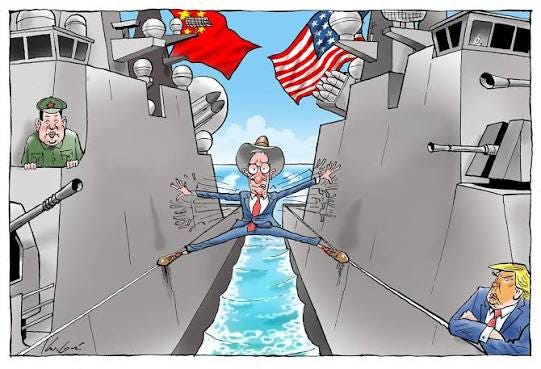
Synopsis: Australia’s refusal to join America’s war on Iran has been hailed as diplomatic skill. In my opinion it reveals a foreign-policy establishment still reasoning inside Cold War assumptions. That establishment is fluent in deterrence, incurious about China and unable to picture peace as more than a pause between wars.
Peter Hartcher’s latest column in The Age congratulates Anthony Albanese on having pulled off the unthinkable with Donald Trump.
The column belongs to a familiar genre. Australia’s political and foreign-policy establishment produces a steady procession of policy analyses, strategic assessments, security briefings and geopolitical commentaries, all delivered with considerable authority. Yet beneath the professional language, the confident predictions and the elaborate calculations of national interest, I’m left wondering whether the people advising our governments understand the world they’re attempting to manage.
The achievement, apparently, is that Australia has managed to refuse participation in America’s war against Iran without seriously damaging its relationship with Washington. Albanese has maintained the appearance of independence while preserving the benefits of the American alliance, AUKUS and the Quad. Former officials and strategic commentators are wheeled out to explain just how deftly Australia has navigated this diplomatic minefield. The refusal was also less complete than the celebration implies. Albanese was among the first leaders to endorse the strikes, and Australian personnel have operated throughout in what Canberra prefers to call a defensive capacity.
Refusing to participate in yet another American military misadventure is a welcome exercise of independent judgement. Australia should not be expected to follow Washington into every conflict simply because successive governments have confused alliance obligations with strategic obedience. But I find the larger celebration rather less convincing.
What Hartcher describes as strategic success looks to me more like tactical competence within a strategic framework nobody has bothered to examine. Australia has shown that it can occasionally say no to Washington without asking why so much of its foreign policy remains organised around American strategic priorities in the first place. Tactical independence and strategic autonomy are very different animals.
The intellectual architecture underpinning much contemporary foreign-policy thinking belongs to another era. Its principal assumptions were shaped by the Cold War, reinforced by the post-war American security order and subsequently adapted to accommodate the emergence of China as a major economic and geopolitical power. The vocabulary has shifted. The underlying worldview hasn’t.
We still hear about spheres of influence, strategic competition, deterrence, containment, military preparedness, alliance obligations and the balance of power. These concepts have their place. Nations have legitimate security interests, military capabilities matter, and the behaviour of powerful states can’t just be ignored. But somewhere along the way, the tools of geopolitical analysis have become substitutes for understanding the world itself.
China is the most glaring example. Its rise poses far less of a problem than our inability to understand it. Australia, along with much of the Western world, has made an elementary intellectual mistake in its approach to China. We have taken the emergence of a civilisation with a history of exceptional depth, a distinctive political tradition, its own conception of its place in the world and a different understanding of modernity, and interpreted its rise almost exclusively through the prism of Western strategic anxiety.
China becomes a threat because it is powerful. Its growing economic influence becomes a challenge because it changes the established distribution of power. Its technological achievements become a security concern. Its international relationships are examined principally for evidence of geopolitical ambition.
But where is the equivalent intellectual curiosity about what China actually represents, how it understands the world, what historical experiences shape its thinking, and what kind of international order it believes is possible? Why do we assume that China’s growing influence must necessarily be directed towards displacing the United States, just as Western powers historically sought to establish and extend their own spheres of influence? Why do we assume that a different political and civilisational tradition must ultimately be interpreted as a competing ideological or strategic project? And perhaps most importantly, why do we continue to regard Western conceptions of political legitimacy, development, sovereignty and international order as the universal standards against which everyone else must be measured? Our policy establishment seems oddly reluctant to ask any of them. Perhaps it suspects it has no answers.
I’m not suggesting that China should be beyond criticism. Its policies, actions and international conduct should be examined rigorously, just as those of the United States, Australia and every other nation should be. But there’s a fundamental difference between critically examining another country’s conduct and assuming that its entire development represents a threat to our own. We seem to be losing the capacity to make that distinction.
The result is a self-reinforcing strategic narrative in which every significant Chinese achievement, diplomatic initiative or expansion of international influence is read through a predetermined framework of fear and paranoia. What passes for strategic insight here is an intellectual predisposition wearing the clothes of geopolitical analysis.
We routinely invoke sovereignty, territorial integrity, non-interference, international law and the peaceful settlement of disputes when judging how nations conduct themselves. Yet the application of these principles often seems to depend on who is exercising power, and whether their actions align with Western strategic interests. If these principles mean anything at all, surely they must be universal?
We can’t insist that China respect sovereignty while treating the sovereignty of other nations as negotiable when Western interests are involved. We can’t condemn interference by one power while excusing or rationalising it when undertaken by another. We can’t insist upon a rules-based international order while applying its rules selectively. But that’s exactly what we’ve been doing.
Consistency is what I’m insisting on, and it binds Beijing as tightly as anyone else. The propositions of sovereignty, non-interference, peaceful dispute settlement and equality under international law deserve to be judged on their merits, not dismissed because Beijing happens to be advancing them. If China articulates principles that could contribute to a more stable and equitable international order, why would we reject them without serious examination?
Is the objective to establish principles that serve humanity, or to preserve an international hierarchy in which Western powers retain the authority to define the rules? It’s an uncomfortable question, and we have avoided it for a long time.
I suspect one of the deepest limitations of Western strategic thinking is its assumption that the modern world must ultimately conform to a single developmental and political trajectory.
The West has a particular historical experience and trajectory. Its conception of modernity, progress, individualism, democracy, economic development and international order emerged from specific philosophical, cultural and historical circumstances. Those ideas have made enormous contributions to human development. But that doesn’t make every Western assumption universally applicable, nor does it mean that other civilisations must follow the same path.
China’s development challenges us to think beyond that assumption. Its history, philosophical traditions, conception of social order and relationship between the individual, society and the state offer different ways of understanding political and civilisational development. We should be curious about these differences rather than instinctively suspicious of them.
There are Chinese thinkers seriously exploring alternative models of international order, including the idea of tianxia and the possibility of a more inclusive global political framework. Whether such ideas are practical, desirable or even internally consistent is open to debate. But they deserve intellectual engagement rather than instant dismissal.
The same curiosity should extend to India, Africa and other parts of the world whose intellectual and civilisational traditions are frequently marginalised in discussions dominated by Western colonial assumptions.
The future of humanity should not be a competition to determine which civilisation gets to define modernity for everyone else. On the contrary, it should be an opportunity to explore what different civilisations can contribute to a shared human future. That requires a much more sophisticated form of international engagement than the familiar language of containment and strategic competition.
Here lies the contradiction at the centre of Australian foreign policy. China is Australia’s largest trading partner. Our prosperity is bound up with the economic dynamism of the Asian region. Our future will be shaped in large part by the web of relationships we cultivate across Asia and the wider Global South. Yet we’re pouring enormous financial, political and diplomatic capital into a military architecture that sets us, more firmly each year, against China.
AUKUS is the plainest expression of this contradiction. My position is well known. I regard the decision to bind Australia’s strategic future so tightly to this arrangement as a profound folly. Its extraordinary cost, the uncertainty surrounding its delivery, the disposal of nuclear waste and the opportunity costs involved are all serious enough. More serious still is the assumption beneath them: that Australia must organise its future around the anticipation of a military confrontation with China.
That is a remarkably narrow conception of national security. We’re effectively locking in a single view of the future and committing generations of Australians to its consequences.
But what if that future is neither inevitable nor desirable? What if Australia’s greatest strategic contribution would be to help create the conditions in which conflict between China and the United States never becomes necessary? What if our most valuable national asset were our ability to maintain constructive relationships across competing geopolitical and civilisational traditions?
No country can afford to ignore the possibility of conflict, and under present conditions we should certainly maintain credible defence capabilities. But maintaining the capacity to defend ourselves is a world away from organising our entire economic, diplomatic and military future around the expectation of war. The latter institutionalises pessimism and calls it wisdom. And the more we invest in that pessimism, the harder it becomes to imagine any alternative.
Realism, meanwhile, has become almost synonymous with military preparedness. We’re repeatedly told that the world is becoming more dangerous, that authoritarian powers are increasingly assertive, that the international rules-based order is under threat and that governments must therefore prepare for the worst. There is truth in some of these observations. But the conclusions do not automatically follow.
If the world is becoming a more dangerous place, is it sensible to increase the tools of confrontation and destruction as our first response? If trust between nations is declining, why would we deepen the institutional arrangements that reinforce mutual suspicion? And if the risk of war is on the rise, why is so little intellectual energy devoted to reconstructing the diplomatic, economic and political conditions that make war less likely?
The security dilemma is hardly a new discovery. One nation’s efforts to increase its security can be so easily interpreted by another as preparation for aggression. The resulting response can leave both less secure than before. That doesn’t amount to a case for abandoning defence altogether. It does, however, present a particularly strong argument against confusing the preparation for war with the creation of peace.
A country can possess formidable military capabilities and still be strategically foolish. Indeed, one might argue the history of international relations is littered with examples of governments that mistook military superiority for political wisdom.
I don’t question the intelligence or professional competence of many people working in government, strategic research institutes, universities and foreign-policy advisory circles. There are undoubtedly individuals among them who understand these problems very well. But expertise can become a trap when the assumptions underpinning it are no longer open to examination.
It’s an age-old quandary: give someone only a hammer and every problem starts to look like a nail. People who spend their careers studying military alliances tend to see problems through the logic of alliances. Those whose professional lives revolve around deterrence tend to interpret developments in terms of deterrence. Those who advise governments on managing strategic competition can become so absorbed in managing that competition that they cease to ask whether the competition itself is being unnecessarily intensified. This is how institutional groupthink becomes embedded in public policy. It is also how intelligent people can collectively produce profoundly unintelligent outcomes.
Information isn’t what we lack. We have more intelligence, data, analysis and forecasting capacity than at any previous point in our history. Our predicament lies in the conceptual frameworks through which we filter and interpret it. In today’s world it’s entirely feasible to know far more yet understand far less. We can become increasingly sophisticated at predicting the consequences of our decisions while remaining incapable of questioning the assumptions that produced those same decisions. And we can construct elaborate strategies for managing a dysfunctional international system without ever seriously considering whether the system itself needs to change.
The failure of imagination extends far beyond foreign policy. It’s not simply an Australian problem, nor is it confined to geopolitics. We see the same intellectual paralysis in economics, environmental policy, education, public health, technological governance and democratic institutions. Economic policymakers continue to confuse growth with progress. Environmental policymakers attempt to manage ecological destruction without adequately challenging the economic incentives driving it. Political leaders respond to declining public confidence with more elaborate communication strategies rather than reconsidering the institutional arrangements responsible for that decline.
In every one of these domains, those in charge would rather invest in managing the consequences of their own shortcomings than reconsider the policies, arrangements and governing assumptions that produced them. The result is a civilisation so exquisitely competent at managing the symptoms of its own dysfunction that it no longer confronts the causes. We call it progress. More honestly, it’s the professionalisation of institutional failure. And nowhere do the consequences matter more than in the conduct of international relations, where failures of imagination are eventually measured in human lives.
The twenty-first century requires a much more expansive understanding of security. Military security matters, but it is inseparable from economic security, ecological stability, technological responsibility, social cohesion, energy resilience, food systems and the capacity of societies to cooperate across cultural and political differences. No nation can achieve enduring security in isolation from the conditions affecting the rest of humanity. Nor can global problems be resolved through an international order organised primarily around the preservation of geopolitical advantage.
Climate disruption doesn’t recognise military alliances. Pandemics don’t respect national sovereignty. Artificial intelligence doesn’t confine its consequences to the countries that develop it. Economic instability travels across borders with extraordinary speed. These are interconnected challenges requiring forms of cooperation that transcend the familiar calculations of national advantage. Yet our political institutions remain largely organised around competition between states, while the problems confronting humanity now demand collaboration between societies.
The mismatch is profound. We need people in power who understand that national sovereignty and international cooperation are not necessarily opposing principles. We need strategic thinkers capable of appreciating different civilisations without automatically interpreting difference as danger. We need diplomats who appreciate that accommodation is not capitulation, that dialogue is not weakness and that refusing to participate in a war can be an expression of strength rather than indecision. Above all, we need to recover the capacity to imagine an international order in which peace is not merely the pause between conflicts.
Australia occupies an unusually privileged position. Geographically, economically and culturally, it is situated between worlds that Western foreign-policy thinking too often treats as competing blocs. We have deep historical connections with Europe and North America, but our economic and strategic future is inseparable from Asia. We have an opportunity to develop a foreign policy that reflects this reality rather than perpetually subordinating it to the strategic preferences of a distant ally.
That would require moral fortitude, strategic foresight, intellectual independence and a willingness to challenge some deeply entrenched assumptions. It would also require a fundamental change in how we think about China: less a strategic problem to be managed than one of the most consequential relationships in Australia’s future.
That entails engaging with China as it is, rather than as Western strategic commentators imagine or want it to be. It implies understanding its history and worldview, recognising its legitimate interests, and being prepared to disagree where necessary without converting every single disagreement into evidence of an existential threat. It means applying the same standards to Beijing that we apply to Washington, and demanding that international principles be universal rather than instruments of convenience.
Australia should be capable of maintaining a strong relationship with the United States without automatically endorsing every American strategic initiative. It should be capable of engaging China without treating every diplomatic or economic interaction as a concession. And it should be capable of contributing to regional security without making the militarisation of the region its principal organising ambition. Some will call that fence-sitting. Sovereign judgement has always looked that way to those who prefer obedience.
No doubt Anthony Albanese deserves credit for refusing to follow Trump into the war against Iran. But one sensible decision does not constitute a coherent foreign policy. The more important test is whether Australia can translate that independence into a broader strategic vision.
For now, I remain unconvinced. Better-read policy wonks won’t be enough. Perhaps the most serious problem with contemporary political leadership is that it has become trapped inside the intellectual boundaries of the systems it’s supposed to govern. Its advisers are trained to optimise existing arrangements, manage emerging risks, preserve continuity and protect established interests. They are rarely rewarded for questioning the foundations of the systems themselves.
The world has more than enough managers of geopolitical competition. It is short of people prepared to ask why competition, confrontation and military deterrence became the default organising principles of international affairs. What’s missing is political imagination, intellectual humility and a willingness to entertain possibilities outside the conventional wisdom of the day. Call that idealism if you must. The gravest strategic risks tend to arise when incumbent decision-makers mistake inherited assumptions for immutable truths.
Over eighty years I have watched the world transform in almost every sphere of human endeavour. The distribution of economic power continues to shift. Digital technologies are altering the nature of work, warfare and social relationships. Natural ecosystems are under unparalleled stress. Meanwhile, the institutions and ideologies that shaped the twentieth century are struggling to respond to the complexity of the twenty-first.
Yet our political conversations remain mired in preserving the strategic arrangements of the past. Perhaps that explains why so much policy analysis feels disconnected from reality. The analysts can see what’s happening well enough. What defeats them is imagining anything beyond the conceptual boundaries within which they were trained to reason.
Today’s policy establishment can’t predict the future. Nobody can. That much is forgivable. Its deeper failure is an inability to imagine a future sufficiently different from the past to spare us a repetition of its mistakes. Peace ought to be the default condition of international relations, the founding purpose of government itself, and never an aspiration to be pursued when strategic circumstances permit.
China’s rise should be an invitation to rethink our understanding of humanity’s future, not an excuse to organise that future around the prospect of war. Its influence has already grown, and nothing decided in Canberra will reverse that. What remains open is whether we have the maturity to live with that reality without treating it as a threat to everything we cherish.